
Sandro Botticelli was the great painter of hair. In "The Birth of Venus" (c. 1485, 172.5 x 278.9 cm, Uffizi), Venus's golden-blonde hair blows in the wind, splitting into undulating locks that the art historian Emanuele Lugli calls "a network of ropes, levers, and cantilevers" that do the "muscular work of pulling the spectator's attention in." In his "Idealized Portrait of a Woman" (c. 1480s), the subject's long, braided, honey-blond hair is decorated with more than 200 painted pearls, at a time when wearing pearls in public violated Florentine sumptuary laws. Botticelli made hair his signature. "No one went as far as Botticelli in capitalizing on its intricacy," writes Lugli. And then, in the 1490s, Botticelli stopped. Under the influence of the preacher Savonarola, who declared that unveiled women at mass were "a trap for both the angels and the priests," Botticelli "refrained from painting fabulous manes, covering hair under thick layers of cloth." The man who had made hair the threshold of erotic desire was defeated by the Church. Hair in art is not trivial. It is one of the most loaded subjects in the history of painting. It is sex and salvation, power and submission, identity and erasure.
Hair in art has been "intimately written into definitions of sexuality and gender" across every culture and era. The 13th-century theologian Thomas Aquinas classified hair among "corporeal superfluities, along with urine and feces," things that would not resurrect with the body on Judgment Day. And yet, artists obsessed over hair. Botticelli, Leonardo, Raphael all devoted extraordinary attention to the depiction of hair. The contradiction is the subject: hair is simultaneously trivial and profound, biological and cultural, personal and political. This guide covers hair in art: Botticelli and the hair of Venus, Mary Magdalene and red hair as sin, the tonsure and religious hair, hair and power in portraiture, African hair and identity, hair politics in the 20th and 21st centuries, and what hair in art tells us about the cultures that painted it.
Botticelli and the Hair of Venus: The Threshold of Desire
In "The Birth of Venus" (c. 1485, 172.5 x 278.9 cm, Uffizi), "Primavera" (c. 1480, 202 x 314 cm, Uffizi), and "Idealized Portrait of a Woman" (c. 1480s, 82 x 54 cm, Gemäldegalerie, Berlin), hair is the primary vehicle of beauty and desire. Venus's hair is not just long. It is animated, blown by wind, splitting into tendrils that seem to have their own life. The hair is both veil and ornament. It covers and reveals simultaneously.
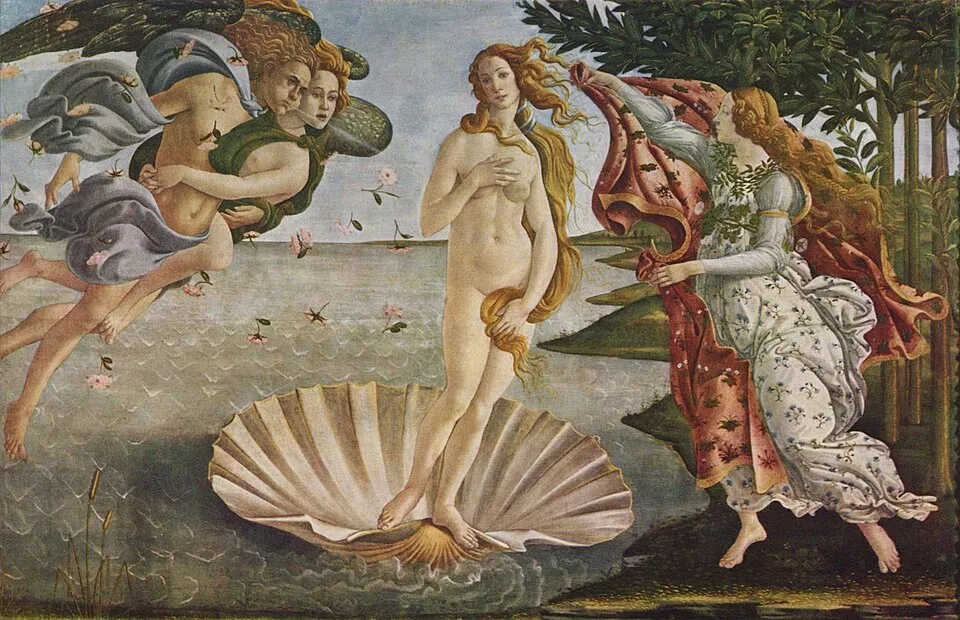
Sandro Botticelli, "The Birth of Venus" (c. 1485). Tempera on canvas, 172.5 x 278.9 cm. Uffizi Gallery, Florence. Image via Wikimedia Commons
In Renaissance Florence, hair was regulated by sumptuary laws, laws that restricted what people could wear. The wearing of pearls in public was restricted. Hair styles were regulated by social class and marital status. Botticelli's paintings, with their extravagant hair and 200 painted pearls, were not realistic depictions. They were fantasies that violated the laws of the time. The Church's attitude toward hair was hostile. Thomas Aquinas classified hair as a "corporeal superfluity," irrelevant to the soul, irrelevant to salvation. Savonarola preached that female hair was "a snare, luring men and boys to lust." The tension between Botticelli's celebration of hair and the Church's condemnation of it is the tension of Renaissance art, between the classical revival of beauty and the Christian suspicion of the body. By the 1490s, under Savonarola's influence, Botticelli stopped painting elaborate hair. His late works cover hair "under thick layers of cloth, or turned them into wavy streaks, as repetitive as they are long." The defeat is visible in the paintings. The man who had made hair the threshold of desire retreated into piety. Lugli calls this "the hegemonic Christian depreciation of hairstyles." For more on the works that define this period, see our guide to famous paintings explained, and the FAMSF has a useful piece on the hidden meanings in Botticelli's hair.
Mary Magdalene: Red Hair as Sin and Salvation
Mary Magdalene is recognizable in art by her long, flowing, red hair. The hair is not decorative. It is a visual attribute that identifies her and encodes her story. In medieval and Renaissance art, "Mary Magdalene was depicted with beautifully braided and arranged red hair to connote her fundamental lascivious nature before her healing or conversion." Red hair was associated with Venus and with sexuality. "Given its relation to the planet Venus, copper- or red-coloured hair implied a venereal character, and thereby was associated with sexuality." In the Mediterranean, where most people had dark hair, red hair was immediately noticeable and immediately suspect.
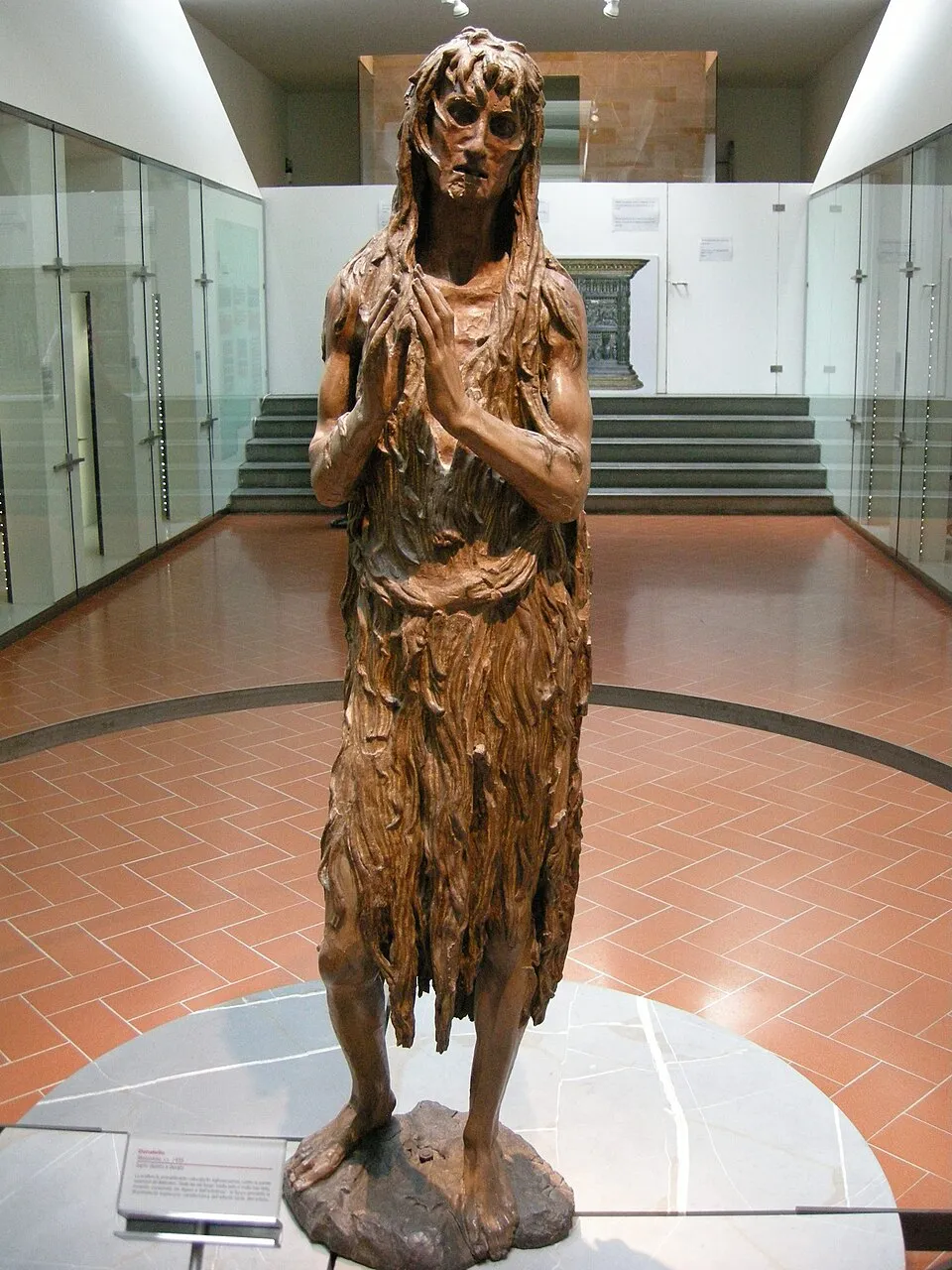
Mary Magdalene with long flowing hair. In medieval and Renaissance art, her red hair signified her "lascivious nature before conversion," while its length and looseness marked her as both penitent and sacred. Image via Wikimedia Commons
Long, loose, flowing hair was the attribute of young unmarried women and of female personifications of sacred love. "Proper married women covered their heads in public as both a sign of their social station and of the preservation of their 'energy' for their husbands." Mary Magdalene's loose hair marks her as outside the social order: neither wife nor virgin, but penitent. The paradox is that the Magdalene's hair is both sin and salvation. It signifies her former life as a sinner (red, loose, abundant) and her converted life as a penitent (covering her body in place of clothing, a sign of humility). The same hair that "typified energy and fertility" and "embodied joie de vivre" also signifies the renunciation of those things. Hair in art is never one thing. It is always double, always both/and. For more on the religious context, see our guide to art and religion, and the Church Times has a clear feature on Mary Magdalene in art.
The Tonsure: Shaved Heads and Religious Power
The tonsure is the shaving of the top of the head, practiced by monks and clergy in the Western Church from the 5th century until it was abolished by Pope Paul VI in 1972. The tonsure was a mark of humility, obedience, and the renunciation of worldly vanity. Three forms existed: the Roman (shaving the top of the head only), the Celtic (shaving the front of the head from ear to ear), and the Eastern Orthodox (complete shaving of the head). Thomas Aquinas, himself a tonsured monk, classified hair as a "corporeal superfluity," irrelevant to the soul. The tonsure enacted this theology: by shaving the hair, the monk renounced the body's most visible ornament and submitted to the Church's authority. The tonsure was not a choice. It was a requirement. Without it, a man could not be a monk.
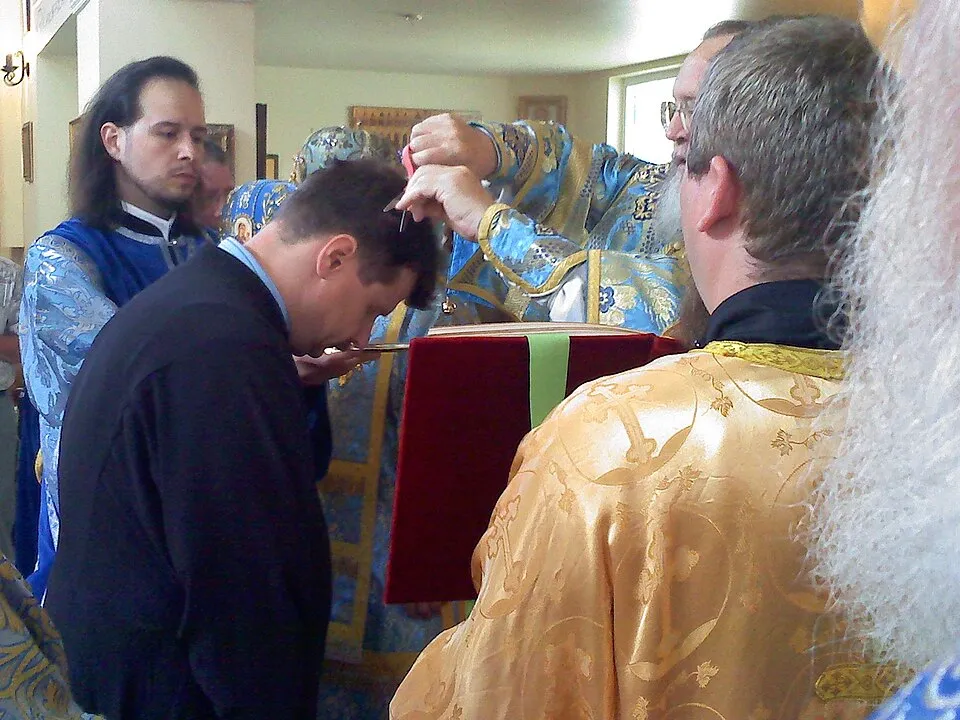
Monastic tonsure in medieval art. The shaved crown represented humility and obedience to God. Thomas Aquinas, who classified hair among "corporeal superfluities," is typically depicted wearing a tonsure. Image via Wikimedia Commons
The tonsure is the inverse of Botticelli's Venus. Where Venus's hair is the threshold of desire, the tonsure is the threshold of renunciation. The shaved head says: I have given up the world. I have given up beauty. I have given up the body. The tonsure is hair as anti-hair, the absence of hair as a sign of spiritual power. The paradox is that the tonsure itself became a sign of power. The shaved head identified the clergy as a separate class, with authority over the laity. The renunciation of hair became a form of social power. For more on the religious context, see our guide to art and religion.
Hair and Power in Portraiture
In royal portraiture, hair is a sign of power and legitimacy. Elizabeth I of England (1533-1603) was painted with elaborate red-gold hair, a visual assertion of her authority and her connection to the Tudor dynasty. Her hair was not just hair. It was a political statement: the queen is beautiful, the queen is powerful, the queen is legitimate. In male portraiture, hair signifies virility and status. Antonis Mor's portrait of Philip II of Spain (1557, 113 x 88 cm, Prado) shows the king with carefully styled hair and a trimmed beard, the hair of a ruler, not a soldier or a peasant. In contrast, Rembrandt's late self-portraits show thinning white hair, the hair of age, of mortality, of the body in decline.
In female portraiture, hair is both ornament and risk. A woman with loose hair is associated with sensuality and disorder. A woman with covered hair is associated with modesty and order. The tension between loose and covered hair is the tension of female portraiture: between desire and propriety, between the body and the social order. For more on how art reflects social structures, see our guide to art and society, and JSTOR Daily has a useful piece on the Renaissance letting its hair down.
African Hair and Identity
In African cultures, hair is "a very important symbol of cultural identity." In Yoruba culture (Nigeria), "hair is highly celebrated by the women as it is seen as a crown of glory upon their heads." In Benin (Edo State, Nigeria), "Chiefs who are mostly men are identified by their unique hair-styles." The hairstyle is a marker of leadership status. "When a king dies, all the men in the kingdom are expected to shave off their hair as a sign of respect for the departed king." In West African traditions, children born with natural locs (dreadlocks) are called "Dada" (Yoruba) or "Ezenwa/Elena" (Igbo). These children are "revered as reincarnated beings with immense spiritual power, with their hair acting as a literal vessel for divine strength." The locs are not a style choice. They are a sign of spiritual authority. Similar traditions exist worldwide: in Indonesia (Rambut Gimbal), in Poland (Plica Polonica), and in the biblical Nazirite vow (Samson's hair as the source of his strength).
Colonialism disrupted African hair traditions. European standards of beauty, straight hair, light skin, were imposed through colonial education, media, and social pressure. The disruption was not just aesthetic. It was ontological. "The hair, being a very important symbol of cultural identity has become a key role in understanding the issues with identity crises in Africa." The natural hair movement of the 20th and 21st centuries is a response to this disruption, a reclamation of African hair as beautiful, powerful, and culturally significant. The CROWN Act (Creating a Respectful and Open World for Natural Hair), first passed in California in 2019, prohibits discrimination based on hair texture and hairstyle. The act is a legal recognition that hair is not just hair. It is identity, it is race, it is power. The 3,500-year history of hair as a symbol of "identity, divine authority, and resistance against colonial suppression" culminates in a law that says: you cannot discriminate against someone for their hair. For more on how different cultures encode meaning, see our guide to color and culture.
Hair Politics in the 20th and 21st Centuries
The long hair of the 1960s counterculture was a political statement, a rejection of the short-haired conformity of the 1950s. Men with long hair were associated with anti-war protests, civil rights, and the sexual revolution. The hair was not just hair. It was a declaration of opposition to the establishment. The Afro, popularized in the 1960s and 1970s, was a political statement, a rejection of European beauty standards and an assertion of Black identity. The Black Panther Party adopted the Afro as part of its visual identity. The hair was not just hair. It was a declaration of pride, of resistance, of self-determination.
In 2026, hair is still political. The CROWN Act has been passed in 24 US states but not federally. Hair discrimination in the workplace, against natural hair, locs, braids, and Afros, remains legal in much of the United States. The debate is not about hair. It is about identity, race, and power. Hair in art and hair in life are the same subject: the body's most visible marker of who you are and where you belong. For more on the current moment, see our guide to contemporary art trends in 2026, and for the related debate about the body in art, our guide to the nude in art history. Our guide on how to look at art for beginners rounds out the picture.
Final Thoughts
Hair in art is one of the most loaded subjects in the history of painting. Botticelli made hair "the threshold to erotic desire," Venus's golden locks, 200 painted pearls, a "network of ropes, levers, and cantilevers" pulling the viewer in, and then stopped, defeated by Savonarola's piety. Mary Magdalene's red hair encoded both sin and salvation: "copper- or red-coloured hair implied a venereal character" and "associated with sexuality," while its length and looseness marked the penitent outside the social order. The tonsure, the shaved head of the monk, was the inverse of Venus: hair as anti-hair, the renunciation of beauty as spiritual power. In African traditions, hair is "a crown of glory" and a marker of leadership. The Dada children, born with locs, are "revered as reincarnated beings with immense spiritual power." Colonialism disrupted African hair traditions, and the natural hair movement and the CROWN Act (2019) are the response, a legal recognition that hair is identity, race, and power.
My position is that hair in art is never trivial. It is one of the most loaded subjects in the history of painting. It is sex and salvation, power and submission, identity and erasure. The CROWN Act is not about hair. It is about identity, race, and power. The 3,500-year history of hair as a symbol of "identity, divine authority, and resistance" is not over. It is still being fought, in courts, in workplaces, and in paintings. Next time you look at a portrait, any portrait, look at the hair, not just the face. The hair is telling you about the sitter's gender, status, religion, and identity. The hair is telling you about the culture that painted it: what it valued, what it feared, what it tried to control. Hair is not trivial. Hair is one of the most loaded subjects in the history of art. And it still is.


