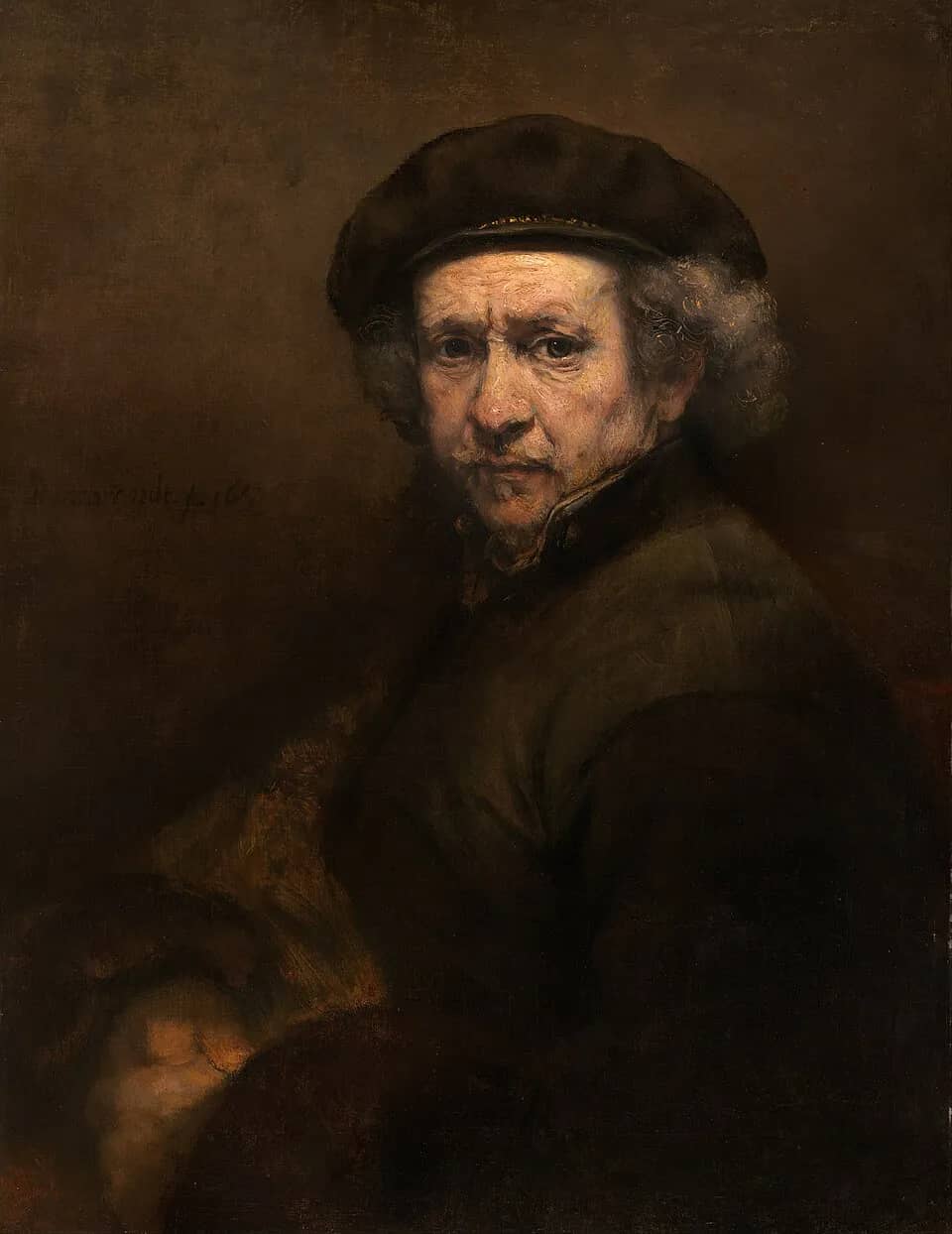
In 1665, Rembrandt van Rijn painted a self-portrait that is now at Kenwood House in London. He was fifty-nine and showing it. The face is heavy, the skin around the eyes is thick with age, and the white cap he is wearing is soft and informal, the kind of thing you wear when you are not performing for anyone. And yet the gaze is absolutely direct. Not challenging, not performative, just present. It is one of the most psychologically complex things in painting, and the reason it works is that Rembrandt understood a truth about portraiture that many painters miss: the face is the start of the information, not the end of it.
Reading a portrait carefully means attending to five layers: the gaze, the expression, the hands, the posture and clothing, and the setting. Each layer communicates independently and in combination with the others. Understanding what each one carries, and how the great portraitists of history handled them, transforms portrait galleries from sequences of faces into something closer to psychological case studies spanning six hundred years.
The Gaze: Where Are They Looking, and What Does It Cost?
The gaze in a portrait does three things at once: it establishes a relationship with the viewer, it reveals or conceals emotional state, and it encodes social meaning. These three functions pull in different directions, and how a painter balances them is one of the central challenges of portraiture.
Direct eye contact, where the sitter looks straight at the viewer, creates the illusion of mutual attention. The viewer feels seen, and this is where much of portraiture's psychological power comes from. But sustained direct eye contact is also a social signal with complex connotations. It can read as confident, challenging, vulnerable, or intimate depending on what the rest of the face and body communicate at the same time. Rembrandt's late self-portraits are the most complete example: the gaze is unflinching without being aggressive, curious without being destabilized, aged without being resigned. You feel genuinely met, not performed to. The [Rembrandt Research Project](https://rembrandtresearch.com/), which spent decades verifying attributions in Rembrandt's corpus, has documented over eighty self-portraits, and what makes them collectively remarkable is exactly this quality of honesty in the gaze across decades of aging.
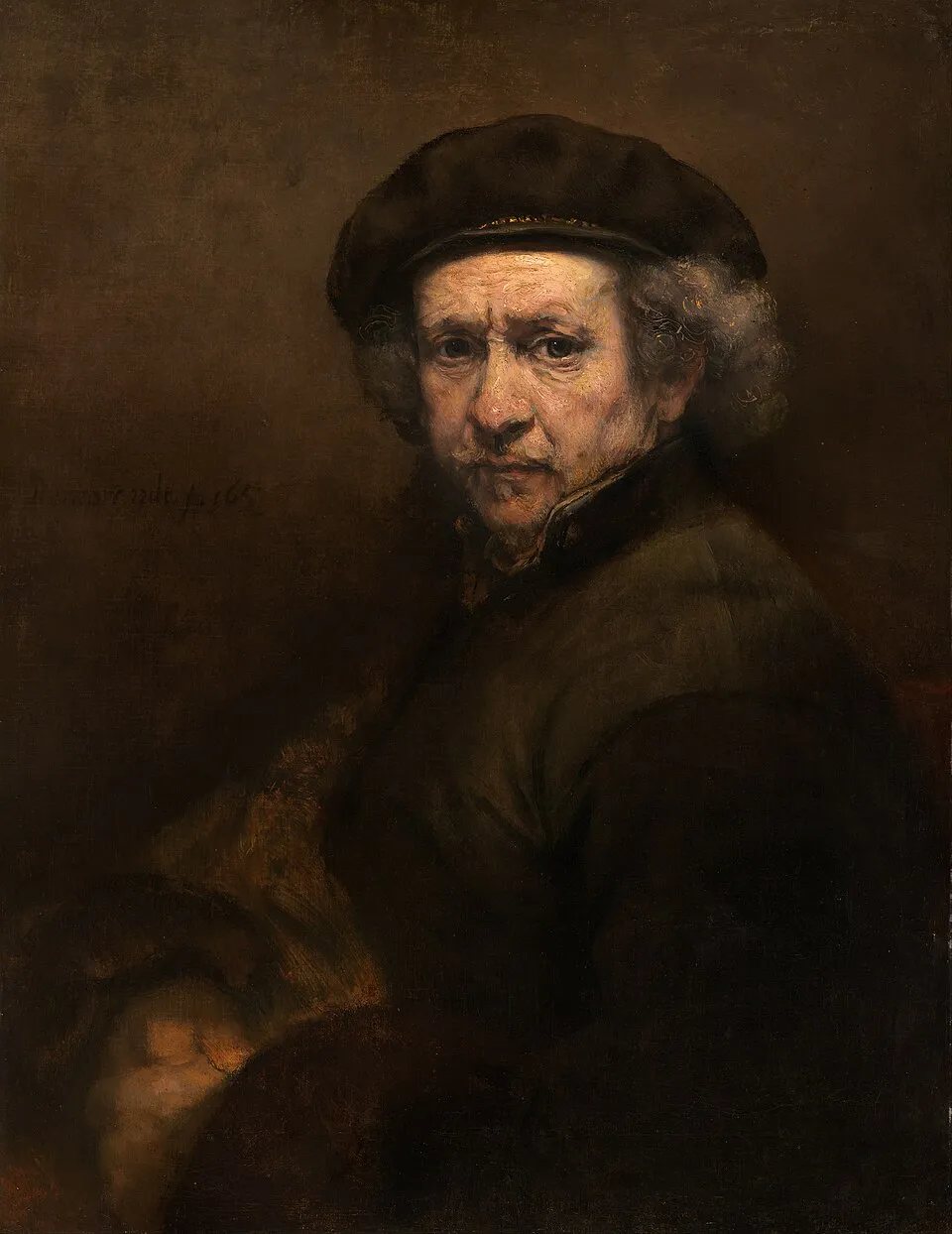
Rembrandt van Rijn, "Self-Portrait" (c. 1665), oil on canvas, 114.3 x 94 cm. Kenwood House, London. In this late self-portrait, the direct gaze and unflinching honesty about age create one of the most psychologically complex encounters in all of painted portraiture. The handling of the eyes, with their specific mixture of tiredness and quiet attention, is the technical and emotional heart of the work. Image: Public domain, via Wikimedia Commons
Averted gaze communicates something entirely different. It can suggest the sitter is lost in thought, is attending to something outside the picture frame, or is emotionally retreating from view. Vermeer's "Girl with a Pearl Earring" (c. 1665) is the most famous example of a calculated transition between averted and direct gaze. The figure appears to have turned at the exact moment of the viewer's approach, creating the illusion of caught motion. The eyes are not fully engaged; they are in the process of engaging, and this transition is what gives the painting its particular quality of intimacy. You feel you have interrupted something.
Expression: What the Mouth and Brow Say
The open mouth is relatively rare in Western portraiture before the 19th century, because showing teeth was associated with extreme emotion, social lowness, or loss of self-control. Formal portraiture of the aristocracy maintained closed mouths as a baseline social signal: the subject is composed, in command. The slight smile, appearing with increasing frequency from the late 15th century onward, required particular technical care, because a smile changes the relationships between every element of the face simultaneously. The difference between a convincing smile and an unconvincing one is registered immediately by the viewer's automatic social cognition, and most painters of the period knew it.
Leonardo da Vinci's extended work on the Mona Lisa (c. 1503-1519) was largely about the challenge of the smile. He needed to paint a mouth and eyes in a relationship that produces the sensation of shifting between two emotional states, so the expression appears to change as the viewer moves or looks away and looks back. His use of sfumato, the soft blending of edges around the corners of the mouth and eyes, makes both areas resist definitive reading. The brain's automatic expression-reading system cannot settle on a single interpretation, and the restless searching for resolution is what produces the Mona Lisa's legendary effect. It is not a mystery. It is a technical solution to a specific psychological problem.
Hands: The Second Face
In portraiture, hands are the second most expressive area of the human body after the face. Painters who handle them well use them to extend and complicate what the face alone communicates. Hands display social status (through rings, gloves, and the gestures of leisure versus labor), emotional state (tightly clasped, relaxed, anxious, authoritative), and character in ways that a face can suggest but rarely state directly.
Hans Holbein the Younger's portrait of "The Ambassadors" (1533) is the best example I know of hand and object use as a complete expressive system. The two French diplomats, Jean de Dinteville and Georges de Selve, stand before a table covered with scientific instruments, globes, and books. Their hands rest on, point toward, and gesture at these objects with studied informality. The hands encode the sitters' intellectual interests, their social sophistication, and their command over the world represented by the instruments. Without the hands, the two figures would be portraits of physical appearance. With them, they become portraits of minds and ambitions.
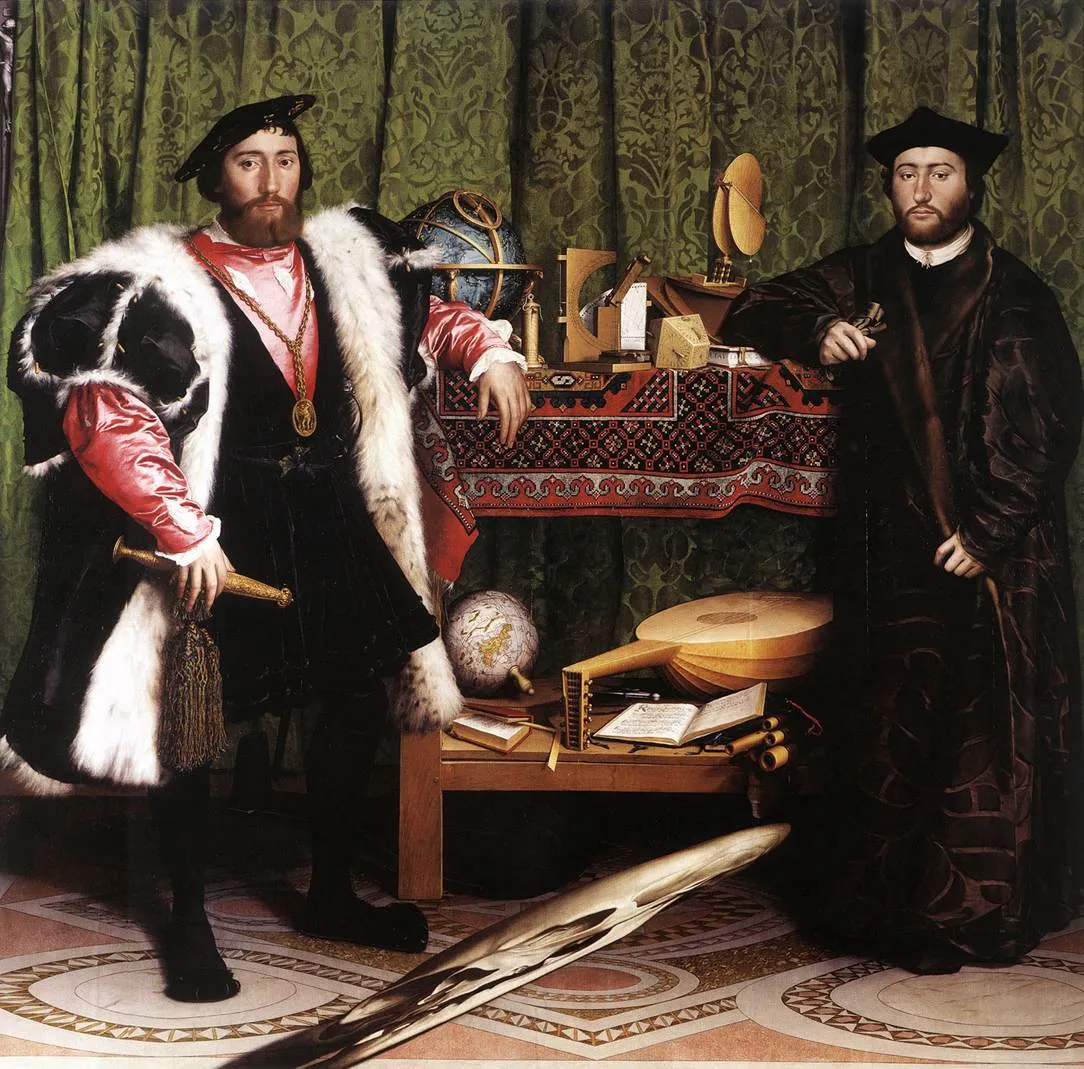
Hans Holbein the Younger, "The Ambassadors" (1533), oil on panel, 207 x 209.5 cm. National Gallery, London. The hands are as carefully described as the faces: each figure's hand position relative to the scientific instruments conveys intellectual ownership of the knowledge the instruments represent. The anamorphic skull in the foreground is a memento mori that can only be read correctly from a specific oblique angle. Image: Public domain, via Wikimedia Commons
John Singer Sargent (1856-1925) built his reputation substantially on his ability to paint hands. His virtuoso brushwork could describe the fall of light on silk and the specific quality of nervous tension in a clenched hand in what appeared to be a few effortless strokes. In "Madame X" (1884), the subject's downward-pressed hands gripping the table edge communicate the effort of composed self-presentation with a directness that the controlled expression of her face withholds. The hands tell you what the face will not. It is one of the most psychologically sharp paintings of the 19th century, and the hands are the reason.
Posture, Clothing, and Setting
Posture communicates social status and internal state at the same time. Upright bearing, weight evenly distributed, gaze forward: the standard posture of authority in official portraiture. Leaning, turned slightly, one shoulder higher than the other: signals of informality, ease, or the relaxed confidence of someone who does not need to perform their status. The rigid frontal posture of medieval portraiture communicated hieratic solemnity. The relaxed contrapposto (weight shifted to one leg) that appears in Renaissance portraiture communicated classical ease, humanism, and the sitter's familiarity with antique traditions.
Clothing in portraiture is documentary evidence that art historians rely on seriously. 16th-century northern European portraiture allows researchers to trace the introduction of specific fabric patterns, the development of the ruff, and the adoption of particular fashions across social classes and national borders, because painters were commissioned to record the sitter's wardrobe with the same fidelity as their face. But clothing also communicated social aspiration, political allegiance, and religious affiliation in ways that contemporary viewers read immediately and modern viewers require historical knowledge to decode.
Reading a Portrait in Practice
The approach that produces the richest engagement is sequential. Start with the overall impression: what do you feel, immediately and automatically? Then move to the gaze: what is the quality of the eye contact? Then the expression: what is the relationship between the eyes and the mouth? Then the hands: where are they and what are they doing? Then the posture: what does the body position communicate about effort, ease, and status? And finally the setting: what do the background and props encode about the sitter's identity and aspirations?
This layered approach connects directly to the broader practice of looking at art systematically, and the portrait format rewards this method because so much is deliberately encoded at each layer. For how portraiture functions within the longer history of figure representation, our guide to figure drawing covers the anatomical and compositional principles behind depicting the human body convincingly. And for the symbolic objects that often appear alongside figures in formal portraits, our guide to reading symbolism in art explains the conventions.
Final Thoughts
Every portrait is a negotiation between the painter's perception and the sitter's self-presentation, between the social conventions of the period and the individual psychology of both parties, between what the patron wants to communicate and what the painter's honesty compels them to include. Reading this negotiation, attending to where the painter confirms the social performance and where they quietly complicate it, is the central pleasure of portrait-looking. It requires no special knowledge to begin. You only need the willingness to spend more than a few seconds with any face you find compelling, and then to start asking why.