
The Turner Prize winner receives £25,000. Each of the other shortlisted artists gets £10,000. The 2025 winner was Nnena Kalu, announced at a ceremony at Bradford Grammar School, presented by magician Steven Frayne, formerly known as Dynamo, in Bradford, that year's UK City of Culture, and broadcast live on BBC News. The 2026 shortlist, announced by Tate Britain, features Simeon Barclay, Kira Freije, Marguerite Humeau, and Tanoa Sasraku. Their exhibition will be held at Teesside University's MIMA, Middlesbrough Institute of Modern Art, from 26 September 2026 to 29 March 2027. The winner will be announced on 10 December 2026. Alex Farquharson, Director of Tate Britain and Chair of the Turner Prize Jury, said: "This year's selection presents a rich and diverse range of work, spanning installation and performance, and with a strong emphasis on sculptural practice. Each artist invites us into carefully constructed scenarios, both real and imagined, that offer distinct perspectives through which to explore the world around us." The Turner Prize has been "the UK's most publicised art award" since its inception, according to Wikipedia. It has also been the most controversial. It is a lightning rod for public debate about what counts as art, who gets to decide, and whether the whole thing is, as Culture Minister Kim Howells famously declared in 2002, "conceptual bullshit."
The Turner Prize is not just an award. It is an annual cultural event, a moment when contemporary art enters the British public sphere, for better or worse. The controversy is the point. The prize "aims to promote public debate around new developments in contemporary British art," as Tate puts it. The debate is often loud, ill-informed, and occasionally brilliant. But it is debate, and in a culture that increasingly ignores contemporary art, debate matters. This guide covers what the Turner Prize is and how it works, the 2025 winner Nnena Kalu and the 2026 shortlist, the history of controversy from Hirst's shark to Howells' "conceptual bullshit," the notable winners from Malcolm Morley in 1984 to Jasleen Kaur in 2024, the prize's evolution, and why it matters. For more on what is happening in art right now, see our guide to contemporary art trends.
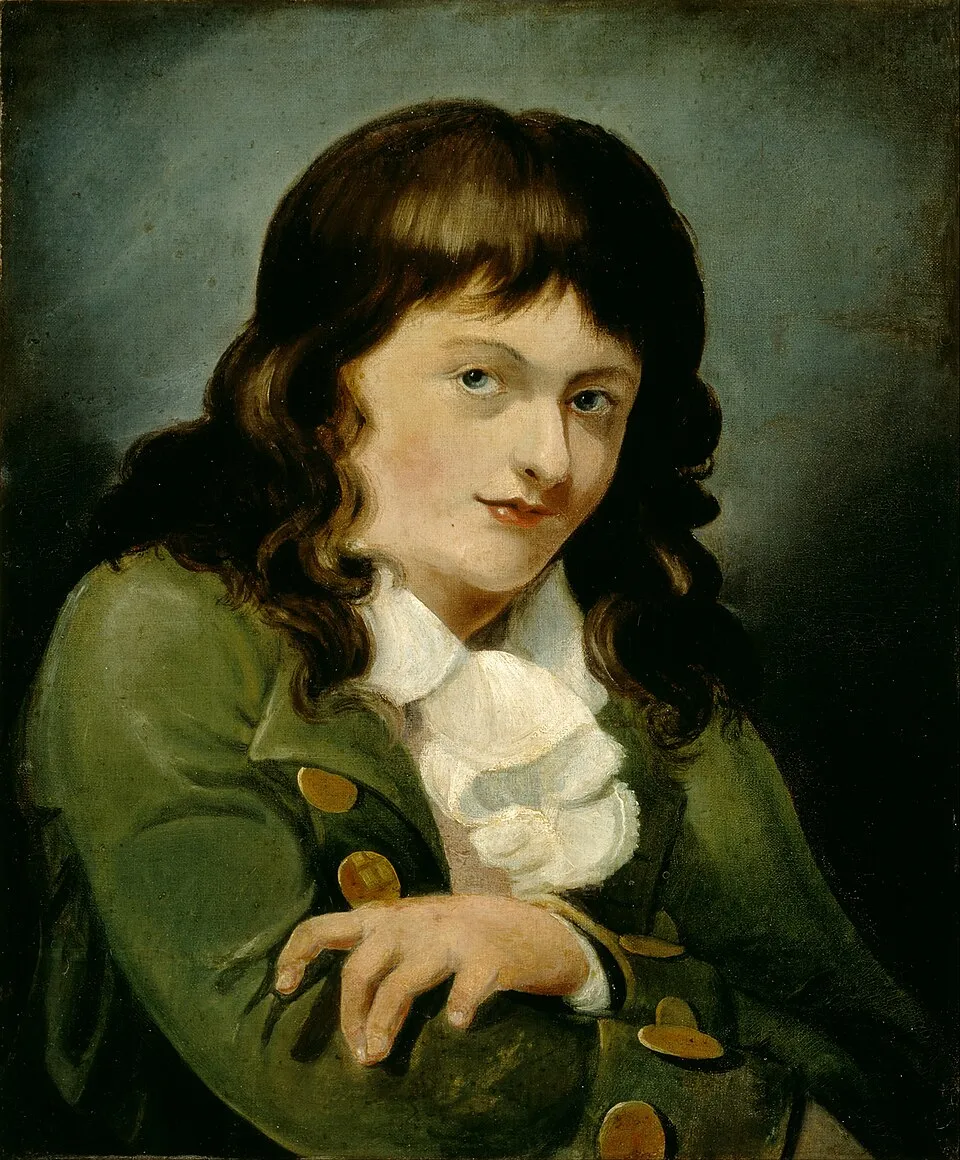
J.M.W. Turner, "Self-Portrait" (c. 1799). Oil on canvas. Tate Britain. "Though he is now considered one of the country's greatest artists, when he was active, his work was controversial. While he is now looked at as a traditionalist, his new approach to landscape painting changed the course of art history, as many of the Turner Prize winners aspire to do" (Wikipedia). Image via Wikimedia Commons
What the Turner Prize Is and How It Works
Established in 1984, the prize is named after the radical painter JMW Turner (1775-1851) and is awarded each year to a British artist for an outstanding exhibition or other presentation of their work, according to Tate. The winner gets £25,000. Each shortlisted artist gets £10,000. The shortlisted and winning artists are chosen by the prize's jury based on a showing of their work that they have staged in the preceding year. Nominations for the prize are usually invited from the public. The shortlist, usually of four or five artists, is announced in July. A show of the nominees' work opens in late October. The prize itself is announced at the beginning of December.
The jury is four independent judges invited by the Tate, chaired by the Director of Tate Britain. The 2025 jury was Andrew Bonacina (independent curator), Sam Lackey (Director, Liverpool Biennial), Priyesh Mistry (Associate Curator, The National Gallery), and Habda Rashid (Senior Curator, Fitzwilliam Museum). The prize is officially not judged on the Tate show, but on the earlier exhibition for which the artist was nominated. This distinction matters. The jury is judging the artist's year, not the prize exhibition. The prize exhibition is for the public.
The Turner Prize also travels. Originating at Tate Britain, it regularly travels to a non-Tate venue in the UK, widening access to contemporary art by bringing it to a local leading arts venue. In 2025 it was at Cartwright Hall in Bradford. In 2026 it will be at MIMA in Middlesbrough. The traveling is part of what makes the prize a national event rather than a London one. For more on approaching unfamiliar work, see our guide to how to look at art.
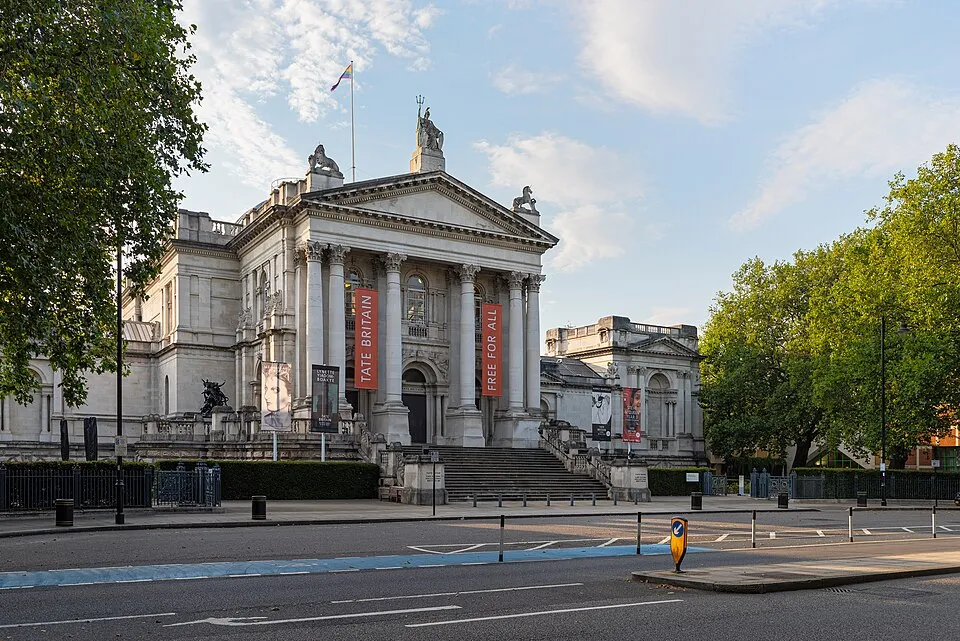
Tate Britain, home of the Turner Prize since 1984. "The Turner Prize aims to promote public debate around new developments in contemporary British art" (Tate). The 2026 exhibition will be held at MIMA, Middlesbrough Institute of Modern Art, from 26 September 2026 to 29 March 2027. Image via Wikimedia Commons
The 2025 Winner: Nnena Kalu and the Bradford Exhibition
The Turner Prize 2025 was awarded to Nnena Kalu. The winner of the £25,000 prize was announced at a ceremony at Bradford Grammar School, presented by magician Steven Frayne, formerly known as Dynamo, in Bradford, that year's UK City of Culture, and broadcast live on BBC News. The shortlist was Nnena Kalu, Rene Matić, Mohammed Sami, and Zadie Xa. The exhibition was at Cartwright Hall Art Gallery in Bradford, from 27 September 2025 to 22 February 2026, co-curated by Jill Iredale, Michael Richmond, and Sophie Bullen for Bradford 2025 UK City of Culture.
The 2025 prize had a particular resonance. Established in 1984, the Turner Prize is named after the radical British painter JMW Turner (1775-1851), whose 250th birthday was marked that year. The prize was awarded on the 250th anniversary of Turner's birth. Kalu's win, on that anniversary, in a City of Culture, broadcast on the BBC, was the prize working as intended. It put an artist most of the British public had never heard of into living rooms across the country. For more on building your own art knowledge, see our guide to teaching yourself art history.
The 2026 Shortlist: Barclay, Freije, Humeau, Sasraku at MIMA
The 2026 shortlist is Simeon Barclay, Kira Freije, Marguerite Humeau, and Tanoa Sasraku. An exhibition of their work will be held at Teesside University's MIMA, Middlesbrough Institute of Modern Art, from 26 September 2026 to 29 March 2027. The winner will be announced on 10 December 2026 at an award ceremony at MIMA. Alex Farquharson said: "This year's selection presents a rich and diverse range of work, spanning installation and performance, and with a strong emphasis on sculptural practice. Each artist invites us into carefully constructed scenarios, both real and imagined, that offer distinct perspectives through which to explore the world around us, and to reflect on our place within it."
The venue matters. MIMA, part of Teesside University, will host the first Turner Prize exhibition in a university setting. As Tate noted, "this moment creates a special context, where contemporary art can inspire discussion, dialogue and new ways of thinking." Middlesbrough is not London. The prize going there is part of the point. For more on what is current, see our guide to contemporary art trends.
The History of Controversy: From Hirst's Shark to Howells' "Conceptual Bullshit"
The controversy started with the first winner. Malcolm Morley was awarded the inaugural Turner Prize in 1984 for his installation of two oil-on-canvas paintings inspired by a trip to Greece. Morley's win sparked controversy because he had been living in New York for the previous 20 years. The question of who counts as "British" has haunted the prize ever since.
The Young British Artists years made the prize a household name. The prize has been "a controversial event, mainly for the exhibits, such as The Physical Impossibility of Death in the Mind of Someone Living, a shark in formaldehyde by Damien Hirst, and My Bed, a dishevelled bed by Tracey Emin." Hirst won in 1995. Emin was shortlisted in 1999. These were the years when the Turner Prize became shorthand for "is this even art?" in the British press.
In 2002, after Culture Minister Kim Howells described the Turner Prize as "conceptual bullshit," Prince Charles wrote a letter of support to him, stating "It has contaminated the art establishment for so long." When a government minister and the heir to the throne are weighing in on a contemporary art prize, the prize is doing its job. It is generating debate.
Since 2000, the Stuckists art group have protested against the prize. In 2008, they gave out leaflets with the message "The Turner Prize is Crap," protesting the lack of figurative paintings among the nominees' exhibitions. The Stuckists also organized the Anti-Turner Prize, an annual £40,000 prize awarded to the artist voted "the worst artist in Britain" from the real Turner Prize's shortlist. Rachel Whiteread was awarded their prize. She initially refused to accept the money, but later changed her mind. Whiteread won the real Turner Prize in 1993, the same year she won the Anti-Turner Prize. The protesters proved the prize mattered enough to protest. For more on how art interacts with public life, see our guide to art and society.
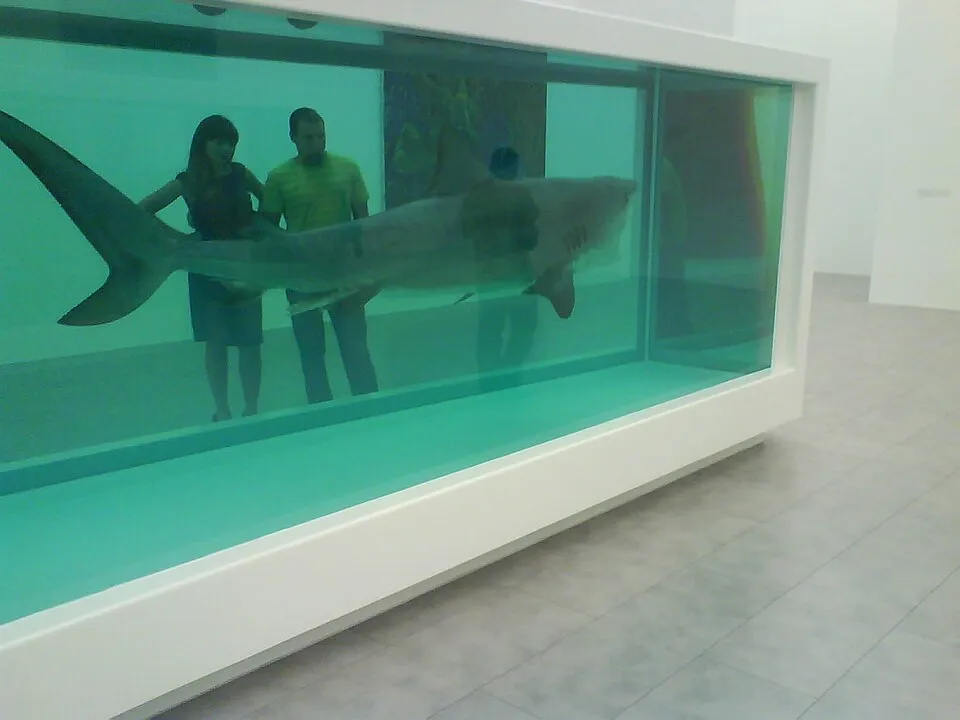
Damien Hirst won the Turner Prize in 1995. The prize has been "a controversial event, mainly for the exhibits, such as The Physical Impossibility of Death in the Mind of Someone Living, a shark in formaldehyde by Damien Hirst, and My Bed, a dishevelled bed by Tracey Emin" (Wikipedia). Image via Wikimedia Commons
Notable Winners Through the Years
The list of winners reads as a history of British art over four decades. Malcolm Morley won in 1984, the inaugural winner, controversial for his New York residency. Howard Hodgkin won in 1985, one of the most distinctive British painters of his generation. Gilbert and George won in 1986, the controversial art duo awarded the prize after a previous nomination in 1984. Anish Kapoor won in 1991, known for monumental public sculptures. Rachel Whiteread won in 1993, the first woman to win, and also won the Anti-Turner Prize the same year. Damien Hirst won in 1995, the shark, the moment the Turner Prize became a household name. Chris Ofili won in 1998, known for paintings incorporating elephant dung. Steve McQueen won in 1999 and went on to win an Academy Award for "12 Years a Slave" in 2013. Wolfgang Tillmans won in 2000, the first photographer to win. Martin Creed won in 2001 for "The Lights Going On and Off," a room where the lights turned on and off. Grayson Perry won in 2003 and accepted the prize wearing a dress.
Lubaina Himid won in 2017, the first Black woman to win, at age 63. In 2019, the prize was shared by all four nominees, Lawrence Abu Hamdan, Helen Cammock, Tai Shani, and Oscar Murillo, after they wrote a letter asking the judges not to choose a single winner. In 2021, Array Collective became the first collective to win, from Northern Ireland. Veronica Ryan won in 2022, the first sculptor to win since 2018, for her work with cast iron, bronze, and marble. Jesse Darling won in 2023, known for sculptures using barriers, fencing, and everyday objects. Jasleen Kaur won in 2024 for her exhibition "Alter Altar," exploring personal and collective history. Nnena Kalu won in 2025, announced at Bradford Grammar School as part of Bradford 2025 UK City of Culture. For more on specific works, see our guide to famous paintings.
The Prize's Evolution: Age Limits, Traveling Venues, and Shared Wins
Between 1991 and 2016, only artists under the age of 50 were eligible. The age limit was removed in 2017, the year Lubaina Himid won at age 63. Removing the limit was an admission that the prize had been excluding artists at the height of their powers. Himid's win made the argument better than any policy paper could.
The prize is awarded at Tate Britain every other year, with various venues outside of London being used in alternate years. Recent venues include Hull in 2017, Margate in 2019, Hull again in 2021, Eastbourne in 2022, Liverpool in 2023, Bradford in 2025, and Middlesbrough in 2026. The traveling has turned a London institution into a national one.
The shared win in 2019 was unprecedented. All four nominees wrote a letter asking the judges not to choose a single winner. The jury agreed. It was the first time the prize was shared. In 2021, Array Collective, a Belfast-based group of artists, became the first collective to win. The prize had evolved from rewarding individual artists under 50 to rewarding artists of any age, working in any medium, including collectives, exhibited at venues across the UK. The evolution reflects changes in contemporary art itself. The boundaries between media, between individual and collective practice, between center and periphery, have dissolved. For more on building a foundation in art, see our guide to teaching yourself art history.
Why the Turner Prize Matters
Since its inception, the prize itself has received considerable criticism. It has also received considerable attention, more than any other art prize in the UK. The Turner Prize is the one time each year when contemporary art becomes a topic of national conversation in Britain. That visibility is not a side effect. It is the purpose.
The controversy is not a byproduct. It is the point. "The Turner Prize aims to promote public debate around new developments in contemporary British art." The debate is often ill-informed, but it is debate. In a culture that increasingly ignores contemporary art, debate matters. The Turner Prize introduces the public to artists they would never otherwise encounter. Nnena Kalu, Rene Matić, Mohammed Sami, Zadie Xa. These are not household names. The Turner Prize makes them, briefly, into household names. That introduction has value, even if the public's response is sometimes hostile.
The prize was named after Turner because, though he is now considered one of the country's greatest artists, when he was active, his work was controversial. While he is now looked at as a traditionalist, his new approach to landscape painting changed the course of art history, as many of the Turner Prize winners aspire to do. The prize is a bet that today's controversy is tomorrow's classic. Sometimes the bet pays off, as with Hirst, Whiteread, and Perry. Sometimes it does not. But the bet is worth making. For more on getting started, see our guide to art for beginners.
Final Thoughts
The Turner Prize, established in 1984 and named after the radical painter JMW Turner (1775-1851), awards £25,000 to a British artist for an outstanding exhibition or other presentation of their work. The 2025 winner was Nnena Kalu, announced at a ceremony at Bradford Grammar School presented by magician Steven Frayne, formerly known as Dynamo, in Bradford, that year's UK City of Culture, and broadcast live on BBC News. The 2026 shortlist, Simeon Barclay, Kira Freije, Marguerite Humeau, and Tanoa Sasraku, will exhibit at Teesside University's MIMA, Middlesbrough Institute of Modern Art, from 26 September 2026 to 29 March 2027, with the winner announced on 10 December 2026. The prize has been "the UK's most publicised art award" and "a controversial event, mainly for the exhibits." In 2002, Culture Minister Kim Howells called it "conceptual bullshit," and Prince Charles wrote a letter of support. The Stuckists protested with leaflets reading "The Turner Prize is Crap." Rachel Whiteread won both the real prize and the Anti-Turner Prize in 1993. In 2019, all four nominees shared the prize after requesting it. In 2021, Array Collective became the first collective to win. The age limit, under 50 from 1991 to 2016, was removed in 2017, when Lubaina Himid won at 63. The prize travels: Hull, Margate, Eastbourne, Liverpool, Bradford, Middlesbrough.
The 2026 Turner Prize exhibition opens at MIMA, Middlesbrough, on 26 September. Admission is free. Go. Walk through the four artists' work. Form an opinion. Argue about it. That is what the prize is for. The Turner Prize is not about agreeing on what is good. It is about disagreeing about what is art. And that disagreement, loud and messy and occasionally ill-informed, is the most valuable thing the prize produces. It is the one week each year when Britain talks about contemporary art. Join the conversation. For more on the broader calendar of art events, see our guide to the art fairs calendar.


