
In 1917, a Dutch painter named Piet Mondrian wrote: "The emotion of beauty is always obscured by the appearance of the object. The object must be removed from the picture." He then spent the next 27 years painting nothing but straight black lines and rectangles of red, blue, and yellow on white fields. He was not alone. A group of Dutch artists calling themselves De Stijl ("The Style") believed that art should be reduced to its most basic elements: horizontal and vertical lines, primary colors, and flat planes. Nothing else.
De Stijl emerged in the Netherlands during World War I. The Netherlands was neutral, which meant Dutch artists were cut off from the Paris avant-garde but also free from the war's disruption. The movement was launched with a journal of the same name, founded by Theo van Doesburg in 1917, which ran for 10 years and published 90 issues. In June 2026, MoMA announced a major exhibition called "Mondrian Boogie Woogie" that will reunite the artist's two final paintings for the first time in over three decades, opening at the Kunstmuseum Den Haag in September 2026 before traveling to MoMA in March 2027.
This guide covers Mondrian's path from landscape painting to pure abstraction, Van Doesburg's role as organizer and provocateur, the split between the two over diagonal lines, the expansion of De Stijl into architecture and design, and why a movement that produced almost no representational images changed the visual world.
Mondrian's Path to Abstraction
Mondrian's early career was unremarkable. He painted naturalistic landscapes of the Dutch countryside: windmills, dunes, and rivers in the Hague School tradition. He was competent but conventional. The shift began between 1908 and 1911, when Mondrian moved to Paris and encountered Cubism. His landscapes became increasingly geometric. Trees reduced to vertical and horizontal lines. Dunes reduced to colored planes.
"The Gray Tree" (1912) and "Flowering Apple Tree" (1912) show the progressive elimination of naturalistic detail. The tree becomes a pattern of lines. By 1913, the tree is gone entirely. What remains is a composition of intersecting black lines on a white ground, with occasional patches of muted color. You can watch the representational world draining out of his paintings year by year, like water leaving a basin.
The theoretical basis for this reduction came from theosophy. Mondrian read Madame Blavatsky's spiritual movement and believed that underlying the visible world was a deeper, spiritual reality expressed through pure geometric form. This placed him in the same company as Hilma af Klint, who was painting abstract works before abstraction had a name. Both artists believed that geometry was a language for truths that the visible world could not express.
A 2024 biography by Nicholas Fox Weber, "Mondrian: His Life, His Art, His Quest for the Absolute," traces this journey from landscape painter to abstractionist in detail. Weber argues that Mondrian's reduction was not a rejection of nature but an attempt to find what was universal in it. The tree disappears from the painting not because Mondrian lost interest in trees, but because he decided that the vertical and horizontal lines the tree reduced to were more real than the tree itself.
The Founding of De Stijl
Theo van Doesburg was the movement's engine. He was a painter, writer, and organizer who founded the journal, recruited contributors, and promoted De Stijl across Europe. Without Van Doesburg, Mondrian would have painted his compositions in isolation. With Van Doesburg, those compositions became the basis of an international movement.
The journal's first issue appeared in October 1917. Contributors included Mondrian, Van Doesburg, Vilmos Huszar, Bart van der Leck, and the architect J.J.P. Oud. Bart van der Leck's contribution is often overlooked, but he had already been using primary colors and geometric forms before De Stijl was founded. Mondrian credited Van der Leck with showing him the way to pure abstraction. Van der Leck quit the movement after a disagreement in 1918, but his influence on Mondrian's mature style is undeniable.
Huszar's cover for the first volume of De Stijl magazine used the movement's own visual language: rectangles and lines in primary colors. The journal itself was a De Stijl artwork. This was not a magazine about a movement. It was the movement manifesting itself in print.
The Kunstmuseum Den Haag maintains the world's largest Mondrian collection and has positioned De Stijl as the origin of geometric abstract art through its permanent displays and rotating exhibitions. The museum's partnership with MoMA on the upcoming "Mondrian Boogie Woogie" exhibition, announced in June 2026, confirms its central role in De Stijl scholarship.
Neoplasticism: The Theory
Mondrian's term for his style was "Nieuwe Beelding" (Neo-Plasticism), first published in the journal in 1917 and 1918. The rules were strict. Only horizontal and vertical lines. No diagonals. Only primary colors (red, blue, yellow) plus white, black, and gray. Only flat planes. No shading, no depth. Asymmetrical composition.
The reasoning behind these rules was not arbitrary. Horizontal represented the earth, the universal principle of extension. Vertical represented the spiritual, the principle of growth. Their intersection represented the balance of opposites, which Mondrian saw as the underlying structure of reality. Every painting was a diagram of this balance.
The elimination process is visible across Mondrian's career. His compositions from 1920 onward show a progressive reduction. By the 1930s, some paintings have only a few lines and one or two colored rectangles. By the 1940s, the lines themselves begin to disappear, replaced by colored blocks that imply lines through their edges.
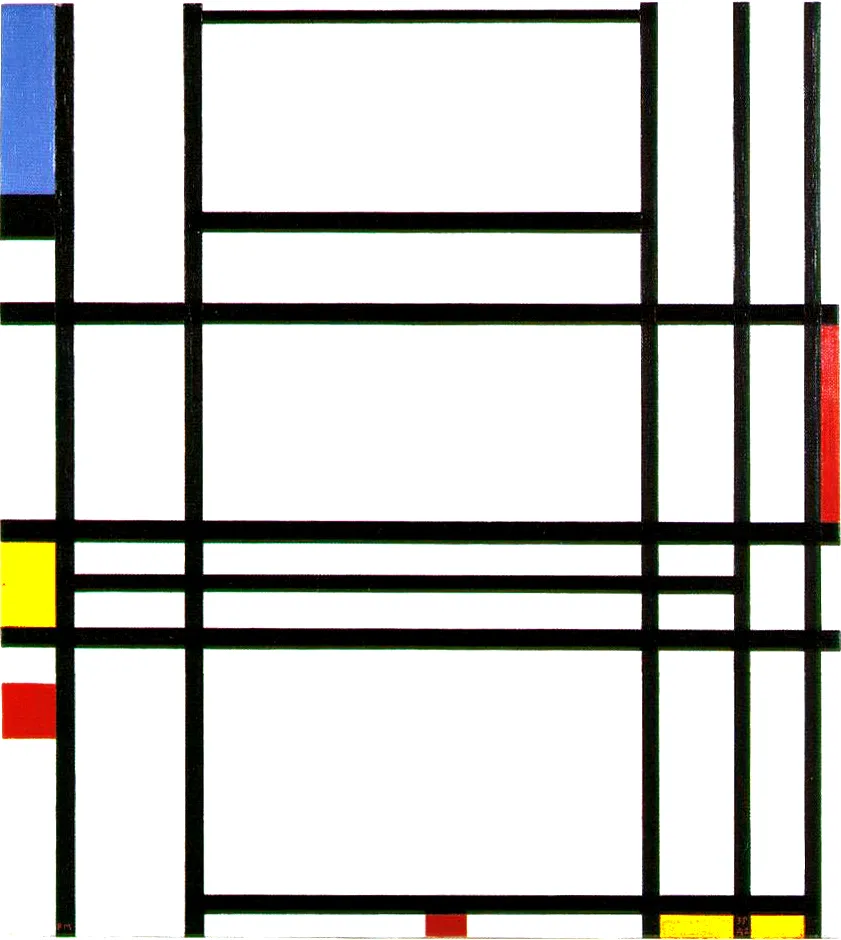
Piet Mondrian, "Composition No. 10" (1939-42). Oil on canvas, 80 x 73 cm. Private collection. Wikimedia Commons.
As MoMA's artist page on Mondrian documents, this reduction was not simplification. Each painting involved months of adjustment. Mondrian moved lines fractions of millimeters, repainted rectangles multiple times, and lived with the compositions for weeks before deciding they were finished. The simplicity was earned through labor, not achieved through absence.
The Split: Mondrian vs. Van Doesburg
The crisis came in 1924. Van Doesburg introduced diagonal lines into his compositions, calling them "Counter-Compositions." He argued that the strict horizontal-vertical system was too rigid. The diagonals opened up new visual possibilities.
Mondrian saw diagonals as a betrayal. The horizontal-vertical distinction was the foundation of Neoplasticism. Diagonals introduced a third direction, which destroyed the binary opposition that gave the system its meaning. A diagonal line is neither horizontal nor vertical. It collapses the categories that the entire theory depends on.
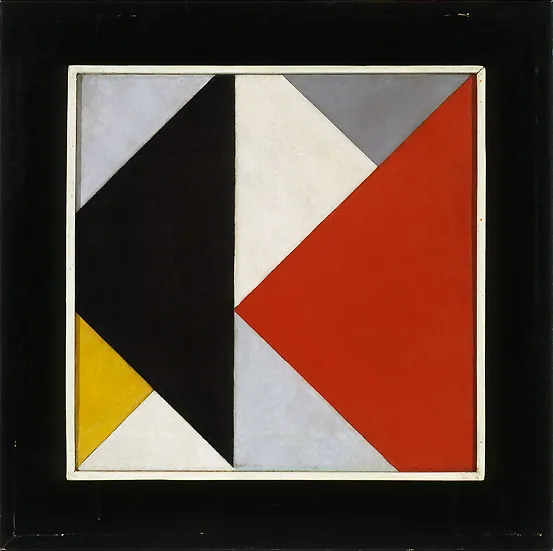
Theo van Doesburg, "Counter-Composition" (1924). Oil on canvas. Centraal Museum, Utrecht. Wikimedia Commons.
Mondrian quit De Stijl in 1925. He and Van Doesburg never reconciled, though they continued to develop their ideas independently. Mondrian was right to leave. Van Doesburg's diagonals are more visually interesting than Mondrian's orthogonal compositions, but they break the philosophical system that made De Stijl more than decoration. Without the horizontal-vertical rule, the paintings become abstract designs rather than statements about the structure of reality. The diagonal destroys the meaning, even as it enriches the surface.
The split between Mondrian and Van Doesburg parallels a tension that runs through the entire Bauhaus movement: the conflict between theoretical purity and visual freedom. Mondrian chose purity. Van Doesburg chose freedom. Both positions have consequences.
De Stijl Beyond Painting: Architecture and Design
Gerrit Rietveld's "Red and Blue Chair" (1918) is a chair made of plain wood, painted in primary colors, using only horizontal and vertical elements. It is simultaneously a chair and a De Stijl sculpture. You can sit in it, but sitting is almost beside the point. The chair is a demonstration that De Stijl principles could extend beyond the canvas into the physical world.
Rietveld's Schroder House (1924) in Utrecht applies De Stijl principles to architecture. The house is a UNESCO World Heritage Site and one of the most important buildings in modern architectural history. Its sliding walls, movable screens, and asymmetric composition translate Mondrian's grid into three-dimensional space. You can live inside a De Stijl painting.
The influence on graphic design was equally significant. De Stijl's grid system, primary color palette, and sans-serif typography became the foundation of Swiss graphic design in the 1950s, which in turn shaped corporate identity, signage systems, and web design. Every grid-based layout you encounter online has De Stijl DNA in it.
The 2025 exhibition "Trailblazers of the Abstract" at the Royal Museum of Fine Arts Antwerp (KMSKA) explored this multidisciplinary reach, juxtaposing De Stijl with the Antwerp Modern Art Circle. The exhibition included Van Doesburg's rare folding maquette for the Cafe l'Aubette interior in Strasbourg, described as the "Sistine Chapel of modernism," alongside architectural designs, furniture, and graphic works by Rietveld, Oud, and others. The show ran from May 29 to September 7, 2025 and demonstrated how De Stijl's principles diffused across Europe through networks of artists, architects, and designers who shared the belief that geometric abstraction could build a better postwar world.
This ambition to reshape daily life connects De Stijl to Art Nouveau's concept of the total work of art, though the two movements reached opposite conclusions about what that work should look like.
Why De Stijl Still Matters
The Guggenheim's "Piet Mondrian: Ever Further" exhibition (November 2024 to April 2025) traced Mondrian's progressive reduction from early landscapes to final abstractions. The exhibition showed that the simplification was not a limitation but a discipline. Each reduction opened new problems that Mondrian solved through further reduction, in a process that continued until his death in New York in 1944.
MoMA's announced "Mondrian Boogie Woogie" exhibition, opening at the Kunstmuseum Den Haag in September 2026 and at MoMA in March 2027, will reunite "Broadway Boogie Woogie" (1942-43) and "Victory Boogie Woogie" (1942-44) for the first time in over three decades. These are the largest canvases Mondrian ever used for abstract painting, each 50 by 50 inches. The exhibition will explore how boogie woogie music and Black diaspora culture in New York shaped Mondrian's late work. Curator Leah Dickerman noted that Mondrian's writing during this period was "the most explicitly political of his career," framing boogie woogie as "an art form that created a space of freedom." This reframing positions De Stijl not as a closed European system but as a movement that absorbed and responded to cultural forces far beyond its origins.
A 2024 book by Nancy J. Troy and Ann Marguerite Tartsinis, "Mondrian's Dress," traced how Yves Saint Laurent's 1965 Mondrian dress collection turned the artist's grids into fashion commodities. The dresses sold better than Mondrian's paintings ever did. The irony is sharp: the man who removed the object from the picture became a brand object himself.
The legacy is everywhere. Every grid-based design system, every minimal logo, every use of primary colors in modernist architecture descends from De Stijl. The movement's idea that art should express universal principles rather than personal emotion is the foundation of Minimalism. For the broader context of how De Stijl fits into the history of abstract art, see our art movements timeline and art history cheat sheet.
Final Thoughts
De Stijl lasted 10 years as a formal movement (1917 to 1927) but its visual language is everywhere. In IKEA furniture, in subway maps, in corporate logos, in the grid of your phone screen. Mondrian's belief that reducing art to its essentials would reveal something universal was either prophetic or self-fulfilling. Either way, the world now looks the way he painted.
The upcoming reunion of Mondrian's two final paintings at the Kunstmuseum Den Haag and MoMA offers a rare chance to see where this reduction ultimately led. "Broadway Boogie Woogie" and "Victory Boogie Woogie" are not pure Neoplasticism. They are Neoplasticism opened up by jazz, by New York, by the energy of a city that Mondrian encountered in his final years. The strict horizontal-vertical grid is still there, but it pulses.
Visit the Schröder House in Utrecht (tours available, book ahead). The Kunstmuseum Den Haag has the world's largest Mondrian collection. And if you want to understand how Mondrian's abstraction connects to the broader tradition of artists who painted the invisible, read about Kandinsky and the invention of abstract art.


