
In March 2026, the Serpentine Galleries in London unveiled a 295-foot-long painting made entirely on an iPad. Its creator was 88 years old. The work, "A Year in Normandie" (2020-21), winds around the gallery walls like a secular version of the Bayeux Tapestry, recording the seasons in Hockney's garden in northern France through more than 100 digital panels stitched into an unbroken panorama. Standing next to it, you feel the same thing you feel with a great scroll painting: time passing, light shifting, the world observed with real patience.
David Hockney has been making this kind of work for over six decades, and the Serpentine show is the latest proof that he has not run out of things to say. He is the rare artist whose reputation has only grown with age. The swimming pools he painted in Los Angeles in the 1960s made him famous. The Yorkshire landscape series in the 2000s expanded his range. The iPad work that started around 2009 baffled some critics and then gradually won them over. Now, with "A Year in Normandie" receiving its London premiere alongside new acrylic portraits from 2025, it is clear that Hockney is not slowing down. He is still working out problems about how we see the world, and he is doing it in public.
This guide covers his formation, his major bodies of work, the obsessions that hold his career together, and why he remains one of the most important British painters of any era.
Bradford to London: The Formation of an Eye
Hockney was born on July 9, 1937, in Bradford, Yorkshire, into a working-class family. His father was a clerk and a committed pacifist. The family had little money, but Hockney showed exceptional drawing ability early and won a place at Bradford Grammar School on scholarship. He went on to Bradford College of Art, then won a place at the Royal College of Art in London in 1959.
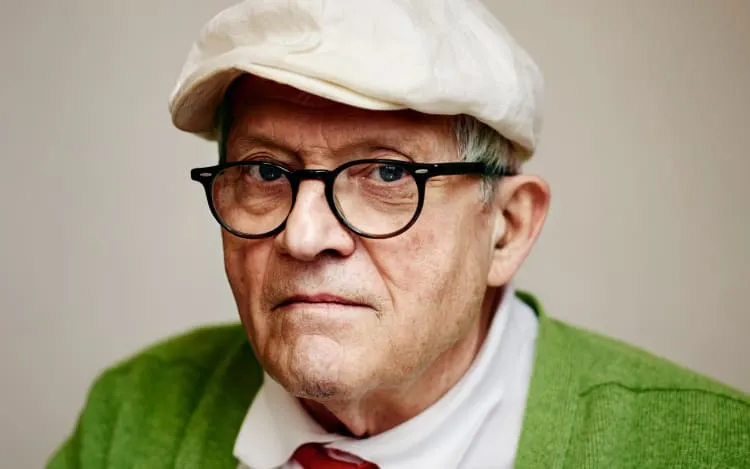
A portrait of David Hockney. Image Source: Floren
The Royal College in the early 1960s was one of the most interesting places in British art. Pop Art was emerging, and Hockney was at the center of it. His graduate show paintings, including the series of works he made in response to Walt Whitman's "Leaves of Grass," displayed a combination of graphic boldness and personal directness that immediately set him apart. He graduated in 1962 and was already being talked about as the most gifted artist of his generation.
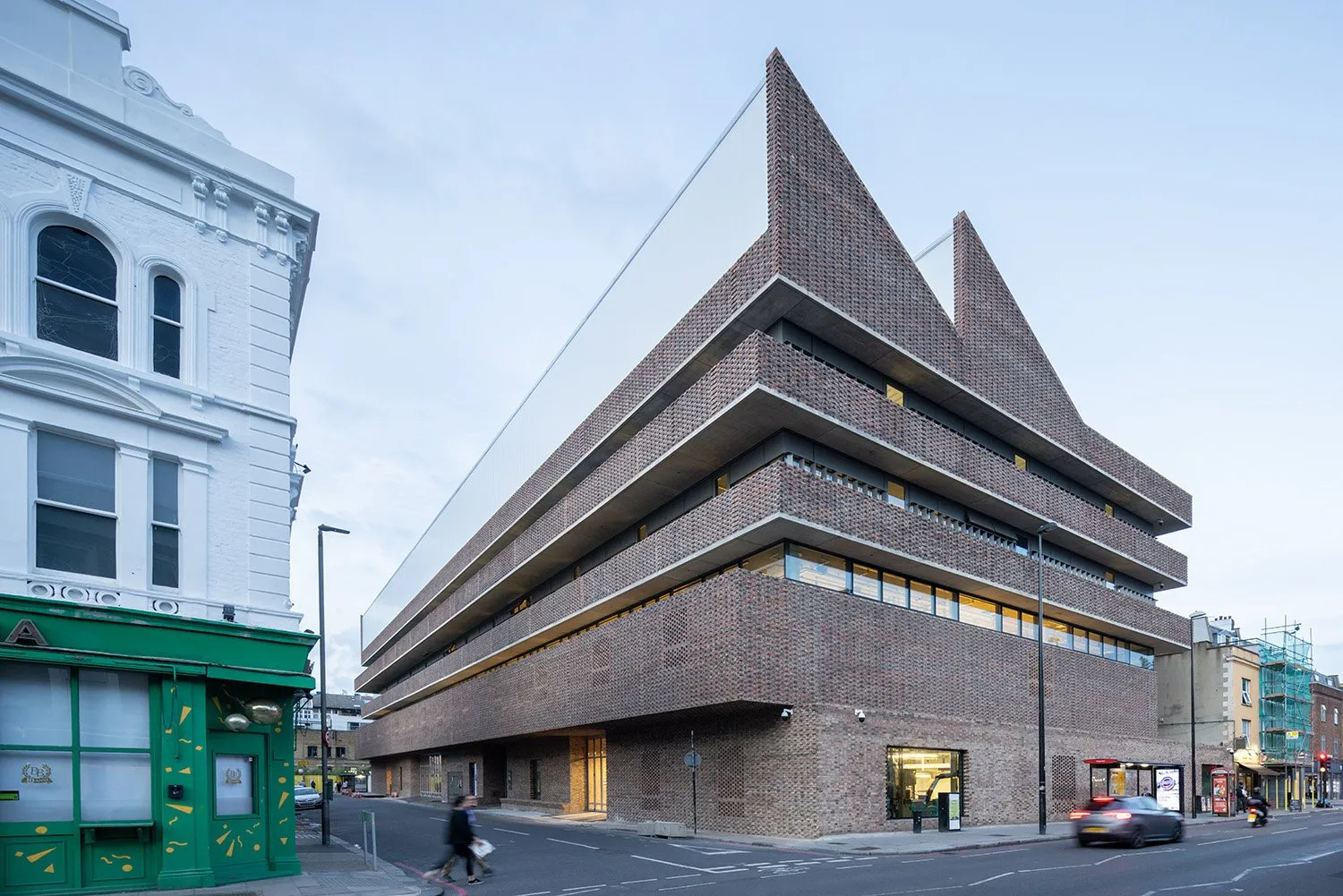
The Royal College of Art, London. Image Source: Royal College of Art
California and the Swimming Pool Paintings
Hockney first visited Los Angeles in 1963, almost on a whim, and the city changed everything. The light was different from anything he had encountered in England or New York: flat, even, and extremely bright. The architecture was low and horizontal. The culture was openly accepting of his homosexuality in ways that Britain, where male homosexuality remained illegal until 1967, was not. He moved there the following year and began the pool paintings that would define the first phase of his international reputation.
"A Bigger Splash" (1967) is the most famous of them. The diving board at the left is painted with flat, graphic precision. The house and palm trees in the background are rendered in simple, almost diagrammatic strokes. The splash itself is completely different: an explosion of white, gestural, energetic marks that capture the moment of entry into the pool. The contrast is deliberate. Hockney was thinking about the problem of representing movement in a medium that is inherently still, and the splash was his solution.
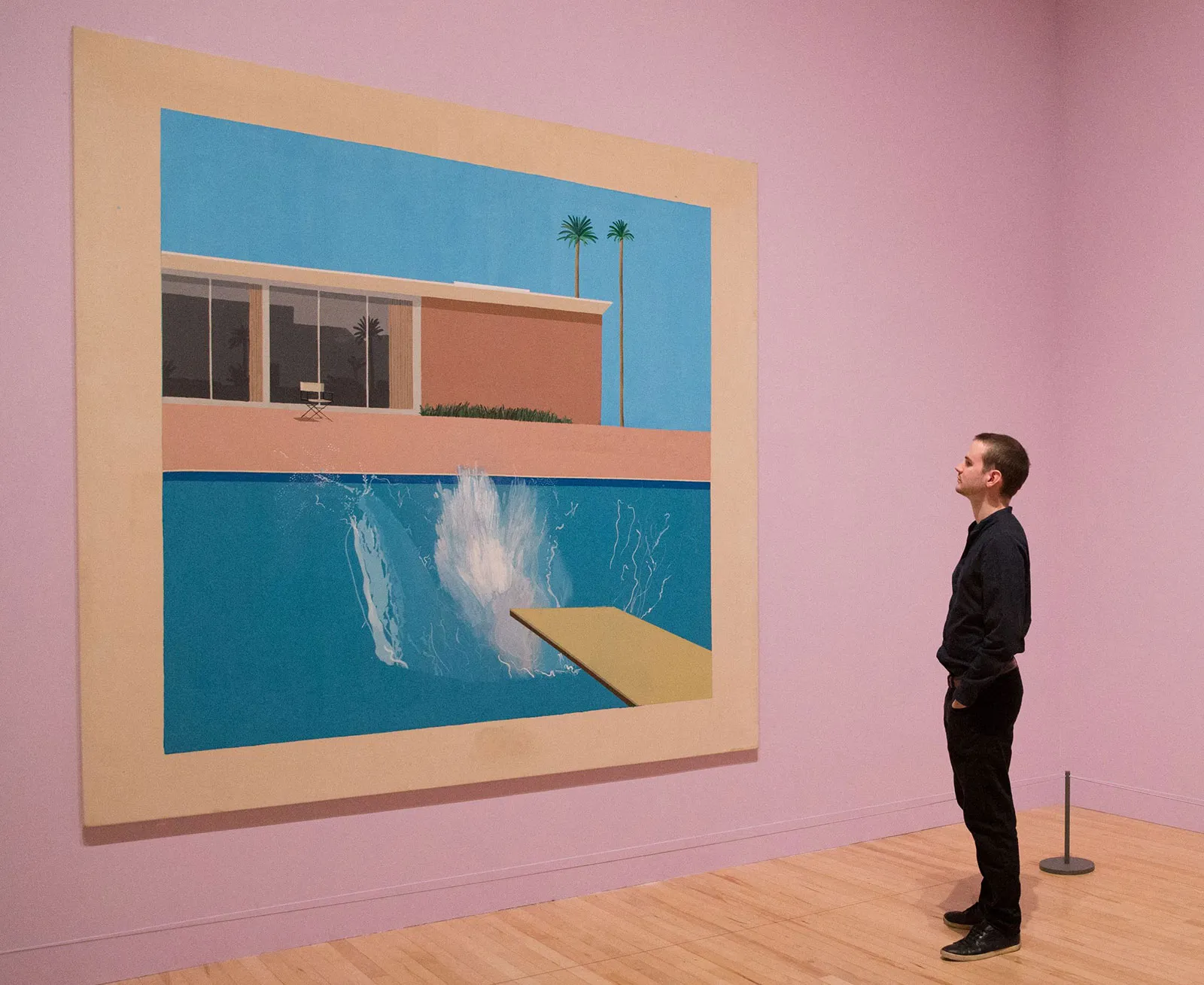
David Hockney, "A Bigger Splash" (1967), acrylic on canvas, 242.5 x 243.9 cm. Tate Modern, London. The painting took Hockney two weeks to complete, with the splash itself painted last using a small decorating brush to achieve its energetic, scattered quality.
What made these paintings technically interesting is that Hockney was using acrylic paint, relatively new at the time, applied in flat, even layers that dried quickly without the yellowing that oil produces over decades. The California blue of the pool water in these paintings is specific and unmistakable. It comes from mixing Cerulean and Cobalt with titanium white, applied over a white gesso ground, and it has not aged or shifted. You can verify this by looking at the original at Tate Modern in London, or at "Portrait of an Artist (Pool with Two Figures)" (1972) at the Getty Museum in Los Angeles, which sold at Christie's in 2018 for $90.3 million, then a record for a living artist at auction.
The Problem of Perspective and the Joiners
By the late 1970s, Hockney was becoming increasingly interested in the limitations of the single-viewpoint perspective system that Western painting has used since the Renaissance. His argument, developed extensively in his 2001 book "Secret Knowledge: Rediscovering the Lost Techniques of the Old Masters," is that photography and perspective painting both fix the viewer at a single point in space and time, which does not reflect how we actually experience the world. We move. Our eyes scan. We see a room by moving through it, not by standing still and looking through a rectangular frame.
His response was the "Joiners": composite photographs assembled from dozens or hundreds of individual Polaroid or 35mm prints arranged into a single image. "Pearblossom Highway, 11-18th April 1986" combines roughly 850 photographs of a stretch of California desert road taken from multiple angles and multiple positions. The result is something between a road map and a painting, full of visual information but organized by the logic of looking rather than the logic of optics. The J. Paul Getty Museum, which holds the work, describes it as one of the most important photographic works of the late 20th century.
The Joiners were not just experiments. They were a sustained argument about vision, one that Hockney was making simultaneously in writing, lectures, and conversations with scientists and art historians. His position, that the camera has trained us to accept a narrow and impoverished way of seeing, remains an interesting one regardless of whether you agree with his conclusions.
Yorkshire and the Return to Landscape
In the early 2000s, Hockney returned to Yorkshire to care for his dying mother and stayed. He began painting the East Yorkshire Wolds, the rolling chalk hills north of the Humber estuary, with an intensity and commitment that produced some of the largest work of his career. "Bigger Trees Near Warter" (2007), made up of 50 individual canvases joined together and measuring 15 feet by 40 feet, was painted in situ, outdoors, in the tradition of Constable and Turner.
The Yorkshire paintings are not nostalgic. They are about observation and color and the particular quality of northern English light, which is grey and changeable and nothing like California. Hockney used vivid, almost Fauvist color to render a landscape that most people would describe as drab. The series culminated in a major retrospective at the Royal Academy in London in 2012 that drew nearly 600,000 visitors, one of the most successful exhibitions in the Academy's history. The Tate holds several major works from this period in its permanent collection.
The iPad and a New Way of Working
Hockney started drawing on the iPhone in 2008 and moved to the iPad when it launched in 2010. He was immediately enthusiastic. The medium let him work in any light, including outdoors at night, with a range of marks that approached what he could do with watercolor. He sent his iPad drawings to friends by email before he had fully decided they counted as art, and some of them appeared in exhibitions before the critical conversation about whether they were serious had even started.
The skepticism was considerable in the early years. The response from critics tended toward the indulgent: here is a great artist playing with a toy. That view has not survived contact with "A Year in Normandie." The frieze, made over 12 months during the 2020 lockdown, is a genuine painting in every sense that matters. It records changing light, shifting weather, the growth and decay of specific trees and plants, with a freshness that the fixed medium of oil on canvas would not have allowed. As Hockney himself has said, "new ways of seeing mean new ways of feeling." The iPad let him work outdoors through the Norman winters, sitting in his truck with the heater running, looking through the windscreen and painting what he saw. That is exactly what Constable and Monet did, with the materials available to them.
The Serpentine exhibition, on view through August 23, 2026 and curated by Hans Ulrich Obrist, also includes new acrylic paintings on canvas from 2025: five portraits of people in Hockney's immediate circle, including his partner Jean-Pierre Gonçalves de Lima and his carer Thomas Mupfupi, all painted against the recurring motif of a gingham tablecloth. These paintings are among the most direct and psychologically present portraits he has made. Alongside the Serpentine show, 2026 also saw Hockney receive the Officier rank in France's Légion d'Honneur, recognizing his years working in Normandy and his long engagement with French artistic tradition.
What Holds the Career Together
The reason Hockney's work holds together across its many phases and media is that he has always been working on the same questions: What does it mean to look at something? How does a picture represent the experience of seeing, rather than just the appearance of the seen? How do different technologies change what a painter can notice and record?
These questions connect the Los Angeles pool paintings to the Joiners to the Yorkshire landscapes to the iPad work. They also connect him to a long tradition of artists who understood their medium as a research tool. His admiration for Vermeer, Ingres, and Picasso is not incidental. He has written and talked at length about what he learned from each of them, and you can see that learning in his own work if you look carefully. His treatment of water in the pool paintings comes partly from studying how Vermeer rendered light on reflective surfaces. His interest in multiple viewpoints in the Joiners is in direct dialogue with Cubism.
For more on the Pop Art movement Hockney emerged from, see our guide to Pop Art. For the broader context of how artists use technology as a creative tool, our guide to digital art is worth reading alongside his iPad work.
Final Thoughts
David Hockney at 88 is still one of the most original painters alive. The Serpentine show makes the case that "A Year in Normandie" is not a late-career curiosity but a genuine contribution to the history of panoramic painting, made with a medium nobody would have predicted 20 years ago. His career teaches a lesson that applies far beyond art: the most important thing is to keep asking questions about how to do the thing you are doing, even after you are already famous for doing it well.
If you want to engage with his work directly, the Tate's collection pages on Hockney give access to high-resolution images and archival material. The Serpentine exhibition is free and runs through August 23, 2026. What aspect of his work surprises you most? Share in the comments below.


