
Aboriginal Australian body painting is the oldest continuing art tradition in the world, at least 60,000 years old, and still practiced today. The designs are painted on the body with ochre (red, yellow, white, and black clay) mixed with animal fat. The patterns are not decorative. They are inherited through family lines and clan relationships. "Individuals cannot freely choose designs or motifs. Authority to use particular designs is earned, taught, and regulated through lore." The body painting is part of ceremony. When painted, the person "may embody the presence of an ancestral being through movement, song, and dance. This is not symbolic theatre, it is a cultural transformation that activates law, story, and responsibility." Body painting is not art in the Western sense. It is not an image on a surface, it is not made for an audience, and it is not permanent. It is a living practice in which the body is both the canvas and the instrument, painted, danced, sung, and then washed off. The art is not the paint. It is the transformation.
Body painting is practiced on every continent and in every culture. Aboriginal Australian body painting is the oldest. Henna (mehndi) is 5,000 years old, practiced across South Asia, the Middle East, and North Africa. African body painting includes the elaborate patterns of the Himba (Namibia), the Wodaabe (Niger), and the Surma (Ethiopia). In the West, body painting has been adopted by performance artists, Marina Abramović, Rebecca Horn, ORLAN, who use the body as medium, canvas, and subject. This guide covers Aboriginal Australian body painting and ochre, henna/mehndi traditions, African body painting, the Western performance art tradition, the difference between body painting as cultural tradition and body painting as contemporary art, and what body painting means in 2026.
Aboriginal Australian Body Painting: The Oldest Art Tradition
Aboriginal Australian body painting is "among the oldest continuing cultural practices in the world and date back thousands of years." The designs are painted with ochre, natural clay pigments in red, yellow, white, and black, mixed with animal fat for durability. Body painting "follows strict cultural protocols. Individuals cannot freely choose designs or motifs. Patterns are inherited through family lines, clan relationships, and ceremonial rights. Authority to use particular designs is earned, taught, and regulated through lore." The designs are not personal expressions. They are cultural property, owned by families and clans.
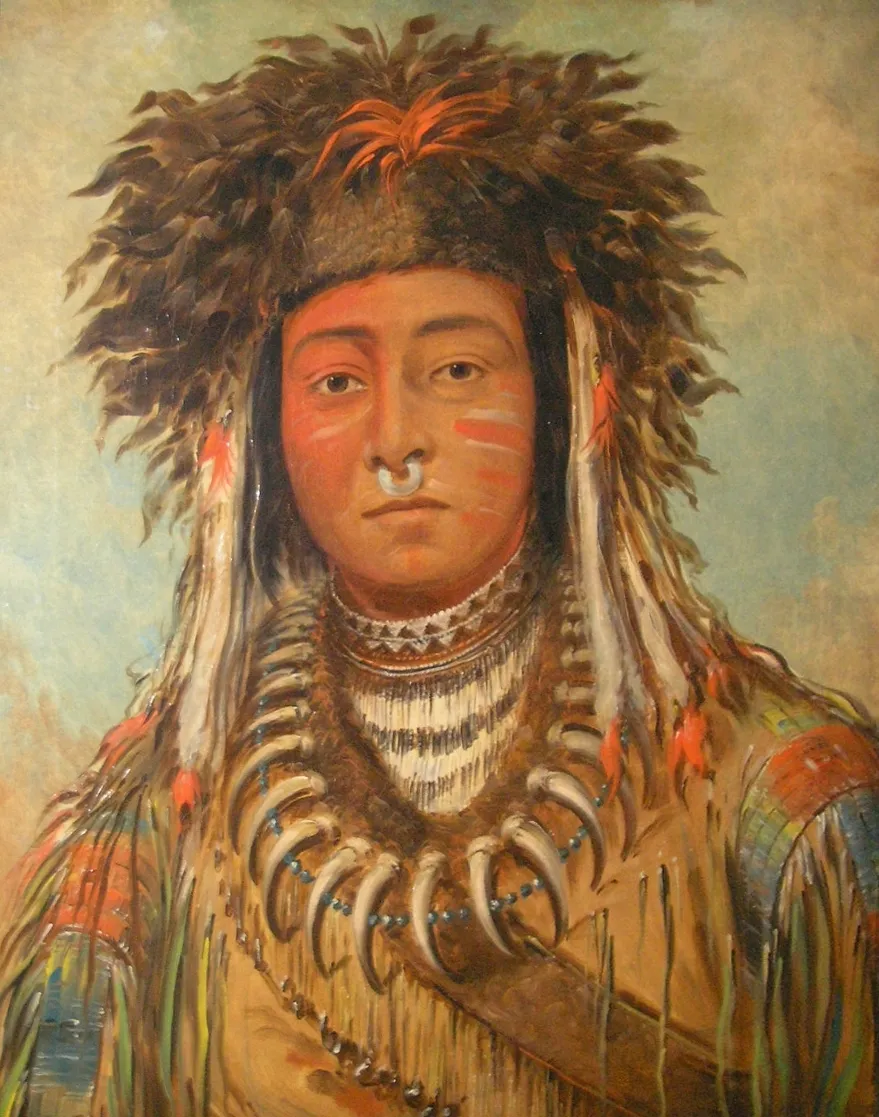
Aboriginal Australian ceremonial body painting with ochre. The tradition dates back tens of thousands of years and continues today. Photo by Silar. Image via Wikimedia Commons
Body painting is part of ceremony: initiation, funerary rites, fertility rituals. In Arnhem Land, young boys are painted for rites of passage with clan and totemic designs. Among the Yolngu, men are painted according to their moiety, Dhuwa or Yirritja, which determines their ceremonial role and artistic authority. In Utopia (Central Australia), women paint each other's bodies for awelye ceremonies. "The old women paint the ceremonial designs on their breasts, first with their fingers, and on their chests, and then with a brush called a typale, made from a stick. They paint with red and white ochres. Then they dance." Body painting is not decoration. It is transformation. "When painted for ceremony, a person may embody the presence of an ancestral being through movement, song, and dance. This is not symbolic theatre, it is a cultural transformation that activates law, story, and responsibility." The paint is not art. The transformation is art. The paint is a tool for becoming.
The contemporary connection is direct. Aboriginal body painting is the source of contemporary Aboriginal art. The designs on canvas, by artists like Minnie Pwerle, Kathleen Petyarre, and Gloria Petyarre, are translations of body paint designs onto a permanent surface. "The bold linear pattern of stripes and curves throughout Minnie Pwerle's painting illustrates women's ceremonial body paint design." The canvas is a record of a practice that is, by nature, ephemeral. The body paint is washed off, but the canvas remains. Aboriginal Art Australia published a useful overview of Aboriginal body painting, and Japingka Gallery has a detailed article on Aboriginal art and body painting. For more on how art encodes social structures, read our guide on art and society.
Henna/Mehndi: The Temporary Art
Henna (Lawsonia inermis) is a plant whose leaves produce a reddish-brown dye. The dye has been used for body painting for over 5,000 years, across South Asia, the Middle East, and North Africa. The earliest evidence comes from ancient Egypt, where henna was used to stain the fingers and toes of mummies. Henna paste is made from ground henna leaves mixed with water (or lemon juice) and essential oils. The paste is applied to the skin in intricate patterns, floral, geometric, figurative, using a cone or a stick. The paste dries and is left on the skin for several hours, staining the skin reddish-brown. The stain lasts 1-3 weeks. It fades as the skin exfoliates.
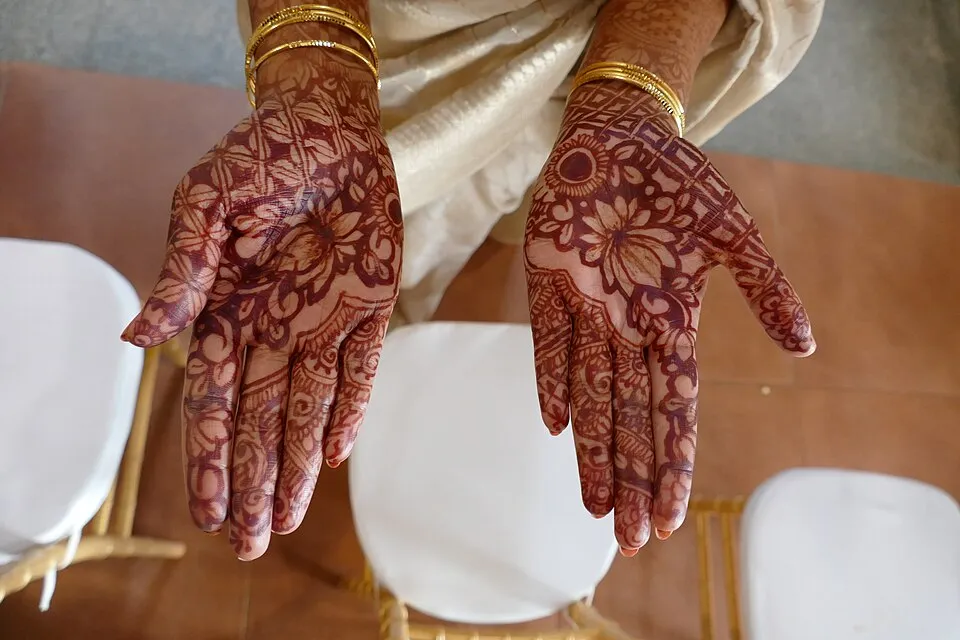
Henna (mehndi) hand painting. The tradition dates back over 5,000 years and is practiced across South Asia, the Middle East, and North Africa. Image via Wikimedia Commons
Henna is associated with weddings. The "henna night" (mehndi ki raat) is a pre-wedding celebration in which the bride's hands and feet are decorated with elaborate patterns. Henna is also used for Eid, Diwali, and other festivals. The patterns are traditionally floral and geometric, but contemporary henna artists create portraits, landscapes, and even corporate logos. Henna is a temporary art. It lasts 1-3 weeks and then disappears. This ephemerality is not a limitation. It is the point. Henna is an art of the moment. It is made for a specific occasion, worn for a specific time, and then allowed to fade. The impermanence is part of the meaning: the beauty is temporary, the celebration is temporary, the body is temporary. Henna is a meditation on transience. The most beautiful art is the art that does not last. For more on how different cultures read visual symbols, read our guide on color and culture.
African Body Painting: Identity, Status, and Beauty
The Himba of Namibia: Himba women cover their skin and hair with otjize, a mixture of red ochre, butter fat, and aromatic herbs. The red paste gives the skin a reddish-brown color that symbolizes earth, blood, and life. The otjize is applied daily. It is not ceremonial but habitual, a form of self-care and beauty practice. The red color is also protection from the sun and insects. The Wodaabe of Niger: Wodaabe men paint their faces for the Gerewol festival, a courtship ceremony in which men compete for the attention of women. The face is painted with red, yellow, and white patterns that emphasize the eyes, the cheekbones, and the teeth. The painting is a form of male beauty. The Wodaabe are one of the few cultures in which men, not women, are the primary objects of beauty. The Surma of Ethiopia: Surma body painting is done with white chalk, yellow ochre, and red ochre. The patterns are geometric, lines, dots, spirals, and are applied with fingers or sticks. The painting is done for festivals and ceremonies, and the patterns change with the occasion.
African body painting is not "body art" in the Western sense. It is not a medium for self-expression or artistic creativity. It is a cultural practice, a form of identity, status, and beauty that is governed by tradition. The patterns are not invented. They are inherited. The colors are not chosen. They are prescribed. The body is not a canvas for the individual. It is a surface for the culture. For more on how cultures read visual symbols differently, read our guide on color and culture.
Marina Abramović: The Body as Medium
Marina Abramović (b. 1946, Belgrade, Yugoslavia) is the most famous performance artist in the world. Her work uses the body as medium, not as canvas (she does not paint the body) but as subject, instrument, and material. "The Artist Is Present" (2010), at MoMA from March 9 to May 31, 2010, was the most attended performance art event in history. Abramović sat silently at a wooden table for 736 hours and 30 minutes, opposite an empty chair. Visitors could sit in the chair for as long as they wanted. Many cried. Over 850,000 visitors came. The performance was a demonstration of presence, the body as medium for attention, for connection, for the passage of time. The performance had no paint, no image, no object. Only two bodies, sitting across from each other, looking.
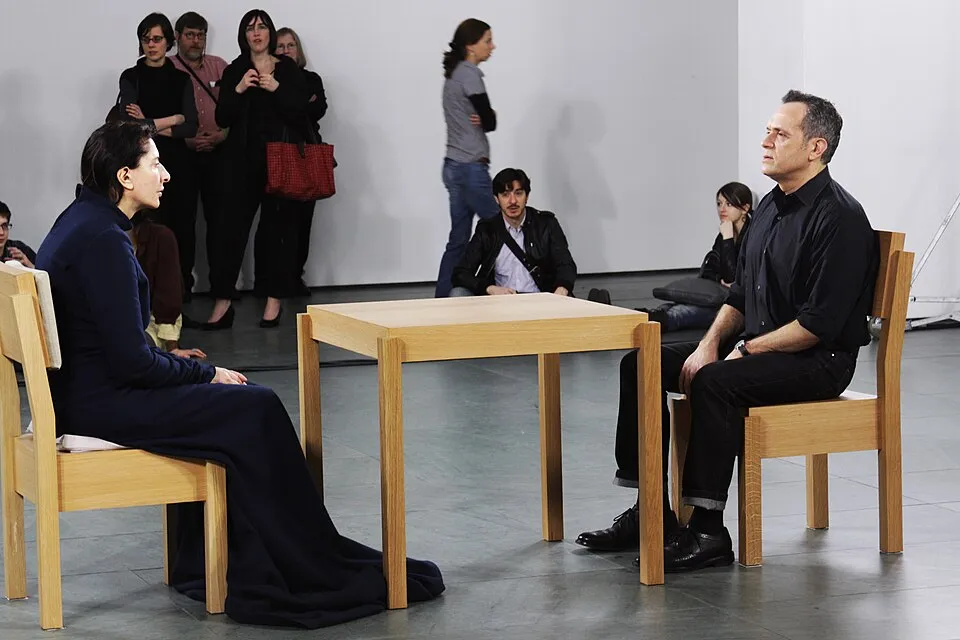
Marina Abramović, "The Artist Is Present" (2010). Performance, Museum of Modern Art, New York, March 9 to May 31, 2010. Photo by Bryan Russeth. Image via Wikimedia Commons
Abramović's early performances were more violent. "Rhythm 0" (1974) placed 72 objects (including a knife, a whip, and a loaded gun) on a table and invited the audience to use them on her body. "Rhythm 5" (1974) involved lying inside a burning five-pointed star until she lost consciousness. The early work tested the body's limits: pain, danger, and the relationship between artist and audience. In 1980, Abramović and her partner Ulay spent five months in the Australian outback, living among Aboriginal communities. The experience transformed her work. "Transforming her art practice from one of confrontational body art to a mental art of empathy." The shift from confrontation to empathy, from the body in pain to the body in presence, is the arc of Abramović's career. Abramović's work is not body painting. It is body art. The body is not painted but performed. The art is not on the body. It is the body, in space, in time, in relation to another body. The significance is that Abramović made the body a museum subject. She brought the body, as medium and as artwork, into the institution that had previously displayed only objects. For more on where this kind of work sits in the current scene, see our guide on contemporary art in 2026.
Rebecca Horn and ORLAN: The Body as Sculpture
Rebecca Horn (b. 1944, Germany) uses body extensions, prosthetic devices attached to the body that transform it into a sculptural object. "Unicorn" (1970-1971) is a white horn worn on the head, transforming the body into a mythical creature. "Finger Gloves" (1972) are long, finger-extending gloves that make the hands into tools. The body is not painted. It is extended, modified, and reimagined. ORLAN (b. 1947, France) uses surgery as art. Between 1990 and 1993, she underwent a series of plastic surgeries, performed as performances, broadcast live to galleries, in which her face was altered according to features from classical paintings (the chin of Botticelli's Venus, the nose of Gérard's Psyche). The surgeries were not for beauty. They were a critique of beauty standards and the medicalization of the female body. ORLAN's body is both the artwork and the artist. She is the sculptor and the sculpture.
Horn and ORLAN extend body art beyond painting and performance into sculpture and surgery. The body is not a surface for image. It is a material for transformation. The body can be extended (Horn), modified (ORLAN), or simply present (Abramović). The common thread is that the body is the medium, not a surface for art but the art itself. For the feminist context of this work, read our guide on feminist art theory.
Body Painting in 2026
Aboriginal body painting, henna, and African body painting continue as living traditions, not as museum pieces but as practices embedded in daily life, ceremony, and identity. The continuation is not automatic. It requires the transmission of knowledge from elders to the next generation, and it requires the survival of the communities in which the practices are embedded. The threat is not just cultural appropriation but cultural destruction, the loss of land, language, and ceremony that makes the body painting meaningful.
Body painting in the contemporary art world has moved beyond paint. Abramović uses presence. Horn uses extension. ORLAN uses surgery. The body is the medium, but the medium is not paint. The question is: what can the body do? It can sit, it can speak, it can bleed, it can be cut, it can be present. The body in contemporary art is not a canvas. It is a subject, an instrument, and a site of political action. The line between cultural tradition and contemporary art is not clear. Aboriginal artists like Emily Kame Kngwarreye and Minnie Pwerle translated body paint designs onto canvas, and the canvases are in museums. The translation is not a betrayal. It is a survival strategy. The body paint is ephemeral. The canvas is permanent. The canvas ensures that the designs survive, even when the ceremonies do not. But the canvas is not the ceremony. It is a record, a trace, a memory. The body painting is the art. The canvas is the archive. For a related art form that also uses the body as canvas, read our guide on tattoo as art, and for the broader question of how the body has been represented in art, see our guide on the nude in art.
Final Thoughts
Body painting is the oldest and most ephemeral art form. Aboriginal Australian body painting, at least 60,000 years old, uses ochre to transform the body into an ancestral being, "not symbolic theatre, but a cultural transformation that activates law, story, and responsibility." Henna (mehndi), 5,000 years old, is a temporary art that meditates on transience. The beauty lasts 1-3 weeks and then fades. African body painting (Himba, Wodaabe, Surma) is a cultural practice of identity, status, and beauty governed by tradition. In contemporary art, Marina Abramović made the body a museum subject. "The Artist Is Present" (2010) was a demonstration of presence, not painting. Rebecca Horn extended the body with prosthetic devices. ORLAN used surgery to critique beauty standards. The common thread is that the body is the medium, not a surface for art but the art itself.
My view is that body painting is not decoration. It is transformation. The impermanence of body painting is not a limitation but the meaning: the art lives on the body, and the body is temporary. The crossover between cultural tradition and contemporary art is not appropriation but survival. The canvas is the archive of a practice that is, by nature, ephemeral. For help training your eye to see art in all its forms, read our guide on how to look at art.
Next time you see body painting, in a museum, at a festival, or in a photograph, do not see it as decoration. See it as the oldest art form in the world: a transformation of the body into art, meaning, and identity. The paint will be washed off. The body will remain. And the tradition, if it is respected, protected, and transmitted, will continue.


