
In September 1991, two German hikers found a body in the Alps, near the Austrian-Italian border. The body was frozen in ice at 3,210 meters. It was initially thought to be a modern climber who had died in an accident. It was not. It was Ötzi the Iceman, a natural mummy dating to approximately 3300 BCE, over 5,000 years old. And Ötzi had tattoos. Scientists identified 61 tattoos on his body, carbon-ink marks in 19 groups of parallel lines and crosses, located on his lower back, joints, and legs. The tattoos correspond to acupuncture points. They may have been a form of medical treatment for joint pain and arthritis. Ötzi is the oldest known tattooed human body, and his tattoos are not decorative. They are therapeutic. The history of tattoo is 5,000 years old, and it begins not with art but with medicine. But tattooing has always been more than medicine. In Polynesia, tattooing is a visual language that encodes ancestry, rank, and spiritual status. In Japan, irezumi is a 500-year tradition of full-body tattooing with mythological imagery. In Māori culture, ta moko is a facial tattoo that records genealogy. No two faces are the same. Tattoo is the oldest art form in the world, older than painting, older than sculpture, older than architecture, and it is the most personal, because the canvas is the body.
Tattoo has been practiced on every continent and in every culture. The oldest evidence is Ötzi (c. 3300 BCE). Clay figurines with tattooed faces from Japan date to 5000 BCE. Egyptian mummies with tattoos date to 2000 BCE. The word "tattoo" comes from the Polynesian "tatau," "to mark," and was brought to Europe by Captain James Cook's crew after their voyage to Tahiti in 1769. This guide covers the history of tattoo as art: ancient tattooing (Ötzi, Egypt, Japan), Polynesian and Māori tattoo, Japanese irezumi, the Western encounter (Cook, sailors, circus), the stigma and criminalization of tattoo, the fine art crossover (contemporary tattoo artists, museum exhibitions), and what tattoo means as art in 2026.
Ancient Tattooing: Ötzi, Egypt, and Japan
Ötzi the Iceman (c. 3300 BCE) had 61 carbon-ink tattoos in 19 groups, located on joints and along the spine. The tattoos correspond to acupuncture points. The hypothesis is that they were therapeutic, not decorative. The ink was made from soot (carbon), the same material used in the earliest cave paintings. Egypt provides the next evidence. Tattooed mummies date to c. 2000 BCE. The most famous is Amunet, a priestess of Hathor (c. 2134-1991 BCE), with parallel lines on her abdomen, thighs, and arms. Egyptian tattoos were associated with fertility and protection. The markings were believed to have apotropaic power, the power to ward off evil. Japan offers the earliest evidence of tattooing in the form of clay figurines with tattooed faces (dogū figurines) dating to 5000 BCE. The figurines have markings on the face, arms, and body that may represent tattoos, scarification, or body paint.
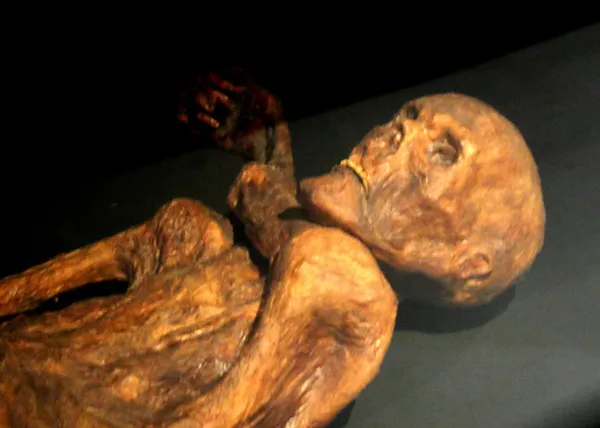
Ötzi the Iceman reconstruction. The mummy has 61 carbon-ink tattoos in 19 groups, dating to c. 3300 BCE. South Tyrol Museum of Archaeology. Photo by Thilo Parg. Image via Wikimedia Commons
Tattoo is the oldest art form. It predates painting (Chauvet cave, c. 32,000 BCE, is older, but tattoo and painting are contemporaneous, both use carbon-based pigment). Tattoo is also the most intimate art form. The canvas is the body, and the artwork lives and dies with the body. There is no museum for ancient tattoos. They are destroyed when the body is destroyed. The only surviving ancient tattoos are on mummies, preserved by accident. For more on the carbon pigment that connects tattoo to cave painting, read our guide on the history of black.
Polynesian and Māori Tattoo: Tatau and Ta Moko
The word "tattoo" comes from the Polynesian "tatau." Polynesian tattooing is among the most sophisticated in the ancient world, a complex visual language that encodes ancestry, rank, and spiritual status. Samoan tattoo masters (tufuga) used hand-tapping methods, striking a comb of bone or teeth into the skin with a mallet, to create bold, symmetrical patterns covering large portions of the body, particularly from waist to knees (the pe'a for men, the malu for women). The process is painful and long. A full pe'a can take months, and it is a mark of manhood and endurance. The man who flinches brings shame on his family.
The Māori of New Zealand developed the most sophisticated facial tattoo in the world. Ta moko is not "tattooing" in the Western sense. It is a carving of the skin, using chisels (uhi) to cut grooves into the face and rub pigment into the cuts. The result is a textured, raised pattern, not a flat image but a sculpture on the skin. Each moko is unique. It records the wearer's genealogy, rank, and personal history. "The head was considered the most important part of the body, with the face embellished by incredibly elaborate tattoos or 'moko,' which were regarded as marks of high status." Polynesian and Māori tattoo is not decoration. It is identity. The patterns are inherited through family lines and cannot be freely chosen. The authority to wear particular patterns is earned, taught, and regulated by cultural law. The tattoo is a public record of who you are, where you come from, and what you have achieved. Removing a moko is a form of cultural erasure. It is the destruction of a person's identity.
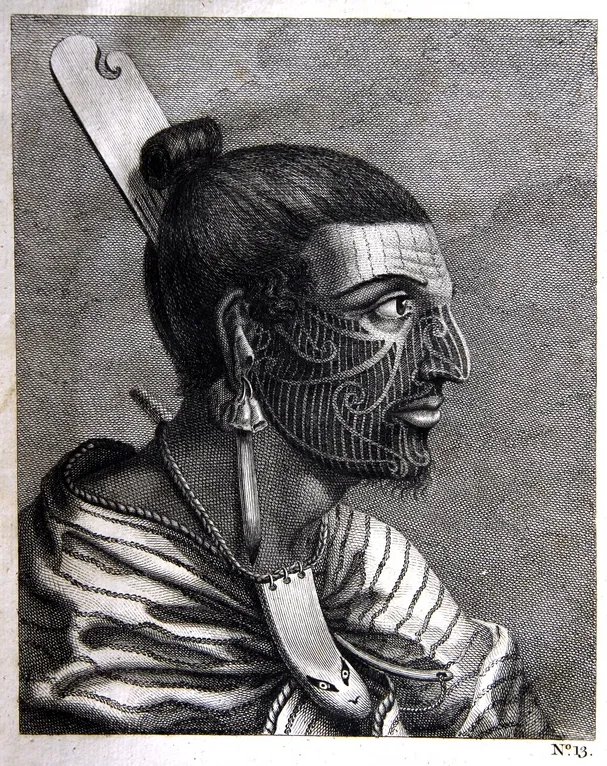
Māori chief with traditional ta moko facial tattoo. The patterns record genealogy, rank, and personal history. Photo by George French Angas, 1847. Image via Wikimedia Commons
European missionaries banned tattooing in Polynesia and New Zealand in the 19th century, seeing it as a "savage" practice. The ban nearly destroyed the tradition. In the late 20th century, Polynesian and Māori tattoo was revived, and the revival is one of the most important cultural movements in the Pacific. For more on how different cultures read visual symbols differently, read our guide on color and culture. The Smithsonian Magazine published a useful overview of the worldwide history of tattoos.
Japanese Irezumi: The Art of the Floating World
Japanese tattooing (irezumi) developed during the Edo period (1603-1868). The earliest tattoos were punitive. Criminals were marked on the face or arm as a form of punishment. But by the early 19th century, irezumi had become an art form, large-scale, full-body tattoos with mythological and natural imagery: dragons, koi fish, tigers, cherry blossoms, waves, and demons (oni). Japanese tattooing uses hand-poking (tebori), a needle or group of needles attached to a bamboo rod, pushed into the skin by hand. The technique is slow. A full-body tattoo can take years. The result is a depth and richness of color that machine tattooing cannot match.
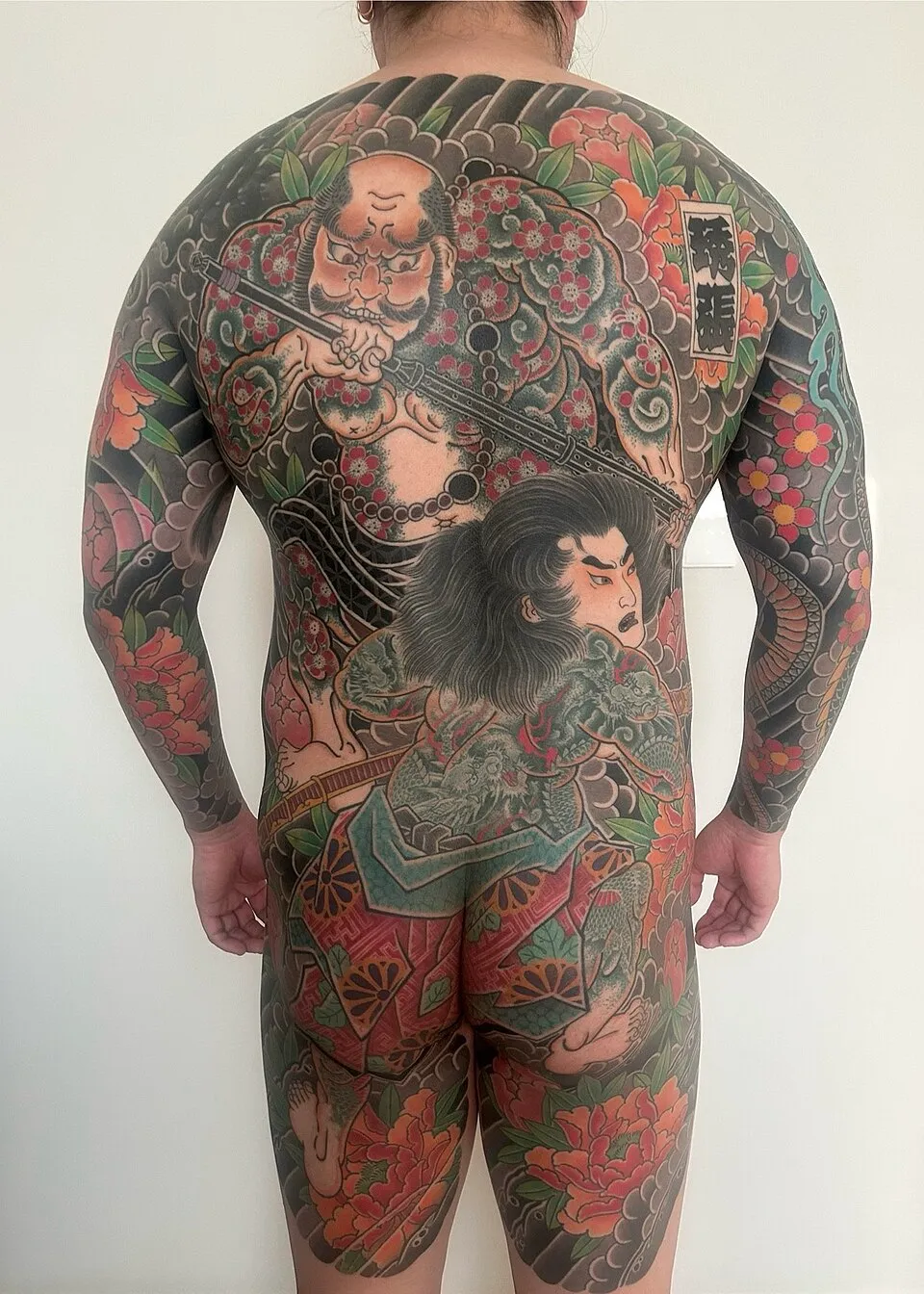
Japanese woodblock print showing irezumi tattoo designs. The Japanese tattoo tradition dates to the Edo period (1603-1868). Image via Wikimedia Commons
Irezumi draws on the same imagery as ukiyo-e (woodblock prints), the "floating world" of the Edo period. The designs are narrative. They tell stories from Japanese mythology, folklore, and literature. A dragon represents wisdom and protection. A koi fish represents perseverance. A cherry blossom represents the transience of life. The body becomes a scroll, a painted narrative that wraps around the torso, arms, and legs. In Japan, tattooing has been associated with criminality since the Edo period. The yakuza (Japanese organized crime) adopted irezumi as a mark of loyalty and endurance. A full-body tattoo is a demonstration of pain tolerance and commitment. The association with the yakuza has made tattooing stigmatized in Japan. Public baths (onsen), gyms, and beaches often ban tattooed people. The stigma persists in 2026, despite the global acceptance of tattoo as art. For more on how art encodes social structures, read our guide on art and society.
The Western Encounter: Cook, Sailors, and the Circus
The word "tattoo" entered the English language in 1769, when Cook's crew returned from Tahiti with the Polynesian word "tatau." Cook's naturalist, Sir Joseph Banks, described the tattooing process in detail and had several sailors tattooed during the voyage. In the 18th and 19th centuries, tattooing spread through the European and American navies. Sailors acquired tattoos as souvenirs of their travels: a turtle for crossing the equator, an anchor for crossing the Atlantic, a swallow for every 5,000 nautical miles sailed. By the late 19th century, tattooing was associated with sailors, soldiers, and the working class.
In the late 19th and early 20th centuries, tattooed people were exhibited in circuses and sideshows. "The Tattooed Lady" was a standard attraction. The exhibition of tattooed people as "freaks" reinforced the stigma. Tattooing was associated with the exotic, the primitive, and the abnormal. The Western encounter with tattooing transformed it from a cultural practice into a commodity. Polynesian tattooing, which had been a sacred art form, was reduced to a souvenir, a decoration for sailors. The transformation is a colonial story: the colonizer takes the art of the colonized, strips it of its cultural meaning, and turns it into entertainment.
The Fine Art Crossover: Tattoo in Museums
In the late 20th and early 21st centuries, tattoo crossed from the margins to the museum. The turning point was the 2015 exhibition "Tattoo" at the Musée du Quai Branly in Paris, which presented tattooing as a global art form with a 5,000-year history. The exhibition traveled to the Field Museum in Chicago and the Royal Ontario Museum in Toronto. Contemporary tattoo artists like Horiyoshi III (Japan, b. 1946), Leo Zulueta (USA, b. 1952, pioneer of modern tribal tattoo), and Filip Leu (Switzerland, b. 1967) are recognized as masters of their art. Horiyoshi III was awarded the Japanese Order of the Rising Sun in 2010, the first tattoo artist to receive a national honor. Their work is collected, exhibited, and studied as art.
The fine art crossover raises a question: if tattoo is art, where is the artwork? The artwork is on the body. It cannot be separated from the person who wears it. It cannot be sold, hung on a wall, or placed in a museum (unless the person is in the museum). Tattoo challenges the fundamental assumption of Western art, that the artwork is an object separate from the artist. In tattoo, the artwork is the body, and the body is the artwork. The fine art crossover is not just a recognition of tattoo as art. It is a challenge to the Western category of "art" itself. If a tattoo is art, then the body is a canvas, the needle is a brush, and the skin is a surface. But the body is not a canvas. It is a person. The tattoo is not just an image. It is a mark on a living body, and it will be destroyed when the body is destroyed. Tattoo is the most ephemeral and the most permanent art form: ephemeral because it dies with the body, permanent because it cannot be removed without destroying the skin. DailyArt Magazine published a useful overview of the history and culture of tattoos. For more on where this kind of work sits in the current scene, see our guide on contemporary art in 2026.
Tattoo in 2026
Tattoo is now mainstream. Approximately 30% of adults in the US and UK have at least one tattoo. The stigma has largely disappeared in the West, though it persists in Japan and in some professional contexts. The global tattoo industry is worth an estimated $3 billion. The cultural appropriation debate is live. The appropriation of Polynesian, Māori, and Japanese tattoo designs by Western tattooers and wearers is a subject of ongoing discussion. Is it cultural appropriation for a non-Māori person to wear a moko-inspired design? The answer depends on whether the design carries cultural meaning (it does) and whether the wearer understands and respects that meaning (often they do not). The debate is not about whether tattoo should cross cultural boundaries. It has always crossed boundaries. The debate is about whether the crossing is respectful or exploitative.
The future of tattoo is not in the museum. It is on the body. The museum can exhibit photographs of tattoos, tools of tattooing, and historical artifacts, but the tattoo itself is on the skin, and the skin is not in the museum. Tattoo is the art form that refuses to be institutionalized. It lives on the body, and it dies with the body. That is its power and its limitation. For a related art form that also uses the body as canvas, read our guide on body painting, and for the broader question of how the body has been represented in art, see our guide on the nude in art.
Final Thoughts
Tattoo is the oldest art form in the world, 5,000 years old, practiced on every continent. Ötzi the Iceman (c. 3300 BCE) had 61 therapeutic tattoos. Egyptian mummies (c. 2000 BCE) had tattoos of fertility and protection. Japanese dogū figurines (5000 BCE) show tattooed faces. Polynesian tatau is a visual language of ancestry and rank. Māori ta moko is a facial carving that records genealogy. No two faces are the same. Japanese irezumi is a 500-year tradition of full-body narrative tattooing. The Western encounter (Cook, 1769) transformed tattoo from cultural practice to sailor's souvenir to circus attraction. The fine art crossover (Quai Branly, 2015) brought tattoo into the museum, but tattoo resists institutionalization because the artwork is the body, and the body is not in the museum.
My view is that tattoo is the most personal art form because the canvas is the self. The fine art crossover is not just a recognition of tattoo as art but a challenge to the Western category of "art" itself. The cultural appropriation of Polynesian, Māori, and Japanese designs is a real issue. The crossing of cultural boundaries must be respectful, not exploitative. You can read more about the history on Wikipedia's history of tattooing. For help training your eye to see art in all its forms, read our guide on how to look at art.
Next time you see a tattoo, on a stranger, a friend, or yourself, do not see it as decoration. See it as the oldest art form in the world: a mark on the body that carries 5,000 years of history, culture, and meaning. The tattoo is not on the body. It is the body, marked and made into art.


