
"In 1971 a group of Aboriginal artists from the government settlement at Papunya began painting traditional designs using acrylic paints and small boards. This was the beginning of the Western Desert art movement that has become one of Australia's most recognisable art forms and which led to the formation of the first Aboriginal arts business, Papunya Tula Artists cooperative, in 1972" (National Museum of Australia). "The Papunya Tula Artists cooperative was Australia's first Aboriginal arts company and foreshadowed the federal government shifting its Indigenous policies from assimilation to self-determination" (NMA). In 2025, Tate Modern in London staged its own Emily Kam Kngwarray retrospective. The exhibition is on view until 11 January 2026. "How Tate's Emily Kam Kngwarray show is revealing the fraught market dynamics of Aboriginal art" (The Art Newspaper, October 2, 2025). The story of Aboriginal art in contemporary galleries is a story of extraordinary artistic achievement, and of controversy. "After three years, investigations and now a $4.4m lawsuit" (The Guardian, April 11, 2026): the NGA's cancelled "Ngura Pulka" exhibition and the lawsuit that followed have exposed the fractures in the Aboriginal art market. Aboriginal art is one of the most significant contemporary art movements of the past 50 years. It is also one of the most exploited, faked, and contested.
Aboriginal art has been in Australian museums for decades, but its presence in international contemporary galleries is relatively recent. The Papunya Tula movement (1971) is the starting point, but Aboriginal art traditions are tens of thousands of years old, the oldest continuous artistic tradition on Earth. The tension between this heritage and the contemporary art market is at the heart of the controversy. This guide covers Aboriginal art in contemporary galleries through the Papunya Tula movement (1971, Geoffrey Bardon, the school wall mural, the cooperative), Emily Kame Kngwarreye (c. 1910-1996, the Tate Modern retrospective 2025-26), Albert Namatjira and the Hermannsburg School, the controversy (fakes, the $4.4m lawsuit, the NGA's cancelled "Ngura Pulka" exhibition), the market dynamics, and why this matters.
Emily Kame Kngwarreye (c. 1910-1996). "Visual elements related to The Dreaming were important parts of the Desert Art Movement at Papunya Tula, where Kngwarreye first began to develop her skills as a painter" (Wikipedia). "Possibly the finest abstract art achievements to date in Australia" (James Mollison, NGA director, 1984, via Art Bulletin). Image via Wikimedia Commons.
Papunya Tula: The Western Desert Art Movement (1971)
In the late 1960s some men in Papunya began creating artwork in the Hermannsburg style. In 1971 Bardon arrived in the town. He became interested in the sinuous patterns his students would draw in the playground sand and realised they had deep societal meaning. He proposed creating a public mural for the local school using these images. The children were reluctant to participate, but eventually a group of elders met Bardon and presented him with a design, based on the honey ant dreaming, that they approved for the project.
The movement grew as more men became interested in painting and in October 1971 they formed the Papunya Artists cooperative within the Papunya School. The name Papunya Tula was born at a gathering of painters at Charley Creek near Alice Springs in June 1972. Bardon asked the men "What do you want to call the company?" The Pintupi man Charlie Tarawa (Tjaruru) immediately said, "Papunya Tula," which is the name of a hill outside the town that means "a meeting place for all brothers and cousins." The company is entirely owned and directed by traditional Aboriginal people from the Western Desert, predominantly of the Luritja/Pintupi language groups. It has 49 shareholders and now represents around 120 artists.
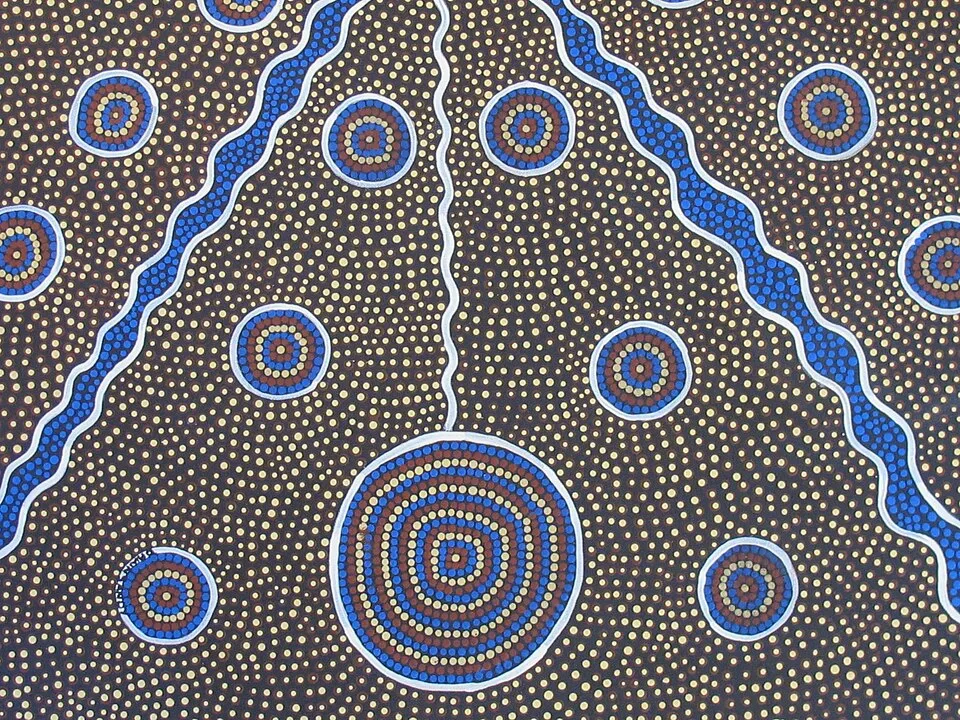
Papunya Tula painting. "In 1971 a group of Aboriginal artists from the government settlement at Papunya began painting traditional designs using acrylic paints and small boards. This was the beginning of the Western Desert art movement" (National Museum of Australia). "The Papunya Tula Artists cooperative was Australia's first Aboriginal arts company" (NMA). Image via Wikimedia Commons.
Papunya Tula Artists was the first Aboriginal-owned collective dedicated to the production of works for a commercial market, establishing a new model for the many art centres that were to follow. It was only a couple years after Bardon's initial interaction with the Papunya community that the Whitlam Government created the Aboriginal Arts Board (1974). Recently a group of curators and scholars have questioned this emphasis, arguing that it was instead Anmatyerr men from the east and north who made the first Western Desert paintings. Bardon's narrative dominates Papunya art history, overshadowing the contributions of Aboriginal artists. For the wider movement context, see our complete guide to art movements.
Emily Kame Kngwarreye: The Greatest Aboriginal Painter
Emily Kame Kngwarreye (c. 1910-1996) began painting in her late 70s at Papunya Tula. Visual elements related to The Dreaming were important parts of the Desert Art Movement at Papunya Tula, where Kngwarreye first began to develop her skills as a painter. Formed by community elders in 1971 with the support of Geoffrey Bardon, the school encouraged artists to develop their own ideas. She produced thousands of paintings in the last years of her life. The Papunya paintings were "possibly the finest abstract art achievements to date in Australia" (James Mollison, director of the National Gallery of Australia, 1984, via Art Bulletin). This assessment applies to Kngwarreye's work as much as to the early Papunya boards.
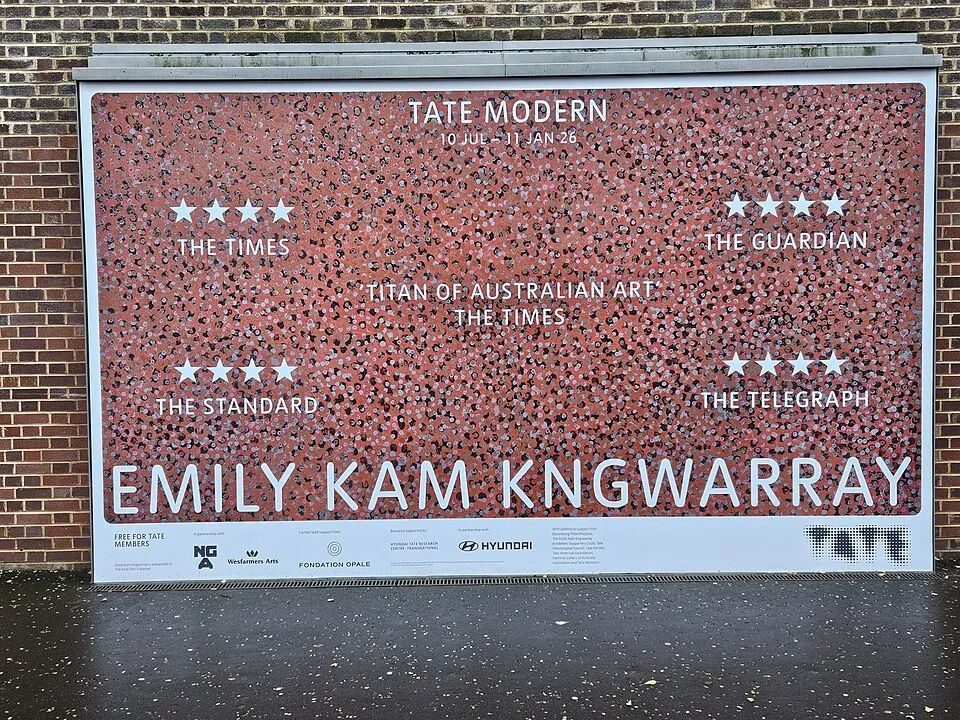
In 2025 London's Tate Modern staged its own Emily Kam Kngwarray retrospective. "Emily Kam Kngwarray, Tate Modern, London, until 11 January 2026" (The Art Newspaper). The exhibition is the first retrospective of an Aboriginal Australian artist at Tate Modern, a landmark in the international recognition of Aboriginal art. The name change is its own story. "Art world split over NGA name change for one of Australia's greatest female painters" (The Guardian, December 23, 2023). The National Gallery of Australia changed the spelling of Kngwarreye's name to "Kam Kngwarray," a decision that reflects the complexity of Aboriginal naming conventions and the politics of cultural representation. In publicity material already released, the museum is using the new NGA-approved spelling of the artist's name. Elsewhere on the Tate's website it continues to refer to her as Emily Kame Kngwarreye. For more on the works that anchor this history, see our guide to famous paintings explained.
Albert Namatjira and the Hermannsburg School
Albert Namatjira (1902-1959) was an Arrernte artist from the Hermannsburg community in the Northern Territory. He learned watercolor painting from Australian artist Rex Battarbee in the 1930s and adapted the European watercolor tradition to depict the Central Australian landscape. Namatjira was the first Aboriginal artist to achieve national and international recognition. His watercolors of the Central Australian landscape, the MacDonnell Ranges, the ghost gums, the red earth, are both European in technique and Aboriginal in their relationship to Country. He was the first Aboriginal person to be granted Australian citizenship (1957), a status that was not extended to most Aboriginal people until 1967.
The watercolor tradition established by Namatjira was continued by his family and community. In the late 1960s some men in Papunya began creating artwork in the Hermannsburg style, connecting the Hermannsburg School to the Papunya Tula movement. For how to read the work itself, see our guide on how to look at art.
The Controversy: Fakes, Exploitation, and the $4.4m Lawsuit
With regard to the recent work the Indigenous Art Code and Arts Law have done against the proliferation of fake "dot art" and souvenirs (ArtsHub). The Aboriginal art market has been plagued by fakes, mass-produced imitations sold as authentic Aboriginal art, undermining the market for genuine work and exploiting cultural heritage. After three years, investigations and now a $4.4m lawsuit (The Guardian, April 11, 2026): the National Gallery of Australia's cancelled "Ngura Pulka" exhibition and the lawsuit that followed. The exhibition, which was to feature works from the APY Lands, was cancelled amid questions about the authenticity and provenance of the works. The lawsuit has exposed the fractures in the Aboriginal art market, the tension between community, commerce, and authenticity.
Emily Kam Kngwarray exhibition, Tate Modern, London. "Installation view of the Emily Kam Kngwarray exhibition at Tate Modern, London, on show until 11 January 2026" (The Art Newspaper). "In 2025 London's Tate Modern will stage its own Emily Kam Kngwarray retrospective" (The Guardian). Image via Wikimedia Commons.
How Tate's Emily Kam Kngwarray show is revealing the fraught market dynamics of Aboriginal art (The Art Newspaper, October 2, 2025). The Tate retrospective has brought international attention to Aboriginal art, but it has also revealed the market's problems: the exploitation of artists, the proliferation of fakes, the tension between community ownership and individual authorship, and the complex politics of cultural representation. The controversy is not a flaw in Aboriginal art. It is a consequence of bringing a tradition rooted in Country and ceremony into a contemporary market that was not designed for it. Aboriginal art is communal, ceremonial, and rooted in Country. The art market is individual, commercial, and rootless. The friction between these two systems is the source of both the art's power and its problems. For the social framework behind this, see our piece on art and society.
Why This Matters
Aboriginal art is one of the most significant contemporary art movements of the past 50 years. The Papunya Tula movement (1971) produced "possibly the finest abstract art achievements to date in Australia" (James Mollison, 1984). Kngwarreye's work has been exhibited at Tate Modern, the first Aboriginal Australian artist to receive a retrospective there. Aboriginal art is not just art. It is an assertion of sovereignty, of the right to represent Country, to tell stories, to make art from a tradition that is tens of thousands of years old. "The Papunya Tula Artists cooperative was Australia's first Aboriginal arts company and foreshadowed the federal government shifting its Indigenous policies from assimilation to self-determination" (NMA). The art and the politics are inseparable.
The challenge is to bring Aboriginal art into contemporary galleries without destroying what makes it Aboriginal: the connection to Country, the communal ownership, the ceremonial roots. The controversy is not a reason to exclude Aboriginal art from galleries. It is a reason to change how galleries work, to accommodate a tradition that does not fit the Western model of individual authorship, commercial production, and market exchange. If you are new to this material, start with our guide on art for beginners, and for a structured approach, see our guide on how to teach yourself art history.
Final Thoughts
"In 1971 a group of Aboriginal artists from the government settlement at Papunya began painting traditional designs using acrylic paints and small boards. This was the beginning of the Western Desert art movement" (NMA). "The Papunya Tula Artists cooperative was Australia's first Aboriginal arts company" (NMA). "The company is entirely owned and directed by traditional Aboriginal people from the Western Desert, predominantly of the Luritja/Pintupi language groups. It has 49 shareholders and now represents around 120 artists" (Papunya Tula Artists). Geoffrey Bardon arrived in 1971, "became interested in the sinuous patterns his students would draw in the playground sand," and "proposed creating a public mural for the local school." "The name Papunya Tula was born at a gathering of painters at Charley Creek near Alice Springs in June 1972" (NMA). "Papunya Tula Artists was the first Aboriginal-owned collective dedicated to the production of works for a commercial market" (ArtsHub). "Recently a group of curators and scholars have questioned this emphasis, arguing that it was instead Anmatyerr men from the east and north who made the first Western Desert paintings" (Art Bulletin). Emily Kame Kngwarreye (c. 1910-1996) "began to develop her skills as a painter" at Papunya Tula (Wikipedia). "Possibly the finest abstract art achievements to date in Australia" (James Mollison, 1984). "In 2025 London's Tate Modern will stage its own Emily Kam Kngwarray retrospective" (The Guardian). "Emily Kam Kngwarray, Tate Modern, London, until 11 January 2026" (The Art Newspaper). "Art world split over NGA name change" (The Guardian, December 23, 2023). "How Tate's Emily Kam Kngwarray show is revealing the fraught market dynamics of Aboriginal art" (The Art Newspaper, October 2, 2025). "After three years, investigations and now a $4.4m lawsuit" (The Guardian, April 11, 2026). Albert Namatjira (1902-1959) was "the first Aboriginal artist to achieve national and international recognition." "The proliferation of fake 'dot art' and souvenirs" (ArtsHub). The controversy is not a flaw. It is a consequence of bringing a tradition rooted in Country into a contemporary market that was not designed for it.
Go to Tate Modern before January 11, 2026. The Emily Kam Kngwarray retrospective is the first retrospective of an Aboriginal Australian artist at the museum. Look at the paintings, the "Earth's Creation" series, the "Alhalkere" works, the late minimalist paintings. Then go to the National Gallery of Australia in Canberra, which holds the world's largest collection of Aboriginal art. Then go to Papunya Tula's website (papunyatula.com.au). The cooperative is still operating, still owned and directed by traditional Aboriginal people. Buy directly from the cooperative, not from tourist shops. The fakes are everywhere. The real work is made by the artists, in the desert, on Country. "The Papunya Tula painting style derives directly from the artists' knowledge of traditional body and sand painting associated with ceremony" (Papunya Tula Artists). It is the oldest continuous artistic tradition on Earth, made contemporary. It deserves to be seen, and it deserves to be seen honestly. For reference, read the NMA's Papunya Tula page, the Guardian on the NGA name change, and the Art Newspaper on the fraught market dynamics. For where this tradition sits now, see our guide to contemporary art trends.


