
Melbourne-based artist Richard Lewer has won the Archibald Prize 2026 and $100,000 for his portrait of Pitjantjatjara Elder, senior artist and ngangkari (traditional healer) Iluwanti Ken. Lewer's work was selected from 1,034 entries for the Archibald Prize in 2026 and is one of 59 finalist works on display at the Art Gallery of New South Wales, according to AGNSW. The portrait was painted following time spent on Country with Ken in the Aṉangu Pitjantjatjara Yankunytjatjara (APY) Lands of South Australia, where she lives and works. Board president Michael Rose said: "All the trustees were immediately drawn to Richard Lewer's portrait of Iluwanti Ken. It's a powerful and energetic portrait by an accomplished artist and has captured the energy of another artist that he admires and respects greatly. You can sense that admiration in the work." Accepting the award, Lewer said he was "chuffed to be here" and that winning the Archibald "means everything to me." The Archibald Prize is "Australia's most prestigious art prize," per Wikipedia. Established in 1921, it has been awarded annually for 105 years, with two exceptions, for "the best portrait, preferentially of some man or woman distinguished in Art, Letters, Science or Politics, painted by any artist resident in Australasia." The prize money has been AU$100,000 since July 2015. The Archibald, Wynne, and Sulman Prizes 2026 exhibition runs 9 May to 16 August at the Art Gallery of New South Wales.
The Archibald Prize is to Australia what the Turner Prize is to Britain: an annual cultural event that puts art into the public sphere. But where the Turner Prize celebrates contemporary art in all media, the Archibald celebrates a single, ancient form. The painted portrait. In an era of photography and digital media, the Archibald insists that painting still matters. This guide covers what the Archibald Prize is and how it works, the 2026 winner Richard Lewer for Iluwanti Ken and the 2025 winner Julie Fragar for Justene Williams, the history of controversy from Dobell in 1943 to Bloomfield in 1975, notable winners from William Dargie's eight wins to Nora Heysen as first woman, the People's Choice Award, the Wynne and Sulman Prizes, and why the Archibald matters. For more on what is current, see our guide to contemporary art trends.
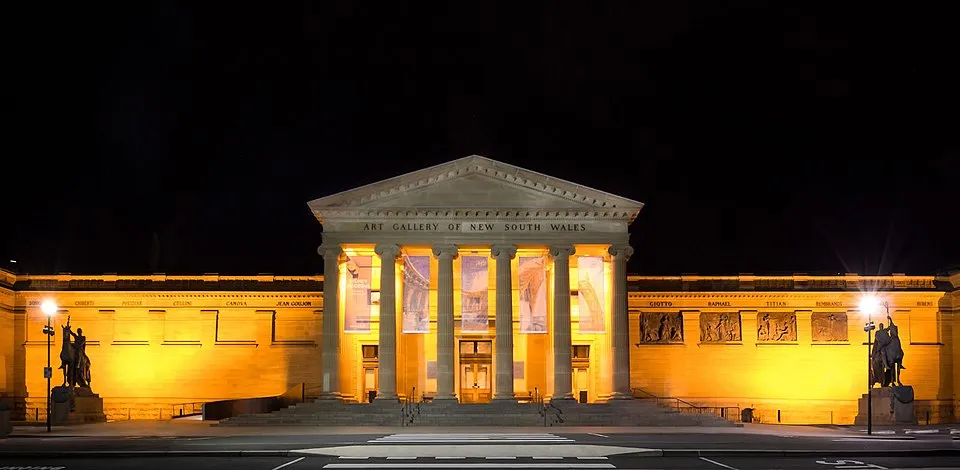
Art Gallery of New South Wales, Sydney. The Archibald Prize has been administered by the AGNSW trustees since 1921. "The winners of the Archibald Prize and the Wynne Prize are decided by the Art Gallery's Board of Trustees" (AGNSW). Image via Wikimedia Commons
What the Archibald Prize Is and How It Works
Established in 1921, the Archibald Prize is Australia's most prestigious art prize and is awarded annually to the best portrait, "preferentially of some man or woman distinguished in art, letters, science or politics, painted by any artist resident in Australasia." The prize money has been AU$100,000 since July 2015. It was first awarded in 1921 after the receipt of a bequest from J. F. Archibald, the editor of The Bulletin who died in 1919. J.F. Archibald (1856-1919) was a journalist and editor who shaped Australian cultural life through The Bulletin magazine.
The winners of the Archibald Prize and the Wynne Prize are decided by the Art Gallery's Board of Trustees. The Sulman Prize is judged by a guest artist. In 2026, two-time Archibald winner Del Kathryn Barton judged the Sulman. All finalists in the Archibald, Wynne, and Sulman Prizes 2026 were exhibited at the Art Gallery from 9 May to 16 August 2026. Following the exhibition at the Art Gallery, the Archibald Prize 2026 finalist works tour to six venues across New South Wales and Victoria. The scale is considerable: 1,034 entries in 2026, 59 finalists. The Archibald is the next richest portrait prize in Australia after the Doug Moran National Portrait Prize.
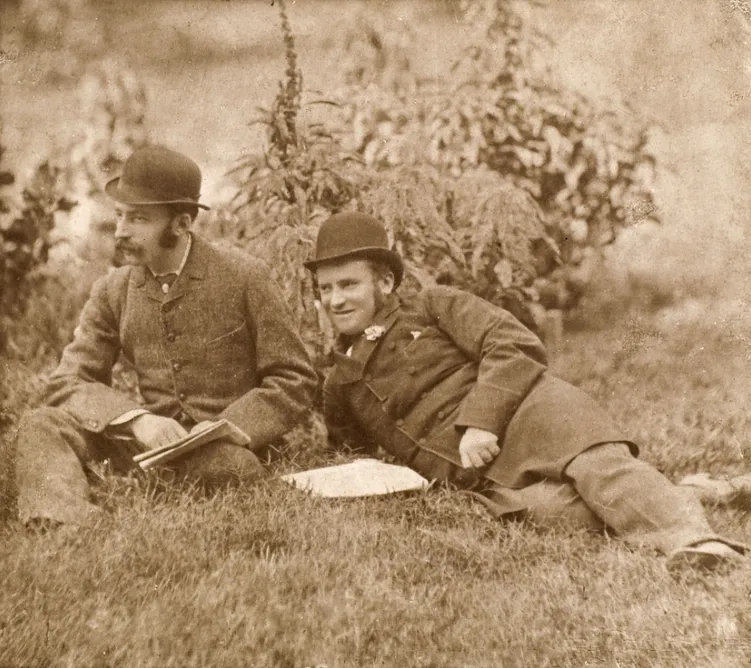
J.F. Archibald (1856-1919), editor of The Bulletin, whose bequest established the prize. The Archibald Prize has been "Australia's most prestigious art prize" since 1921, "awarded annually to the best portrait, 'preferentially of some man or woman distinguished in art, letters, science or politics, painted by any artist resident in Australasia'" (AGNSW). Image via Wikimedia Commons
The 2026 Winner: Richard Lewer and Iluwanti Ken
Melbourne-based artist Richard Lewer won the Archibald Prize 2026 and $100,000 for his portrait of Pitjantjatjara Elder, senior artist and ngangkari (traditional healer) Iluwanti Ken. The work is a portrait that speaks powerfully to presence and cultural responsibility, painted by Lewer following time spent on Country with Ken in the Aṉangu Pitjantjatjara Yankunytjatjara (APY) Lands of South Australia. Iluwanti Ken is a senior artist and ngangkari who works at Tjala Arts in the APY Lands. She is also a finalist in this year's Wynne Prize, making her both a subject and a finalist in the same year.
Lewer's portrait of Ken becomes the fifth painting of a First Nations person to win the Archibald in its 105-year history, joining portraits of artist Karla Dickens, AFL player Adam Goodes, musician Gurrumul, and actor David Gulpilil, according to ABC News. Born in Aotearoa New Zealand in 1970, Lewer has lived and worked in Melbourne since 1996. He is a painter, draughtsman, printmaker, sculptor, and video artist, whose work presents an unsparing vision of the human condition. He has been a multiple-time finalist in the Archibald in 2026, 2025, 2022, 2021, 2020, and 2017. A six-time finalist who finally won. Lewer was chosen unanimously by the board of trustees of the Art Gallery of New South Wales, including artists Tony Albert and Caroline Rothwell. For more on how art reflects culture, see our guide to art and society.
The 2025 Winner: Julie Fragar and Justene Williams
Brisbane artist Julie Fragar won the Archibald Prize 2025 and $100,000 for her portrait of fellow Brisbane artist and colleague Justene Williams, titled "Flagship Mother Multiverse (Justene)," which depicts Williams as an "active master of a multiverse of characters and events." Accepting the prize, Fragar said: "You work your whole career imagining this might happen one day. Thinking back to myself as a 17 year old showing up at the Sydney College of the Arts, a kid from country New South Wales, it's incredible to think I have won the Archibald Prize. Portrait painting wasn't taken as seriously in the 1990s as it is today. I have always regarded the Archibald Prize as a place that understood the value of portraiture."
This was the 15th time the Archibald Prize has been awarded to a woman, and Fragar is the 13th woman to win since its inception in 1921. In 105 years, only 15 women have won. That number is the story. The Archibald has been slow to recognize women, and the slowness is part of what the prize reflects about Australian cultural life. For more on specific works, see our guide to famous paintings.
The History of Controversy: From 1922 to Dobell to Bloomfield
From the outset, controversy has courted the Archibald Prize. In 1922, artists John Longstaff and George Lambert were deemed ineligible for the award on the grounds of residency, with both artists maintaining London studios. The question of who counts as "resident in Australasia" started with the very first years of the prize. The use of the term "distinguished" in JF Archibald's will provided ammunition for detractors, who also at times begrudged the inclusion of sitters who are not "Australian." Literary critic Alfred Stephens deemed in 1922: "A portrait of Tom, Dick or Mary Anne is less valuable to Australia than a portrait of a person who has given distinguished service to national life."
When Nora Heysen, at just 28, became the first woman to win the Archibald in 1938, Max Meldrum's controversial public stance pillorying her success was unyielding. The 63-year-old declared: "If I were a woman, I would certainly prefer raising a healthy family to a career in art." He was contentiously appeased when the trustees awarded him both the 1939 and 1940 Archibald Prize. The sexism was open, public, and rewarded.
The 1943 Dobell court case was the biggest controversy in the history of the prize. Two artists took the Gallery trustees to court after they awarded the 1943 Archibald Prize to William Dobell for his portrait of artist Joshua Smith. The challenge claimed it was a caricature rather than a portrait. Dobell won the court case and kept the prize. The case forced a public conversation about where portraiture ends and caricature begins, and whether the distinction even matters.
In 1953, several art students, including John Olsen, protested against William Dargie's winning portrait, the seventh time he had been awarded the prize. One protester tied a sign around her dog which said "Winner Archibald Prize, William Doggie." Dargie went on to win again in 1956. In 1975, John Bloomfield's portrait of Tim Burstall was disqualified on the grounds that it had been painted from a blown up photograph, rather than from life. The prize was then awarded to Kevin Connor. In 1983, John Bloomfield sued for the return of the 1975 prize, which was unsuccessful. The controversies are not flaws in the prize. They are the prize. Each one forces a public conversation about what portraiture is, who it is for, and what it should represent. The Archibald is not just a prize. It is an annual referendum on Australian portraiture. For more on approaching portraits, see our guide to how to look at art.
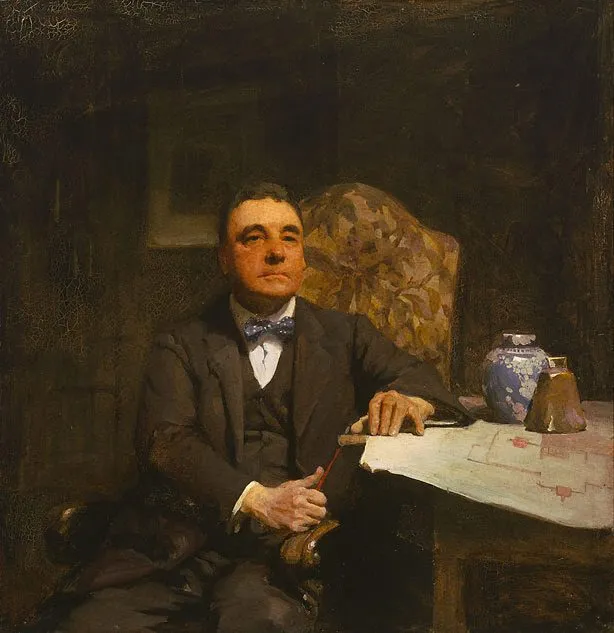
William Dobell, "Mr Joshua Smith" (1943). The portrait triggered "the biggest controversy in the history of the prize, in which two artists took the Gallery trustees to court after they awarded the 1943 Archibald Prize to William Dobell, for his portrait of artist Joshua Smith" (AGNSW). Image via Wikimedia Commons
Notable Winners and Records
Sir William Dargie holds the record for most awards, with eight wins spanning 1941 to 1956. He won again in 1956 after the 1953 student protest. Nora Heysen won in 1938 as the first woman, at age 28. Her win was attacked by Max Meldrum, who said women "could not be expected to paint as well as men." William Dobell won in 1943 with the most controversial portrait in Archibald history, "Mr Joshua Smith." The court case tested whether a portrait could be a caricature and still be a portrait. On becoming prime minister in 1972, Gough Whitlam commissioned his friend Clifton Pugh to paint the official portrait. Pugh's portrait of Whitlam won the 1972 Archibald Prize. Craig Ruddy won both the Archibald Prize and the People's Choice Award in 2004 for his portrait of David Gulpilil, "David Gulpilil, Two Worlds," the first "double" win since the People's Choice Award was inaugurated in 1988. Julie Fragar won in 2025 as the 15th woman to win in 105 years. Richard Lewer won in 2026 with the fifth portrait of a First Nations person to win in 105 years. A six-time finalist who finally won, unanimously. For more on building your knowledge, see our guide to teaching yourself art history.
The People's Choice Award and the Packing Room Prize
The People's Choice Award, in which votes from the public viewing the finalists are collected to find a winner, was first awarded in 1988. Since 2021 the award comes with a monetary prize of A$5,000. The inaugural People's Choice Award was won by Fred Cress with his portrait of fellow artist John Beard, which had also won the Archibald Prize. This was the first "double" win until Craig Ruddy won both awards with his portrait of David Gulpilil in 2004.
The Packing Room Prize has been awarded since 1991 and comes with a monetary prize of A$3,000. It is awarded by the gallery staff who receive, unpack, and install the portraits. The Packing Room Prize is a working-class counterpoint to the trustees' decision. The people who hang the art get a say. The Archibald is not just the trustees' decision. It is three decisions: the trustees' prize, the People's Choice, and the Packing Room Prize. Each one represents a different perspective, institutional, public, practical. The three sometimes agree and often do not. The disagreement is the point. For more on getting started, see our guide to art for beginners.
The Wynne and Sulman Prizes: The Archibald's Siblings
The Wynne Prize is Australia's oldest art prize and is awarded annually for "the best landscape painting of Australian scenery in oils or watercolours or for the best example of figure sculpture by Australian artists." In 2026, the $50,000 Wynne Prize was won by Gaypalani Waṉambi for her metal work "The Waṉambi tree." In 2025, she won the $100,000 top prize at the National Aboriginal and Torres Strait Islander Art Awards. The $40,000 Sulman Prize for a genre or subject painting or mural went to Lucy Culliton for her painting of her rescue greyhound, titled "Toolah, artist model." This year's Sulman was judged by two-time Archibald winner Del Kathryn Barton.
All three prizes, Archibald, Wynne, and Sulman, are exhibited together at the Art Gallery of New South Wales. The Archibald, Wynne, and Sulman Prizes 2026 exhibition runs 9 May to 16 August. The combined exhibition is one of the largest annual art events in Australia. For more on how art interacts with public life, see our guide to art and society.
Why the Archibald Matters
The Archibald is Australia's most visible cultural mirror. The portraits show who Australians consider "distinguished" in art, letters, science, and politics. The sitters are politicians, artists, writers, athletes, musicians, Indigenous elders. The portrait is a record of who mattered, in a given year, to the artists of Australia. The tradition runs 105 years, with two exceptions. Through wars, depressions, cultural revolutions, and digital transformations, the Archibald has continued. It is one of the longest-running art prizes in the world. The continuity is the point. In a culture that changes rapidly, the Archibald is an anchor.
Like the Turner Prize, the Archibald generates public debate. The Dobell court case, the Heysen and Meldrum sexism, the Dargie protests, the Bloomfield disqualification. Each controversy forced a public conversation about portraiture, gender, style, and medium. The debate is the prize's contribution to Australian cultural life. The Archibald has been slow to include women, 15 winners in 105 years, and First Nations sitters, 5 in 105 years. The 2026 winner, Richard Lewer's portrait of Iluwanti Ken, is a step toward correcting that imbalance. But the slowness is also the story. The Archibald reflects Australia's cultural values, including its blind spots. For more on getting started, see our guide to art for beginners.
Final Thoughts
The Archibald Prize, established in 1921, is Australia's most prestigious art prize, awarded annually for the best portrait, "preferentially of some man or woman distinguished in art, letters, science or politics, painted by any artist resident in Australasia." AU$100,000 since 2015. The 2026 winner: Richard Lewer for his portrait of Pitjantjatjara Elder, senior artist and ngangkari Iluwanti Ken, selected from 1,034 entries and one of 59 finalist works. Lewer was chosen unanimously by the board of trustees. The portrait is the fifth painting of a First Nations person to win the Archibald in its 105-year history. The 2025 winner: Julie Fragar for "Flagship Mother Multiverse (Justene)," the 15th time the Archibald Prize has been awarded to a woman, and Fragar is the 13th woman to win since its inception in 1921. Controversies include the 1922 residency dispute, the "distinguished" debate, Nora Heysen's 1938 win attacked by Max Meldrum, the 1943 Dobell court case, the 1953 Dargie protest, and the 1975 Bloomfield disqualification. Records: Sir William Dargie with 8 wins, Craig Ruddy's 2004 double win. The People's Choice Award since 1988, the Packing Room Prize since 1991. The Wynne Prize at $50,000 and Sulman Prize at $40,000 exhibited alongside the Archibald.
The Archibald, Wynne, and Sulman Prizes 2026 exhibition runs through 16 August at the Art Gallery of New South Wales. If you are in Sydney, go. If you are not, the exhibition tours to six venues across New South Wales and Victoria. Walk through the 59 finalist portraits. Vote in the People's Choice Award. Look at the faces. Each one is a person someone considered worth painting, worth spending hours, days, weeks capturing in oil or acrylic or watercolor. That act of looking, of deciding that a person is worth painting, is what portraiture is. It is what the Archibald has celebrated for 105 years. For more on Britain's equivalent, see our guide to the Turner Prize.


