
Watercolor is a paradox. It is the first painting medium most people encounter, those little pan sets in grade school, and it is also one of the most technically demanding mediums in all of art. The same qualities that make watercolor accessible to children, water-soluble, quick-drying, easy to set up, make it treacherous for serious painters. Unlike oil or acrylic, watercolor is largely unforgiving. You cannot paint light colors over dark ones. You cannot easily cover up mistakes. The white of the paper is your lightest value, which means you must plan ahead, preserving white areas from the start. And yet, when it works, watercolor produces effects that no other medium can match: luminous transparency, delicate color gradations, and a liquid spontaneity that captures the fleeting qualities of light, water, and atmosphere like nothing else.
J.M.W. Turner, often considered the greatest watercolorist in Western art history, used the medium to create visions of light so intense that they seem to dissolve solid form into pure radiance. Winslow Homer's watercolors of the Caribbean and the Maine coast capture the weight and movement of water with astonishing directness. John Singer Sargent's watercolor landscapes have a bravura confidence that makes impossibly complex scenes look effortless. These artists understood watercolor's unique properties and worked with them rather than against them. The Tate's artist page on Turner provides extensive documentation of his watercolor practice, including his innovative use of scraping, wiping, and lifting techniques that went far beyond conventional brushwork.
This guide introduces the fundamental techniques of watercolor painting, explains what makes the medium unique, and offers practical guidance for beginners and appreciators alike.
What Makes Watercolor Different from Every Other Medium
Watercolor paint consists of finely ground pigment suspended in a water-soluble binder, usually gum arabic. When applied to paper, the water evaporates, leaving a thin, transparent layer of pigment. This transparency is watercolor's defining characteristic and the source of both its beauty and its difficulty.
Transparency: The Core Property
In oil and acrylic painting, pigment is opaque. You can cover one color with another. In watercolor, each layer is transparent, meaning light passes through the pigment, reflects off the white paper beneath, and passes back through the pigment again. This double pass through the color is what gives watercolors their characteristic luminosity. They seem to glow from within. Understanding color theory becomes especially important in watercolor because overlapping transparent layers create new colors through optical mixing rather than physical mixing on a palette.
The Paper Is Not Just a Support
In watercolor, the paper is an active participant in the painting. The white paper serves as the lightest value in the painting. There is no white watercolor paint, or rather, there is, but purists avoid it because it defeats the whole point of the medium. This means the artist must plan carefully, deciding in advance which areas will remain white and painting around them. The paper's texture, called tooth, also affects how paint settles. Rough paper creates a granulated, textured appearance. Smooth, hot-pressed paper allows precise, detailed work.
Water as a Variable
The ratio of water to pigment determines everything in watercolor: transparency, intensity, flow, drying time, and edge quality. More water creates pale, flowing washes with soft edges. Less water creates intense, saturated marks with harder edges. Learning to control this ratio is the central technical challenge of the medium. You are not just painting with color. You are painting with water, and water has its own ideas about where it wants to go.
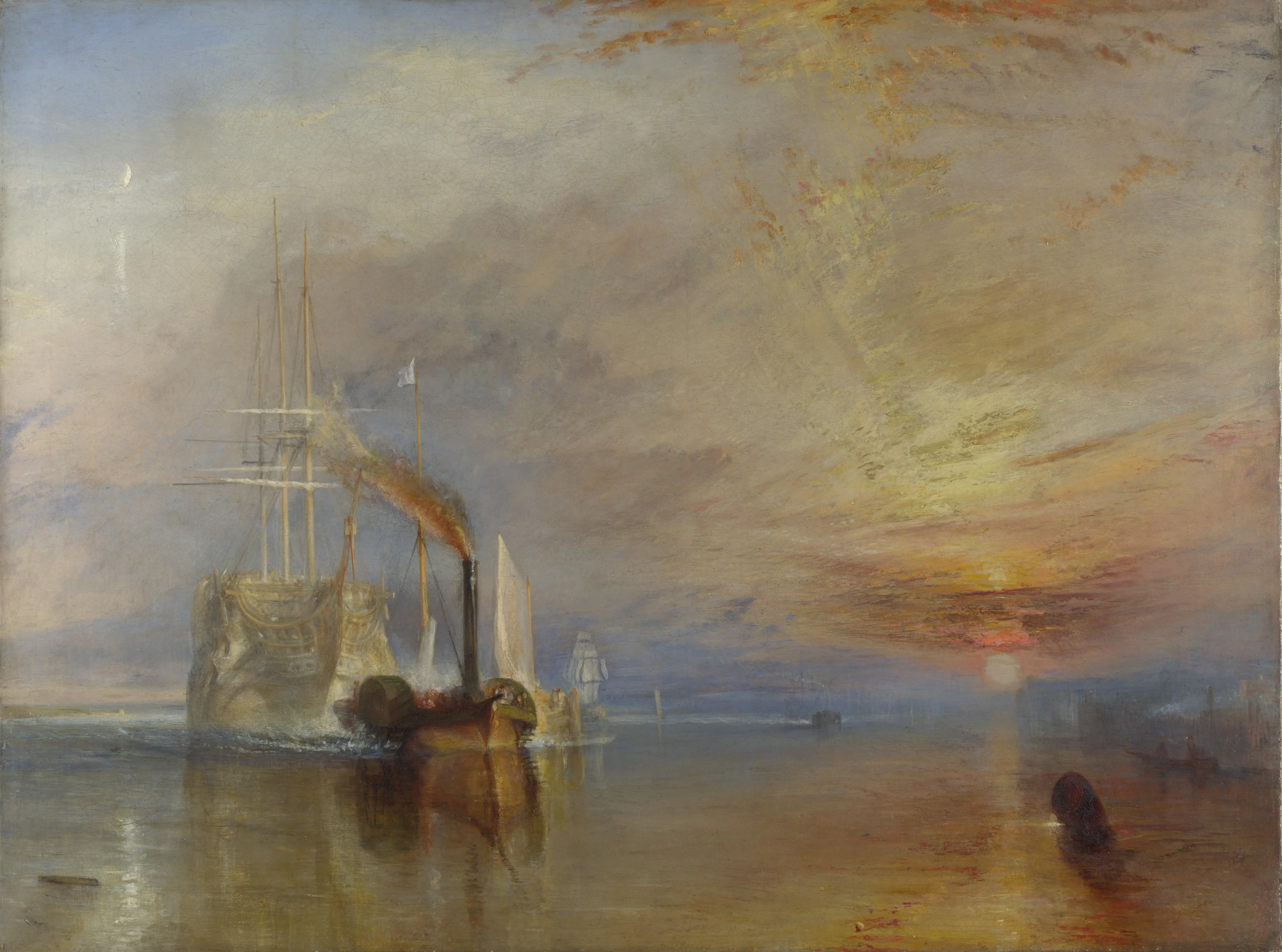
J.M.W. Turner, "The Fighting Temeraire" (1839), oil on canvas, 91 x 122 cm. National Gallery, London. While this particular work is in oil, Turner was one of history's greatest watercolorists, and his mastery of light and atmosphere was developed through extensive watercolor practice. Image: Public domain, via Wikimedia Commons
Essential Watercolor Techniques
Flat Wash
The flat wash is the most basic watercolor technique: applying an even layer of diluted color across an area. Tilt your paper at a slight angle, about 15 degrees, load a large brush with a consistent paint-to-water mixture, and draw horizontal strokes across the paper, slightly overlapping each stroke with the one above. The tilt causes excess paint to collect at the bottom of each stroke, which gets picked up by the next stroke, creating an even distribution. It sounds simple, but achieving a truly even flat wash requires practice.
Graded Wash
A graded wash transitions smoothly from dark to light, or from one color to another. Start with a concentrated mixture at the top and gradually add more water with each successive stroke. The result is a seamless gradient that is perfect for skies, reflections, and atmospheric effects. Turner's luminous skies are built on masterful graded washes.
Wet-on-Wet
This is watercolor's most characteristic and magical technique. Wet the paper first with clean water, then drop or brush color onto the wet surface. The pigment spreads and blooms unpredictably, creating soft, diffused edges and organic shapes. Wet-on-wet is ideal for skies, backgrounds, and any area where you want soft, atmospheric effects. The challenge is controlling the spread. Too much water and the paint disperses into nothing. Too little and it does not flow freely. The Winsor and Newton technical guide provides detailed instructions for controlling wet-on-wet effects, including how paper weight and angle affect the flow.
Wet-on-Dry
Applying wet paint onto dry paper produces hard, defined edges and allows precise control. This technique is used for details, sharp edges, and areas where you want clear definition. Most watercolor paintings combine wet-on-wet for atmospheric areas and wet-on-dry for detailed elements. The contrast between soft and hard edges creates visual interest and depth.
Glazing (Layering)
Glazing involves applying thin, transparent layers of color over previously dried layers. Because watercolor is transparent, each new layer modifies the color beneath it. A glaze of yellow over dried blue creates green. A glaze of red over yellow creates orange. This additive process allows artists to build complex, luminous color effects that would be impossible to achieve by mixing paint on a palette. The key rule of glazing: each layer must be completely dry before the next is applied. Painting over a damp layer will lift the previous paint and create muddy, blotchy results, one of the most common watercolor mistakes. For more on how layered color creates depth, see our guide to oil painting techniques, which covers glazing in the context of oil paint.
Lifting
Because watercolor remains somewhat water-soluble even after drying, you can lift color from the paper using a clean, damp brush, sponge, or tissue. This technique creates highlights, softens edges, and corrects minor mistakes. Some pigments lift more easily than others. Staining pigments like phthalo blue resist lifting, while sedimentary pigments like cerulean blue lift cleanly.
Dry Brush
Loading a brush with concentrated pigment and very little water, then dragging it quickly across dry paper, creates a rough, broken texture. The paint catches on the high points of the paper's surface, leaving gaps that show the white paper beneath. This technique is excellent for rendering textures like tree bark, stone walls, sparkling water, and grass. Winslow Homer used dry brush extensively in his coastal watercolors to capture the texture of rocks and the shimmer of water.
Materials for Getting Started
Watercolor paints come in two forms: tubes, which contain moist concentrated paste, and pans, which are dried cakes of pigment. Tubes are more economical for large washes. Pans are more convenient for travel and smaller work. For beginners, a basic palette of eight to twelve colors is sufficient. Essential colors include cadmium yellow, yellow ochre, cadmium red, alizarin crimson, ultramarine blue, cerulean blue, burnt sienna, and Payne's gray. Buy the best quality you can afford. Student-grade paints have less pigment and more filler, which makes them less vibrant and harder to control. Artist-grade paints from Winsor and Newton, Daniel Smith, or Schmincke are more expensive but dramatically better to work with.
Paper is the most important material in watercolor. Good paper makes mediocre technique look better. Bad paper makes great technique look worse. Look for paper that is at least 140 lb (300 gsm) weight, because lighter paper buckles when wet. Cold-pressed paper, with medium texture, is the most versatile choice. Hot-pressed paper, which is smooth, is for detailed work. Rough paper is for expressive, textured effects. 100% cotton paper from Arches, Fabriano Artistico, or Saunders Waterford is vastly superior to wood-pulp paper. It absorbs water more evenly, allows more working time, and lifts cleanly.
A few good brushes are better than many cheap ones. Start with a large round brush, size 12 to 14, for washes. Add a medium round brush, size 6 to 8, for general work. And a small round brush, size 2 to 4, for details. Kolinsky sable brushes are traditional and excellent but expensive. Good synthetic alternatives like Princeton Neptune or Da Vinci Casaneo are available at lower price points. For more on art materials generally, see our guide to the essential art toolkit.
Famous Watercolorists to Study
J.M.W. Turner (1775 to 1851) is the master of atmospheric light and color in watercolor. His late watercolors verge on abstraction and demonstrate what the medium can do in the hands of someone who has spent decades mastering it. Winslow Homer (1836 to 1910) is the American painter whose Caribbean and Maine watercolors combine bold color with astonishing technical control. John Singer Sargent (1856 to 1925) is known for oil portraits, but his watercolors are arguably even more impressive: rapid, confident, and luminous. Paul Cezanne (1839 to 1906) used watercolor's transparency to analyze form and space, influencing Cubism and modern art. For more on Cezanne's approach, see our guide to Cezanne as the father of modern art.
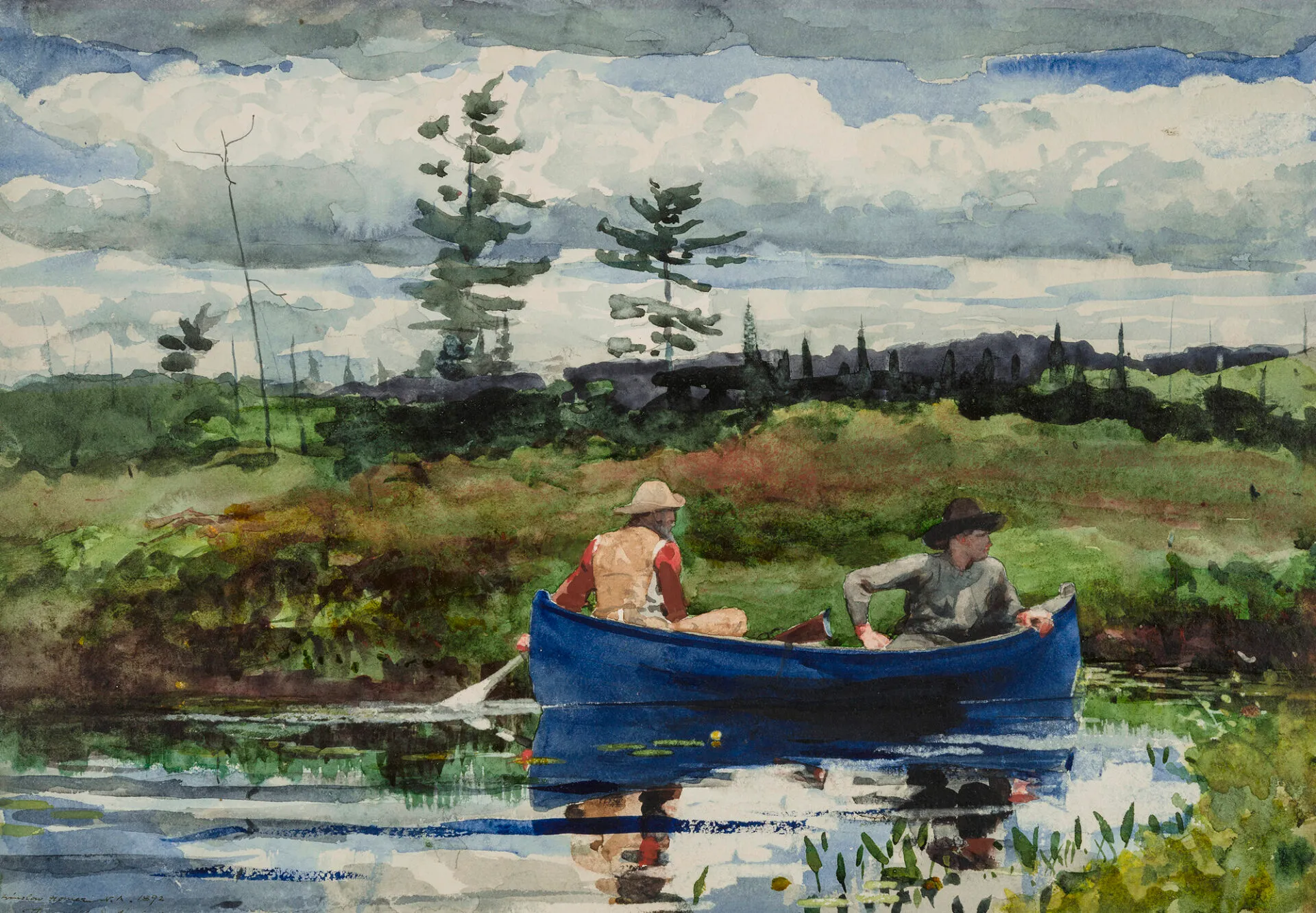
Winslow Homer, "The Blue Boat" (1892), watercolor on paper. Museum of Fine Arts, Boston. Homer's mastery of wet-on-wet technique and bold color made him one of America's greatest watercolorists. Image: Public domain, via Wikimedia Commons
Final Thoughts
Watercolor rewards patience, planning, and a willingness to let go of total control. The medium's transparency means you are always working with the light of the paper, building up color in layers rather than covering surfaces opaquely. Mistakes are hard to hide, which means every successful watercolor carries a quiet authority. You know the artist got it right, often on the first try.
Whether you want to start painting or simply deepen your appreciation of watercolor when you encounter it in museums, understanding these basic techniques transforms how you see the medium. The next time you stand in front of a Turner watercolor, you will recognize the graded washes in his skies, the wet-on-wet blooms in his clouds, and the precise wet-on-dry marks in his architectural details. You will appreciate the extraordinary skill required to make it all look effortless. For more art techniques, explore our guides to texture in art and how to read a painting step by step. Have you tried watercolor painting? What did you find most challenging? Share in the comments below.


