
The Kalachakra sand mandala at the Rubin Museum of Art in New York takes a team of Buddhist monks approximately five days to construct. They work with metal funnels called chak-pur, tapping them to release colored sand grain by grain onto a flat surface, building outward from a central point with geometric precision that accumulates, over those five days, into a design measuring roughly three feet across. The mandala depicts the palace of the Kalachakra deity, with concentric circles and square enclosures containing hundreds of individual deity figures, each placed according to a canon that has not substantially changed in over a thousand years. When the mandala is complete, the monks perform prayers over it, then sweep the sand into a pile and pour it into a nearby river. The destruction is the point.
This ritual illustrates what a mandala actually is and what it is not. It is not primarily a decorative object, though mandalas are beautiful. It is not primarily a meditation aid in the soft wellness-culture sense, though sustained attention to one can produce meditative states. It is a cosmological diagram: a map of a sacred universe rendered in a specific visual language, constructed for a specific ritual purpose, and understood within a specific religious tradition. The versions that appear on yoga studio walls and mindfulness apps are related to this original function the way pop music is related to liturgical chant. The family resemblance is real but the context has changed completely.
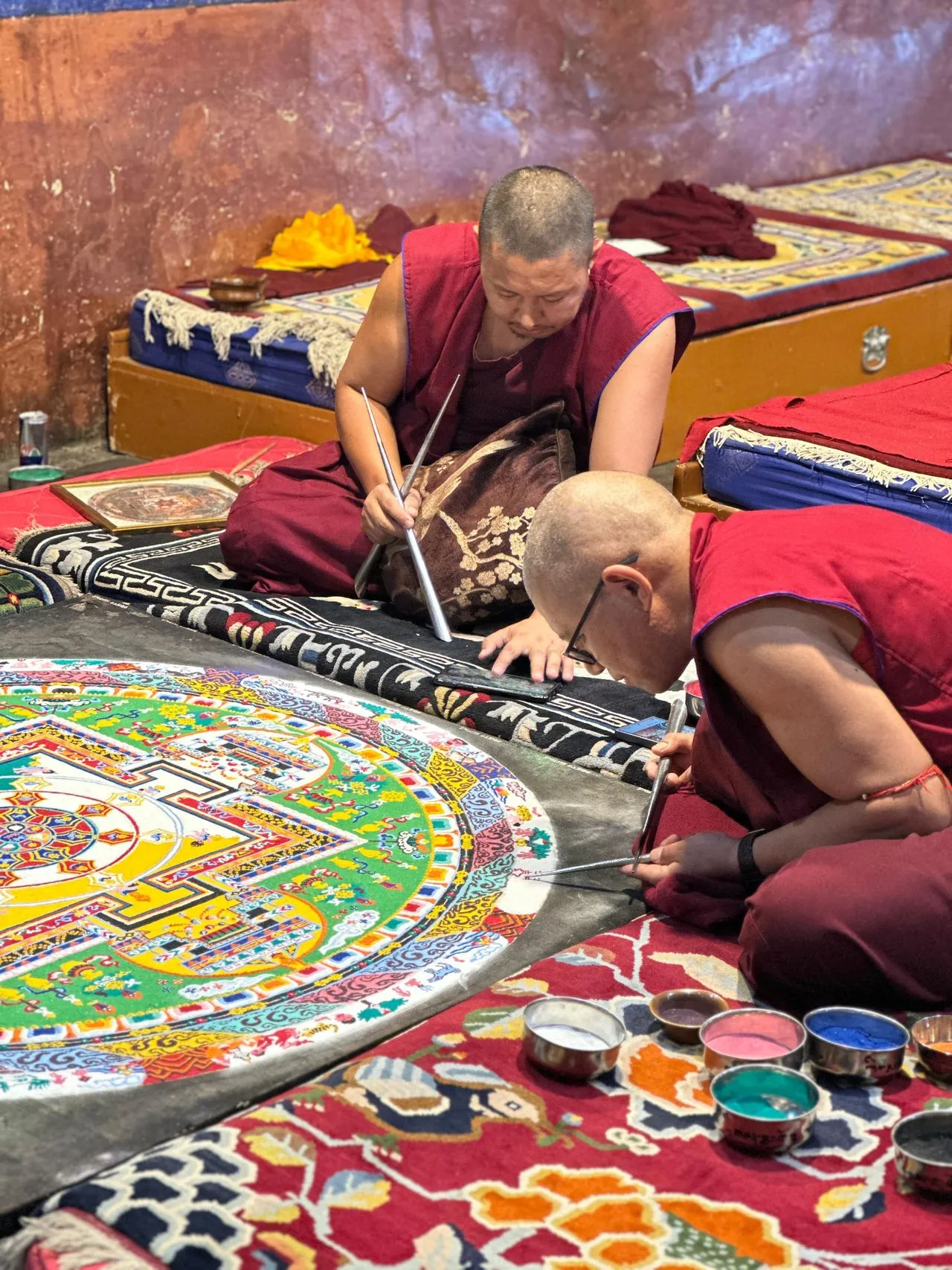
Photo by Ex Route Adventures on Pexels.com
What a Mandala Is: The Sanskrit Root and the Core Structure
The word mandala comes from Sanskrit and means, roughly, circle or sacred circle. The term appears in the Rigveda, one of the oldest texts in any Indo-European language, where it refers to the circular groupings of hymns in that collection. In the context of visual art, mandala describes a specific type of diagram characterized by a central point, called the bindu, surrounded by concentric geometric structures that radiate outward in symmetrical patterns.
The basic structure appears across Hindu and Buddhist traditions, but with significant differences in meaning and use. In Hinduism, mandalas frequently appear as yantras, geometric diagrams used in worship to represent deities and cosmic forces. The Sri Yantra, one of the most complex Hindu mandalas, interlocks nine triangles around a central bindu to represent the union of Shiva and Shakti and the structure of the cosmos. In Vajrayana Buddhism, particularly in the Tibetan and Japanese Shingon traditions, mandalas are palace-diagrams depicting the arranged realms of specific Buddhas and bodhisattvas, used both as sacred objects and as supports for meditation visualization practice.
The psychologist Carl Jung used the mandala as a central concept in his theory of individuation, arguing that circular, symmetrical patterns appear spontaneously in the dreams and artwork of people undergoing psychological integration, and that they represent the Self as a whole. Jung's interpretation, outlined in works including "Mandala Symbolism" (1950) and "The Archetypes and the Collective Unconscious," introduced the concept to Western psychological and artistic contexts. His work is the primary reason mandalas have become widespread in Western therapeutic and creative settings, and it is also the source of the idea that mandalas are universal human symbols rather than culturally specific ritual diagrams. That claim is contested by scholars of Hindu and Buddhist traditions, and understanding the tension between the two framings helps clarify what mandalas actually are in their original contexts.
Hindu Mandalas and Yantras
In Hindu practice, the visual diagrams used in ritual and meditation are more commonly called yantras. A yantra is a geometric diagram that serves as the visual body of a deity: to worship using the yantra is to worship the deity directly, not merely to contemplate a representation of them. The Sri Yantra is the most widely used example. Its four downward-pointing triangles represent the feminine divine principle (Shakti), its five upward-pointing triangles represent the masculine (Shiva), and their interlocking creates forty-three small triangular fields arranged around a central bindu. The entire structure is understood as a compressed image of the universe in dynamic equilibrium.
Mandalas in the architectural sense also appear throughout Hindu temple design. The ground plan of a traditional Hindu temple is typically a mandala diagram called a vastu purusha mandala, with the innermost sanctuary corresponding to the central bindu. The temple as a whole is understood as a three-dimensional mandala: a physical embodiment of cosmic order that the worshipper enters and moves through. This architectural tradition is described in ancient texts including the Manasara and the Mayamata and represents one of the most sophisticated applications of mandala geometry in any tradition.
Buddhist Mandalas: The Palace and the Path
Tibetan Buddhist mandalas are most familiar to Western audiences as sand constructions or as the complex painted silk scroll paintings called thangkas. But the mandala in Vajrayana Buddhism is primarily a meditation device: a visualization of the enlightened realm of a specific deity, used in tantric practice as the object of sustained mental visualization. The practitioner meditates on the mandala, visualizes entering it, moves through its palace architecture, and encounters the deity at its center. The mandala is both a map of the path and a description of the destination.
The formal structure of a Tibetan mandala follows a fixed canon. The outer ring is typically a ring of fire representing transformation, followed by a ring of vajra (diamond thunderbolts), followed by lotus petals representing purity, then a square palace with four gates oriented to the cardinal directions. Within the palace, the central deity is surrounded by attendant figures in a specific pattern. Every element is specified in the root tantra text associated with that deity and cannot be altered without changing the meaning of the diagram.
The Japanese Shingon tradition, brought from China to Japan by the monk Kukai in 806 CE, uses two primary mandalas together: the Womb Realm Mandala (Taizo-kai) and the Diamond Realm Mandala (Kongo-kai). The Womb Realm represents the compassionate, nurturing aspect of enlightenment; the Diamond Realm represents its indestructible wisdom aspect. Shingon ritual uses both mandalas as the basis for elaborate ceremonies involving mudras, mantras, and visualization. The Toji temple in Kyoto holds examples dating to the 9th century, designated as National Treasures of Japan.
Sand Mandalas: Construction and Dissolution
The Tibetan sand mandala tradition produces some of the most demanding and most visually extraordinary objects in world art. The mandala is constructed on a flat wooden platform using colored sand, mineral pigments, and sometimes semi-precious stone powders, applied through chak-pur funnels with millimeter precision over several days. A Kalachakra sand mandala, one of the most complex types, requires that the monks making it have studied the design for years before construction begins, and the process is accompanied throughout by specific ritual observances.
The ritual dissolution at the end of the mandala's ceremonial life is often described in Western contexts as a lesson in impermanence. That description is accurate but incomplete. The dissolution is also a blessing: the mixed sand, ritually charged during construction and consecration, is released into flowing water to spread the mandala's beneficial energy into the natural world. The destruction ends the mandala's specific existence but not its effects.
The Geometry: Why Symmetry Matters
The mathematical structure of mandala design is more demanding than it appears from casual viewing. A traditional mandala is built on a grid that divides the circular space into specific angular units, and every element must align precisely with those units. The construction begins by establishing the central point, then drawing concentric circles and squares at specific proportional relationships to each other. The precision is not merely aesthetic. In the Buddhist understanding, the mandala is effective as a meditation object only if it accurately depicts the enlightened realm it represents. An error in the geometry is an error in the cosmological map.
The radial symmetry that gives mandalas their characteristic visual quality is also what makes them effective as meditation objects in the non-tradition-specific sense. Symmetrical patterns with a clear center naturally attract and hold visual attention. Studies in visual attention research have found that radially symmetrical patterns with a central focal point produce longer dwell times and lower reported cognitive effort than equivalent patterns without symmetry. The traditional explanation for why mandalas work as meditation supports and the cognitive science explanation are not in conflict; they describe the same phenomenon from different angles.
Mandalas in Contemporary Art and Practice
The adaptation of mandala forms outside their original religious contexts has produced a wide range of contemporary practices. In fine art, several painters and printmakers have used mandala geometry as formal structure without claiming religious content. Art therapy applications, popularized by the Jungian tradition and widely adopted in clinical settings, use the act of creating symmetrical circular designs as a tool for accessing and externalizing psychological states. The therapeutic literature on outcomes is mixed, but many practitioners and clients report significant personal benefit from the practice, whether that benefit derives from the specific form of the mandala or from the focused, repetitive quality of the making process itself.
In 2025, a major exhibition at the Rubin Museum of Art in New York focused specifically on the relationship between traditional Himalayan mandala design and contemporary art, bringing together historical thangkas alongside works by contemporary artists who engage with the mandala as a formal and conceptual reference point. The exhibition's catalog, published by the museum, is one of the most accessible scholarly treatments of mandala iconography available in English.
For the broader context of symbolism in art and how geometric patterns carry meaning across traditions, the guide to reading symbolism in art provides a useful framework. For the related tradition of Islamic geometric art, which shares the mandala's interest in mathematical precision and cosmological meaning but within a different religious context, the Islamic art and geometry guide explores that territory. Have you worked with mandalas in your own art practice? Share your experience in the comments.


