
In 1941, Henri Matisse was diagnosed with abdominal cancer. He underwent surgery that left him bedridden and unable to stand at an easel. He was 71 years old. Rather than stop making art, he invented a new medium, the gouache-découpée, or cut-out. He painted sheets of paper with brilliant gouache colors, then directed assistants to cut them into shapes that he arranged on the walls of his room. "The paper cut-out allows me to draw in color," he said. "It is a simplification for me. Instead of drawing the outline and putting the color inside it, the one modifying the other, I draw directly in the color." The cut-outs, "Blue Nude II" (1952), "The Snail" (1953), "Large Composition with Masks" (1953), are now considered among his greatest works. They would not exist without the cancer. Matisse's disability did not limit his art. It transformed it. He is not the only example. Frida Kahlo painted from a wheelchair and a bed, her body immobilized by a steel corset, her spine shattered by a bus accident. Chuck Close, paralyzed from the neck down by a spinal artery collapse in 1988, continued to paint with a brush strapped to his wrist, producing the grid portraits that made his reputation. Judith Scott, born with Down syndrome and deaf, did not begin making art until age 43, when she started wrapping found objects in yarn and thread, sculptures now in the Brooklyn Museum and the Museum of Modern Art.
The relationship between disability and art is not a story of "overcoming." It is a story of transformation. Disability changes the conditions under which art is made: the tools, the posture, the speed, the medium. The art that results is not "despite" the disability but "because of" it. The disability is a material condition that shapes the work as surely as the pigment or the canvas. This guide covers Frida Kahlo and the broken body, Henri Matisse and the cut-outs, Chuck Close and the grid, Judith Scott and the wrapped sculptures, the "tortured genius" myth and why it is wrong, and what disability brings to art that ability does not.
Frida Kahlo: The Broken Body as Subject
Kahlo's disability began early. She contracted polio at age 6, which left her right leg thinner and shorter than the left. Then on September 17, 1925, at age 18, a bus accident in Mexico City changed everything. An iron handrail pierced her abdomen and pelvis, fracturing her spine, collarbone, ribs, right leg, and right foot. She spent 3 months in a full-body cast, then years in corsets and braces. She underwent at least 30 surgeries across her life. Her right leg was amputated below the knee in 1953, one year before her death at 47.
Kahlo painted from a bed, often lying on her back with a mirror suspended above her, painting herself because she was the subject she knew best. "I paint myself because I am so often alone and because I am the subject I know best." Her paintings depict her body in pain. "The Broken Column" (1944) shows her torso split open, a shattered Ionic column in place of her spine, nails piercing her skin. "Without Hope" (1945) shows her in a hospital bed, force-fed by a funnel. "Tree of Hope" (1946) shows her in a back brace on one side and in a red surgical gown on the other. The paintings are not illustrations of pain. They are records of a body that has been broken, repaired, broken again, and painted. For more on Kahlo's life and work, read our guide on Frida Kahlo.
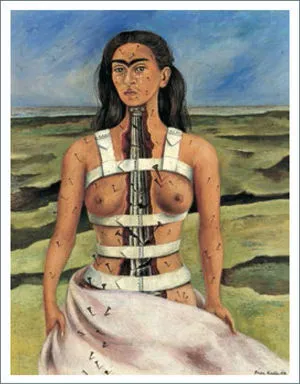
Frida Kahlo, "The Broken Column" (1944). Oil on masonite, 40 x 30.5 cm. Museo Dolores Olmedo, Mexico City. Image via Wikimedia Commons
The significance of Kahlo's art is that it is not "about" disability in the sense of advocacy or representation. It is disability. The pain, the immobilization, the surgical interventions, the corsets and braces, these are the materials of her art. Her paintings are not pictures of a disabled body. They are paintings made by a disabled body. The distinction matters. The disability is not a theme but a condition of production. Disability Rights Florida published a useful overview of Kahlo's disability-themed paintings that traces this connection.
Henri Matisse: The Cut-Outs and the Scissors
Matisse's abdominal cancer was diagnosed in 1941. Surgery at age 71 left him bedridden and wheelchair-bound for the last 13 years of his life (1941-1954). He could not stand at an easel. He could not hold a brush for extended periods. He had used paper cut-outs as a compositional tool since the 1930s, cutting shapes and pinning them to the wall to plan paintings and murals. After 1941, the cut-out became the primary medium. He painted sheets of paper with gouache (a water-based paint), then directed assistants to cut the shapes he specified. He arranged the shapes on the walls of his room at the Hôtel Regina in Nice, pinning and re-pinning them until the composition was right.
The works are monumental. "Blue Nude II" (1952, 116.3 x 81.9 cm, Centre Pompidou), "The Snail" (1953, 286.4 x 287 cm, Tate), "Large Composition with Masks" (1953, 340 x 340 cm, National Gallery of Art, Washington). Some are over 3 meters wide. They are also the most radical works of Matisse's career. A 20th-century master of oil painting abandoned oil for scissors and paper. The cut-outs are not a compromise. They are an invention. The disability forced a simplification that was also an intensification. "The paper cut-out allows me to draw in color," Matisse said. "It is a simplification for me." The cut-outs are more direct, more chromatic, more abstract than his paintings. The disability did not diminish his art. It distilled it. For more on Matisse's career and philosophy, read our guide on Matisse.
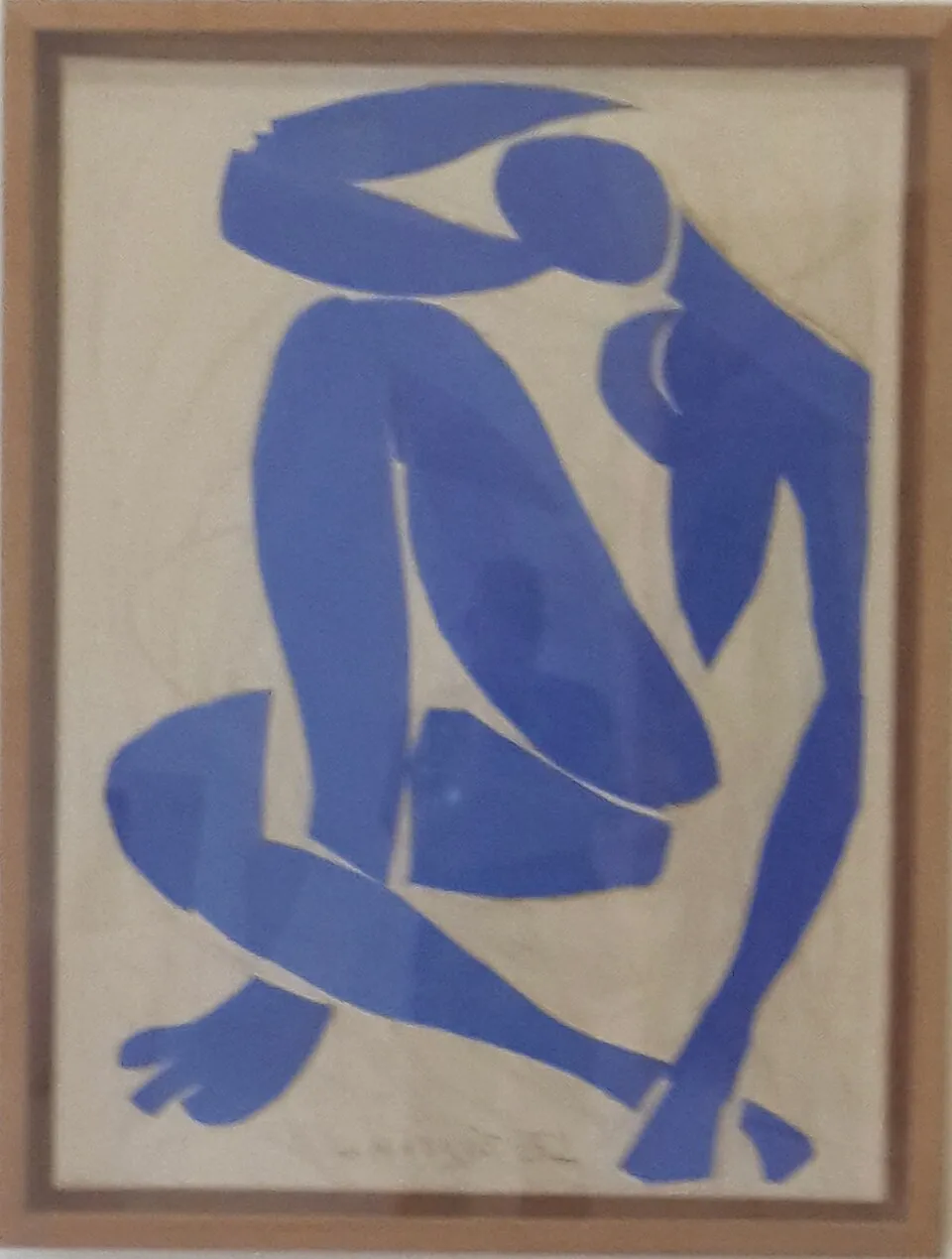
Henri Matisse, "Blue Nude II" (1952). Gouache on paper, cut and pasted, 116.3 x 81.9 cm. Centre Pompidou, Paris. Image via Wikimedia Commons
Chuck Close: The Grid and the Wrist Brace
In December 1988, Close suffered a spinal artery collapse, a seizure that damaged spinal blood vessels, leaving him paralyzed from the neck down. After months of physical therapy, he regained limited use of his arms but not his hands or legs. He uses a wheelchair and holds a brush with a wrist brace.
Close's early work was photorealistic, meticulous, and precise. "Big Self-Portrait" (1967-1968, 274.3 x 212.4 cm, Walker Art Center) shows a massive face painted from a photograph, every pore and hair rendered in exact detail. He painted faces by filling a grid of small squares with color, building the image cell by cell. The technique required fine motor control and long hours at the easel. After the collapse, Close could not hold a brush with his fingers. He strapped a brush to his wrist and continued to paint. But the grid changed. The cells became larger, looser, more expressive. The photorealism gave way to a kind of pointillism. Each cell is now a circle or oval of color, and the portrait emerges from the accumulation of these colored shapes. The faces are still recognizable, but the surface is different, rougher, more abstract, more physical.
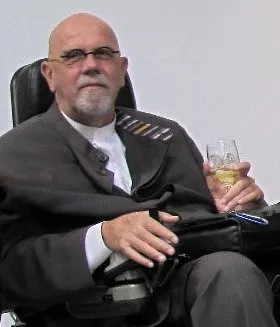
Chuck Close, "Big Self-Portrait" (1967-1968). Acrylic on canvas, 274.3 x 212.4 cm. Walker Art Center, Minneapolis. Image via Wikimedia Commons
Close's post-disability work is not "despite" the disability. It is shaped by it. The wrist brace produces a different mark than the fingers. The larger cells are a response to reduced motor control. The looser surface is a consequence of the tool. The disability changed the technique, and the technique changed the art. Close himself has said: "I don't think my work got worse after the collapse. I think it got different." For more on where Close's work sits in the current scene, see our guide on contemporary art in 2026.
Judith Scott: Wrapping and the Found Object
Judith Scott (1943-2005) was born with Down syndrome and deafness. She was institutionalized at the Columbus State School in Ohio at age 7 and spent 35 years in an institution, with no education, no art, no creative stimulation. In 1985, her twin sister Joyce gained custody and moved her to California. In 1987, at age 44, Judith enrolled in a creative arts program at the Creative Growth Art Center in Oakland. She showed no interest in painting or drawing. Then a fiber artist visited the center and demonstrated wrapping techniques. Judith picked up yarn and a found object and began wrapping.
Over the next 18 years, Scott produced over 200 wrapped sculptures. Objects (chair legs, broom handles, pieces of wood, bicycle wheels) wrapped tightly in yarn, thread, and fabric. The sculptures are abstract, dense, and mysterious. They look like cocoons, mummies, or ritual objects. They have no representational content. They are pure form, pure material, pure process. Scott's work was discovered by the art world in the 1990s. She had her first solo exhibition at the Intuit Gallery in Chicago in 1999. Her work is now in the Brooklyn Museum, the Museum of Modern Art, the American Folk Art Museum, and the Collection de l'Art Brut in Lausanne. She is one of the most celebrated "outsider artists" of the 20th century. You can read more about her life and work on Wikipedia's entry on Judith Scott.
Scott's work challenges the assumption that art requires training, education, or intention. She did not begin making art until age 44. She did not describe her work or explain her process. She was deaf and had Down syndrome. She lived in a world that most people cannot access. And yet her sculptures are recognized as major works of art. The significance is not that Scott "overcame" her disabilities. It is that her disabilities produced a form of art that no one else could have made. The wrapping, the density, the secrecy of the objects, these are qualities that come from a specific body and a specific mind, not from training or tradition. For more on how art encodes social structures, read our guide on art and society.
The "Tortured Genius" Myth and Why It Is Wrong
The "tortured genius" is the idea that great art comes from suffering, that mental illness, physical disability, or emotional trauma are the sources of artistic creativity. The myth is reinforced by biographies of artists like Van Gogh (mental illness), Kahlo (physical disability), Goya (deafness), and Munch (anxiety). The implication is that suffering is necessary for great art, that if the artist were not suffering, the art would not be great.
The myth romanticizes suffering. It treats disability as a gift, a "blessing in disguise" that produces creativity. This is offensive to disabled people, who do not experience their disability as a gift. It also creates a moral hazard. If suffering produces great art, then we should not alleviate suffering. We should preserve it, for the sake of the art. The myth also ignores the evidence. Most great artists were not disabled, and most disabled people are not great artists. The relationship between disability and art is not causal. It is conditional. Disability changes the conditions of production, but it does not cause creativity.
The reality is that disability is a material condition, not a creative force. It changes the tools, the posture, the speed, the medium. Matisse's cancer did not give him creativity. It forced him to invent the cut-out. Close's paralysis did not give him creativity. It forced him to change his grid. Kahlo's accident did not give her creativity. It gave her a subject (her body) and a position (the bed). The art that results from disability is not caused by the disability. It is made possible by it, in the sense that the disability creates conditions that the artist works within and against. The "tortured genius" myth is not just wrong. It is harmful. It romanticizes suffering, stigmatizes disability, and creates a false equivalence between pain and creativity. The truth is more interesting. Disability changes the conditions of art-making, and the artist responds to those changes with invention, adaptation, and creativity. The art is not "despite" the disability. It is in dialogue with it. For more on this debate, read our guide on the tortured artist myth.
Disability in Art in 2026
Museums and galleries are increasingly accessible. Wheelchair ramps, audio descriptions, tactile tours, sign language interpretation are now standard in major institutions. But the art world's accessibility is still largely physical. It addresses mobility, not cognitive or sensory disability. The question is not just "can disabled people visit museums?" but "can disabled people make art, exhibit art, and be recognized as artists?"
Representation is the other problem. Disabled bodies are still largely absent from art. The nude tradition idealizes the able body. Portraiture traditionally represents the powerful, the wealthy, the able. Disabled bodies appear in art as symbols, of suffering, of courage, of pity, but rarely as subjects, as agents, as makers. The disability rights movement has challenged this absence, but the representation of disabled bodies in art is still the exception, not the norm. For more on the nude tradition and what it excludes, read our guide on the nude in art.
The most interesting disability art being made today is not art that represents disability but art that is made from disability, art that is shaped by the specific conditions of a specific body. This is not art "about" disability. It is art that is disability, in the sense that the disability is a material condition of production. The future of disability art is not representation but production. Not painting disabled bodies but making art with disabled bodies. Fiveable maintains a useful list of famous artists with disabilities that shows the breadth of this work.
Final Thoughts
Disability has shaped some of the most important art of the 20th century. Frida Kahlo painted from a wheelchair and a bed, her body immobilized by a steel corset. "The Broken Column" (1944) is a portrait of disability as subject. Henri Matisse, bedridden with cancer at 71, invented the cut-out. "Blue Nude II" (1952) and "The Snail" (1953) are works that would not exist without the disability. Chuck Close, paralyzed from the neck down in 1988, continued to paint with a brush strapped to his wrist. The grid changed, the surface changed, the art changed. Judith Scott, born with Down syndrome and deaf, did not begin making art until age 44. Her wrapped sculptures are now in MoMA and the Brooklyn Museum.
My view is that the "tortured genius" myth, the idea that suffering causes creativity, is not just wrong but harmful. It romanticizes suffering, stigmatizes disability, and creates a false equivalence between pain and creativity. Disability does not cause creativity. It changes the conditions of production. The art that results is not "despite" the disability but in dialogue with it, a dialogue between a body, a medium, and a set of constraints that produces something that could not have been made any other way. For help training your eye to see these conditions in the work itself, read our guide on how to look at art, and for the broader context of how art encodes social structures, see our guide on art and society.
Next time you see a painting by Kahlo, a cut-out by Matisse, or a portrait by Close, do not think "they made this despite their disability." Think: "they made this because of their disability, because the disability changed the conditions, and the conditions changed the art." Disability is not an obstacle to creativity. It is a material condition that shapes the work as surely as the pigment or the canvas.


