
Titian was born around 1488-1490 and died in 1576. He lived to be about 86, an extraordinary age for the 16th century. He painted until the end. His last painting, the "Pietà" (c. 1576, 389 x 347.5 cm, Gallerie dell'Accademia, Venice), was intended for his own tomb. It shows the dead Christ held by the Virgin Mary, with Titian himself as Nicodemus, the old man who supports the body. The painting is dark, loose, and unfinished. The brushwork is rough, the contours blurred, the paint applied in thick strokes. It does not look like the work of a man in decline. It looks like the work of a man who has stopped caring about finish and is painting only what matters. Titian was about 86 when he painted it. He is not alone. Rembrandt painted his last self-portrait in the year of his death, at 63. Goya painted the Black Paintings at 72. Monet painted the late water lilies in his 70s and 80s. The late work of great artists is not a decline. It is a rupture.
The concept of "late style" was articulated by Theodor Adorno in his essay "Late Style in Beethoven" (1937). Adorno argued that the late work of great artists is not a resolution or a summing-up but a rupture, a break with the artist's own past, a refusal of convention, a turn toward difficulty and fragmentation. Beethoven's late quartets (1824-1826) are the model: complex, dissonant, and inaccessible, written by a composer who was deaf and knew he was dying. This guide covers Titian's late style and the "Pietà," Rembrandt's last self-portraits, Goya's Black Paintings, Monet's late water lilies, Beethoven's late quartets as a parallel, the concept of "late style" (Adorno, Said), and what aging brings to art that youth does not.
Titian's Late Style: The Loose Brush (1562-1576)
Titian (Tiziano Vecellio, c. 1488-1576) was the greatest painter of the Venetian school. He worked for emperors, popes, and kings: Charles V, Philip II, Pope Paul III. He painted for over 70 years. Around 1562, when Titian was in his early 70s, his style changed. The smooth finish of his earlier work gave way to a rough, loose brushwork, what the Venetians called "pittura a macchia" (patchy painting). The contours blurred, the palette narrowed to ochres, browns, and reds, and the paint was applied in thick, visible strokes, sometimes by finger as well as brush.
The works are "The Crowning with Thorns" (c. 1570, 280 x 182 cm, Alte Pinakothek, Munich), "The Flaying of Marsyas" (c. 1570-1576, 212 x 207 cm, Archbishop's Palace, Kroměříž), and "Pietà" (c. 1576, 389 x 347.5 cm, Gallerie dell'Accademia, Venice). These works are dark, violent, and unfinished. They depict suffering, torture, and death. In Titian's lifetime, critics saw the late style as a sign of decline. "The old man was losing it, that his eyesight was too weak and his hand too shaky." The curators of the 2023 Accademia exhibition "favor the idea that Titian's visible brushwork is also his artistic signature." The medical interpretation (2019 SEN study) suggests cataracts may have contributed to the narrowed palette.
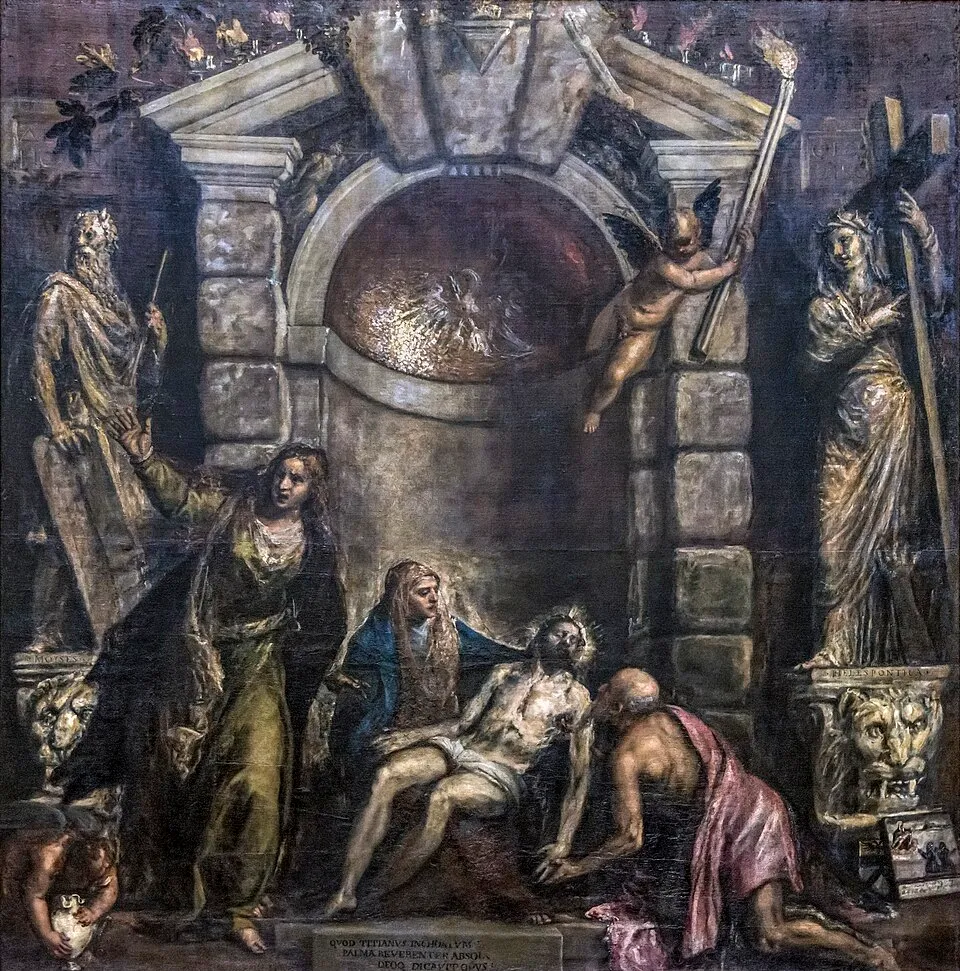
Titian, "Pietà" (c. 1576). Oil on canvas, 389 x 347.5 cm. Gallerie dell'Accademia, Venice. Image via Wikimedia Commons
Titian's late style is not decline. It is revolution. The loose brushwork, the thick impasto, the blurred contours, these are the techniques that Velázquez, Rubens, Rembrandt, and eventually Manet and the Impressionists would adopt. Titian's late style is the foundation of modern painting, the moment when oil paint became a material to be manipulated, not just a surface to be finished. For more on the stories behind specific works, see our guide on famous paintings.
Rembrandt's Last Self-Portraits (1658-1669)
Rembrandt van Rijn (1606-1669) painted more self-portraits than any artist before him: about 40 paintings, 31 etchings, and 7 drawings. The self-portraits span his entire career, from age 22 to his death at 63. "Self-Portrait" (1658, 133.7 x 103.8 cm, Frick Collection, New York) shows Rembrandt at 52, seated like a king, in a golden robe, with deep wrinkles and weary eyes. "Self-Portrait with Beret and Turned-Up Collar" (1659, 84.5 x 66 cm, National Gallery of Art, Washington) shows him at 53, his face lined, his expression ambiguous. "Self-Portrait" (1669, 86 x 70.5 cm, Mauritshuis, The Hague) is his last, painted in the year of his death, showing a 63-year-old man with thin white hair, deep wrinkles, and an unflinching gaze.
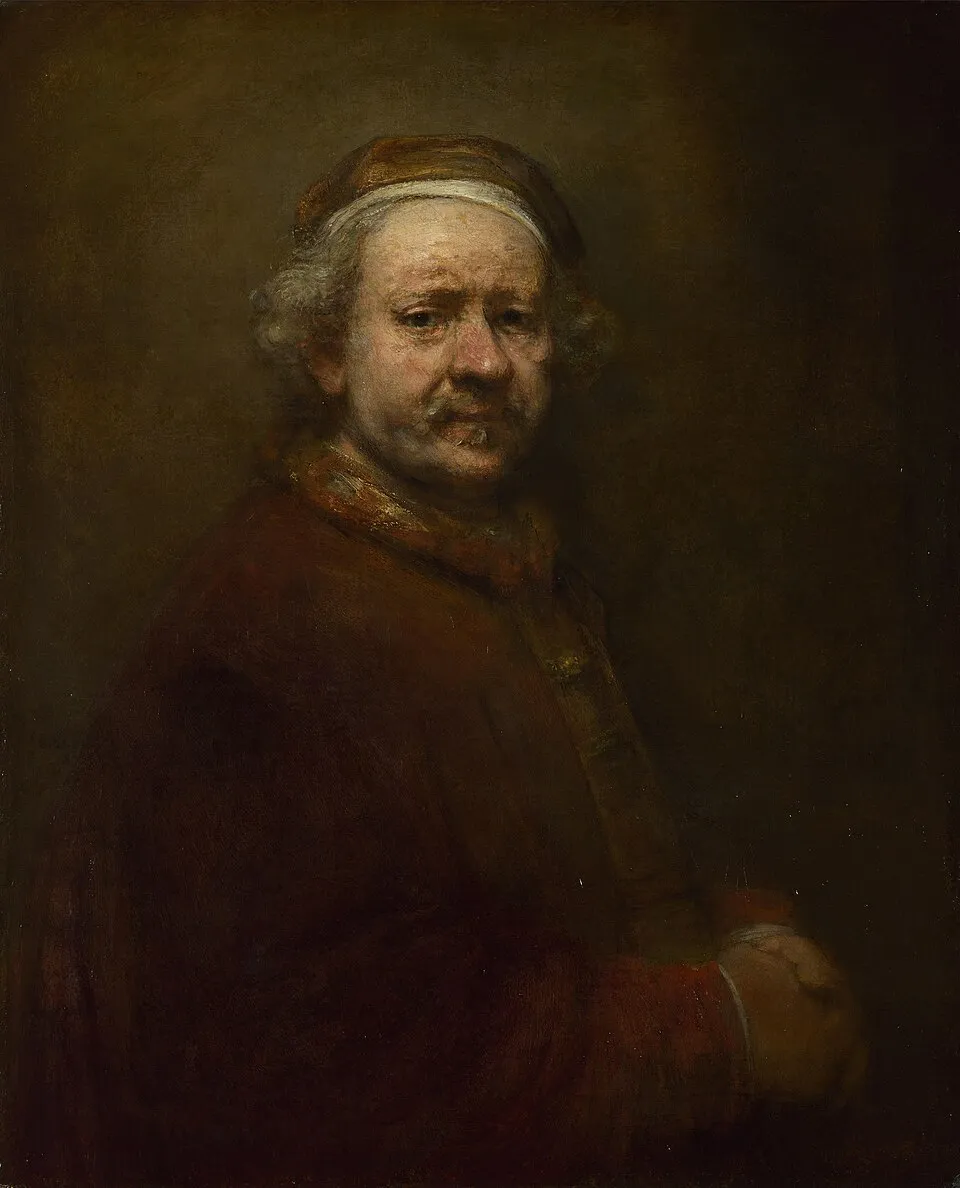
Rembrandt van Rijn, "Self-Portrait" (1669). Oil on canvas, 86 x 70.5 cm. Mauritshuis, The Hague. Image via Wikimedia Commons
The late self-portraits are simpler, rougher, and more honest than the early ones. The young Rembrandt showed himself as a gentleman, a soldier, a laughing face, a performer. The old Rembrandt shows himself as he is: old, poor (he had declared bankruptcy in 1656), and mortal. The paint is rough, the colors are muted, the background is dark. There is no posing, no costume, no performance. Just a face, looking at itself. The late self-portraits are the most honest self-portraits in art history. They do not flatter, they do not idealize, they do not perform. They show an old man looking at himself, and the looking is the subject. The late self-portraits are not about appearance but about existence: the fact of being old, the fact of being mortal, the fact of looking at yourself and seeing the end. For more on Rembrandt's career, read our guide on Rembrandt.
Goya's Black Paintings (1819-1823)
Francisco Goya (1746-1828) moved into the Quinta del Sordo (Deaf Man's House) outside Madrid in 1819, at age 72. He was deaf, isolated, and disillusioned. He had witnessed the atrocities of the Peninsular War and the repression of the restored monarchy. He painted 14 murals directly on the walls of the house: "Saturn Devouring His Son" (143.5 x 81.4 cm), "Witches' Sabbath" (140 x 79 cm), "The Dog" (134 x 80 cm), "Fight with Cudgels" (123 x 266 cm). The paintings are dark, violent, and despairing. They depict horror, madness, and cruelty. They were painted for no audience but Goya himself.
The Black Paintings are the ultimate late style, a complete break with Goya's earlier work. The court painter who painted tapestry cartoons and royal portraits is gone. In his place is an old, deaf man painting nightmares on his walls. The brushwork is rough, the colors are dark (blacks, browns, ochres), the compositions are stark. The paintings are not finished. They are raw, as if Goya could not be bothered with polish. Adorno's concept of late style, "a break with the artist's own past, a refusal of convention," describes Goya exactly. The Black Paintings are not the work of a man at peace with his life. They are the work of a man who has seen too much and is past caring what anyone thinks. For more on the stories behind these works, see our guide on famous paintings.
Monet's Late Water Lilies (1914-1926)
Claude Monet (1840-1926) began the water lilies series in 1899 at his garden in Giverny. The late series, the "Grandes Décorations," were painted between 1914 and 1926, when Monet was in his 70s and 80s. They are now in the Musée de l'Orangerie in Paris: 8 panels, each 2 meters high and up to 17 meters long, installed in two oval rooms. The late water lilies are radically different from the early ones. The early paintings (1899-1909) are representational. You can see the water, the lilies, the bridge, the sky reflected in the pond. The late paintings (1914-1926) are abstract. The surface of the pond dissolves into pure color and brushstroke. There is no horizon, no sky, no edge. Only the surface of the water, which is also the surface of the canvas.
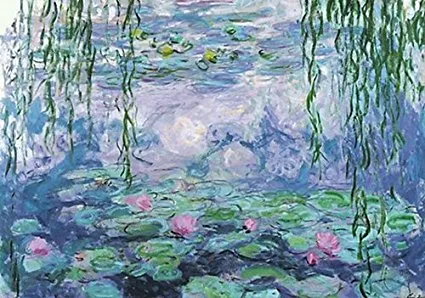
Claude Monet, "Water Lilies" (c. 1916-1919). Oil on canvas. Musée de l'Orangerie, Paris. Image via Wikimedia Commons
Monet was in his 70s and 80s, suffering from cataracts (diagnosed 1912, surgery 1923), grieving the death of his wife Alice (1911) and his son Jean (1914), and working on the most ambitious project of his career. He destroyed canvases. "I have just destroyed at least 30 canvases, to my great satisfaction" (1907). He collapsed in 1908 from the strain. The late water lilies are the most abstract paintings of Monet's career. They push Impressionism to the edge of abstraction. They are also the most personal, a record of an aging painter's impaired vision, his grief, and his obsession with a single subject. The late water lilies are not "about" the pond at Giverny. They are about the act of seeing, the failure of seeing, and the persistence of painting in the face of both. The Smithsonian Magazine published a useful overview of Monet's water lilies. For more on his movement, read our guide on Impressionism.
Beethoven's Late Quartets: The Parallel (1824-1826)
Ludwig van Beethoven (1770-1827) wrote his late string quartets (Op. 127, 130, 131, 132, 135) between 1824 and 1826, when he was in his mid-50s, completely deaf, and in failing health. The quartets are complex, dissonant, and unconventional. They break the rules of classical form, with sudden shifts of key, tempo, and mood. They were considered unplayable and incomprehensible by contemporaries.
Theodor Adorno, in "Late Style in Beethoven" (1937), argued that the late quartets are not a resolution but a rupture. The late style is characterized by "the absence of synthesis." The parts do not come together into a harmonious whole. The music is fragmentary, difficult, and resistant. Adorno saw this as a response to mortality: the late artist, aware of death, refuses the illusion of resolution and presents the truth of fragmentation. Edward Said extended Adorno's analysis in "On Late Style" (2006, posthumous). Said argued that late style is not about wisdom or serenity but about "intransigence, difficulty, and unresolved contradiction." The late artist does not sum up. He breaks open. The late work is not a conclusion but a provocation. You can read more about the concept on Wikipedia's entry on late style.
The concept of late style, developed in relation to music, applies equally to painting. Titian's "Pietà," Rembrandt's last self-portrait, Goya's Black Paintings, Monet's late water lilies, all are examples of late style: a rupture with the artist's own past, a refusal of convention, a turn toward difficulty and fragmentation. The late style is not decline. It is the most radical phase of the artist's career. For more on how art encodes social and material conditions, read our guide on art and society.
What Aging Brings to Art That Youth Does Not
Aging changes the body. The eyes (cataracts, presbyopia), the hands (tremor, arthritis), the energy (fatigue, illness). These changes affect the art: the brushwork loosens, the palette narrows, the finish disappears. The aging body produces a different art than the young body, not a worse art, but a different one. Aging also changes the mind. The artist has seen more, lost more, and is more aware of mortality. The late work is often darker, more personal, and less concerned with convention or audience. The artist who is near the end of life has less to lose and less to prove. The work becomes more honest, more radical, more itself.
The aging artist also has decades of technical mastery. The late style is not a failure of skill but a liberation from skill. The artist is so skilled that they can dispense with finish, with convention, with the expectations of patrons and audiences. The late style is what happens when mastery meets mortality: the artist knows how to paint and knows that time is running out. Aging is not a decline in artistic ability. It is a transformation. The late style is the most radical, most personal, and most honest phase of the artist's career. The culture that values youth over age in art is wrong. The late work is often the greatest work. Titian at 80, Rembrandt at 63, Goya at 75, Monet at 80, these are the ages at which artists produce their most revolutionary work. The lesson of late style is that art does not decline with age. It deepens. For more on where this kind of work sits in the current scene, see our guide on contemporary art in 2026, and for the related question of how illness shapes late work, read our guide on illness and art.
Final Thoughts
Aging transforms art. Titian's late style (1562-1576), the loose brush, the thick impasto, the blurred contours, revolutionized painting and founded modern oil technique. Rembrandt's last self-portraits (1658-1669) are the most honest self-portraits in art history, an old man looking at himself without flattery or performance. Goya's Black Paintings (1819-1823) are the most radical late style in art, a deaf, isolated old man painting nightmares on his walls. Monet's late water lilies (1914-1926) push Impressionism to the edge of abstraction, a record of impaired vision, grief, and obsession. Beethoven's late quartets (1824-1826) provide the theoretical model: Adorno's "late style," a rupture with the past, a refusal of synthesis, a turn toward difficulty and fragmentation.
My view is that aging is not decline. It is the most radical phase of the artist's career. The culture that values youth over age in art is wrong. The late style is not a summing-up but a rupture, a break with the artist's own past, a refusal of convention, a turn toward difficulty. The late work is what happens when mastery meets mortality: the artist knows how to paint and knows that time is running out. For help training your eye to see these qualities in the work itself, read our guide on how to look at art.
Next time you see a late Titian, a late Rembrandt, a late Monet, do not see it as a decline from the artist's "prime." See it as the opposite: the moment when the artist, freed from convention and audience, produced the most radical work of their career. The late style is not the end of art. It is art at its most honest, most personal, and most free.


