
Note: AI-generated images are discussed and referenced in this article for illustrative context.
In October 2018, an AI-generated portrait called "Edmond de Belamy" sold at Christie's for $432,500. The estimate had been $7,000 to $10,000. The result shocked the art world and launched a debate that has only intensified since: when a machine makes an image, is that image art? And if it is, who made it?
By 2026, the debate has moved well beyond philosophy into courtrooms, legislative chambers, and gallery walls. In March 2025, the United States Court of Appeals for the DC Circuit affirmed that AI cannot be recognized as an author under copyright law, confirming that artworks generated solely by machine have no copyright protection. Simultaneously, artists including Sarah Andersen, Kelly McKernan, and others have pursued class-action lawsuits against Stability AI and Midjourney, alleging that these companies trained their models on billions of copyrighted images without consent. The legal questions are not settled. But they are no longer hypothetical.
This article examines the philosophical question that started the debate, the practical and legal realities that have since complicated it, and where the argument currently stands.
What AI Art Actually Is
AI image generators like Midjourney, DALL-E, and Stable Diffusion produce images by training large neural networks on vast datasets of existing images. The model learns statistical patterns across billions of examples and generates new images by predicting what pixel arrangements satisfy a given text prompt. This is not a trivial process. The results can be visually sophisticated, coherent, and sometimes genuinely surprising.
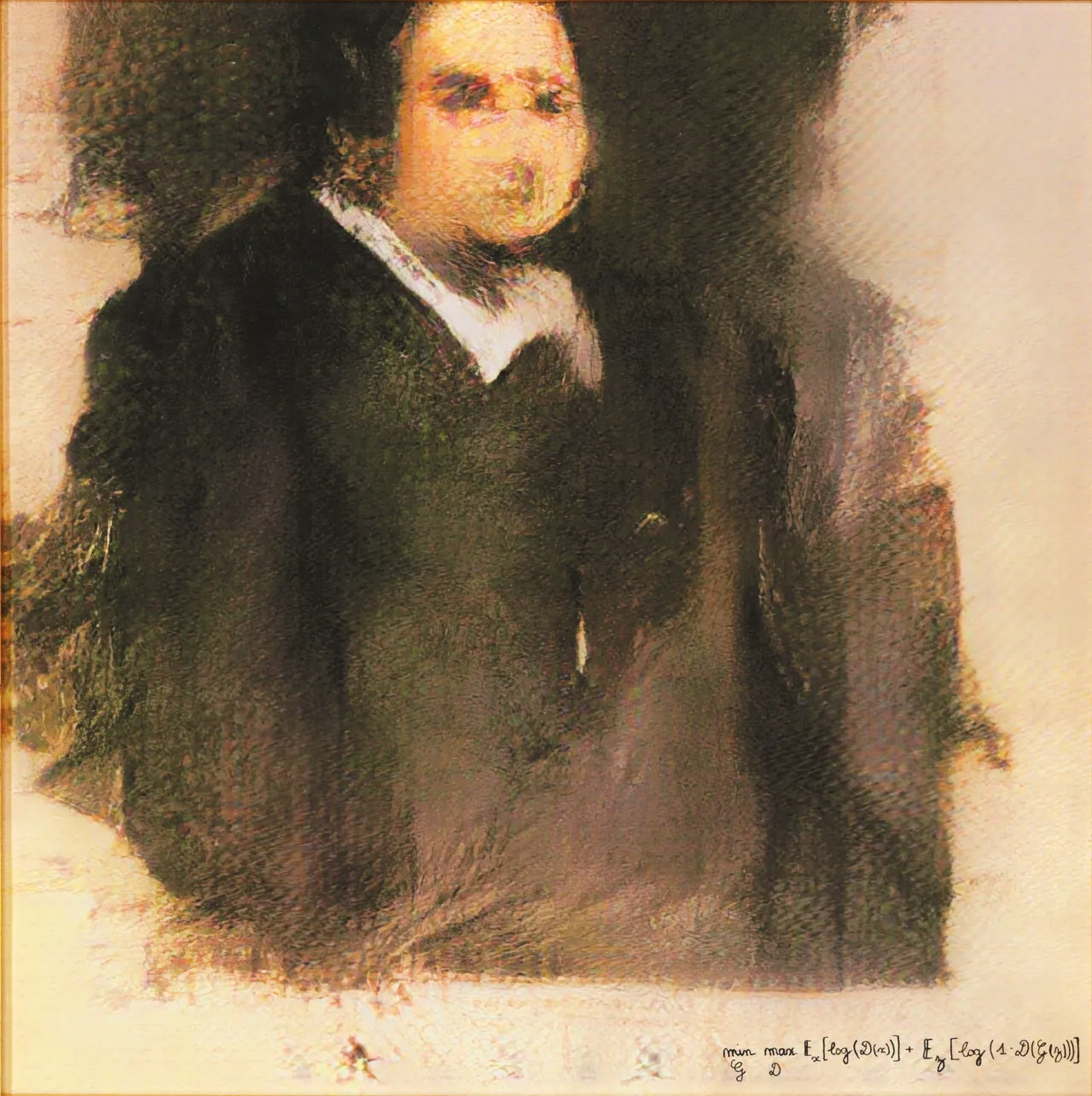
The AI-generated portrait "Edmond de Belamy," 2018, created by the collective Obvious using a generative adversarial network, sold for $432,500 at Christie's. The hammer price was 43 times the high estimate.
What the process does not involve is lived experience, aesthetic judgment developed through failure, or any understanding of what the image means. The model has no concept of beauty, suffering, joy, or irony. It has extremely sophisticated pattern matching applied to a very large dataset. Whether that distinction matters for art is the core question.
The Case Against AI Art as Art
The most serious argument against AI-generated images qualifying as art is not that they look bad (many look impressive) but that the category of art has traditionally required human intention and human experience as its engine. When Goya painted his Black Paintings on the walls of his house during a period of deafness, political exile, and advancing age, the paintings were shaped by what he was living through. The distorted figures and hallucinatory darkness are not decorative choices. They are the visual residue of a specific human situation. You can feel this in the work. There is no equivalent in a Midjourney prompt.
The legal system has arrived at a version of this position. The 2025 DC Circuit ruling in Thaler v. Perlmutter confirmed that copyright requires human authorship. AI cannot be the author of its own output. This matters practically: AI-generated images with no human creative contribution are currently in the public domain from the moment of creation. Anyone can use them without permission or payment.
There is also the question of what AI image generators are trained on. The class-action lawsuit against Stability AI and Midjourney (Andersen et al., filed 2023, still active in 2025) argues that training on copyrighted images without consent amounts to large-scale infringement. Some claims have been dismissed on technical grounds, but the underlying question, whether scraping the entire visual internet to build a commercial product respects the rights of the artists whose work provided the training data, has not been resolved. Many working artists find this straightforwardly unjust, and that moral position seems reasonable regardless of what the courts ultimately decide.
The Case for AI Art as Art
The opposing argument is that art has always been defined by its effects on viewers, not by the process that produced it. If an AI-generated image moves you, disturbs you, or makes you think, those responses are real regardless of how the image was made. The emotional response is not a secondary effect. It is, by many theories of art, the primary phenomenon.
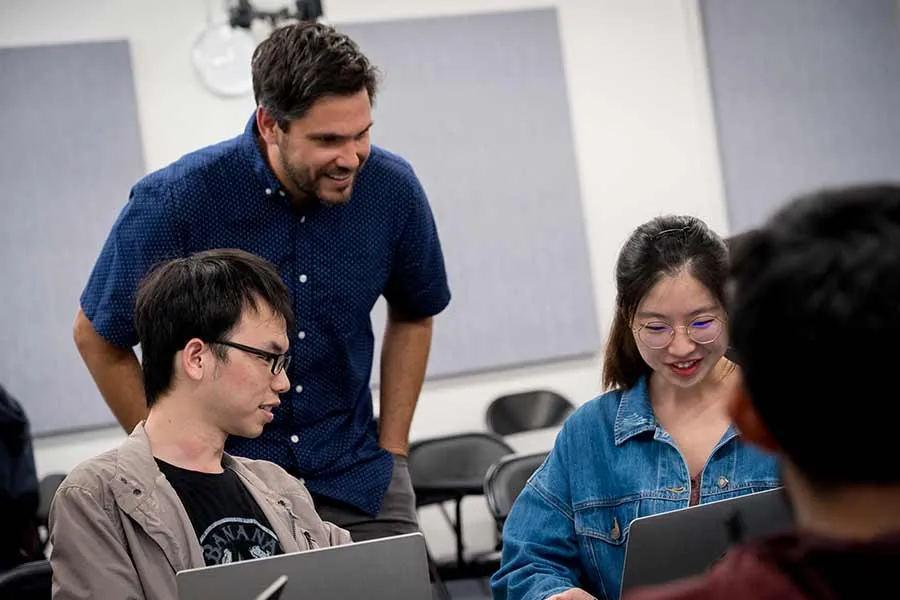
UC San Diego students using AI to generate art. Source: UC San Diego Today
There is also a meaningful distinction between a system autonomously generating an image from a simple prompt and an artist who uses AI tools as part of a developed creative practice. Refik Anadol, a Turkish-American media artist, has spent years building large-scale installations using AI trained on specific datasets, photographs of a building's history, recordings of ocean sounds, archival images of a city. The AI is generating outputs from carefully curated material with a clear conceptual framework behind the choices. This is not the same as typing "dragon in the style of a Renaissance painting" and accepting whatever comes back. Treating these two things identically flattens a real distinction.
The history of art is partly a history of tools changing what is possible. Photography was accused of replacing painting in the 1840s. It did not replace painting; it changed what painting was for. Video was accused of replacing film. It did not. Each new technology shifts the landscape without erasing what came before. AI will likely follow the same pattern, becoming one tool among many rather than the termination of human creative practice.
The Copyright and Authorship Problem
The legal and ethical issues are the ones with the most immediate practical consequences. If AI-generated images have no copyright protection, businesses can use them without acquiring rights, which makes them useful for commercial purposes but economically worthless as art objects in the traditional sense. If AI models were trained on copyrighted work without compensation, the artists whose work powered the training dataset have a legitimate grievance.
Several countries are developing legislative responses. The EU's AI Act, which came into full effect in 2024, requires AI systems to disclose when their outputs are AI-generated and requires training data transparency. The United States has been slower to legislate specifically on AI and copyright, leaving courts to work through the questions case by case.
The practical outcome for working artists, as of mid-2026, is significant market disruption in areas like commercial illustration, stock photography, and concept art for games and films, where AI-generated content can be produced faster and more cheaply than human-made alternatives. The concern is not philosophical. It is economic, and it is real.
Where the Debate Actually Stands
The question "is AI art still art?" is probably the wrong question, because "art" is not a fixed category with a membership committee. Art is what a culture collectively decides to treat as art, and that collective decision is always in motion. The more useful questions are: Who made this, and do they deserve credit and compensation? What does this image know about human experience, and does that matter to its value? What are the conditions under which a person using AI tools is genuinely creating something, and when are they simply consuming output?
My own view: AI-generated images produced by simply typing a prompt into a commercial tool and accepting the result are not art in any meaningful sense, any more than selecting a filter on Instagram is photography. But artists who develop rigorous creative practices that involve AI as one element among many, who make hard decisions about training data, output selection, and conceptual framework, are doing something that deserves to be taken seriously. The tool does not determine the work. The artist does.
Final Thoughts
The arrival of AI image generation is genuinely disruptive. It raises real questions about authorship, originality, economic fairness, and the nature of creative labor that will not be resolved quickly. But the history of art is full of moments when new technologies provoked exactly this kind of crisis, and art has consistently adapted rather than disappeared. The current turmoil is an argument worth having, not a sign that something has ended.
For context on how technology has changed creative practice before, our guide to digital art as a creative frontier covers the longer arc. For a deeper look at what defines artistic quality beyond technique, our guide to what makes art good addresses the philosophical questions directly. Where do you stand on AI art? The comments are open.


