
Most people who feel nervous talking about art are not nervous because they lack intelligence or knowledge. They are nervous because they think there is a correct way to respond, a language they have not yet learned, and that saying the wrong thing will reveal them as an outsider. This anxiety produces two common failure modes: either silence, or the opposite, a stream of vague, hedging adjectives ("it is interesting, very powerful, sort of... evocative") that communicates nothing and satisfies no one.
Art criticism, at its best, is nothing more than precise observation combined with honest response. The most respected critics, whether Robert Hughes, Linda Nochlin, or Dave Hickey, built their authority on the willingness to say specific things about specific works, to describe what they actually saw and what they actually thought, without hiding behind abstractions. You do not need their knowledge base to do the same thing at a lower level. You need a framework for looking, a habit of describing before interpreting, and the courage to have an actual opinion.
This guide gives you that framework in four steps.
Step One: Look Before You Label
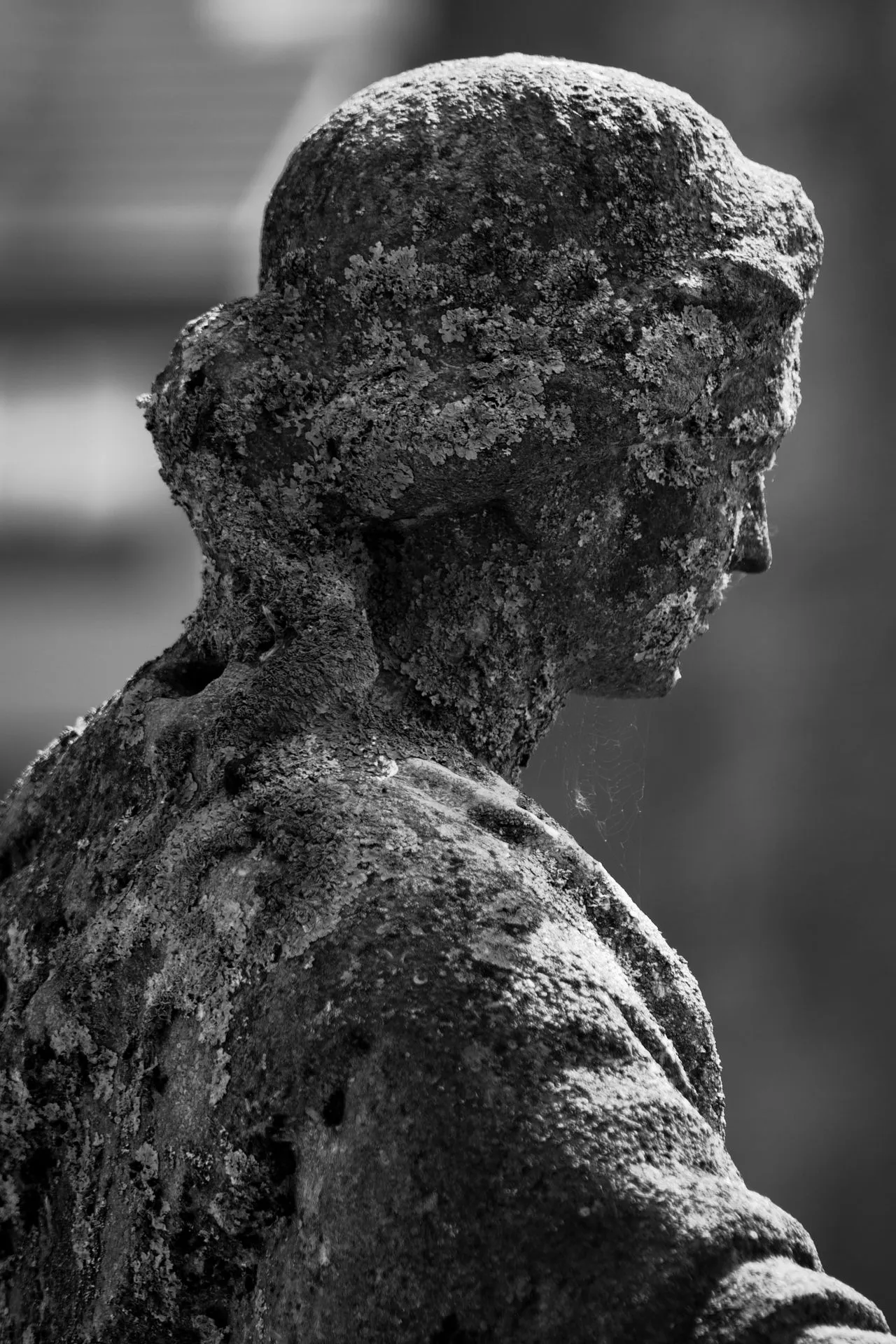
Photo by Budget Bizar on Pexels.com
The most common mistake in talking about art is reaching for interpretation before completing the work of description. Someone stands in front of a painting for fifteen seconds, decides it is "about isolation," and defends that reading without being able to say what they are actually seeing. This produces criticism that is abstract, unconvincing, and often wrong.
Before you form any opinion about what a work means or whether you like it, spend time simply describing what is there. Color: what hues are present, how saturated are they, what proportion of the image does each occupy? Line: are the edges hard or soft, the forms geometric or organic, the shapes static or implying movement? Texture: is the paint surface thick or thin, does the mark-making create a consistent texture or a varied one? Scale: how large is the work, and how does the scale affect your experience of standing in front of it?
This descriptive phase sounds mechanical, but it produces real benefits. It slows you down. It forces you to actually look rather than project. And it generates the specific observational material that criticism requires. "The paint is applied in short horizontal strokes throughout, with the exception of the figure's face, where the strokes are longer and more vertical" is infinitely more useful as the foundation for a critical statement than "it feels lonely."
When you encounter a work like Jan van Eyck's "The Arnolfini Portrait" (1434), the descriptive phase alone yields extraordinary material: the convex mirror at the back of the room reflecting two figures, including presumably the painter himself; the single lit candle in the chandelier above a fully lit room; the shoes left carelessly by the door. Description precedes interpretation, and in this case, it makes the interpretation richer because you are responding to specific things rather than general impressions.

Jan van Eyck, "The Arnolfini Portrait," 1434. National Gallery, London. Before interpreting what this painting is "about," describe what you actually see: the convex mirror, the single candle, the green dress, the small dog. The interpretation follows from the description.
Step Two: Use Descriptive Language, Not Evaluative Language
The fastest way to sound pretentious when talking about art is to reach immediately for evaluative adjectives: "brilliant," "powerful," "moving," "incredible." These words carry no information. They tell the person you are talking with nothing about what you are experiencing or why. They are also difficult to argue with, which gives them a false rhetorical authority: saying "this painting is incredibly powerful" shuts down conversation because there is nothing specific to agree or disagree with.
Descriptive language, by contrast, opens conversation because it can be verified, contested, and built upon. "The figure in the foreground is roughly twice the scale of the figures behind it" is a description that can be agreed with, adjusted, or given a different interpretive weight by your conversation partner. "The palette is almost entirely neutral except for the single red element in the upper left" gives someone something to work with.
A useful test: if you cannot point to something specific in the work to support what you are saying, you are probably in evaluative territory rather than descriptive territory. Move back to the work. Find the specific visual evidence for what you are feeling, and describe that instead.

Photo by rana aldemir on Pexels.com
Step Three: Frame Responses as Your Experience, Not Universal Truth
The pretentiousness trap is almost always a function of claiming that your response is the correct or inevitable response. "This painting is depressing" closes down a conversation. "I find this painting depressing, and I think it is because of the grey-green palette and the way the figures are positioned with their backs to each other" opens it up. The second version communicates more, sounds less authoritarian, and invites a genuine response.
This is not false modesty or intellectual hedging. It is precision. Your response is data. The grounds for that response (the palette, the composition, the specific visual choices you have identified) are also data. Presenting both together gives your conversation partner something to engage with, and it demonstrates that you are taking the work seriously rather than using it as a mirror for your own emotions.
The language shift is simple: "This feels like..." rather than "This is..."; "I notice that..." rather than "Clearly, this shows..."; "What strikes me is..." rather than "What is obvious here is..." These are not passive or uncertain framings. They are honest framings that accurately reflect the subjective nature of aesthetic response.
Step Four: Bring Context Gently and Accurately
Context can deepen a critical engagement enormously, but only when it is accurate and only when it is connected to something you have actually observed in the work. Art historical knowledge deployed as a way of demonstrating expertise, rather than genuinely illuminating what you are looking at, is among the clearest signals of pretentiousness.
Saying "this reminds me of Cubism because of the geometric fragmentation of the figure" is useful if the work actually shows geometric fragmentation of a figure. Saying "this reminds me of the late Baroque period" without being able to say specifically what in the work produces that impression is not useful, and experienced viewers will notice the gap between the claim and the evidence.
If you are genuinely uncertain about the context, say so and frame it as a question: "I am getting a sense of something like German Expressionism from the color, is that a reference the artist is making intentionally?" This is a more honest and often more generative approach than asserting a connection you are not sure of. Artists, particularly in studio visit contexts, usually appreciate questions that show genuine looking rather than performed knowledge.
The Balance: Strengths and Weaknesses Together
A critique that only identifies strengths is not a critique. It is praise, which is fine in its place but which does not help an artist develop their work. A critique that only identifies weaknesses is not useful either, because it does not give the artist or the viewer any orientation toward what is working. Useful criticism identifies both.
This does not mean treating every work as if it deserves equal praise and criticism for balance. Some works are genuinely stronger in their successes than their failures. Others are interesting primarily for what goes wrong. The critic's job is to describe what is actually there, not to maintain a false equilibrium.
When identifying what you think is not working, the key is to ground the observation in the work rather than in your taste. "The final third of the canvas feels under-resolved compared to the upper two-thirds" is a useful observation about relative completion within the work. "I just don't really like abstract painting" is taste, not criticism, and it is more honest to acknowledge it as such.
Practice: Three Exercises for Developing Critical Language
The capacity to talk meaningfully about art develops through practice, and there are specific exercises that accelerate it faster than simply visiting galleries and hoping the language arrives on its own.
The first exercise is written description without interpretation. Stand in front of a work, or sit with a high-quality reproduction, and write for ten minutes describing only what you see: every color, every edge, every texture, every spatial relationship. No interpretation, no evaluation, no context. This exercise develops the observational vocabulary that criticism requires.
The second exercise is timed comparison. Choose two works, either in the same gallery or in reproduction, and write for five minutes about how they are different and how they are similar. Comparison forces you to be specific because you need to say which work has a particular quality and which does not.
The third exercise is reading professional criticism and identifying the specific observations on which each critical claim is built. Take a review from Artforum or the Burlington Magazine and trace each interpretive statement back to its observational foundation. Over time, this builds an intuitive understanding of how claims and evidence work together in art writing.
Final Thoughts
Talking about art well is not about knowing the right vocabulary or having the right academic background. It is about taking the work seriously enough to actually look at it, being honest about what you see and feel, and grounding your responses in specific observations rather than general impressions. The critics who have advanced our understanding of art, from Robert Hughes to Linda Nochlin, shared one characteristic above all others: they wrote about what they could actually see, and they had the courage to say what they thought about it.
You can do the same thing. Start with description. Be honest about your response. Ground every interpretive claim in a specific observation. And do not mistake confidence for certainty: the most interesting art criticism is often provisional, willing to be wrong, and open to revision in the face of better looking.
For the broader context of how visual elements produce responses in the first place, read our guide to how art communicates emotion without words. And for the framework of composition that underlies most of what you will observe in a painting, our introduction to composition in art gives you the foundational vocabulary.


