When I first saw a Francis Bacon painting in person at the Tate Britain, I physically stepped back. The figure in "Study after Velazquez's Portrait of Pope Innocent X" (1953) looked like it was trapped inside a glass box, screaming, its mouth open in a silent howl while dark smears of paint dragged across the face. My immediate reaction was revulsion. I thought: this is ugly. This should not exist. Then I stood there for another ten minutes, unable to leave.
That split between disgust and fascination is what neuroaesthetics researchers are now mapping with remarkable precision. A 2025 meta-analysis published in the journal Cortex examined the neural correlates of negative aesthetic evaluations toward visual artwork and found that the right fusiform gyrus, a brain region central to facial and object recognition, is specifically activated when we judge art as ugly. The study, led by researchers who analyzed 16 neuroimaging experiments, also confirmed that the brain processes negative aesthetic judgments differently from negative reactions to non-artistic images, suggesting that the context of "art" itself changes how our neural systems handle displeasure. You can read the full paper at PMC (PubMed Central).
What this means is that finding art ugly is not a failure of taste or education. It is a measurable brain response with specific neural signatures. But it is also a response that can be trained, shifted, and overturned. Understanding how that process works requires looking at disgust, exposure, cultural conditioning, and the neuroscience of aesthetic judgment.
The Disgust Response: When Art Feels Wrong
The psychologist Jonathan Haidt argued that disgust is one of the most powerful human moral emotions, evolved originally to protect us from contamination and physical danger but then extended by culture into the moral and social domain. We find certain things disgusting not because they are literally dangerous but because they violate categories we consider important. Something that mixes what should be separate (living and dead matter, human and animal, public and private) triggers a strong aversive reaction.
A 2024 study in Nature Human Behaviour by Xianyang Gan and colleagues identified a neurofunctional signature of subjective disgust that generalizes across oral distaste and socio-moral contexts. The researchers found that disgust triggered by moral or social transgression activates the same core neural systems as disgust triggered by spoiled food. This finding has direct implications for art: when Francis Bacon paints smeared and distorted flesh, or when Cindy Sherman stages grotesque character photographs, they are activating the same neural circuits that evolved to protect us from rotting meat. The brain does not neatly separate "this is art" from "this is dangerous" in its initial processing.
The British artist Marc Quinn made a self-portrait bust from nine pints of his own frozen blood ("Self," 1991). The combination of self-portraiture with bodily material produces a visceral unease in many viewers that goes beyond simple aesthetic disapproval. When I saw it at the National Portrait Gallery, I watched visitors recoil, lean in, recoil again. That oscillation between attraction and repulsion is exactly what the neuroscience predicts: the brain is simultaneously processing the object as art (engaging aesthetic evaluation systems) and as bodily material (engaging disgust systems).
But aesthetic disgust extends well beyond bodily content. People report genuine revulsion at abstract paintings they cannot decode, at conceptual art they find intellectually fraudulent, at technically crude work shown in prestigious contexts. In these cases, disgust is not about physical contamination but about category violation: the sense that something has been misclassified, that an object is claiming a status it has not earned. A 2026 study published in Social Cognitive and Affective Neuroscience demonstrated that people show a measurable neural bias against artworks labeled as AI-generated compared to identical artworks labeled as human-created, with EEG recordings showing higher P300 amplitudes and alpha power for "human" labels. The art did not change. The label changed. And the brain responded with different levels of cognitive engagement based on that label alone.
The Ugly Duchess and the History of Deliberate Ugliness
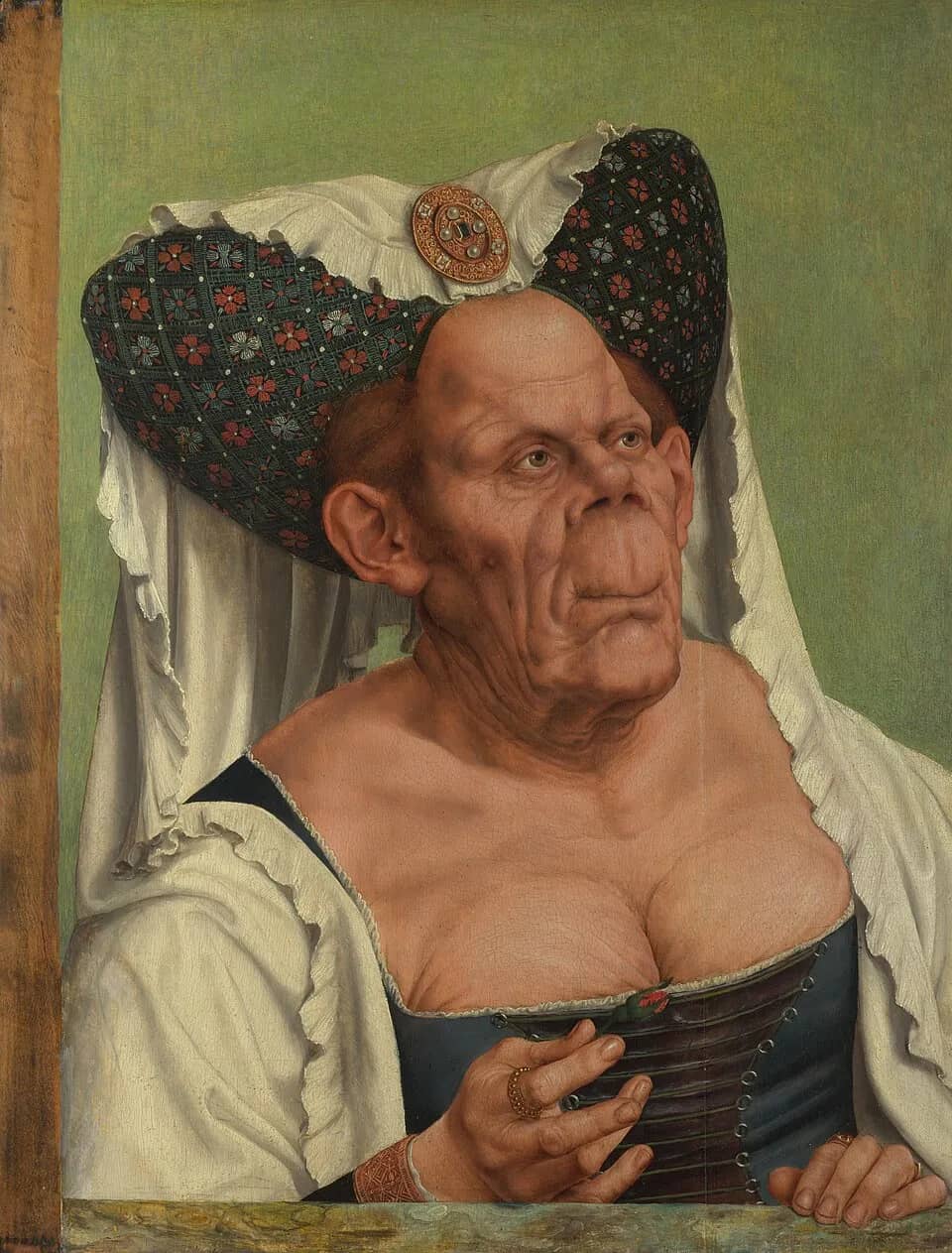
Art has always included deliberate ugliness. Quentin Massys painted his "Grotesque Old Woman" (also called "The Ugly Duchess") around 1513. The painting depicts an elderly woman in a low-cut dress, her face rendered with hyperrealistic fidelity to the effects of age and unconventional bone structure. She holds a flower, the conventional symbol of love and courtship. The combination of the conventional romantic gesture with the deliberately unconventional subject is the point: the painting is a satirical commentary on vanity and on the comedy of human desire persisting beyond the period when culture considers it appropriate.
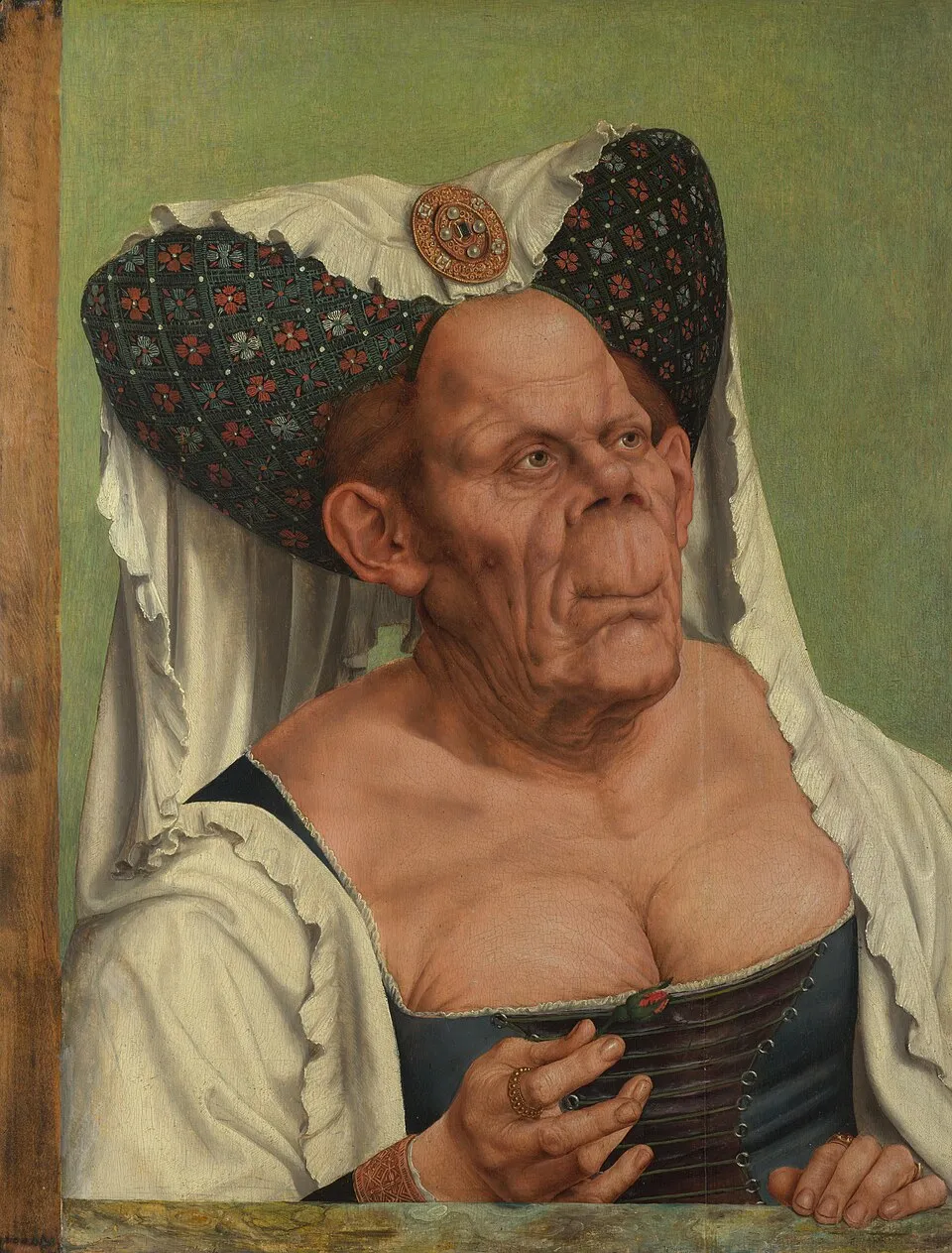
Quentin Massys, "A Grotesque Old Woman" (also called "The Ugly Duchess"), c. 1513, oil on panel, 64.2 x 45.5 cm. National Gallery, London. The painting treats an "ugly" subject with the same careful attention that would conventionally be reserved for a beautiful one. Image: Public domain, via Wikimedia Commons
Deliberate ugliness serves different purposes in different periods. In German Expressionism, the distorted figures of Ernst Ludwig Kirchner and Emil Nolde rejected classical beauty standards in the service of emotional intensity. In Dada, ugliness was a weapon against the bourgeois culture that had produced the First World War. In contemporary art, ugliness is often a political tool. Kara Walker uses silhouette forms that are both decorative and horrifying, depicting the violence of American slavery in a visual language that makes it impossible to look away or look comfortably. You can read more about her work in our Kara Walker artist profile.
How Taste Is Formed: Exposure, Complexity, and the Brain
The mere exposure effect, first described by Robert Zajonc in 1968, remains one of the most replicated findings in psychology. People tend to find things more appealing the more they have been exposed to them, even without conscious recognition of the familiarity. A study published in 2025 in Empirical Studies of the Arts by researchers examining how familiarity with different complexity levels influences aesthetic judgments found that prior exposure to complex images changes how viewers rate subsequently encountered images. Participants familiarized with high-complexity images rated intermediate images as less complex, and their liking ratings were significantly predicted by this recalibrated perception of complexity.
This means that what we find ugly is very often simply what we have not yet seen enough of. Impressionism was derided as ugly and incompetent when it first appeared in the 1870s. A critic wrote that Claude Monet's "Impression, Sunrise" (1872) looked like unfinished wallpaper paste. Within thirty years, Impressionist paintings were the most fashionable and expensive works in Europe. The paintings had not changed. The viewers had changed, through exposure. Our guide to Impressionism covers this transformation in detail.
A 2026 study published in Nature Communications by Xinyu Liang and colleagues used 7T fMRI to identify two principal dimensions organizing shared aesthetic evaluations of paintings: visual semantics and hedonic valuation. Category-selective regions along the ventral visual stream tracked variation in visual semantics (what the painting depicts), while medial prefrontal and subcortical circuitry tracked hedonic valuation (how much viewers liked it). The study also found that individual differences in this aesthetic space, particularly within default mode network regions, scaled with visual art expertise. In plain terms: the brains of people with more art experience process paintings differently. Their neural architecture for aesthetic evaluation is literally reorganized by exposure.
The same process has repeated with Cubism, Abstract Expressionism, and Minimalism. In each case, the initial public reaction was revulsion and the accusation that the work was not really art. In each case, extended exposure and critical explanation shifted the response. This does not mean that all initially ugly art eventually becomes beautiful. But it does mean that the instinct to dismiss unfamiliar art as ugly is worth examining carefully before acting on it. If you want to understand why abstract art in particular provokes this reaction, our guide to why abstract art makes people uncomfortable breaks down the specific psychological mechanisms at work.
Cultural Relativity and the Limits of Universal Taste
If taste were purely biological, we would expect consistent agreement about beauty across cultures. The evidence does not support this. While some broad tendencies appear cross-culturally (preferences for symmetry, for certain color combinations), the specific visual preferences that distinguish beautiful from ugly are deeply culturally conditioned.
The philosopher Denis Dutton argued in "The Art Instinct" (2009) that aesthetic preferences have a biological foundation in evolutionary fitness signals. But his evidence for cross-cultural agreement was limited to a narrow range of landscape types and figurative subjects. The enormous variation in what different cultures consider beautiful in portraiture, abstract ornament, body modification, architecture, and color choice suggests that the cultural layer on top of any biological baseline is thick and powerful.
A 2024 study by Maria Pombo and Denis Pelli published in iScience examined consensus and contention in beauty judgment and found that while there is measurable agreement about beauty within a given cultural context, the disagreements are substantial and systematic. People do not just differ randomly. They differ in ways that correlate with their cultural background, their training, and their prior exposure to specific visual traditions.
This matters practically because judging art from other cultural traditions using the aesthetic standards of your own tradition is almost guaranteed to produce distorted responses. Features that appear ugly within one visual tradition may be precisely calculated aesthetic achievements within their own traditions. Our guides to African art and Japanese art and the aesthetic of ma cover the visual logic behind traditions that Western eyes often initially misread as primitive or crude.
The Snob Problem: When Taste Becomes Hierarchy
Taste judgments are almost never purely aesthetic. The sociologist Pierre Bourdieu demonstrated in "Distinction: A Social Critique of the Judgement of Taste" (1979) that aesthetic preferences track social class more reliably than they track anything inherent in the artworks themselves. What counts as "good taste" at any given moment is largely what the dominant social class considers good taste, and calling something ugly is often a way of signaling cultural superiority rather than making a genuine aesthetic judgment.
Norman Rockwell's illustrations for the Saturday Evening Post were dismissed as sentimental kitsch by the Abstract Expressionist critics who shaped the mainstream art world from the 1940s onward. Today, Rockwell is exhibited at major museums and his original paintings sell at auction for tens of millions of dollars. The work did not change. The social and institutional gatekeeping around what counts as serious art shifted.
None of this means that aesthetic judgments are purely arbitrary or that all art is equally good. Some art is more technically accomplished, more intellectually rigorous, and more formally inventive than other art, and these qualities can be assessed with some degree of shared criteria. But the initial gut reaction of "this is ugly" is a less reliable guide to these qualities than it feels in the moment. For a broader framework on evaluating art, see our guide to how to critique art without sounding pretentious. And for more on the neuroscience of positive aesthetic experience, our guide to the science of beauty covers what we know about why art moves us.
Final Thoughts
Finding art ugly is not a failure of taste. It is a genuine brain response with specific neural signatures, rooted in disgust circuits, category violation detection, and cultural conditioning. The neuroscience published in 2024 and 2025 confirms that negative aesthetic evaluations are real, measurable, and processed differently from positive ones. But the same research also shows that these responses are not fixed. Exposure changes how the brain processes art. Expertise reorganizes the neural architecture of aesthetic evaluation.
The art that currently makes you most uncomfortable may, with exposure and understanding, become the art you find most interesting. This is one of the best arguments for continuing to look at art that initially repels you. A 2026 paper in the Review of Philosophy and Psychology even proposed that the brain's dopamine system can convert painful aesthetic experiences into rewarding ones through endogenous opioid activation, offering a neurobiological explanation for why we seek out art that disturbs us.
Next time you encounter a painting that makes you want to turn away, try standing there a little longer. Ask what specifically produces the reaction: is it unfamiliarity, category violation, genuine technical incompetence, or a cultural difference you have not yet learned to read? For more on how to build your confidence looking at challenging work, visit our guide to why some artworks give you chills. What artwork have you changed your mind about over time? Share your experience in the comments.