
The Mughal miniature tradition dates to the 16th century, when Emperor Akbar established imperial painting workshops that synthesized Persian manuscript illumination with Indian, Rajput, and European influences. For centuries, miniature painting was one of the great art forms of South Asia, practiced in Mughal courts, Rajput kingdoms, Pahari hill states, and Deccani sultanates. Then it declined. By the mid-20th century, after Partition (1947) and the establishment of Pakistan and India as separate nations, the miniature tradition was considered a dead art form, a craft preserved in museums, not a living practice. In the 1990s, at the National College of Arts (NCA) in Lahore, a painter named Bashir Ahmed established a miniature painting department. "At the NCA, the newly established department went on to produce such acclaimed contemporary artists as Shahzia Sikander (b.1969), Nusra Latif Qureshi (b.1973)" (Burlington Magazine). "No one exemplifies this better than Shahzia Sikander, born in Lahore a generation after the Partition of India (1947) and moving on to the international stage in the years before 9/11. Alongside her near-contemporary Imran Qureshi, she is one of the best-known artists of Pakistani origin alive today" (The Art Newspaper). The revival of miniature painting as contemporary art is one of the most significant developments in South Asian art of the past 30 years, a tradition that was declared dead and then, through the work of a handful of artists at one art school in Lahore, came back to life.
South Asian art is often reduced to Mughal painting in the West, if it is acknowledged at all. But the tradition is far broader: it includes the Pahari and Rajput schools, the Deccani sultanates, the Company School (Indian artists working for British patrons), and the contemporary miniature movement. It also includes modernism (Maqbool Fida Husain, Francis Newton Souza), contemporary art (Shahzia Sikander, Imran Qureshi, Nusra Latif Qureshi, Aisha Khalid), and the diaspora. This guide covers South Asian art through the Mughal miniature tradition (Emperor Akbar, imperial workshops, Persian synthesis), the schools of miniature painting (Mughal, Rajput, Pahari, Deccani, Company School), the decline and revival (Partition 1947, Bashir Ahmed and the NCA Lahore department in the 1990s), the contemporary miniature movement (Shahzia Sikander, Imran Qureshi, Nusra Latif Qureshi, Aisha Khalid), and why this tradition matters.
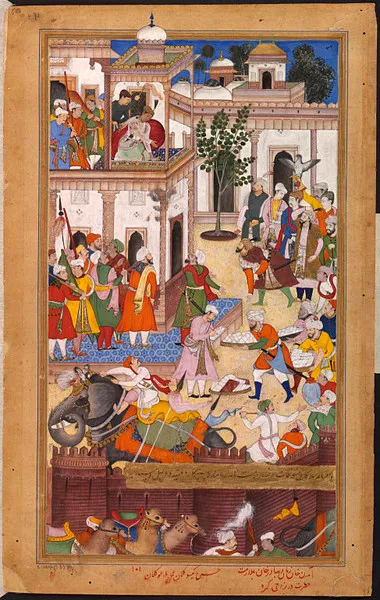
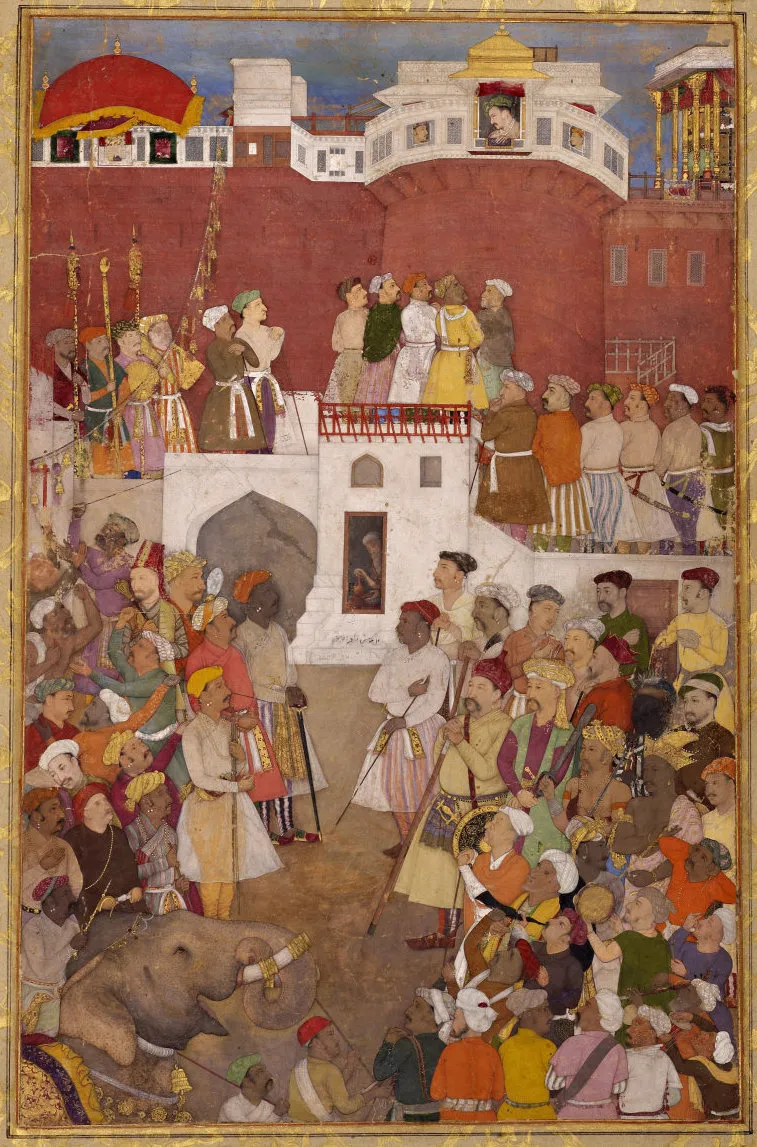
Mughal miniature painting. The tradition dates to the 16th century, when Emperor Akbar established imperial painting workshops. "We believe today that painters of Mughal, Pahari, Rajput, Decani, Company School, AR Chughtai, Bashir Ahmed and his numerous students (Shahzia Sikander, Imran Qureshi, Nusra Latif Qureshi, Aisha Khalid, Talha Rathore, Saira Wasim, Mohammad Zeeshan, Hasnat Mehmood, Waseem Ahmed, Khadim Ali, Wardha Sh[abbir])" form a continuous tradition from the 16th century to the present (The News International). Image via Wikimedia Commons.
The Mughal Miniature Tradition: From Akbar to the Company School
Emperor Akbar (reigned 1556-1605) established imperial painting workshops that brought together Persian painters (brought from Iran by his father Humayun), Indian painters (from local Hindu and Jain traditions), and European influences (brought by Jesuit missionaries). The result was a synthesis, a distinctly Mughal style that combined Persian composition and color with Indian naturalism and European perspective. The schools that followed developed their own distinct styles: Mughal (imperial courts), Rajput (Hindu kingdoms in Rajasthan), Pahari (Hill states in the Punjab Hills), Deccani (sultanates in the Deccan plateau), Company School (Indian artists working for British East India Company patrons in the late 18th and 19th centuries). Each school developed its own style, but all shared the basic format: small-scale, highly detailed, narrative paintings, often illustrating literary texts, historical events, or court life.
The miniature tradition declined in the 19th century as British colonial rule disrupted court patronage. The Company School was the last phase, Indian artists adapting their techniques to British tastes. By the 20th century, after Partition in 1947, the tradition was considered dead. For the wider movement context, see our complete guide to art movements.
The Revival: Bashir Ahmed and the NCA Lahore
At the NCA, the newly established department went on to produce such acclaimed contemporary artists as Shahzia Sikander (b.1969), Nusra Latif Qureshi (b.1973). Bashir Ahmed, a painter trained in the traditional miniature techniques, established the department in the 1990s. We believe today that painters of Mughal, Pahari, Rajput, Decani, Company School, AR Chughtai, Bashir Ahmed and his numerous students form a continuous tradition.
The revival was not about copying old miniatures. It was about using the techniques of miniature painting, the handmade paper (wasli), the squirrel-hair brushes, the mineral pigments, the precise detail, to make contemporary art. The students at the NCA learned the tradition, then broke it open. The NCA miniature department is one of the most successful examples of a traditional art form being revived as contemporary practice. It demonstrates that tradition is not the opposite of innovation. It can be the foundation for it. For a structured way to study this material, see our guide on how to teach yourself art history.
Shahzia Sikander: The International Breakthrough
No one exemplifies this better than Shahzia Sikander, born in Lahore a generation after the Partition of India (1947) and moving on to the international stage in the years before 9/11. Alongside her near-contemporary Imran Qureshi, she is one of the best-known artists of Pakistani origin alive today. Sikander studied at the NCA under Bashir Ahmed, then moved to the United States (Rhode Island School of Design, MFA 1995). She has exhibited at the Whitney Museum, MoMA, and the Venice Biennale.
Shahzia Sikander (b. 1969). "No one exemplifies this better than Shahzia Sikander, born in Lahore a generation after the Partition of India (1947) and moving on to the international stage in the years before 9/11. Alongside her near-contemporary Imran Qureshi, she is one of the best-known artists of Pakistani origin alive today" (The Art Newspaper). Image via Wikimedia Commons.
Sikander's work uses the techniques of Mughal miniature painting, the small scale, the precise detail, the layered composition, to address contemporary themes: gender, identity, colonialism, migration. She deconstructs the miniature tradition from within, using its own tools to question its assumptions. Sikander is the artist who brought contemporary miniature painting to the international art world. Before her, the miniature tradition was considered a historical craft, not a contemporary art form. After her, it is recognized as one of the most innovative practices in contemporary art. For more on the individual works that anchor this history, see our guide to famous paintings explained.
Imran Qureshi and Nusra Latif Qureshi: The Next Generation
Alongside her near-contemporary Imran Qureshi, she is one of the best-known artists of Pakistani origin alive today. Qureshi's work uses miniature techniques to address contemporary violence and politics, particularly the impact of terrorism and political instability in Pakistan. He has exhibited at the Metropolitan Museum of Art (the roof garden commission, 2013) and the Sharjah Biennial. Nusra Latif Qureshi (b. 1973) is one of the acclaimed contemporary artists the newly established department produced. Her work deconstructs the miniature tradition, questioning its colonial and patriarchal structures. She has exhibited internationally and is based in Australia.
Imran Qureshi. "Alongside her near-contemporary Imran Qureshi, she is one of the best-known artists of Pakistani origin alive today" (The Art Newspaper). Qureshi's work uses the techniques of Mughal miniature painting to address contemporary violence, politics, and identity. Image via Wikimedia Commons.
The broader cohort is large. Bashir Ahmed and his numerous students (Shahzia Sikander, Imran Qureshi, Nusra Latif Qureshi, Aisha Khalid, Talha Rathore, Saira Wasim, Mohammad Zeeshan, Hasnat Mehmood, Waseem Ahmed, Khadim Ali, Wardha Shabbir) form a generation of artists who have transformed South Asian contemporary art. The NCA miniature department produced a generation, not a single artist. For the social framework behind this, see our piece on art and society.
Why This Tradition Matters
We believe today that painters of Mughal, Pahari, Rajput, Decani, Company School, AR Chughtai, Bashir Ahmed and his numerous students form a continuous tradition from the 16th century to the present. This is not a dead tradition revived. It is a living tradition that was interrupted by colonialism and Partition, then restored. The contemporary miniature movement demonstrates that tradition and innovation are not opposites. The most innovative art can come from the deepest engagement with tradition, not copying it, but using its techniques, materials, and formats to address contemporary concerns.
The contemporary miniature movement challenges the Western art historical narrative, which treats non-Western traditions as historical (and therefore dead) and Western traditions as contemporary (and therefore alive). The NCA miniature department proves that a non-Western tradition can be both historical and contemporary, that the Mughal miniature is not a museum artifact but a living practice. If you are new to this material, start with our guide on art for beginners, and for how to read the work, see our guide on how to look at art.
Final Thoughts
The Mughal miniature tradition dates to the 16th century, when Emperor Akbar established imperial painting workshops. The schools, Mughal, Rajput, Pahari, Deccani, Company School, developed distinct styles over centuries. The tradition declined under British colonial rule and was considered dead after Partition in 1947. In the 1990s, Bashir Ahmed established a miniature painting department at the National College of Arts (NCA) in Lahore. "At the NCA, the newly established department went on to produce such acclaimed contemporary artists as Shahzia Sikander (b.1969), Nusra Latif Qureshi (b.1973)" (Burlington Magazine). "No one exemplifies this better than Shahzia Sikander, born in Lahore a generation after the Partition of India (1947) and moving on to the international stage in the years before 9/11. Alongside her near-contemporary Imran Qureshi, she is one of the best-known artists of Pakistani origin alive today" (The Art Newspaper). "We believe today that painters of Mughal, Pahari, Rajput, Decani, Company School, AR Chughtai, Bashir Ahmed and his numerous students (Shahzia Sikander, Imran Qureshi, Nusra Latif Qureshi, Aisha Khalid, Talha Rathore, Saira Wasim, Mohammad Zeeshan, Hasnat Mehmood, Waseem Ahmed, Khadim Ali, Wardha Sh[abbir])" form a continuous tradition from the 16th century to the present (The News International). The revival demonstrates that tradition and innovation are not opposites. The most innovative art can come from the deepest engagement with tradition. The contemporary miniature movement challenges the Western art historical narrative, which treats non-Western traditions as historical and Western traditions as contemporary.
Go to the Metropolitan Museum of Art's Islamic Art galleries. They hold one of the finest collections of Mughal miniature paintings. Look at the work from the 16th and 17th centuries, the detail, the color, the narrative. Then look at Shahzia Sikander's work, at the Whitney, at MoMA, or online. Look at Imran Qureshi's work. His 2013 Met roof garden commission is documented online. See how the same techniques, the wasli paper, the squirrel-hair brushes, the mineral pigments, are used to make art about the 21st century, not the 16th. The tradition is not dead. It is alive. It was interrupted, and it came back. For reference, read the Art Newspaper on Shahzia Sikander, the Burlington Magazine on Beyond the Page, and The News International on Miniatures from Several Souths. For where this tradition sits now, see our guide to contemporary art trends.


