
In 1515, Albrecht Durer received a written description and a rough sketch of an Indian rhinoceros that had arrived in Lisbon. He had never seen a rhinoceros. No one in Northern Europe had. He carved a woodblock based on the description and printed an image that circulated across Europe for the next two centuries. The print shows a rhinoceros with a small twisted horn on its back, armor plates riveted to its hide, and decorative scales running down its legs. None of these details are accurate. But Durer's print was so visually authoritative that it shaped European ideas about what a rhinoceros looked like for over 200 years. When a live rhinoceros finally arrived in Europe in 1577, people who saw it reportedly expressed disappointment that it did not match Durer's image.
That is the power of printmaking. A single carved block can produce hundreds of identical images, each one as detailed and visually compelling as a painting, and distribute them across an entire continent. Before photography, printmaking was the only technology that could mass-produce images. It democratized visual culture, spread religious and political ideas, and gave artists a medium that combined the expressive range of drawing with the reproducibility of a printing press.
This guide covers the major printmaking techniques: relief printing (woodcut and linocut), intaglio (etching and engraving), lithography, and screen printing. Each works on a fundamentally different principle, and each has a distinct visual character.
Why Printmaking Changed Everything
Printmaking has played a crucial role in art history for several reasons:
Democratization of art. Prints are affordable multiples. From Durer's woodcuts in the 15th century to contemporary limited editions, printmaking has made original art accessible to a wider audience than painting or sculpture ever could.
Spread of ideas. Before photography, prints were the primary means of reproducing and distributing images. Political cartoons, scientific illustrations, maps, and religious imagery all relied on printmaking to reach mass audiences.
Technical virtuosity. The best printmakers achieve effects impossible in other media. The tonal range of a mezzotint, the precision of an engraving, the graphic power of a woodcut: each technique has unique visual qualities that reward careful looking.
Conceptual innovation. Printmaking's relationship to reproduction, originality, and mass production has inspired conceptual exploration from Warhol's Pop Art to contemporary artists questioning the meaning of authorship in the digital age.
Relief Printing: Woodcut and Linocut
Woodcut
Relief printing is the oldest printmaking technique, originating in China before the 8th century and reaching Europe in the early 15th century. The artist carves an image into a block of wood, removing the areas that should not print. Ink is rolled onto the remaining raised surface, and paper is pressed against it to transfer the image.
The result is a bold, graphic image with strong contrasts between inked and un-inked areas. The wood grain sometimes shows through, adding an organic texture unique to the medium. Woodcut was the dominant printmaking technique in Europe from the 15th through the 16th centuries, and it remained the primary method for mass-producing images until the development of lithography in the 19th century.
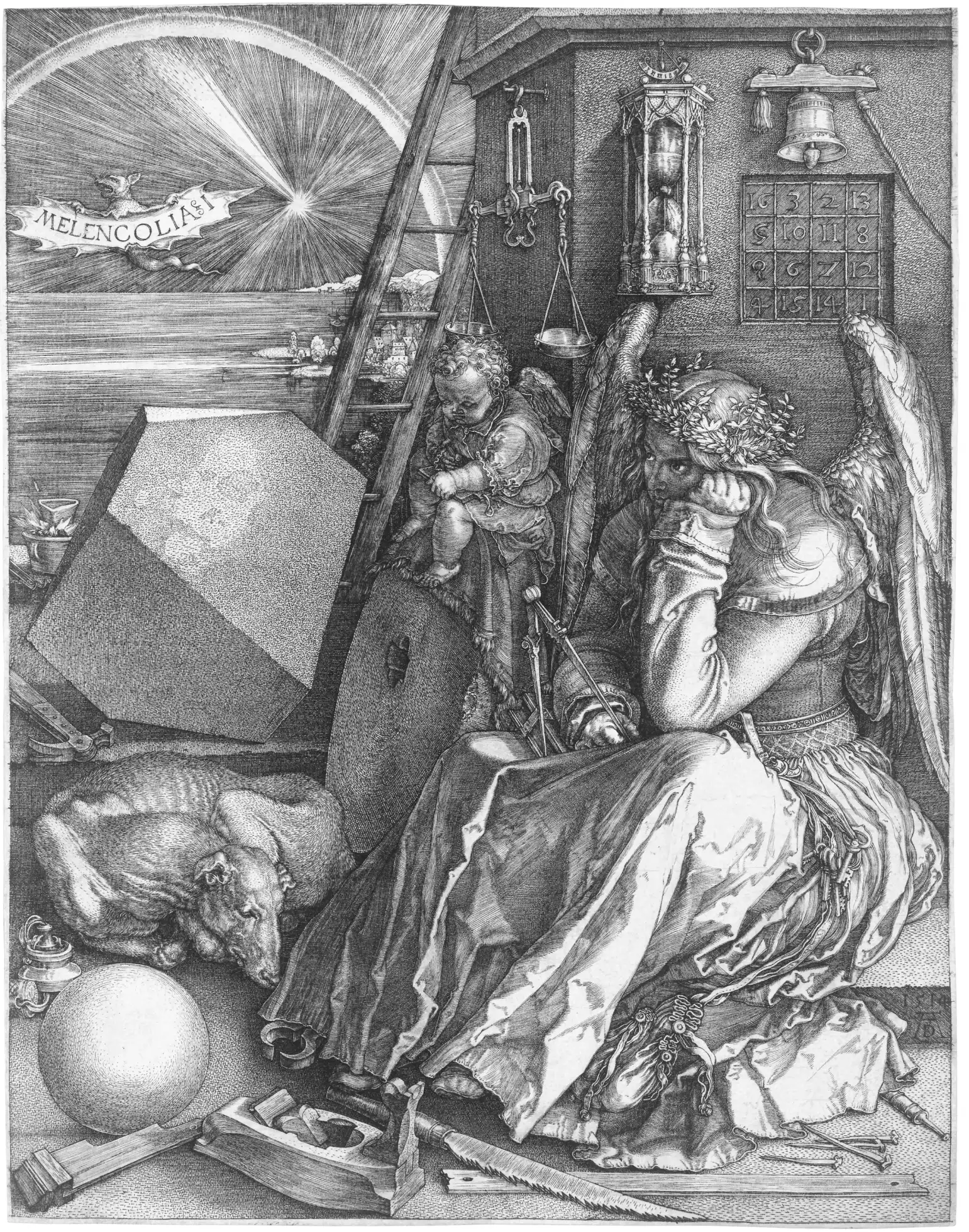
Albrecht Dürer, "Melencolia I" (1514), engraving, 24 × 18.8 cm. One of the most technically accomplished and intellectually complex prints in Western art history. Image: Public domain, via Wikimedia Commons
Albrecht Durer (1471-1528) elevated woodcut from a craft medium to a fine art form. His "Apocalypse" series (1498) demonstrates a level of detail and tonal subtlety that had never been achieved in relief printing. He used a technique called chiaroscuro woodcut, in which multiple blocks printed in different tones create the effect of light and shadow. The level of detail Durer achieved in wood is staggering: fine cross-hatching, delicate textures, and tonal gradations that seem impossible given the blunt instruments involved. In Japan, the ukiyo-e tradition, including masters like Hokusai ("The Great Wave," c. 1831) and Hiroshige, developed color woodcut printing to an extraordinary level of sophistication, using multiple carved blocks (one per color) to create images of remarkable beauty and precision. The Metropolitan Museum's overview of ukiyo-e provides excellent context on the Japanese tradition.
Linocut
Linocut uses the same principle as woodcut but substitutes linoleum for wood. Linoleum is softer, easier to carve, and has no grain, making it more forgiving for beginners while still capable of sophisticated results. The technique was popularized in the early 20th century by artists including Henri Matisse, who created bold, simplified linocuts that complemented his painted work.
Pablo Picasso made some of the most inventive linocuts in art history. In the 1950s and 1960s, he developed a "reduction" technique where he carved and printed successive colors from a single block, progressively removing material between each color layer. This approach produces rich, multi-colored prints from a single matrix, but it is irreversible: each stage destroys the previous one, making it impossible to produce additional prints beyond the initial edition. His "Still Life under the Lamp" (1962) is the most celebrated example of this technique.
Visual character: Bold, graphic, high contrast. The carved marks are visible in the final print. Fine detail is difficult because the cutting tools make blunt, direct marks.
Intaglio Printing: Engraving and Etching
Engraving
Intaglio is the opposite of relief printing. Instead of carving away the negative space and inking the raised surface, the artist cuts the image into a metal plate (usually copper or zinc), fills the cut lines with ink, wipes the surface clean, and forces paper into the lines under heavy pressure. The image prints from the recessed lines, not from the surface.
Engraving involves cutting lines directly into the metal plate with a sharp tool called a burin. This requires enormous physical skill and control. The lines are precise, clean, and deliberate. The depth and width of each line determine its darkness and thickness, giving the engraver complete control over value and texture. Durer's engravings, including "Knight, Death, and the Devil" (1513) and "Melencolia I" (1514), achieve a range of value and textural detail that rivals painting.
Etching
Etching uses acid rather than physical force to create lines. The metal plate is coated with an acid-resistant ground (a waxy substance). The artist draws through the ground with a needle, exposing the metal beneath. The plate is then submerged in acid, which "bites" into the exposed lines. Longer exposure creates deeper, darker lines; shorter exposure creates finer, lighter lines.
Etching revolutionized printmaking because it allowed artists to draw freely, with the same spontaneity as pen and ink, rather than forcing them to carve metal with a burin. The needle moves freely through the soft ground. It feels almost like drawing with a pen, not the controlled, muscular effort of pushing a burin through metal. This freedom attracted painters to the medium. Rembrandt (1606-1669) was the greatest practitioner of etching in art history. He produced over 300 etchings during his career, pushing the medium to levels of tonal richness and emotional depth that had not been achieved before and have rarely been matched since. His etching "Christ Healing the Sick" (c. 1648), known as "The Hundred Guilder Print" because it sold for that enormous sum during his lifetime, combines multiple techniques: etched lines, drypoint burr, and engraving, all on a single plate. The result has the tonal range of a painting, with deep shadows and luminous highlights, all produced from ink pressed into lines cut in metal. The Metropolitan Museum's collection of Rembrandt etchings provides a comprehensive overview of his work in the medium.
Visual character: Fine, precise lines. Rich tonal range through cross-hatching and multiple bitings. Spontaneous, drawn quality in etching. Precise, controlled quality in engraving.
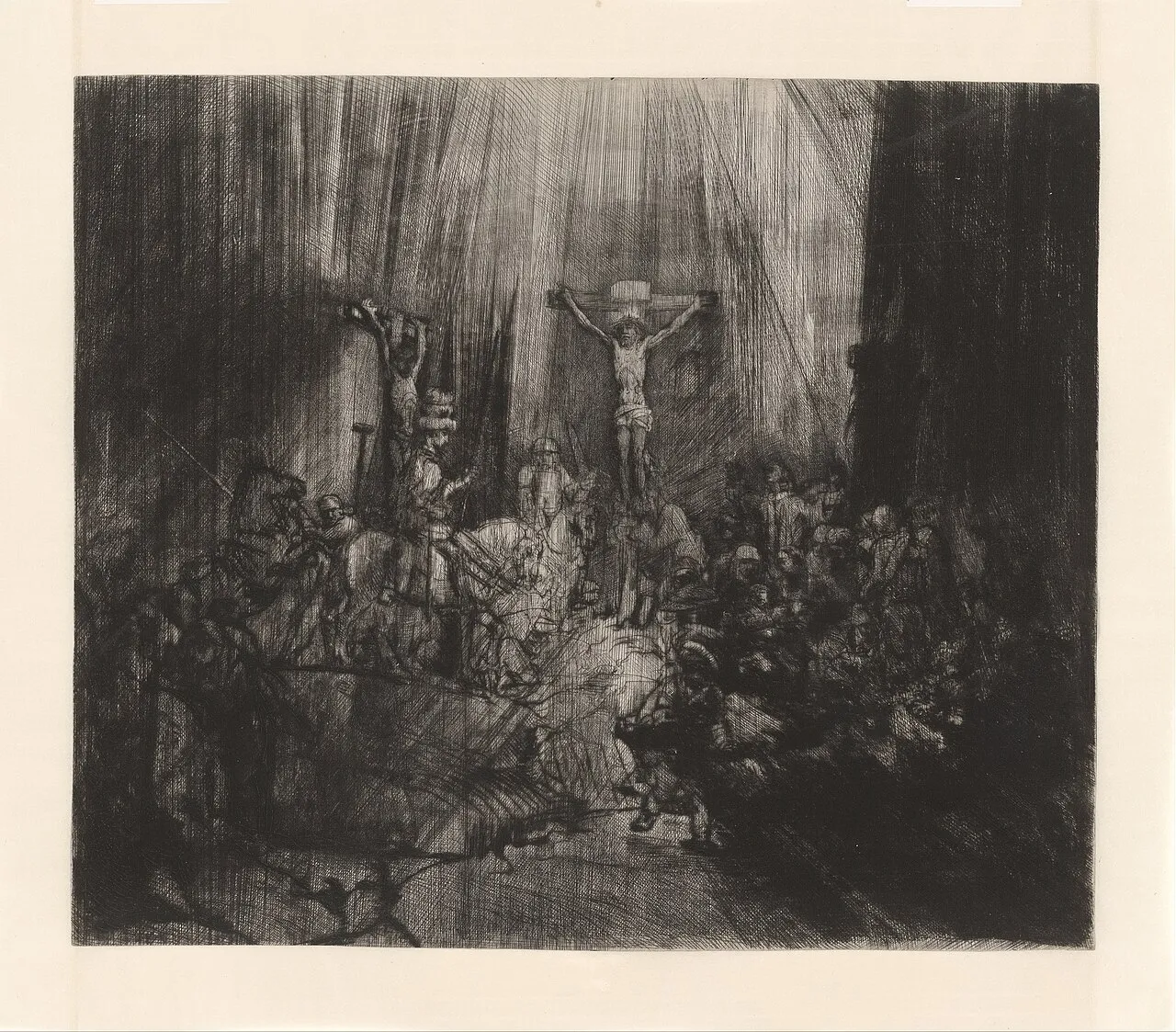
Rembrandt van Rijn, "The Three Crosses" (1653), drypoint and engraving. One of Rembrandt's most powerful prints, demonstrating the dramatic tonal range possible in intaglio printmaking. Image: Public domain, via Wikimedia Commons
Planographic Printing: Lithography
Lithography, invented in 1796 by Alois Senefelder, is based on the principle that oil and water do not mix. The artist draws on a flat limestone slab (or a specially prepared metal plate) with a greasy crayon or ink. The stone is treated chemically so that the greasy areas attract ink while the clean areas attract water and repel ink. When paper is pressed against the inked surface, only the drawn areas transfer.
Lithography's great advantage is that it allows artists to draw freely, without the technical demands of carving or incising. The resulting prints can look remarkably like drawings or paintings. Henri de Toulouse-Lautrec created vivid, dynamic color lithographs for Parisian cabaret posters that are among the most iconic images of the Belle Epoque. Honore Daumier produced over 4,000 lithographs, mostly political cartoons for Parisian newspapers, that are both artistically brilliant and historically significant.
In the 20th century, artists including Picasso, Miro, Jasper Johns, and Robert Rauschenberg used lithography extensively, often in collaboration with master printers at workshops like Gemini G.E.L. and Universal Limited Art Editions (ULAE). The Tate's glossary entry on lithography provides a useful technical overview.
Visual character: Looks like a drawing or painting. Soft, expressive marks. No carving or cutting involved. Wide tonal range possible.
Screen Printing (Serigraphy)
Screen printing, also called silkscreen or serigraphy, works on a completely different principle than either relief or intaglio. A fine mesh screen is stretched tightly over a frame. Areas of the screen are blocked with a stencil, and ink is forced through the open mesh onto the paper below using a squeegee. Each color requires a separate screen, and multi-color prints are built up through successive printings.
Screen printing emerged as a fine art technique in the 1960s, though it had been used commercially for decades. Andy Warhol was the artist who brought it into the gallery. His Marilyn Monroe series (1962) and Campbell's Soup Can series (1962) used screen printing to reproduce photographic images in flat, bold colors. The technique was perfectly suited to his subject matter: the same process used to print T-shirts and product packaging was now producing fine art. The choice of technique was itself a statement about the relationship between art and mass production.
Screen printing became the dominant technique of the Pop Art movement and remains central to contemporary print practice. It is also the technique used in most limited-edition art prints sold today. The Tate's glossary entry on screenprinting provides a useful technical overview.
Visual character: Flat, even areas of color. Photographic imagery possible. Bold, graphic quality. No visible brushwork or carving marks.
Understanding Print Editions
One of the most confusing aspects of printmaking for newcomers is the edition system. Here are the key terms:
Edition size. The total number of prints produced from the matrix. A "limited edition of 50" means fifty prints were made.
Numbering. Each print is numbered (e.g., 12/50 means it is the 12th print in an edition of 50). Lower numbers are not necessarily more valuable. The numbering indicates the order of printing, not quality.
Artist's proof (A.P.). Prints reserved for the artist's personal use, typically 10% of the edition size.
Printer's proof (P.P.). Prints given to the master printer who collaborated on the edition.
State. A version of the print made at a particular stage of the plate's development. Rembrandt frequently printed his etchings in multiple states as he worked on the plate, and collectors value different states differently.
Signature. Original prints are typically signed in pencil by the artist, usually in the lower right margin.
This edition system is what makes prints collectible. Each print in a limited edition is an original work of art, not a reproduction, created directly from the artist's matrix. Understanding this distinction is essential for anyone interested in building an art collection.
How to Appreciate Prints in Museums
When you look at a print in a museum, pay attention to the technique first. Is the image made of carved lines (relief), etched lines (intaglio), drawn marks (lithography), or flat color areas (screen print)? Look at the edges of the image for the plate mark, the embossed ridge left by the pressure of the printing press on intaglio prints. Look at the paper: is it thin and smooth (typical of Japanese woodblock prints) or thick and textured (typical of European etchings)?
Then look at the line work. In a Durer woodcut, the lines are carved with a precision that seems impossible in wood. In a Rembrandt etching, the lines have the spontaneity of pen drawing, with varying widths and depths that create tonal range. In a Warhol screen print, the surface is flat and uninflected, with no visible hand at all. Each technique has its own visual signature, and once you can read those signatures, prints become as rewarding to look at as paintings.
Read the margins for the edition number, title, artist's signature, and date, which are typically written in pencil below the image. And appreciate the physicality: a print is a physical transfer. The paper was literally pressed against a carved block, an etched plate, or an inked screen. This physical contact gives prints a directness that digital reproductions cannot match.
The Metropolitan Museum's Department of Drawings and Prints holds over 1.2 million works on paper and is one of the best public collections for studying printmaking techniques. Many prints are available to view by appointment in the study room.
Final Thoughts
Printmaking occupies a unique position in art history. It is simultaneously one of the oldest and one of the most conceptually modern art forms. Its relationship to reproduction, originality, and accessibility raises questions that have only become more relevant in the digital age, where images can be copied infinitely at zero cost. The concept of a "limited edition," artificial scarcity created by the artist's decision to produce a fixed number of impressions, anticipates the logic of NFTs and digital ownership by several centuries.
Beyond these conceptual dimensions, printmaking is simply a source of some of the most beautiful objects in art. The velvety blacks of a Rembrandt etching, the graphic power of a Japanese woodcut, the vibrant flatness of a Warhol screen print: these are experiences that deserve the same attention and appreciation we give to paintings and sculptures.
If you want to try printmaking yourself, start with linocut. It requires minimal equipment: a linoleum block, carving tools, ink, a roller, and paper. The technique is direct and physical, and the results are immediate. For more on the broader context of how printmaking fits into art history, see our guides to oil painting and drawing fundamentals. For how prints are displayed and preserved in museums, our guide to museum curation includes relevant information about works on paper.


