
Simon Schama's "Power of Art" (BBC, 2006) is an eight-part series examining eight artists, Caravaggio, Bernini, Rembrandt, David, Turner, Van Gogh, Picasso, and Rothko, through one masterwork each. Schama described the series as "not about things that hang on walls, it is not about decor or prettiness. It is a series about the force, the need, the passion of art... the power of art." The New York Times called it a success "not because of the power of the chosen masterpieces but because Mr. Schama masterfully weaves engaging mysteries around each artwork." John Leonard of New York Magazine called it "a series of seminars with a mind equal parts cultivated, enthusiastic, and idiosyncratic: his very own Bernini fountain." "Power of Art" is not the only art history documentary worth watching, but it is the gold standard. BBC's "Civilisations" (2018) spans 31,000 years of human creativity across nine episodes. Waldemar Januszczak's "The Renaissance Uncovered" and Andrew Graham-Dixon's "The Art of China" bring different voices and perspectives. "Tim's Vermeer" (2013) tests whether Vermeer used optical tools. These documentaries do what books cannot. They show you the art, in context, with passion and expertise.
Documentaries are a different medium from books and podcasts. They combine image, sound, and narrative to create an experience that is closer to visiting a museum than to reading a textbook. The best art history documentaries use the visual power of film to make art come alive, showing the scale of a painting, the texture of a brushstroke, the space of a cathedral, in ways that no other medium can. This guide covers the best art history documentaries worth watching: Simon Schama's "Power of Art" (BBC, 2006), BBC's "Civilisations" (2018), Waldemar Januszczak's documentaries, Andrew Graham-Dixon's documentaries, "Tim's Vermeer" (2013), Robert Hughes's "The Shock of the New" (BBC, 1980), and how to watch them.
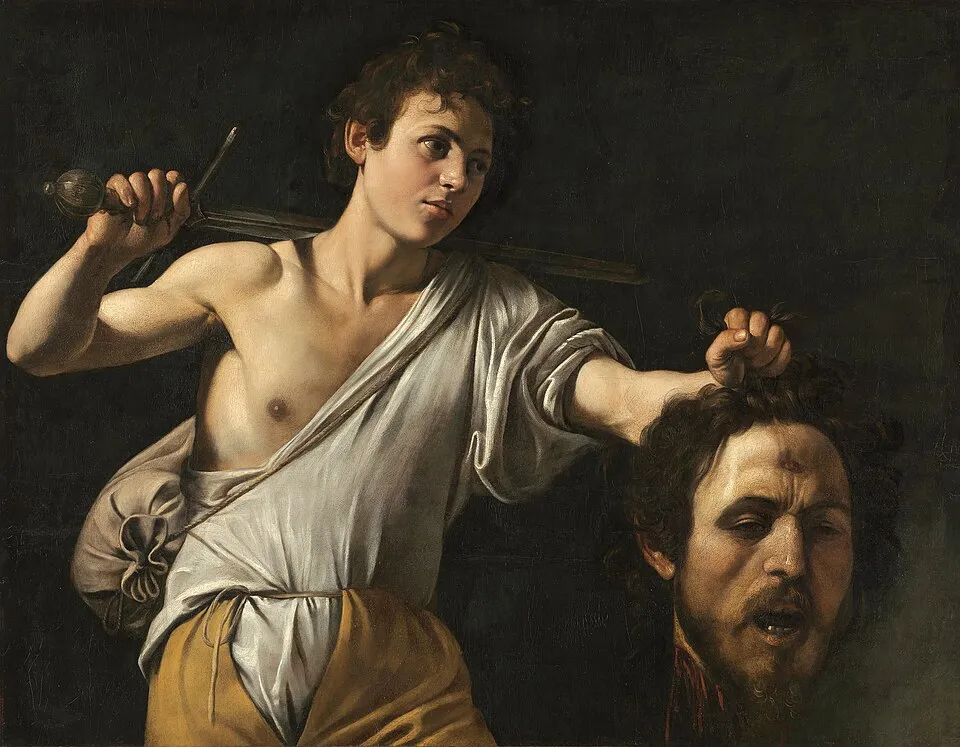
Caravaggio, "David with the Head of Goliath" (c. 1610). Oil on canvas, 125 x 101 cm. Galleria Borghese, Rome. Episode 1 of Simon Schama's "Power of Art" (BBC, 2006). Image via Wikimedia Commons.
Simon Schama's "Power of Art" (BBC, 2006): The Gold Standard
The series is eight episodes, 52 minutes each, covering eight artists in chronological order: Caravaggio (David with the Head of Goliath, 1610), Bernini (Ecstasy of St Theresa, 1647-1652), Rembrandt (The Conspiracy of Claudius Civilis, 1661), David (The Death of Marat, 1793), Turner (Slave Ship, 1840), Van Gogh (Wheat Field with Crows, 1890), Picasso (Guernica, 1937), and Rothko (Black on Maroon, 1958). Schama uses "cinematic techniques to impress upon the viewer the context surrounding the artist, to explain artistic work through language." He aimed to "put viewers into the situations that these artists were facing at the time of painting their works." Special cameras were used to capture exclusive angles of the artworks. For the Bernini episode, a jib camera was necessary to "feel Bernini making the sculpture, modelling the smile of the angel."
The reception was strong. John McDonald of the Sydney Morning Herald describes Schama as "like a Hollywood director, he has the ability to turn the most humdrum aspects of an artist's biography into high adventure." Christopher Smith of the Bangor Daily News noted: "If there's a criticism of the set, it's of Schama himself, who favours a heavy pen. Still, sift through the wordplay and the padding, and what you find is a mind bright with insight." "Power of Art" is the best art history documentary series ever made. Start with episode 1 (Caravaggio) or episode 7 (Picasso's Guernica). Both are gripping from the first minute. For more on the works behind the series, see our guide to famous paintings explained.
BBC's "Civilisations" (2018): The 31,000-Year Survey
"Civilisations" is a nine-episode sequel to Kenneth Clark's landmark "Civilisation" (1969), covering 31,000 years of human creativity across the globe. It is presented by Simon Schama, Mary Beard, and David Olusoga, each bringing their own expertise and perspective. The difference from Clark is the point. Clark's 1969 "Civilisation" was a personal, Eurocentric tour of Western art. The 2018 version is global, covering African, Asian, Mesoamerican, and Islamic art alongside European. Mary Beard covers ancient civilizations. David Olusoga covers art beyond the Western canon. Schama covers the Renaissance to modern.
"Civilisations" is the best broad survey of art history on film. It is not as focused as "Power of Art." The scope is too large for deep dives. But it provides the global context that "Power of Art" lacks. Watch it alongside Gombrich's "Story of Art" for a complete introduction to art history, and pair it with our guide on how to teach yourself art history.
Waldemar Januszczak: The Entertainer
Januszczak, a British art critic of Polish descent, has made numerous BBC documentary series: "The Renaissance Uncovered," "Every Picture Tells a Story," "The Impressionists," and others. Reddit users consistently recommend him. "Anything done by/with Waldemar Januszczak!" and "Check out the YouTube Series BBC Perspective done by Waldemar Januszczak" are typical responses on r/ArtHistory threads asking for documentary recommendations.
Januszczak is irreverent, passionate, and funny, the opposite of Schama's polished academic style. He is not afraid to disagree with received wisdom or to express strong opinions. His documentaries are entertaining first and educational second, but the education is solid. Januszczak is the best documentary host for viewers who find Schama too formal. His enthusiasm is infectious, and his willingness to challenge conventional interpretations makes his documentaries thought-provoking as well as entertaining. If you are new to art history, start with our guide on art for beginners and then queue up Januszczak.
Andrew Graham-Dixon: The Critic
Graham-Dixon, a British art critic, has made documentaries for BBC including "The Art of China," "The Art of Russia," "The Art of Germany," and "The Art of the Netherlands." Each series explores the art of a specific country or culture, connecting art to history, politics, and national identity. Graham-Dixon is more measured than Januszczak and more focused than Schama. His documentaries are structured around a thesis, that a nation's art reveals its national character, and he argues that thesis with evidence and conviction.
Graham-Dixon is the best documentary host for viewers who want to understand art in its cultural and national context. His country-specific series are perfect for deep dives into a single tradition. The framing connects to our piece on art and society.
"Tim's Vermeer" (2013): The Experiment
"Tim's Vermeer" is a 2013 documentary directed by Teller (of Penn & Teller) and produced by Penn Jillette. It follows Tim Jenison, a Texas inventor and tech entrepreneur, as he attempts to reproduce a Vermeer painting using optical tools, specifically a mirror-and-lens setup that Jenison believes Vermeer used. The question is whether Vermeer could have used optical tools, a camera obscura or similar device, to achieve the extraordinary precision of his paintings. Jenison's experiment does not prove that Vermeer used optics, but it demonstrates that it was possible, and that Vermeer's "photographic" precision may be the result of technology, not just talent.
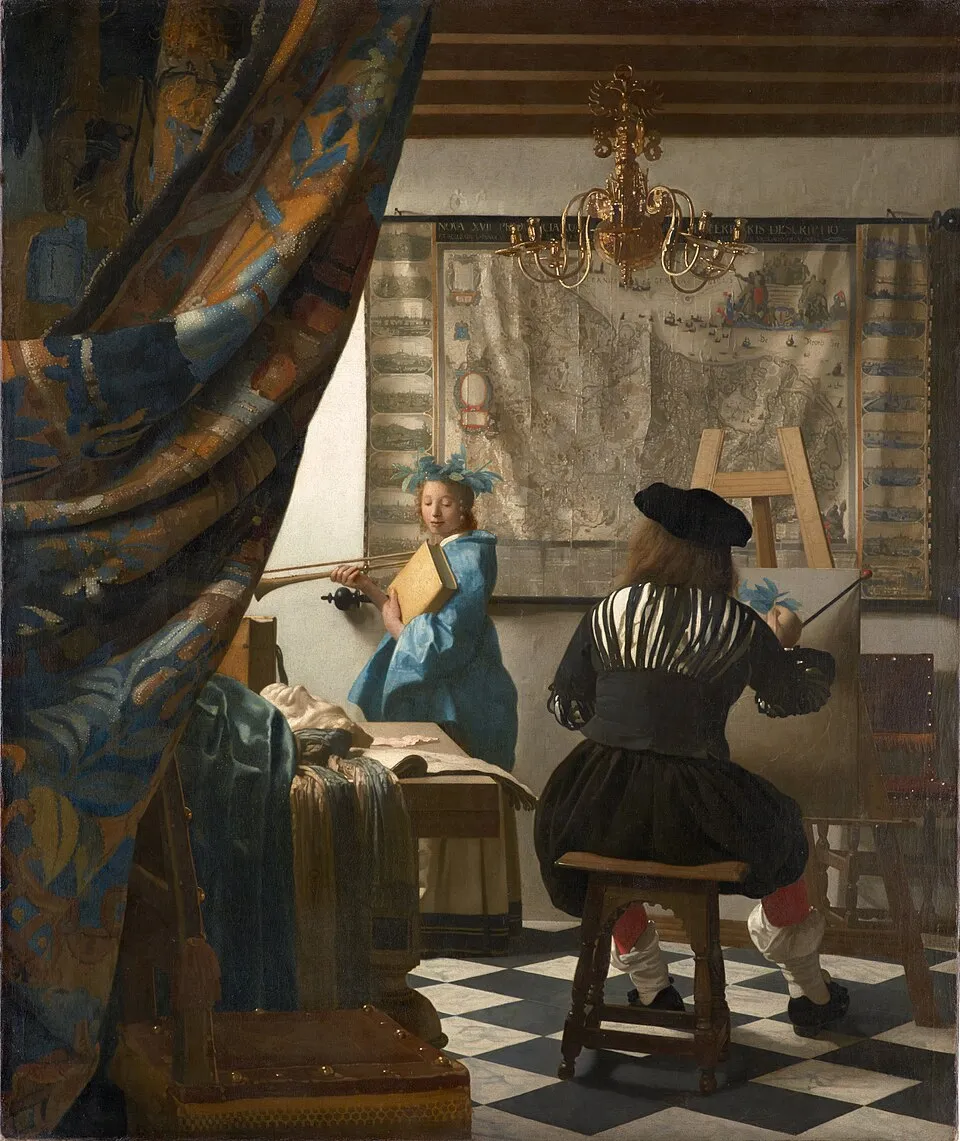
Johannes Vermeer, "The Art of Painting" (c. 1666-1668). Oil on canvas, 120 x 100 cm. Kunsthistorisches Museum, Vienna. The optical precision of Vermeer's work is tested in "Tim's Vermeer" (2013). Image via Wikimedia Commons.
The film was widely praised for its intellectual curiosity and its hands-on approach to art history. It is a documentary about the process of making art, not just looking at it, and it raises questions about the relationship between technology and creativity that are still being debated. "Tim's Vermeer" is the best single art documentary film (as opposed to a series). It is a detective story, an experiment, and a meditation on the nature of artistic skill, all in 80 minutes. For the technical side of painting, see our guide to oil painting techniques.
Robert Hughes, "The Shock of the New" (BBC, 1980): The Classic
"The Shock of the New" is an eight-part BBC series written and presented by Robert Hughes, covering the development of modern art from the Impressionists to the 1980s. It is the documentary equivalent of Hughes's book of the same name, a passionate, opinionated, and deeply informed history of modern art. Hughes is combative, witty, and unafraid to call things what they are. He does not worship modern art. He interrogates it, criticizes it, and defends it in equal measure. His description of the relationship between art and the industrial revolution, how modern art emerged from the shock of modernity, is still the best on film.
"The Shock of the New" is the best documentary on modern art. It is dated. The 1980 production values are visible. But the ideas are not. Hughes's analysis of modernism is as relevant in 2026 as it was in 1980. For the full sweep, see our art movements guide.
How to Watch: Where to Find These Documentaries
BBC iPlayer has most BBC art documentaries (Power of Art, Civilisations, Januszczak, Graham-Dixon), but only in the UK. A VPN can access iPlayer from outside the UK. YouTube has many art documentaries available free, either officially (BBC clips, PBS previews) or uploaded by users. Search for "Simon Schama Power of Art" or "Waldemar Januszczak" and many episodes turn up. "Power of Art" aired on PBS in the US in 2008, and PBS streaming may still have episodes available. PBS also produced its own art documentaries, including a strong Andy Warhol documentary.
Streaming services carry some of these. "Tim's Vermeer" is available on streaming platforms like Amazon Prime and Apple TV. Some BBC documentaries appear on Netflix, Amazon, or BritBox. And do not forget the library. Many public libraries have art documentaries on DVD, a low-tech but reliable option. For more free options, see our guide to the best art history YouTube channels.
Final Thoughts
The best art history documentaries combine the visual power of film with the intellectual depth of art history. Simon Schama's "Power of Art" (BBC, 2006, 8 episodes, 52 minutes each) is the gold standard, covering Caravaggio, Bernini, Rembrandt, David, Turner, Van Gogh, Picasso, and Rothko through one masterwork each, using "cinematic techniques to impress upon the viewer the context surrounding the artist." BBC's "Civilisations" (2018, 9 episodes) spans 31,000 years across the globe, presented by Schama, Mary Beard, and David Olusoga. Waldemar Januszczak brings irreverent passion to "The Renaissance Uncovered" and other series. Andrew Graham-Dixon explores art in national context with "The Art of China," "The Art of Russia," and "The Art of Germany." "Tim's Vermeer" (2013, directed by Teller) is an 80-minute experiment testing whether Vermeer used optical tools. Robert Hughes's "The Shock of the New" (BBC, 1980, 8 episodes) remains the best documentary on modern art, as relevant in 2026 as it was in 1980. Together, these documentaries provide what books and podcasts cannot: the visual experience of art, in context, with passion and expertise.
Start with "Power of Art," episode 1 (Caravaggio) or episode 7 (Picasso's Guernica). Both are gripping from the first minute. Then watch "Civilisations" for the global survey. Then "Tim's Vermeer" for the detective story. Then explore Januszczak and Graham-Dixon for the deep dives. The documentaries are out there. The art is waiting. All you have to do is press play. For reference, see the Power of Art Wikipedia entry, the BBC Documentaries page, and the r/ArtHistory recommendations thread.


