In June 1889, Vincent van Gogh wrote to his brother Theo from the Saint-Paul-de-Mausole asylum in Saint-Remy-de-Provence, describing a view he had been watching through his barred window. "Through the iron-barred window," he wrote, "I can see an enclosed square of wheat ... and above that a morning star that looks very big." He painted that view repeatedly, from dawn and dusk, in different seasons and different weather. The painting we now call "The Starry Night" was made from that window, but it is not quite what Van Gogh saw through it.
The Starry Night is one of the most reproduced artworks in the world, appearing on everything from museum gift shop merchandise to global brand campaigns. Its swirling sky and glowing stars are so familiar that they have become almost abstract, a pattern rather than a painting. But The Starry Night is one of the most emotionally specific and technically ambitious things Van Gogh ever made, and understanding it requires knowing what was actually happening to him during the weeks he painted it.
The Painting: What You Are Looking At
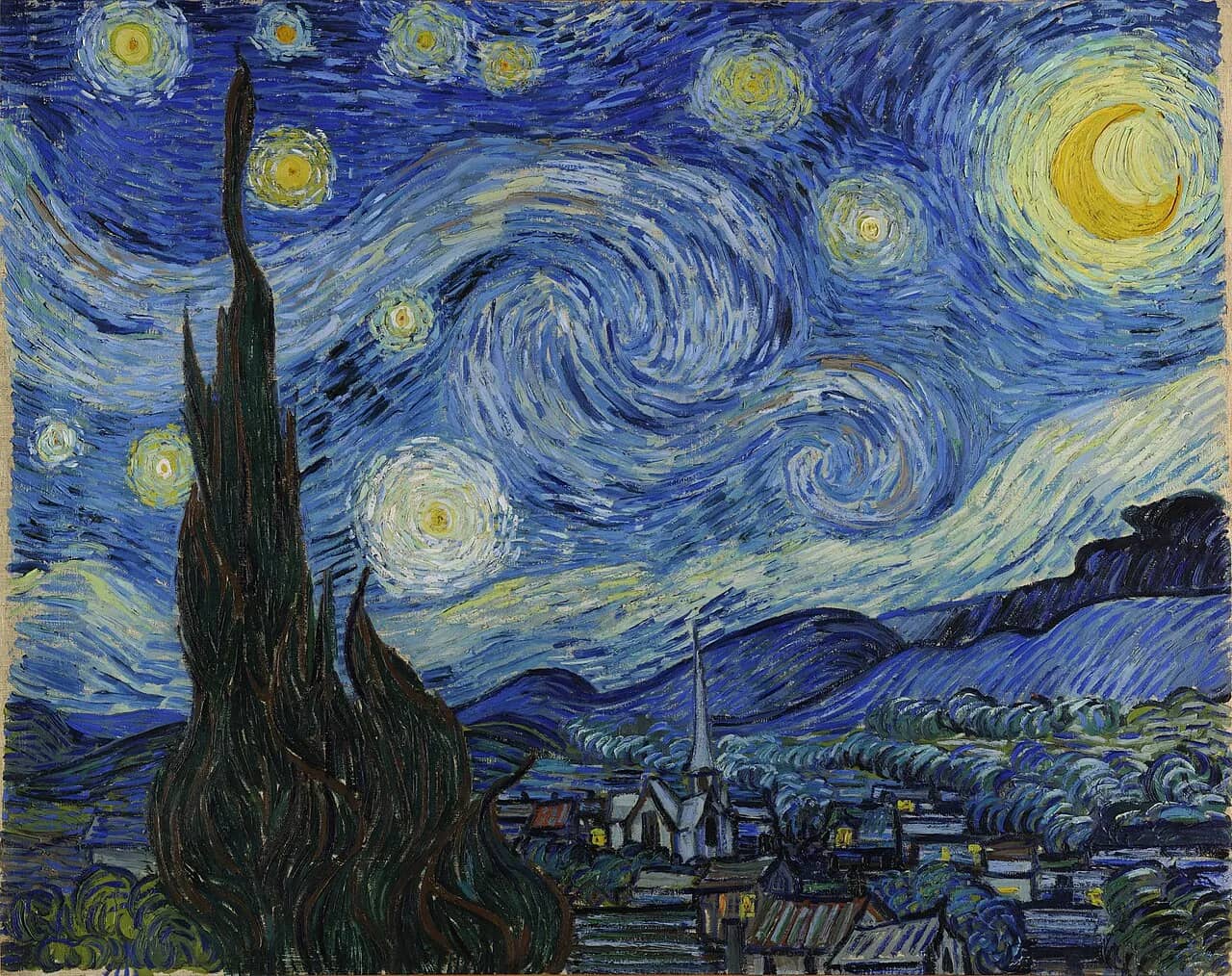
The Starry Night measures 73.7 by 92.1 centimeters, oil on canvas, and has been held by the Museum of Modern Art in New York since 1941. It shows a night sky over a valley, with a village in the foreground and a massive cypress tree rising in the lower left corner. Eleven stars and a crescent moon blaze in the sky. The sky itself is the dominant element. It fills roughly two-thirds of the canvas, composed of swirling spirals and turbulent eddies of blue, blue-white, and yellow-white paint applied in thick, gestural strokes.
The village in the lower right is quiet and domestic. Lit windows suggest inhabited houses. A church steeple rises above the roofline. The landscape is peaceful in a way the sky is absolutely not. This contrast is central to the painting's emotional logic. The earth is still, the sky is alive with energy that can read as either beautiful or terrifying depending on your state of mind.
The cypress in the foreground connects earth and sky, reaching up into the turbulence from the calm ground below. In the Mediterranean tradition, cypresses were associated with mourning and death, and Van Gogh used them frequently in his Saint-Remy paintings with full awareness of this symbolism. He wrote specifically about their beauty in his letters, comparing them to "an Egyptian obelisk" in their dark, flame-like forms.
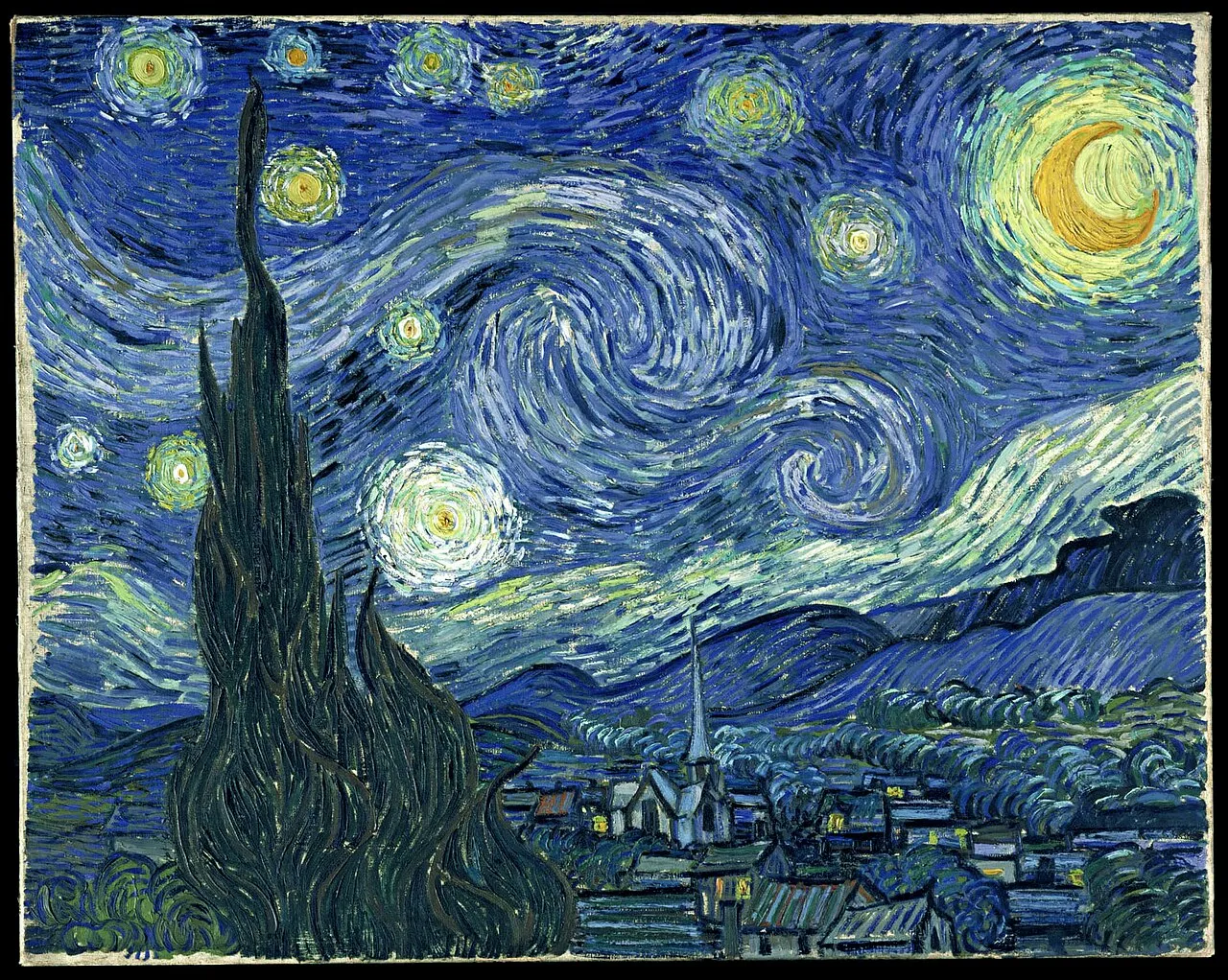
Vincent van Gogh, "The Starry Night" (1889), oil on canvas, 73.7 x 92.1 cm. Museum of Modern Art, New York. Painted from his room at Saint-Paul-de-Mausole asylum during the most productive period of Van Gogh's life. Image: Public domain, via Wikimedia Commons
The Asylum at Saint-Remy and the Context of Crisis
Van Gogh voluntarily admitted himself to the Saint-Paul-de-Mausole asylum in May 1889, three months after the incident in Arles in which he cut off part of his left ear following a breakdown. He would remain there for approximately twelve months, one of the most prolific periods of his career. During his stay, he produced around 150 paintings and the same number of drawings, working with extraordinary focus between episodes of incapacitation.
The exact nature of Van Gogh's illness remains debated. Proposed diagnoses have included epilepsy, bipolar disorder, acute intermittent porphyria, and several other conditions. What the medical records and his letters make clear is that he suffered severe episodic crises during which he was unable to work, followed by periods of lucidity and intense productivity. The Saint-Remy months fell largely in the productive periods, and he used them with urgency, aware that another crisis could arrive at any time.
The Starry Night was painted in early June 1889, a period of relative stability between two serious episodes. Van Gogh himself had mixed feelings about it. In a letter to Theo, he described the painting as a study, expressing doubt about whether the exaggerated movement of the sky served the composition well. He wrote that he preferred the quieter night views he had painted earlier. The painting he was uncertain about became, after his death, the most famous thing he ever made.
The Village That Is Not Saint-Remy
The village shown in The Starry Night is not directly visible from Van Gogh's asylum window. From that window, the view was of an enclosed garden, wheat fields, and the hills of the Alpilles, not a village. Art historians have established that the settlement in the painting combines observed elements (the landscape character of the region) with imagined or remembered ones, particularly the church steeple, which closely resembles the Dutch churches of Van Gogh's homeland rather than the Romanesque churches of Provence.
This makes the painting something more complex than a nocturnal landscape study. It is a psychological composite. The sky above Saint-Remy, but the village of a mental image of home, the Netherlands Van Gogh had left years earlier and never returned to. The painting's emotional depth partly comes from this displacement, the turbulent sky of his present experience projected above a village that exists in memory rather than sight.
Van Gogh's relationship to place and home runs through his entire career. The paintings he made of Arles, of Nuenen, of Auvers-sur-Oise all show a similar pattern. Intense observation of actual places combined with emotional color and compositional choices that transform the observed into the felt. The broader context of these techniques is covered in the Vincent van Gogh artist spotlight.
The Technique: Impasto, Swirls, and What They Cost
The Starry Night is painted with some of the thickest, most physically assertive impasto in Van Gogh's work. The paint in the sky sections is applied in ridges and spirals, some of them raised several millimeters from the canvas surface. Standing next to the painting at MoMA (which is possible, unlike the Mona Lisa at the Louvre), you can see the physical texture clearly, the way each swirling arc was laid down in a single sustained gesture with a loaded brush.
The colors are applied in deliberate contrasts. Cold blue-whites against warm yellows, the dark green-black of the cypress against the luminous sky. Van Gogh was working from his knowledge of color theory, specifically the complementary contrast principles he had studied from Eugene Delacroix and from Charles Blanc's writings on color. He understood that placing complementary colors adjacently, the blues and oranges of the stars, intensified each other's apparent brightness. The glowing quality of the stars is not a technical accident but a deliberate optical effect.
This approach to color as emotional rather than descriptive tool is the defining characteristic of Van Gogh's mature style and connects him to the broader Post-Impressionist project. Where the Impressionists used broken color to capture optical reality, Van Gogh used it to express psychological reality. The sky in The Starry Night is not what a night sky looks like. It is what Van Gogh experienced a night sky feeling like. For how these techniques developed from Impressionism, see the guide to Impressionism explained.
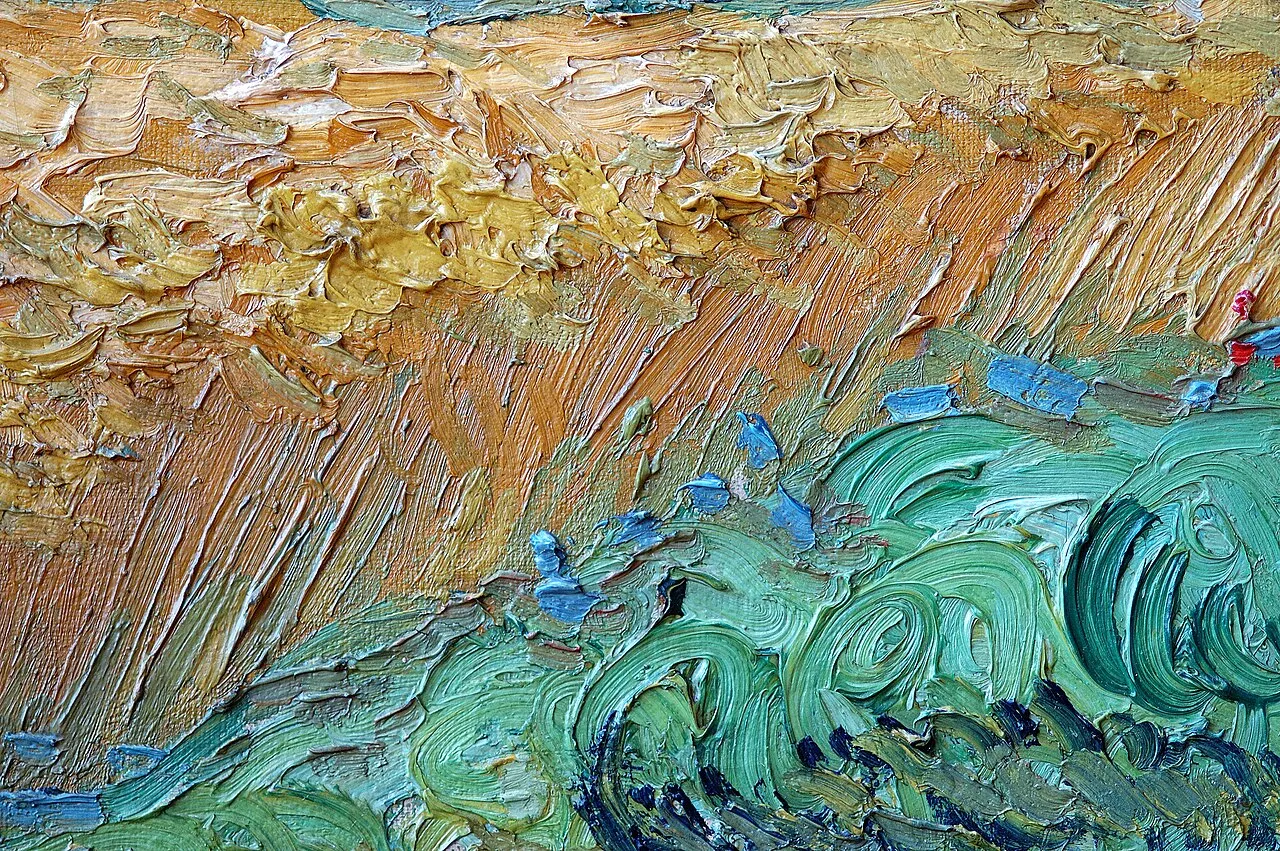
Vincent van Gogh, "Wheat Field with Cypresses" (1889), oil on canvas. Metropolitan Museum of Art, New York. Painted at Saint-Remy during the same period as The Starry Night, showing the same landscape with similar turbulent brushwork. Image: Public domain, via Wikimedia Commons
The Letters and What Van Gogh Said About the Sky
Van Gogh's letters to his brother Theo are among the most extraordinary documents in art history. Honest, observant, and sometimes heartbreaking accounts of what it meant to make art under conditions of severe psychological difficulty. His descriptions of the night sky at Saint-Remy are particularly vivid. In one letter, he wrote: "The night sky is something I paint again and again. Looking at the stars always makes me dream, as simply as I dream over the black dots representing towns and villages on a map. Why, I ask myself, should the shining dots of the sky not be as accessible as the black dots on the map of France?"
This comparison between the stars and the dots on a map is quietly extraordinary. It positions the night sky not as something remote and unknowable but as a kind of territory, navigable, connectable, as intimate as geography. The Starry Night is partly this. An attempt to make the sky as knowable as a map, rendered through the immediate, physical language of paint.
The letters also show Van Gogh's awareness of the strangeness of painting at night. He described setting up candles in his hat to illuminate the canvas, and sometimes working in the moonlight directly. The technical challenge of painting darkness, of finding enough light to see by while capturing the absence of light on the canvas, is one reason the nocturnal paintings from Saint-Remy are so alive. They were made under difficult conditions with extraordinary concentration.
The Turbulence Debate: Does the Sky Follow Physics?
The swirling sky in The Starry Night has attracted scientific attention for years. A 2006 paper by physicist Jose Luis Aragon and colleagues noted that the swirling patterns in the sky correspond closely to turbulent fluid flow as described by Kolmogorov's mathematical framework. The paper argued that Van Gogh had captured the visual appearance of turbulence with unusual accuracy, possibly because his disturbed perceptual state during crisis made him more sensitive to certain kinds of movement.
In September 2024, a new study published in Physics of Fluids by Yongxiang Huang and colleagues reignited this debate. The researchers analyzed all the whirls and eddies in the painting and found that the luminance's Fourier power spectrum exhibited a characteristic -5/3 Kolmogorov-like power-law. They argued that Van Gogh had a very careful observation of real flows, so that not only the sizes of whirls and eddies but also their relative distances and intensity follow the physical law that governs turbulent flows. The study received considerable media attention, with the Smithsonian reporting that the painting "accurately depicts a scientific theory that wasn't described until years after van Gogh's death."
However, these conclusions were challenged in 2025. Mohamed Gad-el-Hak of Virginia Commonwealth University and James J. Riley of the University of Washington published a rebuttal in the Journal of Turbulence arguing that the original findings were "totally flawed." Their foundational objection was that there is no identifiable, measurable scalar fluid property in the painting that can be used to apply the theory of Obukhov and Corrsin. Furthermore, the atmospheric flow field assumed does not even closely satisfy the assumptions required by the theory. As VCU News reported, Gad-el-Hak concluded that "the painting is fascinating and very abstract, and in fact this is an element of what makes it such an iconic work of art."
A separate team led by Daniel Bourgault and Cedric Chavanne of the University of Quebec at Rimouski published additional concerns in August 2025. They applied the same analysis used in the 2024 study to Edgar Degas's "A Woman Seated beside a Vase of Flowers," an indoor scene unrelated to skies or fluid motion. The method again produced a slope near -5/3. If The Starry Night is deemed turbulent based solely on that slope, then the Degas painting would also have to depict turbulence, despite having nothing to do with it. The debate, as reported by Courthouse News, ended with a joint commentary letter published in December 2025 summarizing a year of work challenging the original conclusions.
The scientific debate does not diminish the painting. If anything, it confirms what makes The Starry Night so enduringly compelling. The sky is abstract enough to invite multiple readings, precise enough to reward sustained looking, and emotionally charged enough to make you forget the question of accuracy entirely.
From Overlooked to Iconic: The Painting's Second Life
When The Starry Night was first exhibited in 1889, at the Salon des Independants in Paris, it attracted little attention. Van Gogh himself remained largely unknown outside a small circle of artists and critics until after his death in July 1890. The painting passed through several collections after his death, eventually purchased by MoMA in 1941, the same year the museum opened its expanded building. At MoMA, The Starry Night found the institutional home that established its status.
Its rise to global recognizability was gradual and then sudden. Reproductions multiplied across the 20th century. Don McLean's 1971 song "Vincent" (also known as "Starry, Starry Night") introduced the painting to an entirely new audience. The image has since been used in advertisements, film posters, television series, and digital art at a scale that dwarfs almost any other artwork. Each reproduction introduces new viewers to the original, though it also inevitably flattens the painting's physical and emotional complexity into a pattern.
What to Take Away
The Starry Night is a painting about the night sky above an asylum in southern France, made by a man who was simultaneously producing some of the most vital work in the history of painting and struggling to hold himself together between episodes of severe mental crisis. These two facts are not in contradiction. The painting's emotional intensity comes precisely from its context, but its technical achievement stands independently of its biography.
The swirling sky is not a symptom. It is a formal choice, made by an artist who understood color, light, and movement well enough to transform them into something that has stopped people in their tracks for over a century. If you are visiting MoMA, give yourself time with this painting. Stand close enough to see the impasto ridges. Move back far enough to let the swirling sky read as a whole. Notice the contrast between the still village and the turbulent sky. Then read the letters, because they explain, better than any critical account, what Van Gogh was trying to do.
For the full context of Van Gogh's methods and life, the Van Gogh artist spotlight covers his development from early drawings to the final months at Auvers. For the movement The Starry Night belongs to, the complete art movements timeline places Post-Impressionism in its historical sequence. The companion piece on famous paintings explained covers twenty iconic works with the same depth of attention. And for the science of how paintings like this affect the brain, see our post on the neuroscience of aesthetic experience.