
The first thing almost everyone discovers when they see The Persistence of Memory at the Museum of Modern Art in New York is that it is tiny. The painting measures 24.1 by 33 centimetres, roughly the size of a standard piece of copy paper. The melting pocket watches, the barren Catalan landscape, the strange boneless form draped across the centre of the composition: all of it fits within a space smaller than a laptop screen. This scale is worth noting because it tells you something important about how Salvador Dalí worked and what he was trying to achieve.
The Persistence of Memory, painted in 1931, is one of the most immediately recognisable images in the history of modern art. Its imagery has been reproduced so often that the visual shorthand of "melting clock" has entered general culture as a symbol for warped time, the subconscious, or Surrealism as a whole. But the painting is considerably more specific and stranger than that shorthand suggests, and understanding it means going back to what Dalí himself said about it, the landscape he painted it in, and the particular obsessions that drove his work during the early 1930s.
The Painting: What You Are Looking At
The Persistence of Memory shows a coastal landscape at what appears to be late afternoon or dusk, identifiable as the area around Cap de Creus and Port Lligat on the Costa Brava in Catalonia, where Dalí had grown up and to which he returned in 1930 with his partner Gala. The cliffs in the background, the flat sea, and the raking quality of the light are all observed from Dalí's immediate surroundings. This is not an imaginary dreamscape in the sense of a made-up location; it is a very specific place made strange by the objects within it.
On and around a brown rectangular form in the left foreground (likely a table or platform) sit four clocks or watches. One hangs draped over the edge. A second is draped over the limb of a dead tree branch growing from the same form. A third is draped over a large, fleshy, boneless shape that occupies the centre of the canvas. The fourth watch is closed and covered with ants. At the bottom left, a fly rests on one of the open watches. In the background, the cliffs and sea are lit with the crisp, shadowless light characteristic of the Catalan coast.
The boneless central form has been identified by Dalí himself as a self-portrait, a kind of "soft self-portrait" representing his own sleeping or unconscious body. The single eyelash visible at its upper edge reinforces the identification. This figure, formless and collapsed, lies amid the watches as though equally subject to the same softening process.
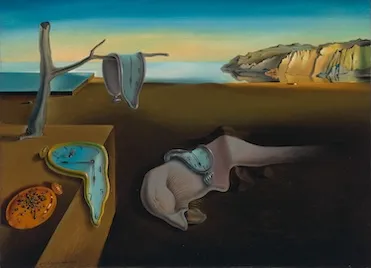
Salvador Dalí, "The Persistence of Memory" (1931), oil on canvas, 24.1 x 33 cm. Museum of Modern Art, New York. Painted in a single afternoon while Gala was at the cinema, according to Dalí's own account. Image: © Salvador Dalí, Fundació Gala-Salvador Dalí, DACS 2026. Fair use. Via Wikipedia
How Dalí Said He Painted It
In his autobiography "The Secret Life of Salvador Dalí" (1942), Dalí gave a vivid account of the painting's origin. He described returning to the studio one afternoon after Gala had left for the cinema, sitting down in front of the half-finished Catalan landscape he had been working on, and noticing a round of Camembert cheese he had left on the table, softening in the afternoon heat. "I sat a long time, absorbed in thought before the familiar object," he wrote. "When Gala returned I told her that I had painted one of the most important pictures of my life."
This story is almost certainly embellished, since Dalí's accounts of his own work were notoriously theatrical. But the anecdote captures something real: the image of the melting watches arose from the domestic, literal experience of soft cheese, and the resulting painting was made quickly, with confidence, in what felt to Dalí like a single sustained creative act. The small scale supports this account; a canvas this size could plausibly be completed in a few intense hours.
The watches in the painting are pocket watches, the kind wound by hand, not clocks on a wall. This specificity matters. A pocket watch is a personal object, worn close to the body, carried as a commitment to keeping time. Dalí's choice of this object rather than a wall clock or an hourglass makes the softening more intimate, something happening to an object that was supposed to be reliable, precise, and entirely under control.
What the Melting Watches Mean
The most persistent interpretation of The Persistence of Memory connects it to Einstein's theory of special relativity, published in 1905, which demonstrated that time is not absolute but relative to the observer's velocity and position. The melting clocks, on this reading, are a visual metaphor for the flexibility of time, the idea that our intuition of time as fixed and universal is scientifically incorrect.
Dalí denied this interpretation explicitly. In a 1954 interview, he stated that the watches had nothing to do with relativity theory. He was more interested, he said, in the experience of time in dreams, where duration is radically different from waking experience. A dream that seems to last hours may occupy only minutes of sleep; a significant event in a dream may be compressed into a single image. The watches, soft and yielding, represent the collapsibility of time in the dream state, not a scientific theory about spacetime.
Freudian psychoanalysis is probably a more relevant frame than physics. Dalí had read Freud carefully, as had most Surrealist artists, and the movement's theoretical underpinning drew heavily on Freud's account of dreams as a space where normal rational constraints dissolved. The ants on the closed watch are a Dalian symbol he used repeatedly throughout his career, associated with decay, mortality, and the return of things to the earth. The fly, too, suggests corruption and the impermanence of living things. The landscape, however beautiful and precisely observed, is essentially a landscape of death, inhabited by decaying objects and a sleeping self.
A 2025 study published in the journal Frontiers in Psychology examined the neuroscience of Surrealist perception, using The Persistence of Memory as a primary example. The researchers found that when viewers encounter impossible but precisely rendered objects like the melting watches, the brain's visual cortex initially processes them as real before the prefrontal cortex flags the impossibility. This creates a brief moment of cognitive dissonance that the researchers argue is the neurological basis of Surrealism's effect: the viewer simultaneously believes and disbelieves what they are seeing. The study used fMRI scanning of participants viewing Dali's painting alongside photorealistic control images, and found that the impossible objects activated the same neural pathways as real objects but with additional engagement from the anterior cingulate cortex, the brain region associated with conflict detection and resolution.
The Ants and the Covered Watch
The closed watch covered in ants is the only one of the four that is not drooping or deformed. It is rigid, closed, and being consumed. Art historians have suggested that this watch, unlike its soft companions, represents the conventional attitude to time: rigid, closed, defended, and yet being eaten away from within by mortality. The soft watches, by contrast, have accepted the dream logic that the rigid watch resists. Whether this reading is accurate or over-determined is impossible to say, but it fits the internal logic of the painting.
Ants appear in a number of Dalí's early works, including the famous sequence in the film "Un Chien Andalou" (1929), which he co-created with Luis Buñuel. In that context too, they are associated with desire, death, and the breakdown of bodily integrity. Dalí described his fear of ants as originating in childhood, and his repeated return to the image suggests it carried genuine emotional weight rather than simply decorative function.
The Landscape and the Real Place
The landscape in The Persistence of Memory is not imaginary. The cliffs visible in the background are the Cap de Creus, the easternmost point of the Pyrenees where they meet the Mediterranean. Dalí was born in nearby Figueres, spent summers at Cadaqués, and moved permanently to the fishing village of Port Lligat, immediately below the Cap de Creus, in 1930. He painted this coastline obsessively throughout his career. The light in the painting, horizontal and shadowless, is the specific light of this place in afternoon, when the sun is behind the cliffs and the bay lies in a particular kind of clear, flat illumination.
Setting the melting watches in this real and precisely rendered landscape is one of the painting's central strategies. Surrealism's power generally comes not from inventing completely unrecognisable worlds but from placing impossible things in recognisable ones. The more precisely Dalí renders the cliffs and the sea, the stranger the melting watches become. This technique, which Dalí called his "paranoiac-critical method," involved deliberately inducing a state of irrational association while maintaining the technical control necessary to paint the resulting imagery with photographic precision.
The broader context of this approach within the Surrealist movement is explored in the Surrealism and the subconscious guide. For a deeper look at Dalí's career and methods, the Salvador Dalí artist spotlight traces his development from his early Catalan paintings through his later commercial period.
The Painting's Journey to MoMA
The Persistence of Memory was sold almost immediately after its completion to Julien Levy, an American art dealer who became the primary promoter of Surrealism in the United States. Levy acquired the painting before Dalí's first major American exhibition, held at his New York gallery in November 1931. The exhibition was a popular and critical success, partly because of the scandal and curiosity that surrounded Surrealism in American cultural life, and the small, intensely strange painting became the most discussed work in the show.
Levy sold it in 1934 to the Museum of Modern Art's founding donor Mrs. Stanley B. Resor. MoMA has held it ever since. At the time of writing, it is one of the most requested works in the museum's permanent collection, attracting a crowd that rivals the attention given to paintings many times its size. The gap between the painting's physical scale and the scale of attention it receives is, in retrospect, very much in keeping with Dalí's aesthetic: maximum effect from minimum material.
In 2025, the Dalí Theatre-Museum in Figueres, Spain, announced a major research project using multispectral imaging and macro X-ray fluorescence to study Dalí's painting techniques across his early period (1929-1939). While The Persistence of Memory itself remains at MoMA, the project has analyzed several contemporaneous works from the same Port Lligat period, revealing that Dalí used an unusually high number of paint layers for such small canvases, sometimes building up 15 to 20 translucent glazes to achieve his characteristic luminous precision. The research also identified pigments consistent with those available at a local supply shop in Cadaqués that Dalí frequented, confirming that even his most fantastical images were made with ordinary materials purchased from a small coastal town.

Dalí's house at Port Lligat, Catalonia, Spain. The Cap de Creus coastline visible in The Persistence of Memory was Dalí's immediate landscape; he lived and worked here from 1930 until the late 1980s. Image: Public domain, via Wikimedia Commons
What Makes It Last
The Persistence of Memory has lasted because it solves, in a very small space, the central problem that Surrealism set itself: how to make the subconscious visible. The painting does not explain or describe the experience of dreaming; it reproduces a version of its visual logic. Soft where things should be hard. Familiar objects in unfamiliar states. A recognisable landscape made strange by a single alteration of physical rules. The technique is precise and the imagery is immediate, and those two qualities together make the painting work across cultures and across generations without needing translation.
The Camembert cheese story, true or not, captures something accurate about the painting's method: it comes from the ordinary world and transforms it by a small but decisive change in the rules. This is what Dali was consistently aiming for, and in The Persistence of Memory he achieved it with a completeness that his larger, more theatrical later works rarely matched. For the context of how Surrealism developed from earlier avant-garde movements, the art movements timeline provides the full historical sequence. The companion piece on famous paintings explained covers other iconic works with the same level of detail. For more on the evolution of art styles that led to Surrealism, see that guide. And for the visual elements Dali used to create his effects, our art toolkit guide breaks them down.


