
On April 26, 1937, German and Italian aircraft bombed the market town of Guernica in the Basque Country of northern Spain. It was a Monday, market day, and the town was full. The raid lasted roughly three hours, with wave after wave of bombers and fighter planes targeting civilians in what military historians now recognise as the first systematic aerial bombardment of an undefended town in history. Estimates of the dead range from 150 to over 1,600, depending on the source.
Pablo Picasso was in Paris when the news reached him. He was already under commission from the Spanish Republican government to produce a mural for the Spanish Pavilion at the 1937 Paris International Exposition. Until the Guernica bombing, he had been working on sketches for a different subject altogether. He abandoned those sketches and, in approximately five weeks between May and June 1937, produced the 349 by 776 centimetre oil painting that became one of the most powerful anti-war statements ever made.
Understanding Guernica means understanding what it shows, how it was made, what the symbols mean (and do not mean), and why the painting's long journey from Paris to New York to Madrid mirrors the political history of the 20th century in ways that remain relevant today.
The Scale and the First Impression
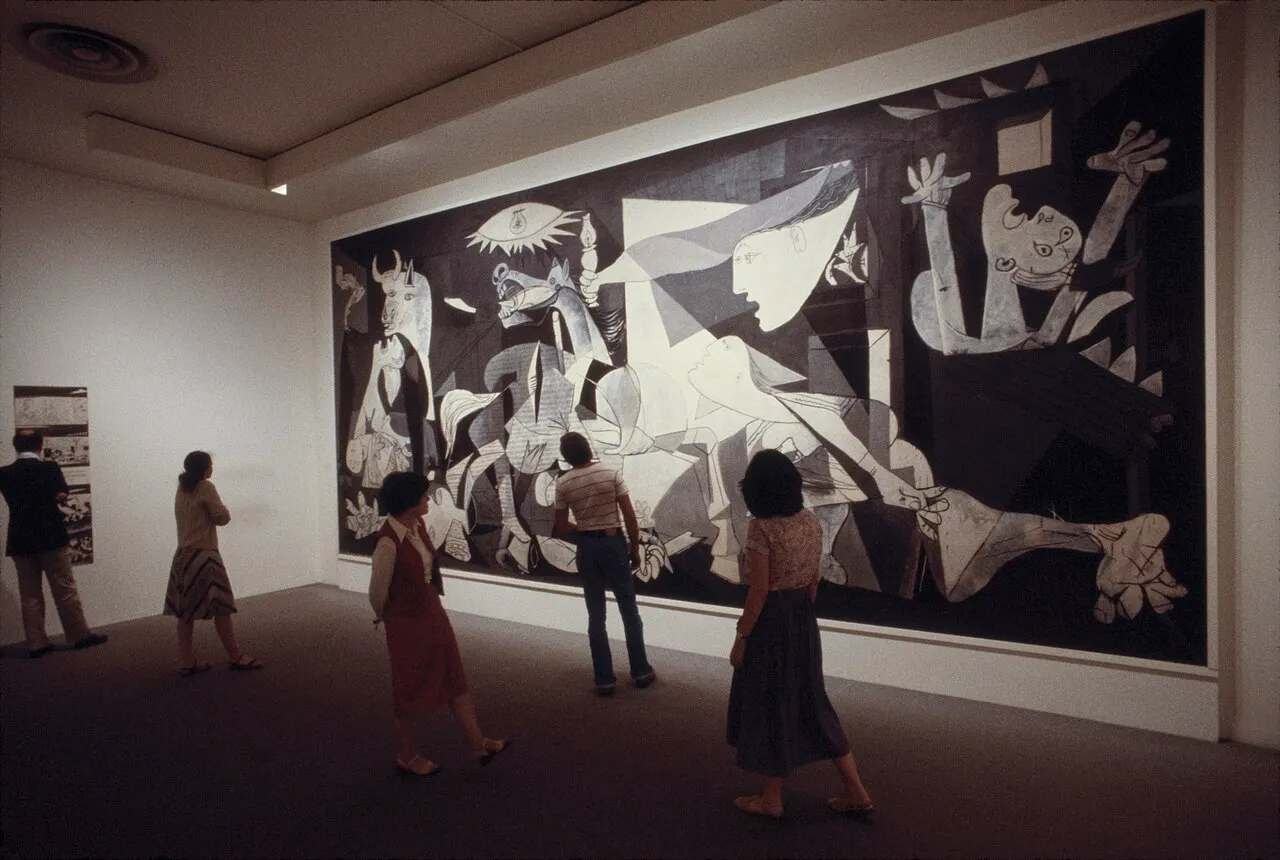
The first thing that hits you when you encounter Guernica at the Museo Reina Sofía in Madrid is its size. At roughly 3.5 metres tall and nearly 8 metres wide, the painting is not an object you look at so much as a space you enter. The Reina Sofía gives it an entire room, with low lighting and a viewing distance calibrated to allow the full composition to register. This is one of those rare cases where reproductions genuinely fail the original; the physical experience of standing in front of Guernica is different in kind, not just degree, from looking at a photograph of it.
The second thing you notice is that it is monochromatic: black, white, and grey throughout, with no colour whatsoever. This was a deliberate choice. Picasso was responding to photojournalism and newspaper photography, which in 1937 was still largely black and white. The palette aligns the painting with documentary evidence, with newspaper front pages and wire photos, rather than with the traditional colour palette of historical painting. It is also a palette associated with grief and shock, the world drained of warmth.
Pablo Picasso, "Guernica" (1937), oil on canvas, 349.3 x 776.6 cm. Museo Reina Sofía, Madrid. Painted in approximately five weeks and first exhibited at the Paris International Exposition. Image: © Succession Picasso/DACS, London 2026. Fair use, via Wikipedia
What the Symbols Mean (and What Picasso Said About Them)
Guernica is full of immediately legible imagery: a screaming horse, a bull, several screaming or weeping women, a dead baby, severed limbs, a soldier's broken body, a lamp thrust into the scene from the upper right, a bare electric bulb hanging from the centre. Picasso produced over 45 preparatory studies and sketches for the painting, and these studies reveal how deliberately each element was considered and revised before the final composition was fixed.
Picasso's own statements about the symbolism are characteristically evasive. In a 1945 interview, he said: "The bull is a bull and the horse is a horse. These are animals, massacred animals. That's all, so far as I'm concerned. It's up to the public to see what it wants to see." Elsewhere, however, he was slightly more specific. He described the horse as representing "the people" or "the innocent" and the bull as representing "brutality and darkness." The screaming woman holding a dead child is directly associated with depictions of the Pietà (Mary holding the dead Christ), a reference that would have been immediately legible to a Catholic Spanish audience.
The lamp thrust into the scene from the upper right, held by a disembodied arm, is often read as hope or truth, a witness bearing light into the darkness. The bare electric bulb in the centre, shaped like an eye, is frequently interpreted as the cold, indifferent eye of technology, the modern world that made this kind of mass destruction possible. These two light sources, the warm lamp and the clinical bulb, frame the horror between two versions of illumination: one human and straining, the other mechanical and blind.
The Preparation: 45 Studies in Five Weeks
The preparatory studies for Guernica, housed in the Reina Sofía's collection alongside the painting itself, show Picasso working rapidly and systematically through compositional possibilities. He began with the central horse and bull, experimenting with their placement and relationship before settling on the rough triangular structure that organises the final composition. The mother and dead child went through multiple transformations, shifting from a seated position to the anguished upward-straining pose of the final painting. The screaming women were developed as separate studies with extraordinary emotional force, their mouths open in the same anguished cry that appears throughout the painting.
Dora Maar, Picasso's companion at the time and an accomplished photographer herself, documented the painting's development through a series of photographs taken at different stages in the studio. These photographs are invaluable art-historical documents; they show the composition being built up and revised, and they confirm that Picasso worked on the canvas with decisive energy over a compressed period, not with the slow deliberation of his earlier Cubist work. The Picasso artist spotlight explores the full development of his Cubist language that underlies Guernica's fragmented forms.
The Cubist Language Applied to Violence
Guernica uses the fractured, multi-viewpoint vocabulary of Cubism, which Picasso had developed with Georges Braque beginning in 1908, but applies it to a subject of extreme emotional and political urgency in a way his earlier Cubist paintings never attempted. In a still life or a portrait, the Cubist fragmentation of planes into simultaneous views can feel like formal experimentation. In Guernica, the same fragmentation reads as physical destruction: bodies broken apart, space fractured by the impact of bombs, reality literally shattered.
The screaming horse in the centre, whose body is made up of competing angles and impossible planes, simultaneously conveys the animal in motion, the animal in pain, and the animal already becoming fragments. The mouth open in a scream, the upward-straining neck, the collapsing legs: these are all visible at once rather than in sequence. This simultaneous visibility, the central principle of Cubism, becomes here a representation of catastrophic simultaneity, the way a bomb blast destroys everything at the same moment rather than in orderly sequence.
The monochromatic palette reinforces this. Colour would have individuated and distinguished the figures; black and white makes them part of a single mass of suffering. The composition moves from the panicked action on the left and right to the collapsed figure of the horse and soldier in the centre, drawing the eye into the painting's heart and offering no comfortable exit from the scene.
The Exile and the Return
After the Paris Exposition closed, Guernica was exhibited in Europe to raise awareness of and funds for the Spanish Republic. When it became clear that Franco's Nationalist forces would win the Spanish Civil War, Picasso agreed to loan the painting to the Museum of Modern Art in New York for safekeeping. He stipulated explicitly that it should not return to Spain until the country had restored democratic freedoms.
Guernica remained at MoMA for decades, becoming one of the most politically freighted artworks in the world. During the Vietnam War era, protests were held in front of it. After Franco's death in 1975 and the subsequent democratic transition in Spain, the Prado Museum formally requested the painting's return. The transfer was not immediate; negotiations with the Picasso estate and the Spanish government continued for several years. The painting arrived in Spain in September 1981, initially hanging in the Prado, and moved to the newly opened Reina Sofía museum in 1992, where it has remained.
The Basque regional government periodically requests that the painting be transferred to the Basque Country, arguing that it belongs to the people and place it commemorates. This dispute, civil and ongoing, is itself a kind of afterlife for the painting's political meaning: Guernica continues to be argued over, and the argument is never purely about aesthetics.
The UN Security Council Moment
The Reina Sofía holds the original, but a tapestry reproduction of Guernica hangs in the United Nations building in New York, outside the entrance to the Security Council chamber. On February 5, 2003, when US Secretary of State Colin Powell held his press conference presenting the case for military action in Iraq, UN staff covered the tapestry with blue curtains and UN flags. The decision to cover Guernica at the moment of a speech justifying war was made without public announcement and was not acknowledged at the briefing.
When journalists noticed and asked about it, the explanation offered was that the blue background would provide better contrast for television cameras. This explanation was widely disbelieved. The episode illustrated with precision the painting's continuing political charge: nearly seventy years after it was made, Guernica still had sufficient force to require concealment at a politically inconvenient moment. For how visual culture and politics have intersected across history, the art and politics guide provides extensive context.
The town of Guernica (Gernika-Lumo) in the Basque Country, Spain. The April 26, 1937 bombing of this market town during the Spanish Civil War was the direct catalyst for Picasso's painting. The town was rebuilt and now hosts a Peace Museum. Image: Public domain, via Wikimedia Commons
Why Guernica Still Matters
Guernica works as a painting, not just as a political statement. The composition is formally extraordinary: the tumbling diagonals, the compression of space, the way the screaming figures press against the edges of the canvas as though trying to escape beyond the frame. The technical command evident in the painting, the rapid laying in of the monochromatic forms, the adjustment of scale to give the horse a near-mythological centrality, reveals an artist working at the absolute height of his powers under conditions of genuine moral urgency.
The painting's political meaning has not diminished with time. It has, if anything, become more flexible: it is invoked in response to every new aerial bombardment of civilians, every conflict in which organised military force is directed against undefended populations. This broad applicability might seem to dilute its specificity, but Picasso's choice to make the imagery symbolic rather than documentary means the painting can absorb new references without losing its original ones.
Visiting Guernica at the Reina Sofía is one of the defining experiences of European art tourism. Take time with the preparatory studies displayed in the adjacent rooms before approaching the painting itself. They show the process behind the finished work in a way that makes the final composition more, not less, astonishing. For how Cubism developed as a visual language, see the Cubism guide. For the full arc of Picasso's career, the Picasso artist spotlight covers everything from the Blue Period to his final years.


