
Michelangelo carved "David" from a single block of Carrara marble that had been quarried forty years earlier and abandoned because its proportions were difficult. Two previous sculptors had tried to work it and given up. Michelangelo looked at the same block and saw a figure that could be freed from it. He spent three years chiseling away everything that was not David, working from a wax model suspended in a water-filled container that he lowered gradually to reveal the next section to carve. The finished sculpture is 5.17 meters tall. The marble is so fine-grained that light penetrates two or three millimeters below the surface before scattering back, which is why the figure seems to glow from within. That property, unique to high-quality marble, is the reason it has been the prestige material of Western sculpture for 2,500 years.
Sculpture is different from painting in one fundamental way: you cannot separate a sculpture from its material. A painting is an image carried by a surface, and the surface is mostly transparent to the viewer. A sculpture is its material. The weight of the bronze, the grain of the wood, the translucency of the marble, the rust on the steel: these are not carriers of meaning. They are the meaning. When you change the material, you change the work. A "David" carved in sandstone would be a different sculpture, with different implications, regardless of whether the form was identical.
This guide covers the major materials sculptors have used across history, the specific techniques required to work each one, and how the choice of material contributes to what the finished sculpture communicates. The Getty's educational resource on sculptural materials provides complementary technical information for readers who want to go deeper.
Stone: Marble, Limestone, and the Subtractive Process
Stone sculpture is subtractive. You start with a block and remove material until the form is revealed. There is no adding back. A miscalculated strike of the chisel can ruin months of work, which is why stone sculptors work from models, use pointing machines or calipers to transfer measurements, and proceed from rough blocking-out to progressively finer carving.
Marble is the queen of stones. Its crystalline structure allows light to penetrate slightly below the surface before reflecting, giving carved marble a luminosity that mimics the translucency of human skin. This is why so many classical and Renaissance sculptures seem to glow with an almost living warmth. The quarries at Carrara in Tuscany have produced white marble for sculptors since Roman times. Michelangelo personally selected his blocks there, spending weeks examining the stone for flaws, grain consistency, and color before committing.
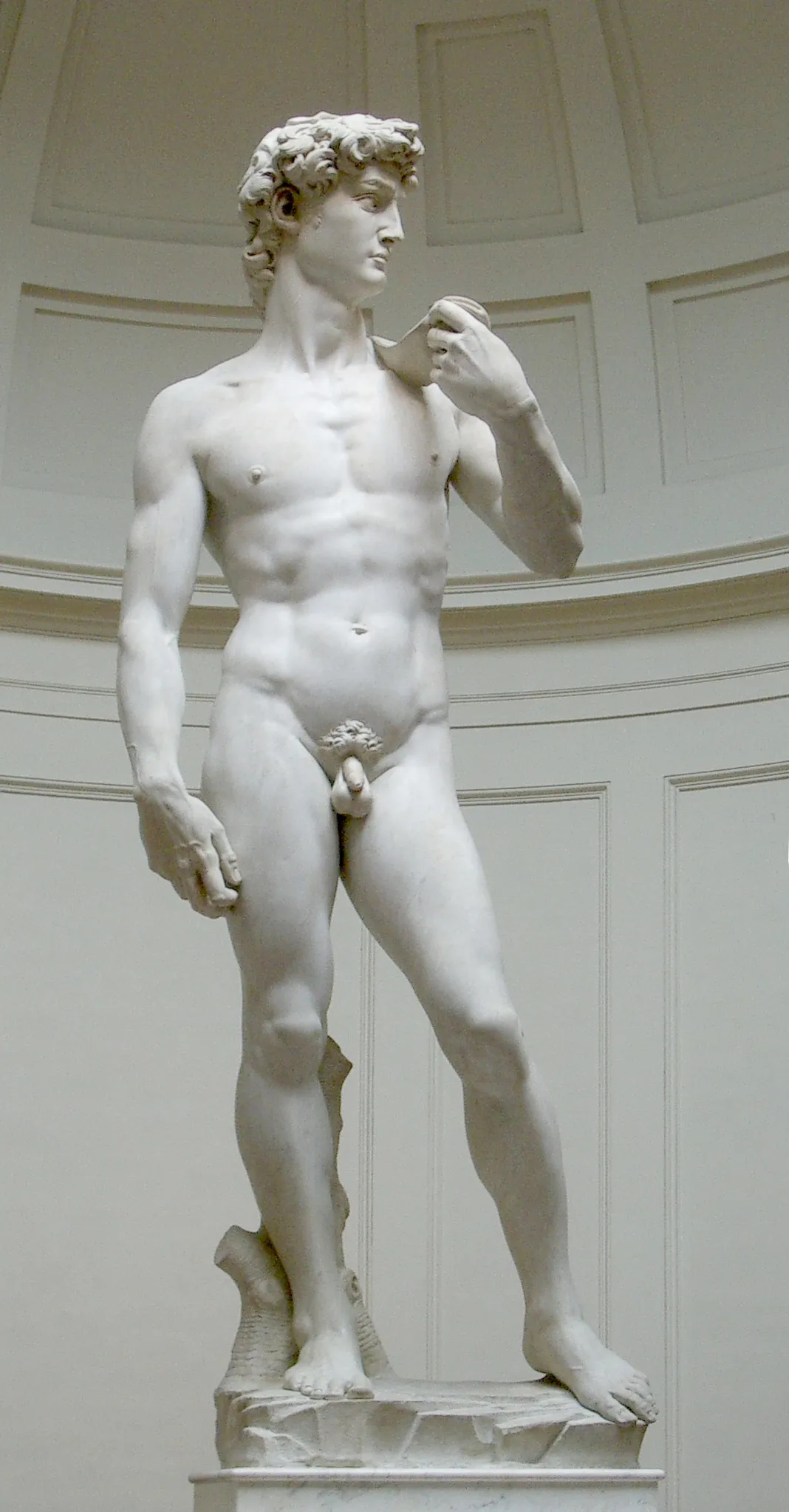
Michelangelo, "David" (1501–1504), marble, 517 cm. Galleria dell'Accademia, Florence. Carved from a single block of Carrara marble that two previous sculptors had abandoned. Image: Public domain, via Wikimedia Commons
The peak of marble carving is probably Bernini. His "Apollo and Daphne" (1622–1625) in the Galleria Borghese shows Daphne transforming into a laurel tree as Apollo reaches for her. The bark grows over her skin. Her fingers become leaves and branches. The marble is carved so thin in places that light passes through it, making the leaves appear to glow. The technical difficulty of carving fingers that thin from solid marble without breaking them is staggering, and Bernini did it at age 24.
Other stones serve different purposes. Limestone is softer and easier to carve, with a warmer, more matte surface. It was the standard material for medieval European church sculpture. Granite is extremely hard and durable, with a granular texture. Ancient Egyptian sculptors worked granite with copper tools and abrasives, a process that required extraordinary patience. Alabaster is soft and translucent, glowing when backlit, and was used for small devotional sculptures and decorative work. Jade, prized in Chinese sculpture for its hardness and color range, is carved with abrasive techniques rather than chiseling because it is too hard to cut with conventional tools.
Clay: The Oldest and Most Forgiving Material
Clay is the most intuitive sculpture material. It is soft, responsive, and forgiving. You can add to it, subtract from it, and reshape it indefinitely until you fire it. This makes it the primary material for learning sculpture and for creating preparatory models, called maquettes, for works that will be executed in more permanent materials.
Clay sculpture is additive. The sculptor builds up the form by adding material rather than carving it away. Small sculptures can be made from solid clay, but larger works must be hollow to prevent cracking and exploding during firing. The techniques for building hollow forms, using coils, slabs, or pinching, are among the oldest technologies in human history. The Venus of Dolní Věstonice, a small ceramic figure found in the Czech Republic, was fired approximately 27,000 years ago.
Raw clay, called greenware, is fragile and water-soluble. Firing it in a kiln at temperatures between 1,000 and 1,300 degrees Celsius transforms it into ceramic, a hard, permanent material. Glazes, which are glass-forming mineral mixtures applied before a second firing, add color, texture, and waterproofing. The range of possible surfaces is enormous, from rough, earthy stoneware to the white, glassy translucency of porcelain.
Contemporary ceramic sculpture has experienced a genuine renaissance. Grayson Perry builds elaborately decorated narrative vases that carry social commentary beneath their ornate surfaces. Ai Weiwei has used porcelain in conceptual installations, most famously dropping a Han Dynasty urn and documenting its destruction, and later creating fields of porcelain sunflower seeds that comment on mass production and Chinese cultural history. The medium's association with craft rather than fine art, which kept it marginalized for decades, has dissolved almost entirely.
Bronze: The Art of Lost-Wax Casting
Bronze, an alloy of copper and tin, has been the prestige material for metal sculpture since the Bronze Age. It is strong, durable, resistant to corrosion, and capable of capturing extraordinary detail. Most importantly, bronze can be cast: poured as molten metal into a mold and cooled to form a solid replica of the original model.
The dominant casting technique is lost-wax casting (cire perdue), a process that has remained fundamentally unchanged for over 5,000 years. The sculptor creates the original form in clay or wax. A mold is made around the original using plaster, silicone, or ceramic shell. A wax replica is cast from the mold. The wax replica is coated in a ceramic shell. The shell is heated, melting out the wax and leaving a hollow cavity. Molten bronze, at approximately 1,100 degrees Celsius, is poured into the cavity. Once cooled, the ceramic shell is broken away, revealing the bronze cast. The surface is then finished through chasing, refining details with tools, and patination, applying chemicals to produce surface color.
Because casting involves a mold, bronze sculptures can be produced in editions. Multiple casts from the same original model are each considered original works. Auguste Rodin's "The Thinker" exists in over twenty authorized bronze casts in museums worldwide, each one produced from Rodin's molds. This multiplicity raises interesting questions about originality and authenticity that parallel the issues in printmaking, where the plate or block similarly produces multiple originals.

Auguste Rodin, "The Thinker" (1904, enlarged version), bronze. Musée Rodin, Paris. Over twenty authorized casts exist worldwide, each an original work from Rodin's molds. Image: CC BY-SA 3.0, via Wikimedia Commons
Wood: Warm, Organic, and Vulnerable
Wood has been used for sculpture across virtually every culture. Its grain, color, and workability vary enormously by species, from the soft, pale basswood favored by European medieval carvers to the dense, dark ebony prized in West African sculpture.
Wood sculpture is primarily subtractive, carved from a solid block, though some traditions build up forms by joining pieces. The material's organic quality, its visible grain, its warmth to the touch, its association with living trees, gives wood sculpture a vitality that cold stone and metal sometimes lack. Tilman Riemenschneider, the medieval German sculptor, carved limewood altarpieces of extraordinary emotional intensity in the late 15th century. He left the wood unpolished, emphasizing its natural warmth and texture rather than disguising it with paint or gilding, a decision that was unusual for his period and that gives his work a directness that still reads as modern.
Wood's vulnerability to rot, insects, and fire means that far fewer historical wood sculptures survive compared to stone or bronze. Many of the world's great sculptural traditions, West African, Pacific Islander, Native American, worked primarily in wood, and the loss of historical examples due to material deterioration has created significant gaps in the art historical record. The Benin Bronzes survived because they were metal. The wooden sculptures from the same culture did not.
Modern and Contemporary Materials
The 20th and 21st centuries dramatically expanded what sculpture could be made from. The expansion was not just about new materials. It was about a fundamental shift in what sculpture was for.
Welded Steel
David Smith, Richard Serra, and Anthony Caro adopted industrial welding techniques to create sculptures from steel beams, plates, and rods. Serra's massive weathering-steel installations, curving walls of rusted Cor-Ten steel that weigh thousands of tons, use industrial material at architectural scale to create overwhelming physical experiences. Standing inside one of Serra's torqued ellipses, the steel rising above you on all sides, you feel the weight of the material in your body. That somatic response is the sculpture's subject.
Found Objects and Assemblage
Marcel Duchamp's readymades, ordinary manufactured objects presented as art, opened the door for sculpture made entirely from pre-existing objects. Louise Nevelson built monumental assemblages from wooden scraps collected from the streets of New York, unified by monochrome paint. Robert Rauschenberg created "combines" that incorporated everyday objects alongside painting. El Anatsui constructs shimmering metal tapestries from recycled bottle caps and copper wire, works that hang like fabric but are made from industrial waste. The material carries its own history into the gallery: the bottle caps reference global trade, alcohol consumption, and West African textile traditions simultaneously.
Light, Air, and Immateriality
Contemporary sculptors increasingly work with immaterial elements. James Turrell sculpts with light itself, creating rooms where carefully controlled illumination becomes a tangible, physical presence. Anish Kapoor's mirrored and void sculptures manipulate perception of space and surface. Olafur Eliasson uses water, fog, and temperature as sculptural materials in immersive installations that dissolve the boundary between the artwork and the environment it occupies.
How Material Shapes Meaning
The choice of material is never neutral. It always contributes to the sculpture's meaning, sometimes in ways the sculptor intends and sometimes in ways that operate regardless of intention.
Marble carries associations with Greek and Roman civilization, with permanence, with classical beauty, with institutional authority. A marble figure references antiquity whether the sculptor wants it to or not. Bronze suggests durability, public commemoration, and institutional weight. Most public monuments are bronze because the material resists weather and communicates permanence. Found objects bring their own histories and associations. A sculpture made from car parts comments on industry and consumer culture through its material alone, before any formal analysis begins. Ephemeral materials, ice, food, flowers, sand, emphasize impermanence and the passage of time. Andy Goldsworthy's nature sculptures, made from leaves, stones, and ice, are designed to decay. The documentation of their dissolution is part of the work.
Final Thoughts
Sculpture is the art form that shares our physical space. Paintings exist behind a frame in their own illusionistic world. Sculptures occupy the same three-dimensional reality we do. We walk around them. We cast shadows on them. We feel their scale in relation to our own bodies. This physical presence, the weight of bronze, the coolness of marble, the roughness of carved wood, is what makes sculpture uniquely powerful.
Understanding materials deepens the experience. When you know that marble is subtractive and unforgiving, you appreciate Bernini's virtuosity differently. When you understand lost-wax casting, Rodin's textured surfaces become more impressive. When you recognize that a found-object assemblage carries the history of its materials into the gallery, the work becomes richer and more layered. The material is not just what the sculpture is made from. It is what the sculpture is made of, in every sense of that phrase.
Want to learn more about art materials and techniques? Explore oil painting techniques, or deepen your understanding of texture in art.


