The most common mixed media problem is not technical. It is conceptual. Most beginners who combine materials end up with work that looks like several different decisions happening simultaneously on the same surface, none of them committed to, none of them resolved. The collaged newspaper sits next to the gestural brushstroke and the drawn line, and they look like strangers. They share a surface but not a purpose.
The artists who make mixed media work at the highest level, from Kurt Schwitters building Dadaist assemblages from urban trash to Anselm Kiefer embedding straw, lead, and ash into monumental canvases about German history, understand one fundamental principle: every material in the work must serve the work. Not "every material must match" or "every material must blend." Serve. The question is not whether your materials look similar to each other but whether they are doing the right thing in the right place.
This guide covers what mixed media actually means, the historical tradition that legitimized it, the principles that determine whether multi-material work succeeds or fails, and practical techniques for building surfaces that hold together visually and physically.
What Counts as Mixed Media
Mixed media is broadly defined as work that uses more than one material or technique in a single piece. Within painting, this might mean combining acrylic with collaged paper elements. Within drawing, it might mean combining graphite with ink wash and watercolor. More expansively, it includes assemblage (three-dimensional found-object work), artist's books, and installation work that integrates printed material, painting, and physical objects.
The definition is deliberately loose because the category emerged from a persistent need in 20th-century art to work outside single-medium disciplines. The academic tradition, with its sharp distinctions between oil painting, watercolor, drawing, and printmaking, did not accommodate the kind of hybrid, process-driven work that many artists wanted to make. Mixed media is the term that covers the gap between those disciplines.
What distinguishes mixed media from simple combination is intentionality. Painting a background and sticking a photograph on it is not mixed media in any meaningful sense. It is laziness unless the relationship between the paint and the photograph is doing something purposeful. Mixed media succeeds when the combination creates something that neither component could achieve alone.
Historical Foundations: Schwitters, Rauschenberg, and Kiefer
Kurt Schwitters (1887 to 1948) is the founding figure of mixed media as a serious artistic practice. Working in Hanover in the years after World War One, he began making collages from the urban debris of postwar Germany: tram tickets, newspaper fragments, string, wire, rusted metal, broken wood, and anything else he found discarded. He called the work "Merz," a nonsense word derived from the German "Kommerz" (commerce), and understood it as an act of aesthetic recycling. He was finding form and beauty in the materials that industrial society had thrown away.
His ambition expanded into the "Merzbau," a construction that gradually took over his Hanover house, incorporating found objects, photographic portraits, and small relics of friends into an evolving three-dimensional collage environment. Destroyed in Allied bombing in 1943, it exists only in photographs, but it remains one of the most audacious examples of mixed media's possibilities. Schwitters's principle, that any material was available for art provided it was handled with care and intention, is the foundation of all subsequent mixed media practice. The Garage Museum of Contemporary Art in Moscow mounted a major exhibition examining the direct lineage from Schwitters to Rauschenberg, framing both artists as pioneers who turned discarded material into serious art.
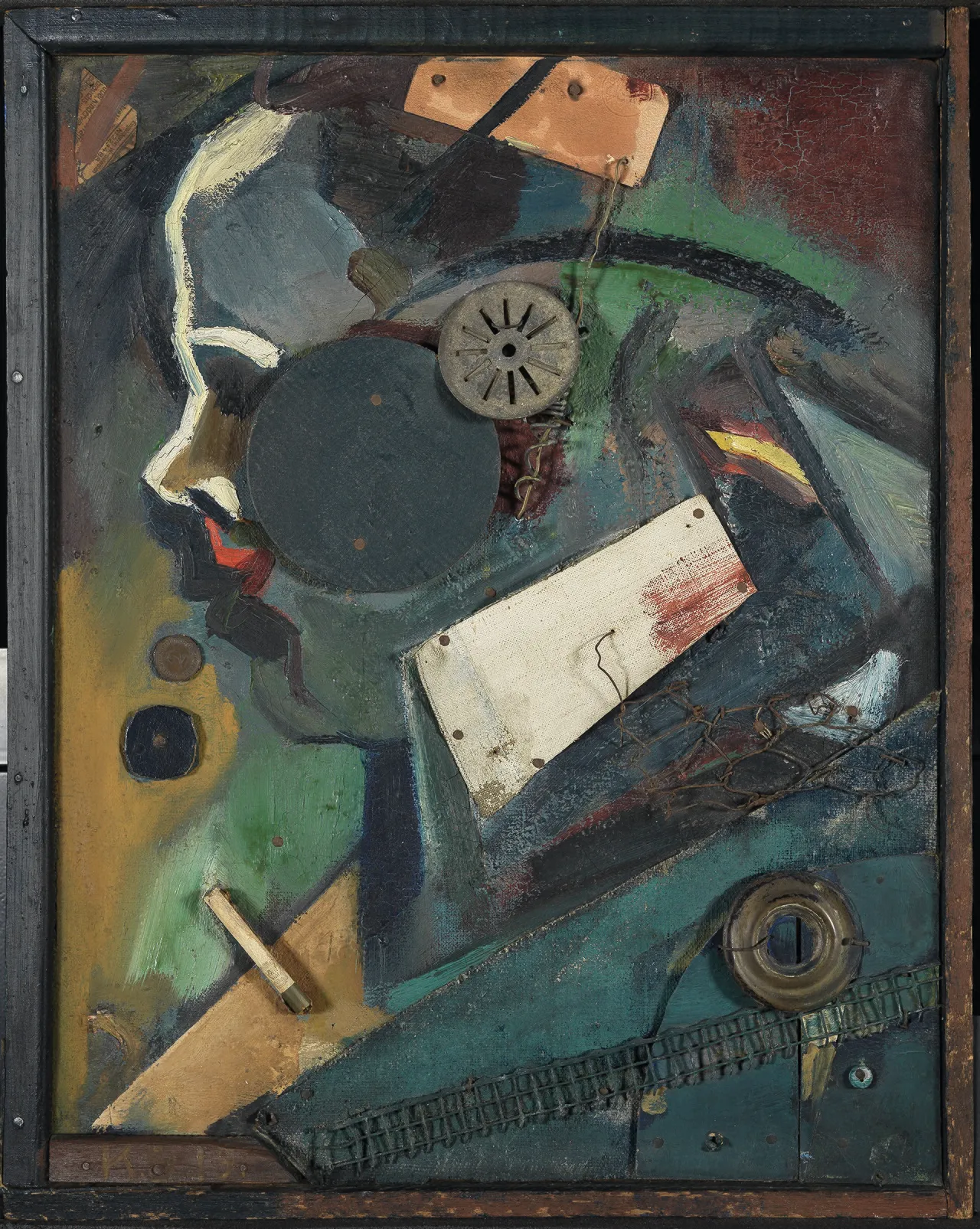
Kurt Schwitters, "Merzbild 1A, Der Irrenarzt" (1919), collage and assemblage on canvas, 48.5 x 38.5 cm. Sprengel Museum, Hanover. Schwitters's Merz works combined found materials with paint and drawing, establishing the principle that any material could serve aesthetic purposes if handled with care and intention. Image: Public domain, via Wikimedia Commons
Robert Rauschenberg took Schwitters's approach and scaled it to American postwar culture. His "Combines" of the 1950s incorporated fabric, newspaper, postcards, magazine photographs, painted canvas, tires, taxidermied animals, and radio sets into works that blurred painting, sculpture, and assemblage into something new. "Bed" (1955) used his own quilt and pillow as supports for gestural paint, simultaneously an Abstract Expressionist painting and a found-object sculpture. Rauschenberg wanted to occupy the space "between art and life," and the Combines do exactly that. They are objects from life that have become art without losing their life-object identity. This connects directly to the collage tradition explored in our guide to collage as art.
Anselm Kiefer (born 1945) extended mixed media into questions of historical memory and German identity. His monumental paintings incorporate straw, lead plates, broken glass, ash, crushed shells, clay, and thorns embedded in thickly painted canvas or lead-covered surfaces. In works like "Margarethe" (1981) and "Osiris und Isis" (1985 to 1987), the physical materials are not decorative additions. They are the meaning. Straw that has burned embodies the destruction of culture. Lead, a material associated with both weight and alchemical transformation, carries the burden of historical complicity. Kiefer's work demonstrates that mixed media's ultimate possibility is making the material itself meaningful.
In 2025, Kiefer's mixed media practice reached a new peak of public visibility. A landmark joint exhibition at the Van Gogh Museum and Stedelijk Museum in Amsterdam presented 25 works including a new 24-meter-long immersive installation titled "Sag mir wo die Blumen sind," combining paint, clay, uniforms, dried rose petals, and gold. The show then traveled to the Royal Academy of Arts in London, where Kiefer's "The Starry Night" (2019), measuring 8.4 meters wide and made with oil, acrylic, gold leaf, straw, clay, burnt wood, wire, and sunflower seeds, nearly filled the gallery wall. The exhibition made clear that Kiefer's mixed media practice is not a technique but a worldview: the materials carry the meaning, and the meaning cannot be separated from the materials.
The Principles Behind Successful Mixed Media Work
Unity Through Repetition
A repeated element, whether a color, a shape, a texture, or a scale, binds disparate materials into a coherent whole. If you use two very different materials, a way of unifying them is to repeat a color from one in the other. Paint over part of a collaged element so that its color echoes other areas of paint, or use the same hue in different materials across the surface. This visual echo tells the eye that the work is one thing, not several things that happen to be on the same surface.
Intentional Contrast
Mixed media work often succeeds through the productive friction between materials. A rough, textured collaged area next to a smooth, flat painted area makes both more visible by comparison. A gestural painted mark next to a geometric printed element creates energy from the contrast. The key is that the contrast should feel deliberate rather than accidental, controlled rather than random. For more on how texture creates visual interest, see our guide to texture in art.
Surface Preparation and Compatibility
Not all materials adhere to all surfaces, and not all materials are compatible over time. Oil and acrylic should not be combined in the same layer because they dry differently and will separate over time. Collaged paper on a flexible canvas can crack as the canvas moves. Ensure that your support is rigid enough for the materials you are adding, and that your adhesive is appropriate for the weight and flexibility of those materials. PVA glue and acrylic gel medium are the most versatile and durable adhesives for paper-based collage elements on a painted support.
Layering Order
Working generally from opaque to transparent and from large to small gives mixed media work a sense of depth and hierarchy. Large painted areas first, collage elements over them, drawn marks and detail last. Transparent glazes applied over the whole surface can unify elements that look disconnected, pulling them into a shared tonal atmosphere. This layering approach mirrors how glazing in oil painting creates depth through accumulated transparent layers.
Practical Techniques Worth Knowing
Image transfer: Photographic images can be transferred to painted surfaces using gel medium. Brush gel medium over a printed image, press it face-down onto the painted surface, let it dry, then wet the paper and rub it away to leave the image embedded in the dried gel. The result is a semi-transparent photographic image that sits within the painted surface rather than on top of it.
Texture creation: Sand, pumice gel, modeling paste, or fine gravel mixed with acrylic medium can be applied as ground texture before painting. Printed or handmade papers give areas of the surface a different visual character from painted areas. Wire mesh, fabric, and thin wood veneer can all be collaged onto a rigid support and then overpainted.
Painted drawing: Line drawn with a brush using fluid paint creates a connection between the painted and drawn elements of a mixed media piece. A drawn contour in india ink over a painted area explicitly merges the two media rather than keeping them separate.
Final Thoughts
Mixed media work rewards courage and commitment. The technical challenges are real but solvable. The conceptual challenges, knowing why each material is there and what it is doing, require more sustained thought. But the combination of materials that would be impossible or limiting in a single medium gives you a range of expression and surface quality that pure painting or drawing rarely achieves.
Start small: combine acrylic paint with collaged paper elements and painted drawing on a rigid board. Build up through experimentation. Study how the artists discussed here handle material relationships, and look at how compositional principles apply just as much to assembled materials as to painted marks. For a deeper look at how found objects became a legitimate artistic medium, our guide to found object art traces the history from Duchamp's Fountain to contemporary assemblage. The material is new; the visual principles are not.