In October 1987, a patchwork of fabric panels was unfolded on the National Mall in Washington, D.C., covering more ground than a football field. Each panel was three by six feet, roughly the size of a human grave, and each one bore the name of someone who had died of AIDS. Visitors walked the aisles in silence. Some knelt. Some fell apart completely. The Reagan administration, which had spent six years largely ignoring the epidemic, suddenly had to reckon with 1,920 names laid out on the grass in front of the Capitol.
That quilt is now the largest community art project in history, with nearly 50,000 panels memorializing more than 110,000 individuals. It is also one of the clearest examples of what protest art actually does: it makes the scale of an injustice impossible to dismiss, and it forces a confrontation that political speech alone cannot achieve. This guide traces how artists from Goya to Banksy have used visual art as a form of resistance, and why the images they made have outlasted the political moments that produced them.
Goya: The First Modern War Artist
Francisco Goya's "The Disasters of War" series, 82 etching prints begun around 1810, is the foundation document of modern protest art. Made during the Peninsular War, when French forces occupied Spain and both sides committed atrocities, Goya's prints broke with everything Western art had done before when depicting conflict. Earlier war imagery followed conventions of heroic narrative: commanders on horseback, disciplined troops, victory framed as divine providence. Goya threw all of that away.
His prints show specific bodies in specific states of degradation. One plate shows a pile of mutilated corpses draped over a dead tree. Another shows prisoners being garrotted. The titles are captions rather than glorifications: "This is worse," "There is no remedy," "Why?" He never published them during his lifetime, knowing what would happen to him if he did. They were finally printed 35 years after his death in 1863.
His 1814 painting "The Third of May 1808" is the clearest bridge between this work and what Picasso would do 123 years later. The French soldiers executing Spanish civilians are faceless, their backs to us, their rifles mechanically level. The man about to be shot spreads his arms. The gesture echoes the Crucifixion but the man's face reads as terror, not martyrdom. That refusal to aestheticize the violence, to make the killing noble or meaningful, is Goya's political argument in visual form. According to the Museo del Prado's catalogue entry for the painting, Goya requested this commission himself, offering to document "the heroic and brilliant actions or scenes of our glorious insurrection against the tyrant of Europe." The painting he actually delivered was something else entirely.
Guernica: Five Weeks, 349 Square Feet
On April 26, 1937, German Condor Legion and Italian Aviazione Legionaria aircraft bombed the Basque town of Guernica during a Monday market. Casualty estimates range from 150 to over 1,600 civilians killed. Pablo Picasso had already been commissioned by the Spanish Republic to produce a mural for the Paris International Exposition. After the bombing, he scrapped whatever he had been planning and spent five weeks producing "Guernica" instead.
The painting is 349.3 by 776.6 cm, roughly 11 by 25 feet. That size matters. When you stand in front of it at the Museo Reina Sofía in Madrid, the screaming figures are roughly life-size, and the overall composition fills your peripheral vision. Picasso stripped out all color, working in black, white, and grey. This was not an accident: those were the colors of newspaper photography and newsreel footage, the media through which most people were encountering the bombing's horror. The formal language of the painting matched the formal language of mass media.
The Cubist fragmentation that Picasso had spent decades developing, the ability to show a face from multiple angles simultaneously, serves a different function here than it does in his portraits or still lifes. The bodies in Guernica are not shown from multiple perspectives to demonstrate perceptual complexity. They are broken apart because the bombing broke them apart. The mother with the dead child, the screaming horse, the dismembered soldier with the broken sword: none of these figures are whole. The painting shows what high-explosive bombs do to living things.
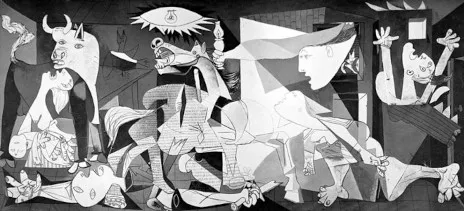
Pablo Picasso, "Guernica" (1937), oil on canvas, 349.3 x 776.6 cm. Museo Reina Sofía, Madrid. Picasso refused to allow the painting to return to Spain while Franco was alive. It was held at the Museum of Modern Art in New York until 1981, six years after Franco's death. Image: Fair use, Pablo Picasso estate / via Wikipedia
The political life of Guernica continued long after Picasso completed it. During the Vietnam War, diplomats objected to its placement outside the UN Security Council chamber as too pointed a comment on what was being discussed inside. A tapestry reproduction of it is still displayed outside that chamber today, though it was famously covered with a blue curtain in 2003 when Colin Powell briefed the press on the case for invading Iraq. Someone understood exactly what it was saying. For more on how Picasso's formal vocabulary made Guernica possible, see our guide to Pablo Picasso: Cubism, Controversy, and a Century of Influence.
Civil Rights: The Camera as a Political Weapon
The American Civil Rights Movement generated protest imagery through photography in ways its leaders understood and deliberately used. Gordon Parks, who became the first Black staff photographer at Life magazine in 1948, documented segregation and Black American life with images that combined high compositional intelligence with direct political content. His 1942 photograph "American Gothic, Washington, D.C." shows a Black cleaning woman named Ella Watson standing in front of an American flag, holding a mop and a broom. It quotes the Grant Wood painting directly. The argument is in the quotation: here is the America that "American Gothic" left out.
The strategy of using cameras to document state violence against nonviolent protesters was not accidental. Civil rights organizers including Wyatt Tee Walker, who served as Chief of Staff to Martin Luther King Jr., understood that the Birmingham Campaign of 1963 was designed partly to produce images. When Birmingham's Public Safety Commissioner Bull Connor turned fire hoses and police dogs on child marchers, those images reached every major newspaper and broadcast network within hours. According to historian Taylor Branch's account in "Parting the Waters" (1988), President Kennedy saw one of the Birmingham photographs and said it made him sick. The Civil Rights Act passed the following year.
Feminist Art: Naming What Was Missing
The feminist art movement of the 1970s had a specific problem to solve: how do you make visible an absence? The women whose contributions had been erased from the cultural record were not there to depict. Judy Chicago's answer, in "The Dinner Party" (1974-79), was to create a monument to the missing through their absence itself. The installation features 39 elaborately decorated place settings arranged on a triangular table, each setting representing a woman from history or mythology. Virginia Woolf gets a place. Sacagawea gets a place. The Primordial Goddess gets a place. Georgia O'Keeffe was still alive when the piece was completed and is represented alongside 38 others who never received the recognition the dinner table implies they deserved.
The imagery is deliberately provocative in a specific way: the ceramic plates use abstracted vulvic forms, referencing female anatomy in a museum context where female anatomy had been depicted only from a male perspective for centuries. The piece is now permanently housed at the Brooklyn Museum, which acquired it in 2002. The Brooklyn Museum's dedicated Dinner Party exhibition page documents the full scope of what Chicago and roughly 400 collaborators built over five years.
Barbara Kruger worked differently. Her text-and-image works from the 1980s use the visual grammar of advertising, black-and-white photographs overlaid with bold white text on red backgrounds, to turn advertising's persuasive vocabulary against the ideology it normally sells. "Your body is a battleground" (1989), produced for the March for Women's Lives in Washington, D.C., became one of the defining images of the reproductive rights debate. The design was deliberately made to look like a campaign poster. It could be printed on a T-shirt or held aloft in a crowd. Protest art has to travel, and Kruger understood that. Our guide to Pop Art covers the visual tradition Kruger drew on and subverted.
The AIDS Memorial Quilt
In November 1985, activist Cleve Jones stood at a candlelight march in San Francisco honoring Harvey Milk and George Moscone. He asked people to write the names of loved ones lost to AIDS on placards and tape them to the wall of the San Francisco Federal Building. Looking at the patchwork of paper against the wall, he thought of a quilt. Two years later, the NAMES Project AIDS Memorial Quilt was unfolded on the National Mall with 1,920 panels.
Today there are nearly 50,000 panels, each three by six feet, memorializing more than 110,000 individuals. The total weight of the quilt is 54 tons. The National AIDS Memorial holds and displays sections of it around the country; as recently as June 2026, panels were on display at churches and public spaces across the United States.
The quilt's power is not separate from its material. Fabric and needlework are domestic, intimate, private crafts. Displaying them on the National Mall converted private grief into public political demand. Each panel was made by someone who loved the person it honored, which meant that each three-by-six-foot rectangle of cloth contained a specific relationship, a specific loss. At a time when people with AIDS were frequently described in dehumanizing terms by politicians and the press, the quilt insisted that each death was a specific person who was loved. It is, the National AIDS Memorial notes, the largest community art project in history.
Banksy and the Street Art of Specific Arguments
Banksy's work is often described as though mystery and anonymity are its primary qualities. That misses what makes it actually effective as protest art. The content is specific. "Flower Thrower" (2003), which appeared on a wall in the Ar-Rajabi neighborhood in Jerusalem, shows a figure in the posture of throwing a petrol bomb but holding a bouquet of flowers instead. The location was not random: it was in a neighborhood frequently affected by the Israeli-Palestinian conflict. The piece appears in a context that gives it precise political meaning.
"Balloon Girl" (2002), the stencil of a girl releasing or reaching for a red heart-shaped balloon, has become one of the most reproduced images of the 21st century. In October 2018, when a framed print of it sold at Sotheby's for just over £1 million, a shredder hidden in the frame activated and partly destroyed the work as the gavel fell. Banksy posted a video of it happening with the caption "Going, going, gone." The piece became a commentary on the art market's ability to absorb and commodify any gesture of resistance. The shredded canvas later sold for £18.6 million in 2021.
His 2015 Dismaland installation in Weston-super-Mare was a full fairground built in a derelict outdoor swimming pool, running for five weeks. It included a wrecked Cinderella carriage surrounded by paparazzi, a working carousel of bombed oil tankers, and dozens of artists making work about consumer culture, surveillance, and political violence. Around 160,000 people attended in five weeks. No conventional gallery could have reached that audience with that content. Our spotlight on Banksy: Street Art's Most Mysterious Figure covers his practice in full.
Why Protest Art Outlasts Its Moment
The practical reason protest art endures is that it creates an image rather than an argument. An argument can be refuted, qualified, or ignored. An image of a mother holding a dead child cannot be argued with. It can be censored, but censorship rarely works the way censors intend: the Nazis organized a touring exhibition of confiscated "Degenerate Art" in 1937 to humiliate modernism, and over 2 million people attended, making it the most visited German art exhibition of the 20th century.
The deeper reason is formal quality. The protest art that survives the moment that produced it is the protest art that solved a visual problem with genuine intelligence. Goya's etchings are not powerful because of their politics alone. They are powerful because Goya found a visual form, the specific unglamorous body in a specific unglamorous moment, that no artist before him had found. The AIDS quilt is not powerful because of the epidemic alone. It is powerful because using domestic fabric as a medium, placing it in the most public space in America, found a form equal to the scale of the grief it expressed.
For more on how art has engaged with political power across history, see our guide to Art and Politics: How Governments Used and Abused Visual Culture and the broader Complete Guide to Art Movements. Which protest artwork do you think has had the greatest real-world political impact? Leave your answer in the comments.