In the military cemetery at Vladslo in Belgium, among the graves of 25,644 German soldiers killed in Flanders, two stone figures kneel facing each other. The man bows his head. The woman wraps her arms around herself and looks downward with an expression that is not simple anguish; it holds something more sustained and more terrible than acute grief. It looks like the face of someone who has not forgiven, and who is not going to. The sculptor Käthe Kollwitz modeled both figures after herself and her husband Karl. Their son Peter is buried nearby. She spent eighteen years trying to make a sculpture that could hold what his death had cost her. She placed it at his grave in 1932, and she went back to see it twice more before she died in 1945.
Art and grief have been connected since the first burial objects were placed beside the dead in Paleolithic caves. Humans have never been able to let death simply end things, and they have always used images to resist that ending: portraits, monuments, shrouds, quilts, murals, prints. Understanding why reveals something essential about what art is actually for, beyond aesthetics and beauty and cultural prestige.
Ancient Traditions: Objects for the Dead and Images for the Living
The oldest function of art in relation to death is the provision of objects for the dead. Ancient Egyptian tombs were stocked with paintings, sculptures, and everyday objects intended to serve the deceased in the afterlife. The care and expense invested in these objects expressed something beyond practical provision: the refusal to let death sever the relationship between the living and the dead.
The Fayum mummy portraits, painted in encaustic (hot wax mixed with pigment) on wooden panels in Roman Egypt between roughly 50 BC and 250 AD, occupy a particularly arresting position in this tradition. They are portrait paintings of specific individuals, executed with remarkable realism and psychological directness, intended to be fastened over the face of the mummified body. Look at one in a museum, and the experience is unlike looking at almost any other historical object. The person depicted is shown at the height of their life, healthy, present, looking directly at you. You are looking at someone dead for nearly two thousand years, and they are looking back. The gap between the intimacy of the portrait and the fact of the death it marks is exactly the gap that grief occupies.
Greek and Roman funerary tradition developed the commemorative relief, the grave stele showing the deceased in an ordinary moment. The Athenian grave stele of Hegeso (c. 410-400 BC), in the National Museum in Athens, shows a young woman examining a piece of jewelry from a box held by a servant. It is a scene of complete everyday normality. The power comes entirely from context: the ordinariness of the moment becomes unbearable because the woman doing it is gone.
Christian Art: Grief as Devotional Practice
Christian art placed grief at the center of its visual program more explicitly than any other major tradition. The Crucifixion, the Deposition, the Lamentation, and the Entombment were depicted thousands of times across Christian art history, in every medium and period. The function of these images was not just narrative. They were meant to produce grief in the viewer, to bring the person looking into sympathetic mourning for Christ's death as a spiritual discipline. The image was the instrument of religious practice, not just its illustration.
Giotto's fresco of the Lamentation of Christ (c. 1305) in the Scrovegni Chapel in Padua is one of the most formally inventive grief images in Western art. His great innovation was psychological specificity: each figure in the scene mourns differently. Mary Magdalene holds Christ's feet with a tenderness that is almost unbearable. One figure tears her hair. Another throws both arms wide in a gesture of total despair. Two angels in the air weep with an uninhibited physical anguish that no human figure is permitted. Giotto understood that grief does not look the same twice, and painted that understanding at a time when Italian painting had no precedent for it.
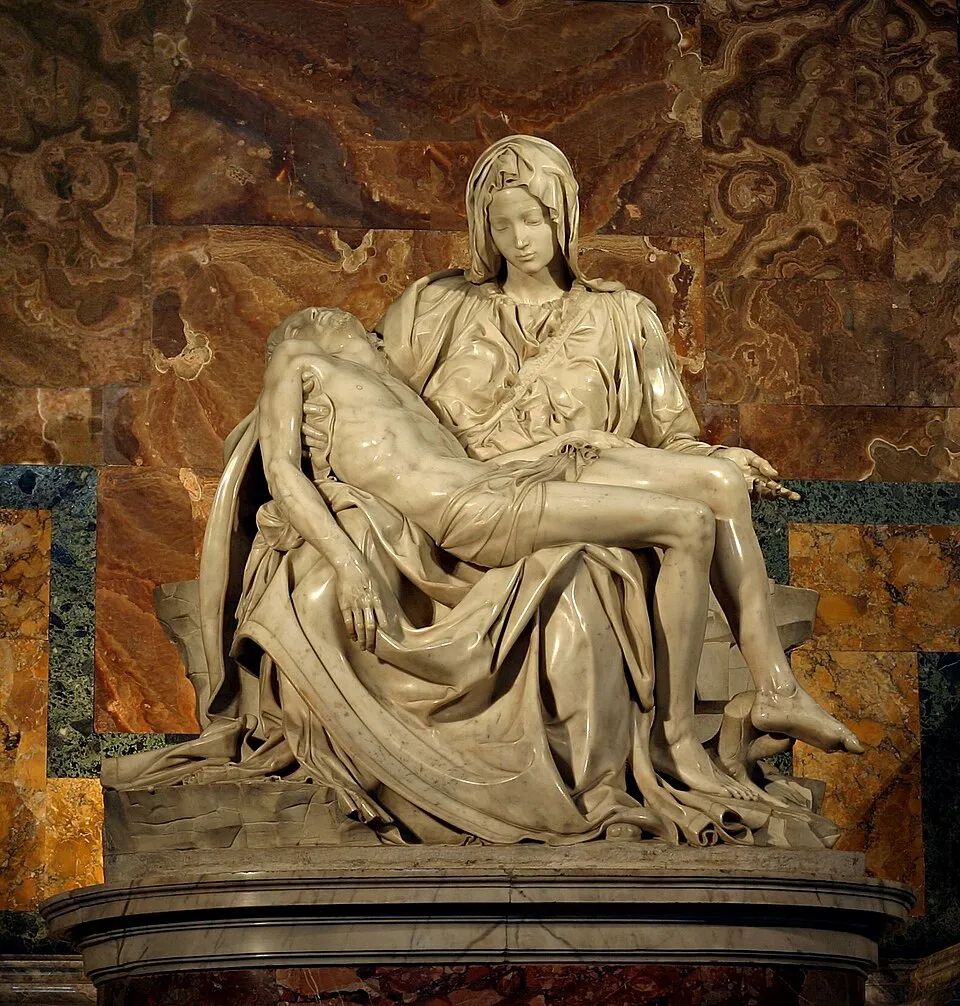
Michelangelo, "Pieta" (1498 to 1499), Carrara marble, 174 cm tall. St. Peter's Basilica, Vatican City. Mary's body is deliberately larger than Christ's, a formal distortion that allows her to hold his adult body as if it were a child's. Michelangelo carved this when he was twenty-four. It is the only work he ever signed. Image: Public domain, via Wikimedia Commons
Michelangelo's Pieta (1498-99) in St. Peter's Basilica takes the same subject and transforms it through deliberate formal distortion. Mary's body is noticeably larger than Christ's, allowing her to hold his adult body with the ease of cradling an infant. Her face is younger than his, which violates biological logic. Michelangelo's own account was theological: a woman of perfect spiritual purity, he argued, would not age as ordinary women do. The Carrara marble is polished to a finish that makes the drapery appear to move. Standing in front of it, the combination of the idealized beauty of the material, the formal distortions, and the subject of a mother holding her dead child produces an experience that has consistently overwhelmed viewers across five centuries. It is the only work Michelangelo signed. He carved his name on the strap across Mary's chest after overhearing a crowd attribute the sculpture to another artist.
Memento Mori and Vanitas: Grief as Reminder
A distinct tradition in the art of loss focuses not on mourning specific individuals but on the universal fact of mortality. Memento mori, Latin for "remember you will die," describes objects and images designed to keep death present in daily life. Medieval art developed the danse macabre, a visual motif showing Death leading figures from every social rank to the grave, the point being that death respects no distinction of wealth or title.
In 17th-century Dutch and Flemish still life painting, this impulse produced the vanitas painting: arrangements of flowers, food, and luxury objects accompanied by a skull, an hourglass, a guttering candle, a watch. The flowers are always at peak bloom, which means they are already beginning to die. The food is already beginning to decay. These are not paintings designed to produce depression. They are designed to sharpen pleasure by framing it in time. Enjoy these things, but know that they are temporary. That is not a pessimistic message. It is a surprisingly practical one.
Käthe Kollwitz: Personal Grief Made Universal
Käthe Kollwitz (1867-1945) is the most important figure in the modern art of grief. Working primarily in printmaking, drawing, and sculpture, she spent her career making images of poverty, loss, and mourning that drew directly on her own experience while addressing states that went well beyond any individual biography. Her early print cycles "The Weavers' Revolt" (1893-97) and "Peasants' War" (1902-08) depicted working-class struggle with a directness and emotional force that made her one of the most widely known artists in Germany before the First World War.
After Peter's death in 1914, her work became more formally stripped down and more intensely personal. Her War cycle (1922-23), produced in response to the mass grief of the conflict that killed her son, uses extreme tonal contrast and highly simplified forms to express states of mourning that feel simultaneously private and communal. Her woodcut "The Mothers" (1919) shows a group of women holding their children close in a compact protective huddle, bodies pressed together, faces not visible. It is one of the most recognizable images of maternal grief in 20th-century art, and it requires no caption. The printmaking tradition she worked in, with its high-contrast blacks and whites and its capacity for mass reproduction, meant her images of grief reached a scale of public circulation that oil paintings never could. The Käthe Kollwitz Museum in Berlin holds the largest collection of her work.
The AIDS Memorial Quilt: Collective Grief at National Scale
In 1987, activist Cleve Jones conceived the NAMES Project AIDS Memorial Quilt as a response to the AIDS crisis. Each panel, measuring approximately 90 by 180 centimeters (the size of a grave), was made by friends, lovers, or family members to honor someone who had died of AIDS-related illness. By the time the full quilt was last displayed on the National Mall in Washington, D.C. in 1996, it contained nearly 40,000 panels and covered the entire Mall from the Capitol to the Washington Monument. It remains the largest community artwork in history.
The quilt works as art for a reason that has nothing to do with craft quality: the variety of the panels is itself the statement. Hand-sewn fabric portraits, embroidered texts, collaged photographs, painted abstractions, found objects stitched onto cloth. Each panel was made by people with no particular artistic training, using whatever felt right to them. That variety says what uniformity could not: the people who died were not a category but individuals whose lives had been specific and irreplaceable, and the people who loved them grieved in ways as specific and irreplaceable as the people they had lost. For more on how art has engaged political and social crisis, see our guide to art as political practice.
Art Therapy and What Research Now Confirms
Contemporary psychology has documented what artists and grieving people have known intuitively for centuries: making art is an effective way to process loss. Art therapy research consistently shows that creative expression helps bereaved individuals externalize internal states, create emotional distance from overwhelming feelings, and build a manageable narrative around loss. The art object made in grief functions as what psychoanalyst Donald Winnicott called a transitional object, something that sits between the internal world of feeling and the external world of shared meaning, allowing the two to communicate.
Looking at grief art also has documented psychological value. Aristotle called it catharsis: the release of suppressed emotion through witnessing its expression in an artistic form. Standing in front of the Kollwitz Grieving Parents, or reading the names sewn into a quilt panel, produces an emotional response that is both deeply personal and connected to a wider human community of loss. The two things are not in tension. The personal and the communal are exactly what great grief art holds simultaneously. Our post on art therapy and mental health covers the research on how making and viewing art affects emotional processing.
What Art Can Do That Language Cannot
Art and grief have been inseparable from the beginning of human culture because grief is one of the experiences that most demands expression and most resists language. The image can hold what words cannot: the particular quality of a face, the specific weight of a body in someone's arms, the social and political dimensions of who is mourned publicly and who is not. The AIDS quilt made visible the names of people whom public grief had refused to acknowledge. The Fayum portraits make present the faces of people dead for two thousand years. Michelangelo's marble makes a theological argument about love and loss that no sermon has ever made as powerfully.
If you want to explore how art processes other difficult emotional states, our posts on the uncanny in art and why art gives you chills cover adjacent territory. What artwork has helped you process loss or grief? Share your experience in the comments.