
In 1990, the director of the Contemporary Arts Center in Cincinnati, Dennis Barrie, was arrested and charged with obscenity for exhibiting photographs by Robert Mapplethorpe. The photographs, part of a touring retrospective called "The Perfect Moment," included images of homoerotic and sadomasochistic content alongside Mapplethorpe's celebrated flower studies and celebrity portraits. The trial became a national flashpoint in the American culture wars, with politicians, religious groups, and art world figures arguing about where art ends and obscenity begins. Barrie was acquitted. The exhibition became one of the most attended photography shows in American history. Mapplethorpe's work became more famous, and more valuable, than it had ever been before.
That pattern, art censored, censorship generates publicity, art becomes more famous, has repeated throughout history with enough consistency that it should give any would-be censor pause. But the impulse to suppress disturbing or challenging images is just as consistent. From Byzantine iconoclasts to Instagram content moderation algorithms, the history of art is also a history of attempts to control what images the public is allowed to see. Understanding that history helps you recognize when it is happening now, and evaluate the arguments on all sides with something other than reflex.
Ancient and Religious Iconoclasm
The Byzantine Iconoclasm (726 to 843 CE)
One of the earliest systematic campaigns of art destruction in Western history occurred in the Byzantine Empire, when Emperor Leo III ordered the removal and destruction of religious icons from churches and public spaces in 726. The iconoclasts, literally "image-breakers," argued that venerating images violated the biblical prohibition against idolatry. The iconodules, the image-defenders, argued that images were legitimate teaching tools and that venerating an icon was honoring the person depicted, not the object itself.
The debate ran for over a century, with icons destroyed and restored depending on which faction held imperial power. The theological arguments were genuine. The political motivations, emperors asserting authority over the church, were equally real. The Second Council of Nicaea ruled in favor of icons in 787 CE, establishing the framework for Christian religious imagery that shaped Eastern Christianity permanently. The episode demonstrated that images carry power and that powerful institutions will always try to control them. Our guide to Art and Religion: Sacred Images Across Christianity, Islam, Buddhism, and Hinduism covers the full context.
The Protestant Reformation
The 16th-century Protestant Reformation brought the image controversy back to Western Christianity. In Zurich, Ulrich Zwingli supervised the whitewashing of church interiors in 1524. In the Netherlands, the Beeldenstorm of 1566 saw Protestant crowds smash statues, slash altarpieces, and destroy stained glass windows across hundreds of Catholic churches over several weeks. Similar destruction occurred in England under Henry VIII and Edward VI, in Scotland, and across the Swiss cantons.
The artistic consequences were significant and, in one respect, accidental. In Protestant regions, the market for religious imagery collapsed. Dutch painters responded by developing secular subjects at a level of quality and ambition that had never before been applied to landscapes, still lifes, and genre scenes. Vermeer, Rembrandt, and Hals all worked in a visual culture shaped partly by the removal of religious patronage. The Golden Age of Dutch painting was, in part, an unintended consequence of religious censorship.
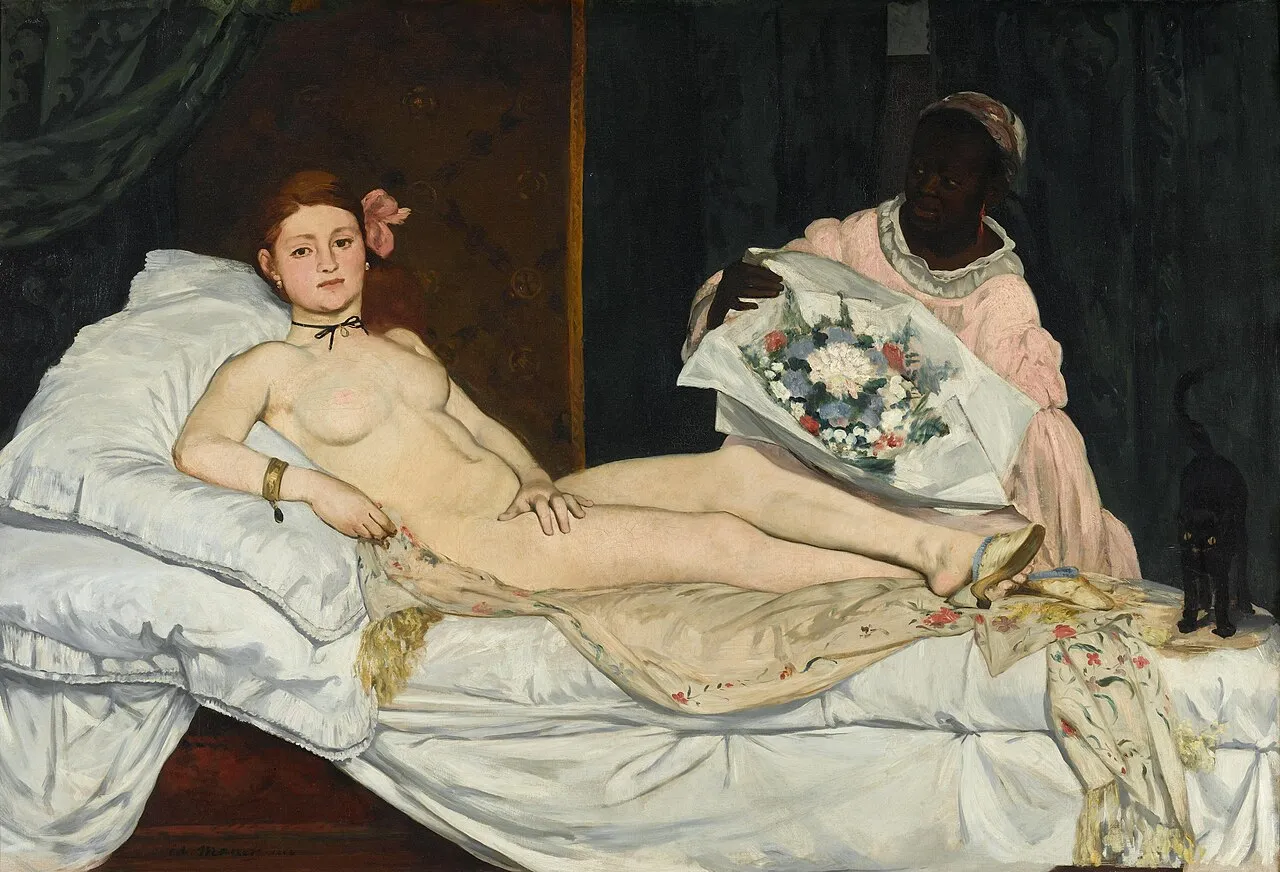
Édouard Manet, "Olympia" (1863), oil on canvas, 130.5 x 190 cm. Musée d'Orsay, Paris. Manet's nude was nearly removed from the 1865 Salon after critics called it obscene. It is now considered one of the most important paintings of the 19th century. Image: Public domain, via Wikimedia Commons
Moral and Sexual Censorship
The Fig Leaf Campaign
In 1564, just weeks after Michelangelo's death, Pope Pius IV ordered Daniele da Volterra to paint draperies over the nude figures in the Sistine Chapel's Last Judgment. Da Volterra earned the nickname "Il Braghettone" (the breeches-maker) for this work. For centuries afterward, fig leaves were added to nude sculptures throughout the Vatican collections, and copies of Michelangelo's David were fitted with removable plaster fig leaves for the comfort of visitors. In Victorian England, the British Museum and the Victoria and Albert Museum installed detachable fig leaves on plaster casts of classical sculptures that could be applied when Queen Victoria visited.
The assumption that the unclothed human body is inherently obscene has driven censorship across every era. What changes is the medium: Renaissance marble, 19th-century oil paint, 21st-century social media content moderation. The logic is constant. The British Museum's collections document several of these episodes directly.
Manet's "Olympia" and the Salon Scandals
When Édouard Manet exhibited "Olympia" at the 1865 Paris Salon, the reaction was close to riot conditions. The painting shows a nude woman on a bed, looking directly at the viewer with complete composure. Academic nudes were standard Salon fare, but academic nudes were always mythological: Venus, Diana, nymphs, figures whose nudity was legitimized by classical precedent and whose eyes were averted. Manet's figure was none of those things. She was recognizably a contemporary Parisian sex worker. Her gaze was not submissive. Guards had to be stationed in front of the painting to prevent it from being physically attacked by visitors.
The Salon nearly removed it. It became, instead, one of the most important paintings of the 19th century. The Impressionists who followed Manet learned something specific from the episode: the scandal was not a failure. It was evidence that the painting had done something real, something that the institution wanted to suppress because it threatened the conventions the institution was built to maintain.
Political Censorship
Nazi "Degenerate Art"
The most systematic art censorship of the 20th century was the Nazi regime's campaign against Entartete Kunst, "Degenerate Art." In 1937, the Nazis organized an exhibition of confiscated modern art in Munich, displaying works by Kandinsky, Klee, Kirchner, Beckmann, Nolde, and dozens of others alongside mocking labels. The labels called the artists mentally ill, Jewish, or Bolshevik, and ridiculed the works as evidence of cultural decay. Over two million people attended, more than any German art exhibition before or since.
Meanwhile, the Nazis ran a simultaneous exhibition called the Great German Art Exhibition, showcasing heroic realism: idealized Aryan bodies, productive factories, pastoral landscapes, wise leaders. The contrast was deliberate. Modern art meant cultural decay. Nazi-approved art meant racial purity and national strength. Over 20,000 works were confiscated from German museums. Some were sold abroad to raise foreign currency. Others were destroyed. Many of the artists, including German citizens, were banned from working or purchasing art supplies. Several died in concentration camps. The episode makes it clear that art censorship is rarely about aesthetics. It is about power, ideology, and the control of what a culture is allowed to remember about itself.
Soviet Socialist Realism
In the Soviet Union, Socialist Realism was imposed as the only permissible artistic style from 1934 onward. Art was required to depict socialist ideals realistically and optimistically: happy workers, heroic soldiers, wise leaders, productive industry. Abstraction, Expressionism, Surrealism, and any form of artistic experimentation were forbidden. Artists who worked outside these requirements faced loss of commissions, exile, imprisonment, or worse.
The unofficial artists, the nonconformists, worked in secret. They shared work through underground exhibitions in private apartments and through samizdat publications. When the Soviet Union collapsed, this suppressed art emerged as one of the most compelling bodies of work produced in the late 20th century, partly because four decades of suppression had given it a moral weight that official art could not approach.
Contemporary Censorship
The Culture Wars
The Mapplethorpe trial in 1990 was one of several flashpoints in the American culture wars over public arts funding. Andres Serrano's "Piss Christ" (1987), a photograph of a crucifix submerged in the artist's urine, prompted Congressional attempts to defund the National Endowment for the Arts. Chris Ofili's "The Holy Virgin Mary" (1996), incorporating elephant dung and magazine imagery, triggered a confrontation between New York Mayor Rudolph Giuliani and the Brooklyn Museum in 1999. Giuliani threatened to cut the museum's city funding and attempted to evict it from its city-owned building. He failed in court.
These cases all exposed the same genuine tension in democratic societies: the public's right not to be compelled to fund offensive content versus the artist's right to free expression. The debate has not been resolved. It resurfaces with each new controversy, and both sides of it contain real arguments.
Algorithmic Censorship
The most pervasive form of art censorship today is algorithmic. Instagram, Facebook, and TikTok use automated systems to detect and remove images containing nudity, regardless of artistic context. Works by Rubens, Mapplethorpe, and Rodin have been flagged and removed by systems that cannot distinguish between a Peter Paul Rubens painting and pornography. Museums and galleries have protested repeatedly. Some platforms have created appeals processes. The systems remain blunt.
This matters beyond mere inconvenience. Social media has become the primary way large numbers of people discover and engage with art. When an algorithm removes a Botticelli because it contains a nude figure, millions of potential viewers lose access to something they might otherwise have seen. The implications for art education and cultural access are real. Our guide on why art matters in society covers the broader case.
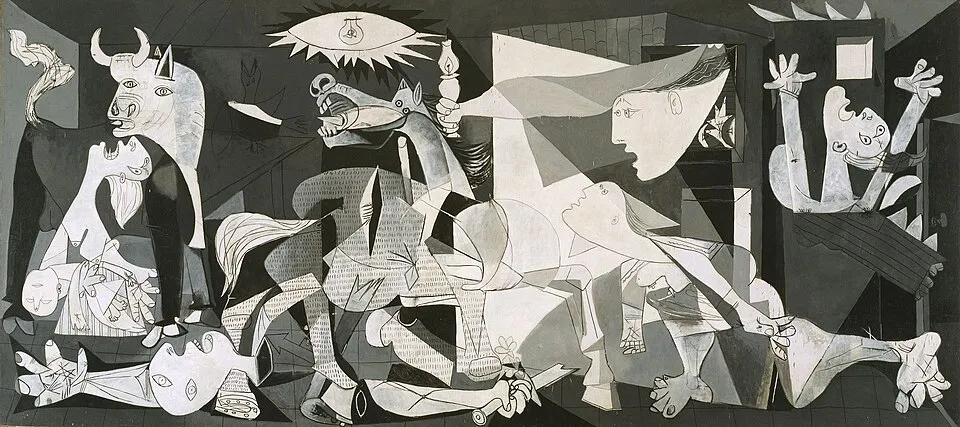
Pablo Picasso, "Guernica" (1937), oil on canvas, 349 x 776 cm. Museo Reina Sofía, Madrid. Banned from Spain under Franco's dictatorship, held at MoMA in New York at Picasso's request until 1981. It arrived in Spain six years after Franco's death. Image: Public domain / Fair use, via Wikimedia Commons
Why Censored Art Becomes More Famous
The pattern is consistent enough to be called a law: banning a work of art almost always increases its significance. Manet's Olympia might have remained a respectable Salon painting, admired and then forgotten. The scandal made it a landmark. The Nazi Degenerate Art exhibition was designed to humiliate modernism. Instead, it inadvertently created the definitive survey of early 20th-century avant-garde art, drawing two million visitors who would not otherwise have seen Kirchner, Klee, and Kandinsky in the same room.
Censorship draws attention to exactly the quality that made the work worth suppressing: its capacity to disturb settled assumptions and make visible what authority prefers to keep hidden. When an institution bans an image, it implicitly confirms that the image has power. That confirmation is, paradoxically, the best possible endorsement.
History consistently shows that societies that suppress artistic expression pay for it in cultural terms, and that the art they attempt to silence tends to outlast the institutions that tried to suppress it. For more on art's relationship to political power, see the guide to Art and Politics: How Governments Used and Abused Visual Culture, and our companion piece on how art communicates emotion without words.


