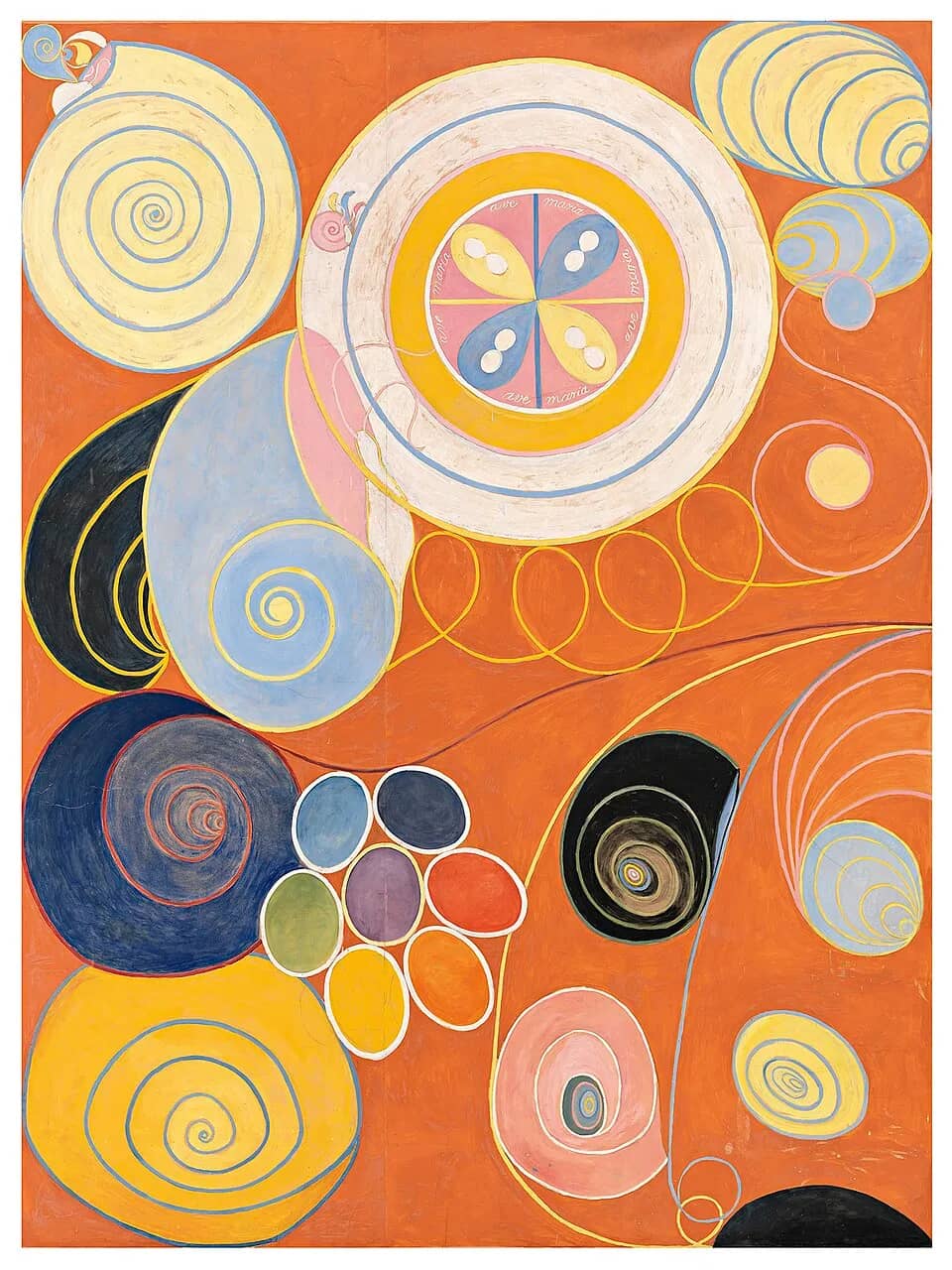
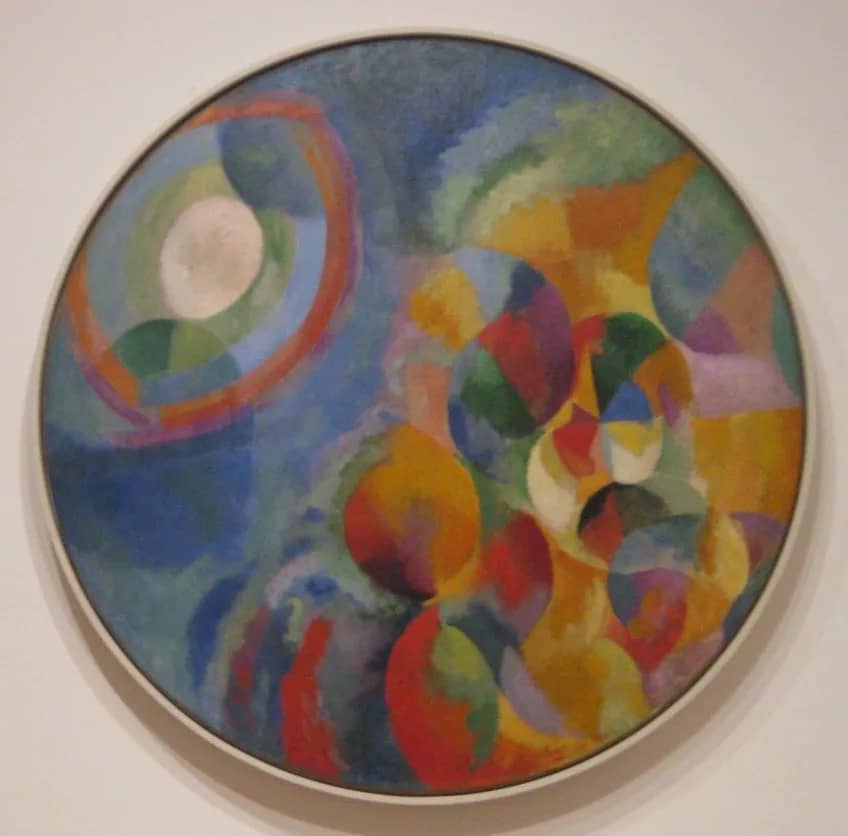
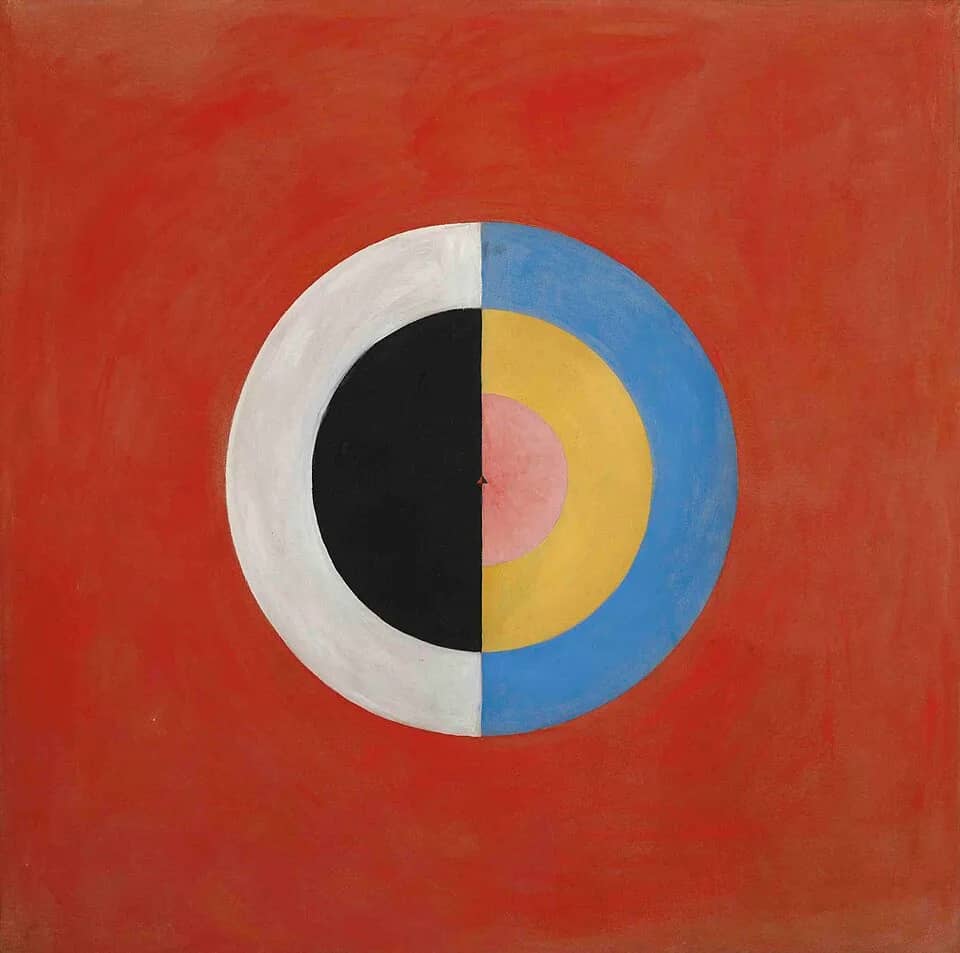
Wassily Kandinsky could hear colors. When he looked at yellow he heard a high trumpet note; blue produced the sound of a cello; green was the middle register of a violin. This was not a metaphor he was reaching for. He had synesthesia, and he understood the condition as the key to his artistic practice. His ambition was to make paintings that worked the way music works: not by depicting the visible world but by using color, form, and rhythm to produce direct emotional responses, bypassing conscious interpretation the way a musical phrase bypasses verbal description.
Kandinsky's synesthesia was unusual, but the desire to bring painting and music into genuine dialogue is ancient. The two arts have compared, borrowed from, and tried to solve each other's problems throughout Western history. The connection runs deeper than analogy. At several key moments, painters and composers have been working from the same underlying theory, applied to different sensory materials. Understanding those moments changes how you listen to music and how you look at paintings.
The Ancient Theory: One Mathematical Order Behind Both
Aristotle proposed that colors stand in the same proportional relationships to each other as musical intervals. The idea persisted. When Isaac Newton discovered in 1666 that white light contained all spectral colors, theorists mapped the color spectrum onto the musical scale, treating both as expressions of the same underlying harmonic order. The Jesuit mathematician Louis Bertrand Castel built a color organ in the 1730s that displayed colored lights as keys were pressed, creating visible music that could be watched as well as heard.
None of these early theories produced lasting artistic results, but they established the framework that painters and composers would return to repeatedly: the idea that the two senses might share underlying principles of harmony and proportion that a sufficiently sophisticated artist could translate between media. The Pythagorean tradition that had originally proposed this, treating both musical harmony and geometric proportion as expressions of the same mathematical order, had never entirely disappeared. It kept resurfacing because the perceptual intuition behind it, that hearing and seeing share structural principles, turns out to be partially correct.
Romanticism: Music as the Model Art
In the Romantic period, music achieved a cultural prestige that the other arts had not previously granted it. The Romantics argued that music, being the most abstract of the arts and least tied to representation, was therefore the purest form of emotional expression. Arthur Schopenhauer called music "the direct copy of the will itself." Walter Pater, in 1877, wrote the sentence that defined the ambition of an entire generation of artists: "All art constantly aspires towards the condition of music."
Painters responded concretely. James McNeill Whistler, from the 1860s onward, titled his paintings with musical terms: "Nocturne in Black and Gold: The Falling Rocket" (c.1872), "Arrangement in Grey and Black, No. 1" (1871, the painting known as Whistler's Mother). The musical titles announced that these paintings should be appreciated as arrangements of color and tone rather than as representations of named subjects. Whistler was doing in paint what Romantic composers were doing in sound: pursuing pure aesthetic experience freed from narrative and moral obligation.
Kandinsky and Schoenberg: Parallel Revolutions
Kandinsky's theoretical text "Concerning the Spiritual in Art" (1911), covered in the spotlight on Wassily Kandinsky: Abstraction, Music, and the Language of Color, argued for a systematic theory of the emotional effects of specific colors and forms, analogous to a composer's theory of the emotional effects of specific keys and intervals. Colors, like tones, have inherent emotional characters. Color combinations, like harmonies, produce specific combined effects. The visual composition could be constructed with the deliberateness of a musical score.
Kandinsky's friendship with the composer Arnold Schoenberg was not incidental to this thinking. Schoenberg was simultaneously developing atonality in music, abandoning the tonal hierarchy that had organized Western music for centuries to pursue a new kind of expressive freedom through twelve-tone serialism. Kandinsky was simultaneously abandoning representation in painting. When Schoenberg abandoned the tonal center, Kandinsky abandoned the depicted object. Both were pursuing the same liberation through the same logic. Their correspondence, which began after Kandinsky attended a concert of Schoenberg's music in Munich in January 1911, documents one of the most explicit conversations between a painter and a composer in art history.
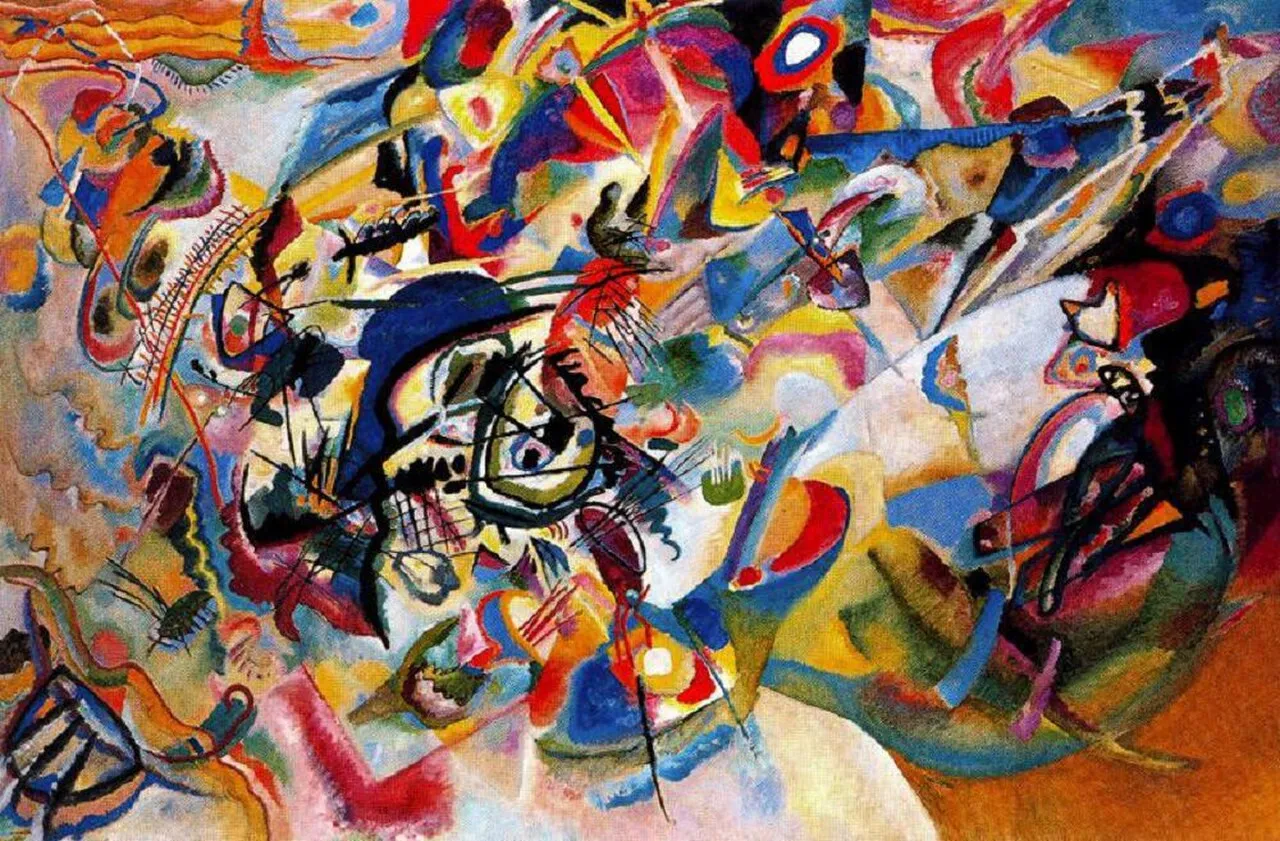
Wassily Kandinsky, "Composition VII" (1913), oil on canvas, 200 x 300 cm. Tretyakov Gallery, Moscow. Over 30 preparatory studies preceded the final work, which was painted in four days. The title class and series name explicitly reference musical composition and its relationship to planning and spontaneity. Image: Public domain, via Wikimedia Commons
Paul Klee: Drawing as Musical Line
Paul Klee, Kandinsky's colleague at the Bauhaus and a professional violinist who played Bach daily throughout his adult life, approached the music-painting relationship from a different angle. His "Pedagogical Sketchbook" (1925), written for Bauhaus students, analyzes visual rhythm, movement, and proportion using explicitly musical concepts. His 1932 painting "Ad Parnassum" is built on a mosaic of small colored squares that he described as his "most polyphonic" work, meaning it has multiple simultaneous visual lines of development that can be followed independently, just as a fugue can be followed voice by voice. The word polyphonic is not a metaphor here. Klee meant the structural principle exactly.
His famous phrase "Taking a Line for a Walk" described the practice of following a drawn line through a composition without predetermined destination, the way improvisation follows a musical phrase. The line moves through time on the surface of the paper the way a melodic line moves through time in performance. This analogy between drawing and melody, between the temporal experience of listening and the spatial experience of looking, is one of the most productive frameworks any visual artist has applied to their own practice.
Pollock and Jazz: Painting as Performance
The Abstract Expressionists drew direct comparisons to musical performance, and in Pollock's case the comparison was not metaphorical. He listened to jazz while working. His drip paintings were made in continuous physical performances across horizontal canvases, his body moving through space, controlling the flow of paint with gesture and momentum. Harold Rosenberg's term "action painting" described the practice: the canvas had become "an arena in which to act" rather than a surface on which to represent.
The parallel with jazz improvisation was noticed immediately by critics. Both involve a performer making irrevocable marks in real time, guided by internalized musical or visual logic, responding to what has just happened as the basis for the next decision. The gesture of the dripped paint corresponds to the gesture of the improvised phrase. Both are irrevocable. Both are shaped by the performer's internalized knowledge of structure and by the specific conditions of the moment. The guide to Abstract Expressionism explores this period in full.
John Cage: Where the Score Became a Drawing
The composer John Cage brought the conversation between music and visual art into shared formal territory. His graphical scores for compositions including "Aria" (1958) and "Concert for Piano and Orchestra" (1958) are visual documents that look more like abstract drawings than conventional musical notation. They are not readable by musicians trained in standard notation; they require visual interpretation that produces different performances from different readers. The boundary between musical score and visual artwork became genuinely uncertain. The Museum of Modern Art's collection includes several Cage scores that are displayed and acquired as artworks.
Cage collaborated directly with the painter Robert Rauschenberg and was part of the same intellectual community as Jasper Johns and the choreographer Merce Cunningham that defined American avant-garde practice in the 1950s and 1960s. His "4'33"" (1952), in which a performer sits at a piano for four minutes and thirty-three seconds without playing, argued that all sounds are music. This position was formally parallel to Marcel Duchamp's argument that any object designated as art is art: both refused the distinction between the aesthetic and the ordinary.
Gerhard Richter: Painting Chance
Gerhard Richter's "Cage Paintings" (2006) and "4900 Colors" (2007) directly acknowledge the debt to Cage. The large-scale abstract works are produced by dragging a squeegee across layers of wet paint, removing and redistributing color in ways that exceed the painter's control. Richter described this as analogous to Cage's use of chance operations: outcomes that are partly intentional and partly accidental, shaped by the process as much as by the artist's decisions. The title "Cage Paintings" names the connection explicitly, which is unusual for Richter, who is not given to explanatory labels.
Contemporary Sound Art: Between Senses
Contemporary practice has produced a field of sound art that treats sound as a sculptural and spatial medium. Laurie Anderson's multi-media performances, Janet Cardiff's audio walks, Susan Philipsz's public sound installations, and Ryoji Ikeda's data-driven audiovisual environments operate in territory that neither pure music nor pure visual art can describe. These works require both senses simultaneously, each modifying the experience of the other. They are the current expression of the aspiration Kandinsky articulated in 1911, and they demonstrate that the question of how hearing and seeing relate is still generating new work.
For the color theory background to these conversations, see Color Theory for Art Appreciation. Which musician or composer do you think has the most visual art sensibility? Share in the comments.