Gordon Willis shot "The Godfather" (1972) in a way that broke Hollywood's technical rules. He placed his key lights above and behind his subjects, leaving eyes in deep shadow, refusing the standard three-point lighting formula that guaranteed viewers could always read facial expressions. The studio was alarmed. But the look Willis created, faces half-swallowed by darkness in ornate rooms, was not a mistake. It was Vermeer. Willis had studied the Dutch master's interiors, where a single directional light source illuminates part of a face and lets the rest dissolve into near-black, and he transferred that visual logic to a crime film about power and moral opacity. The painting was made in Delft around 1665. The film was shot in New York in 1971. The visual idea moved intact across three hundred years.
Cinema borrows from painting constantly and more deliberately than most film writing acknowledges. The greatest cinematographers are visual artists who happen to work with a camera rather than a brush, and understanding their sources in painting history changes how you watch films. This guide traces that relationship in both directions: how cinema absorbed the visual art tradition, and how the best cinematographic work constitutes original visual art in its own right.
Early Cinema: Learning to Compose the Frame
The Lumière Brothers' first films (1895) pointed a camera at the world and recorded what happened. Within a decade, filmmakers had realized the camera could compose as a painter composes: deciding what to include, how to light it, where to place it within the frame. D.W. Griffith, whose "Birth of a Nation" (1915) and "Intolerance" (1916) introduced systematic compositional thinking to narrative film, studied 19th-century academic painting and Romantic landscape to understand how to organize large groups of figures in a two-dimensional frame and how to use the spatial relationship between a small foreground figure and a vast background to produce emotional scale.
German Expressionist cinema of the 1920s made the painting connection explicit rather than learned. "The Cabinet of Dr. Caligari" (1920) used painted sets with distorted perspectives and jagged angular forms taken directly from Expressionist painting. The world of the film was physically built from the visual vocabulary of an art movement. F.W. Murnau's "Nosferatu" (1922) used deep shadow, stark architectural silhouettes, and the contrast between natural landscape and buildings to create effects that drew on both Expressionist painting and the Romantic sublime in landscape painting.
Soviet Cinema: Montage as Visual Theory
Sergei Eisenstein, who had formal training as a painter and designer before becoming a filmmaker, developed montage theory as a systematic account of how film creates meaning through image juxtaposition. His argument that two images in sequence produce a meaning that neither image contains alone, what he called the montage of attractions, drew on Cubism's principle that showing multiple perspectives simultaneously creates a more complete representation of reality. He was applying a visual art theory to a new medium, and doing so consciously.
Eisenstein wrote extensively about El Greco's paintings, particularly their diagonal compositions and the tension they created between different masses within the frame. His own frame compositions in "Battleship Potemkin" (1925) and "October" (1928) show this influence directly: every element placed for visual and emotional effect, diagonal lines carrying dynamic energy across the frame, mass and emptiness in precise tension. These are paintings that also happen to be film frames, and studying them as one would study a painting reveals decisions that are invisible when you watch the film at normal speed.
Vermeer's Light in Cinema
Vermeer's paintings depict a specific and unrepeatable quality of light: soft, diffused, directional daylight entering from the left through domestic windows, falling on figures and ordinary objects with an evenness that makes every surface feel attended to. Several of the most important cinematographers of the past fifty years have cited Vermeer directly as a primary visual reference, and the connection is not superficial.
Gordon Willis's work on "The Godfather" (1972) is the most studied example. His single-source top lighting left actors' eyes in shadow in a way that was considered technically incorrect by Hollywood standards but created precisely the effect he intended: moral opacity, the sense that these men's interior lives are not available to scrutiny. The Vermeer spotlight on this site, Johannes Vermeer: Light Through Windows and Domestic Mystery, covers the painter whose work generated this approach. Vittorio Storaro, cinematographer of "Apocalypse Now" (1979) and "Reds" (1981), has also written extensively about Vermeer as a primary source for his approach to color and light as moral and psychological instruments.
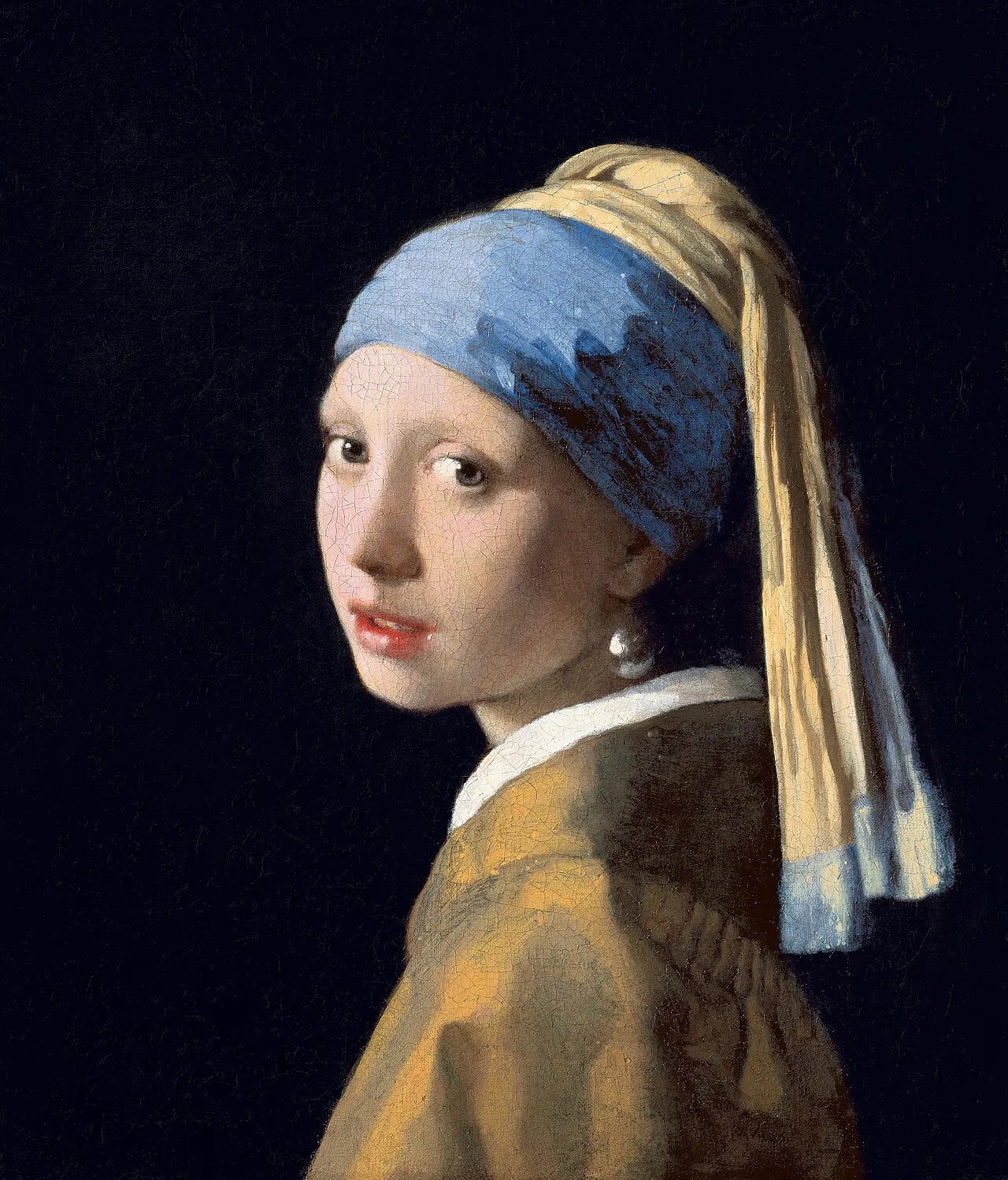
Johannes Vermeer, "Girl with a Pearl Earring" (c.1665). Mauritshuis, The Hague. Vermeer's single-source lighting against near-black backgrounds has been cited by Gordon Willis, Vittorio Storaro, and Roger Deakins as a direct visual reference for their cinematographic work. Image: Public domain, via Wikimedia Commons
Stanley Kubrick: Applying Art History to Live-Action Film
Kubrick started as a professional photographer for Look magazine in the late 1940s, and his visual thinking was shaped by still photography before it was shaped by cinema. His compositional approach is immediately recognizable: symmetrical framing, extreme one-point perspectives that draw the viewer down corridors and roads to a central vanishing point, and a treatment of every element within the frame as a deliberate decision rather than an accident of production.
For "Barry Lyndon" (1975), Kubrick and cinematographer John Alcott used specially designed ultra-fast NASA Zeiss f/0.7 lenses to shoot interior candlelit scenes by candlelight alone, without supplementary film lighting. The visual result recreates the specific lighting conditions of 18th-century paintings by Hogarth, Gainsborough, and Watteau with an accuracy no previous film had achieved. A single candelabra illuminates a card game in a great house the way it would have actually illuminated it in 1750. Individual frames of "Barry Lyndon" are routinely used in university art history courses alongside the paintings they reference. The film is a sustained exercise in applying 18th-century European painting principles to live-action photography, and it works.
Wong Kar-wai: Color as Emotional Temperature
Wong Kar-wai, working with cinematographer Christopher Doyle, developed a visual language in his 1990s and early 2000s films that uses color temperature, focal length, and exposure rate in ways that recall Impressionist and Post-Impressionist ambitions of capturing mood rather than subject. "In the Mood for Love" (2000) is the central example. Its saturated reds and greens, slow-motion sequences, and compositions that push characters to the edges of the frame while walls and doorways occupy the center create a visual experience of longing and missed connection that operates entirely through visual means. The dialogue and plot could be removed and the emotional content would remain.
Wong's color approach draws on Matisse's use of color as emotional temperature rather than optical description, and on the Impressionist commitment to capturing the quality of light at specific moments rather than the stable appearance of objects. The Matisse spotlight, Henri Matisse: Color, Cutouts, and the Joy of Looking, covers the painter whose thinking about color and feeling is most directly relevant to Wong's visual practice.
Barry Jenkins and Caravaggio's Shadow
Barry Jenkins, directing "Moonlight" (2016) and "If Beale Street Could Talk" (2018) with cinematographer James Laxton, has cited Caravaggio as a direct influence on his approach to light in both films. The connection is specific rather than general. Caravaggio's chiaroscuro works by placing figures in deep shadow and illuminating them with concentrated, dramatically directional light sources, so that the light itself carries moral and emotional weight. In "Moonlight," a key scene is lit by a single street lamp against near-total darkness. In "If Beale Street Could Talk," warm interiors contrast with cold exterior scenes in a way that uses color temperature as a moral indicator rather than mere atmosphere.
The guide on Baroque Art: Drama, Light, and the Power of the Catholic Church covers the tradition Jenkins draws on. The point it demonstrates is worth stating clearly: visual conventions developed in 17th-century Italian religious painting remain fully available as expressive tools in 21st-century American cinema. Visual language does not expire.
Video Art: When Moving Images Entered the Gallery
From the 1960s onward, artists including Nam June Paik, Bruce Nauman, Bill Viola, and Pipilotti Rist developed video art, a practice of using moving images in gallery contexts rather than cinemas. This tradition developed a visual language distinct from both commercial cinema and television: long, uncut takes; loops that refuse narrative resolution; multi-channel installations that place viewers inside an environment of images rather than in front of a single screen.
Bill Viola's work is the most sustained example of moving-image art with direct painting sources. His "The Greeting" (1995) extends a five-second movement between three women, based directly on Pontormo's "Visitation" painting of 1528, into a six-minute slow-motion sequence. The work uses slow motion to reveal what normal-speed photography conceals: the specific quality of expression in a face, the precise moment of recognition between two people, the way light moves across cloth. It refers to the painting tradition and simultaneously demonstrates what a moving image can do that a still image cannot.
What to Look for When You Watch a Film
Most film criticism focuses on narrative, character, and social meaning. The visual dimension of cinema, the quality of the light, the relationship between figure and frame, the way composition creates or releases tension, gets less attention than it deserves. This undervaluation misses what the greatest filmmakers have always understood: that the frame is a canvas, light is a medium, and watching a film is a visual experience whose quality shapes everything else the viewer feels.
The tools used for analyzing painting translate directly to film. The How to Read a Painting framework on this site applies to individual film frames as readily as to canvases: composition, color, light, technique, historical context, and synthesized response all carry. Pause a Kubrick film on any frame and apply the framework. The amount of deliberate visual decision in each image becomes immediately visible. Which film do you think engages most directly with painting? Share your thoughts in the comments.