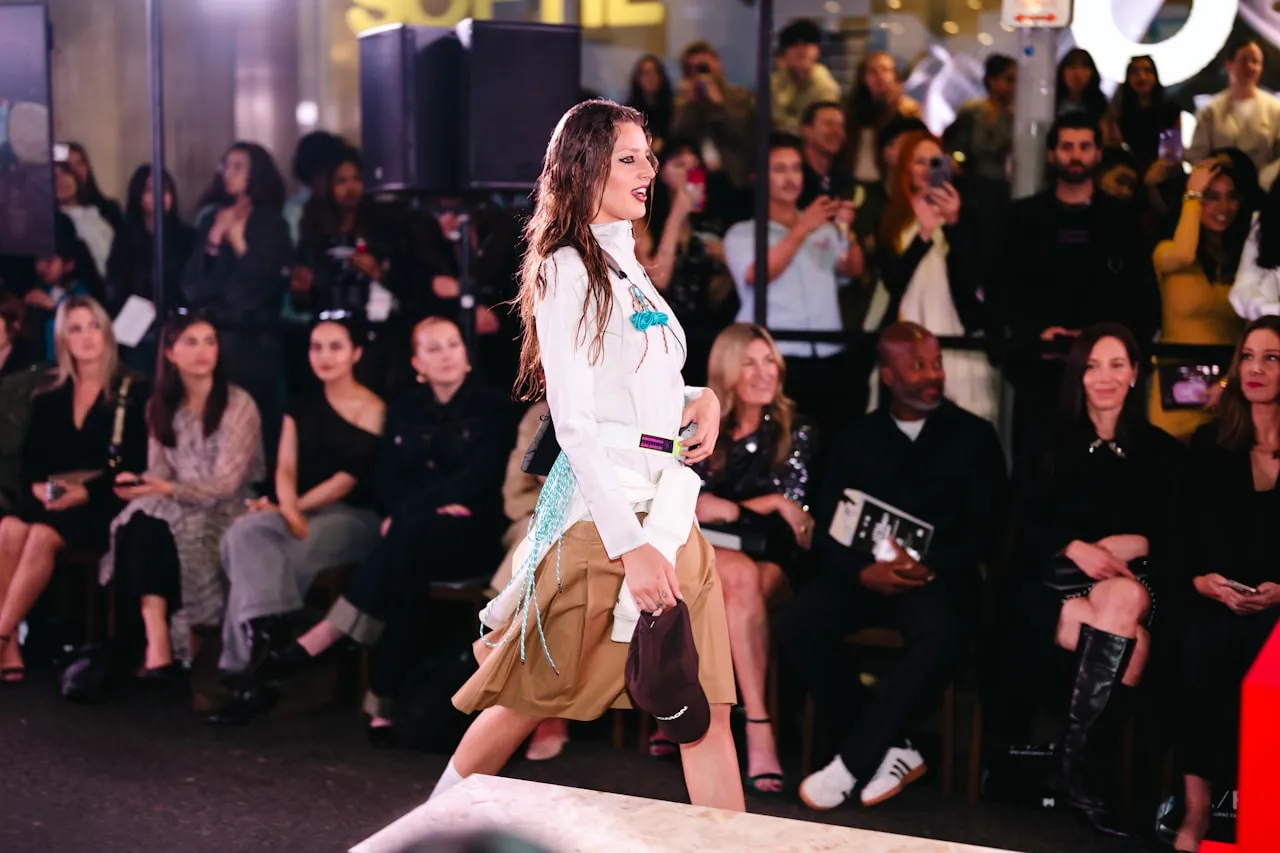
In autumn 1965, Yves Saint Laurent presented six shift dresses made from wool jersey in the colors and grid pattern of Piet Mondrian's De Stijl paintings. The seams of the dresses aligned precisely with the black lines of the grid. The dresses were not prints of Mondrian's paintings on fabric. They were an original design that understood his formal logic well enough to reinvent it in three dimensions on a moving body. They made the cover of every major fashion magazine that season. They are still considered among the most influential garments of the 20th century. And Mondrian, who died in 1944, never made a piece of clothing in his life.
The relationship between fashion and fine art runs deeper and in more directions than most people realize. Painters have always depicted clothing as part of the human image. Designers have drawn on painting, sculpture, and the logic of art movements for inspiration, technique, and conceptual frameworks. The borrowing is constant, not always credited, and genuinely mutual. Understanding the connection changes how you see both disciplines, and it changes how you think about where visual intelligence actually lives.
Paul Poiret and the Avant-Garde (1910s)
The first explicitly articulated connection between Parisian fashion and the art world came through Paul Poiret, whose work in the 1910s overlapped with Fauvism and the early avant-garde. Poiret collaborated directly with the Fauvist painter Raoul Dufy, commissioning textile prints with flat, boldly colored patterns that transferred the Fauvist visual logic from canvas to cloth. He also organized events that deliberately blurred the line between a fashion show and a theatrical spectacle, drawing on the same energy that was transforming theater and visual art simultaneously.
Poiret eliminated the corset from women's fashion, replacing the hourglass silhouette with elongated columnar forms influenced by the Japanese kimono and classical Greek drapery, both subjects of intense artistic interest at the time. What he was doing to the female silhouette was formally analogous to what the Fauves were doing to color: replacing conventional expectation with forms that followed their own internal visual logic rather than the logic of imitation.
Sonia Delaunay: The Canvas and the Coat as the Same Surface
Sonia Delaunay is the clearest example in art history of a painter who moved between fine art and fashion without treating the transition as a compromise. Her Simultanism paintings, abstract compositions of interlocking geometric color forms derived from Michel Eugène Chevreul's color contrast theory, began crossing into textiles in 1911 when she made a patchwork quilt for her son from fabric scraps arranged in geometric color progressions. By the 1920s she was designing fabrics, coats, scarves, and swimwear using the same visual principles as her paintings, and selling them through her own Paris shop.
Her coats and swimsuits from the 1920s are not fashion garments with an artistic aesthetic. They are the same work as her paintings, carried out on a different surface. The saturated complementary colors in geometric arrangements create the same optical vibration in wool as they do in oil on canvas. She did not think of the fabric as a lesser medium. She thought of both the canvas and the coat as surfaces where color and form could be genuinely explored. This position was unusual then and remains unusual now, which is why her fashion work continues to be shown in major exhibitions of her painting.
Elsa Schiaparelli and Surrealism: Objects That Behave Like Art
The most discussed art-fashion collaboration of the 20th century was between Elsa Schiaparelli and Salvador Dalí in the late 1930s. Their Lobster Dress (1937), a white silk evening gown with a large red lobster painted by Dalí directly on the skirt, placed one of Dalí's recurring symbols of sexual anxiety and transformation onto a garment worn by a living body. The result was not a fashion garment that referenced Surrealism. It was a Surrealist object that also functioned as a garment. The distinction matters: the dress exploited the Surrealist principle of displacement, taking an everyday object and placing it in a context that makes it strange.
The Shoe Hat (1937-38), a high-heeled shoe worn inverted as a headpiece, and the Tear Dress (1938), printed with trompe l'oeil rips that appeared to reveal flesh beneath, worked on the same principle. All three displaced familiar objects from their normal contexts, which is exactly what Surrealism does in painting and sculpture. The guide to Surrealism and the Subconscious covers the movement that made these collaborations intellectually coherent.
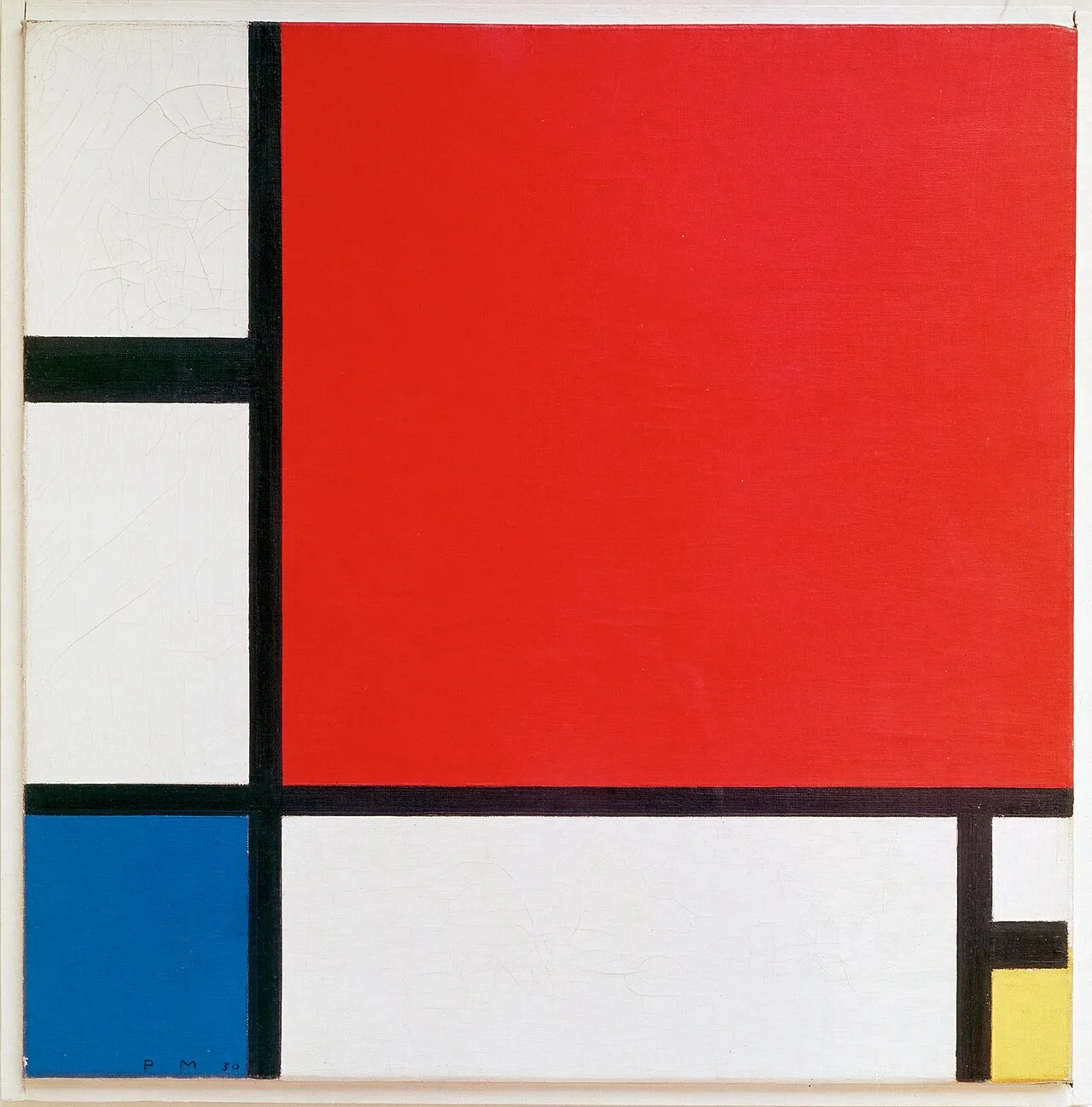
Piet Mondrian, "Composition II in Red, Blue, and Yellow" (1930), oil on canvas, 46 x 46 cm. Kunsthaus Zürich. Mondrian's De Stijl grid became one of the most directly borrowed visual systems in 20th-century fashion design, most famously by Yves Saint Laurent in 1965. Image: Public domain, via Wikimedia Commons
Yves Saint Laurent: Formal Translation, Not Reproduction
The Mondrian collection established a template for what art-inspired fashion can mean at its best: not printing paintings on fabric, but understanding an artist's visual logic well enough to reinvent it in a different medium and context. Saint Laurent returned to this approach throughout his career. His Pop Art-inspired collections of the late 1960s referenced Andy Warhol and Tom Wesselmann in dress forms rather than surface prints. His later collections drew on Picasso's Cubist figure work and Matisse's use of flat color planes as sources for formal ideas rather than imagery to reproduce. The Warhol and Matisse spotlights on this site cover the artists whose visual logic he translated: Andy Warhol and Henri Matisse.
The difference between Saint Laurent at his best and ordinary art-referencing fashion is the depth of engagement. A print of a Van Gogh painting on a T-shirt is reproduction. Six dresses whose construction follows the formal logic of De Stijl is translation. One requires visual intelligence; the other requires only a good printer.
Alexander McQueen: Fashion as Dark Theatre
Alexander McQueen (1969-2010) positioned his runway presentations as theatrical installations rather than shows, and the art historical references in his actual garments were specific and intentional. His Widows of Culloden collection (2006) featured hand-pleated ivory silk organza dresses that drew on the soft, diffuse, light-drenched quality of 17th-century Flemish painting, particularly the textures of lace and fine cloth that Northern European painters rendered with extraordinary attention. His collaboration with the milliner Philip Treacy produced headpieces of sculptural complexity that had no precedent in fashion history and sat naturally in the tradition of object sculpture.
His final collection, Plato's Atlantis (2010), used digitally printed animal and reptile patterns developed through digital manipulation of biological imagery, treating the computer as a medium for generating genuinely new visual forms rather than as a production tool. The collection was also the first live-streamed runway show in history, shown simultaneously on SHOWstudio.com. The show's visual ideas connected directly to the tradition of digital art explored in our guide to Digital Art: The Modern Creative Frontier.
Rei Kawakubo: Applying Conceptual Art Logic to Clothing
Rei Kawakubo of Comme des Garçons represents a different relationship between fashion and art: not the borrowing of visual motifs from painting but the application of conceptual art logic to the structure and premise of garments. Her 1981 Paris debut, with its deconstructed, asymmetric, often deliberately incomplete garments in black, white, and grey, asked the same question that Conceptual Art had been asking about the art object for twenty years: what are the fundamental assumptions of this category, and what happens if you refuse them?
Her 1997 Body Meets Dress, Dress Meets Body collection, in which built-in padded protuberances distorted the conventional female silhouette into shapes with no precedent in fashion history, was received by critics as either visionary or grotesque, which is exactly the reception pattern of serious avant-garde work in fine art. Kawakubo has consistently resisted the designation "fashion designer." The fashion system gives her a context and an audience; the logic of her work is that of conceptual art applied to a different material category.
Contemporary Crossovers: Digital Couture and Living Artists
Contemporary fashion's engagement with fine art continues on multiple fronts. Yayoi Kusama's 2023 collaboration with Louis Vuitton was her second with the brand, following the 2012 collection, and it was the largest she had ever undertaken, covering handbags, clothing, retail spaces, and the facades of stores in major cities with her signature dot patterns. The collaboration generated record commercial results and functioned simultaneously as a genuine extension of her artistic practice into new spatial and material contexts. The spotlight on Yayoi Kusama covers her practice and its visual logic.
Dutch designer Iris van Herpen has used 3D printing, laser cutting, and digital fabrication since 2010 to produce garments whose structural complexity is physically impossible with conventional construction methods. Her forms, branching, crystalline, biomorphic, sometimes resembling solidified water, constitute a genuinely new visual language with no precedent in either art or fashion history. They are also genuinely beautiful in person, which is what separates them from mere technology demonstration. The question of whether fashion is art remains productively unresolved. The most interesting work in both fields happens exactly at the point where the question is pushed hardest. Which designer do you think engages most seriously with visual art? Share your thoughts in the comments.



