
Stand in front of Velazquez's "Las Meninas" (1656) in the Prado in Madrid and notice what happens. You look at the painting. The Infanta Margarita and her attendants look at you. Velazquez, brush in hand, looks at you from behind his enormous canvas. In the mirror on the rear wall, the reflections of King Philip IV and Queen Mariana of Spain look toward you from the position you are now standing in. You are, the painting insists, the King and Queen of Spain. The painting only makes complete sense when a viewer occupies the position it has prepared. Without you standing there, the mirror reflects nothing. The gazes of every figure in the painting point toward a space that you, and only you, can fill.
This is the role of the viewer made explicit. "Las Meninas" is exceptional because it shows this dynamic so overtly, but the principle it demonstrates operates in every work of art. An artwork is not a completed object sealed within itself. It is a proposition, an invitation, a set of conditions for an experience that only happens when a viewer is present. What you bring to a painting, your knowledge, your emotional state, your cultural context, your visual experience, shapes what you find there. Understanding this is not a relativist claim that all interpretations are equally valid. It is a recognition that meaning in art is made between the artwork and the viewer, not deposited in the artwork by the artist and passively received.
What Velazquez Did with Viewer Position
The spatial logic of "Las Meninas" has generated more scholarly writing than almost any other painting in Western art. The art historian Jonathan Brown, the philosopher Michel Foucault (whose opening analysis in "The Order of Things" in 1966 made the painting famous to a generation of theorists), and dozens of others have argued about who exactly we are meant to be when we stand in front of it.
The most persuasive reading is the simplest. The painting depicts the moment a royal sitting is interrupted, with the King and Queen stepping into the studio and everyone turning to acknowledge them. The viewer standing in the Prado is being placed in the position of the royal couple, and therefore in the position of the most powerful figures in 17th-century European society. The mirror on the back wall reflects them, small, as the room's true subject. Velazquez is painting them. The attendants are arranged for their view. And you, the contemporary visitor who may have spent fifteen euros on a museum ticket and who has no claim whatsoever to the Spanish throne, are asked to inhabit that position and experience what it does.
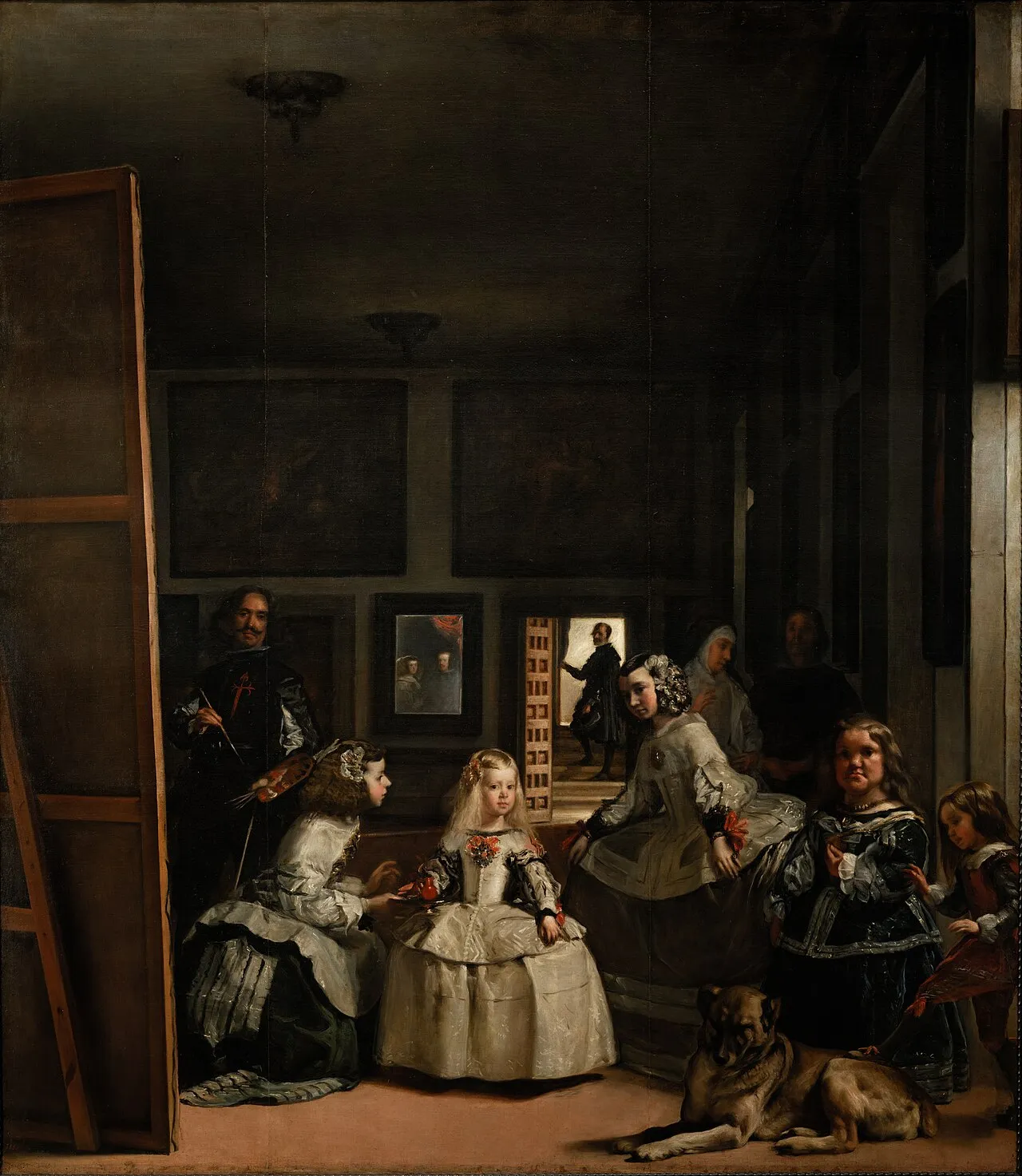
Diego Velazquez, "Las Meninas" (1656), oil on canvas, 318 x 276 cm. Prado Museum, Madrid. The mirror on the rear wall reflects King Philip IV and Queen Mariana in the position occupied by the viewer, making the viewer's presence a structural component of the painting's meaning. Every gaze in the painting points toward where you are standing. Image: Public domain, via Wikimedia Commons
Duchamp and the Creative Act
Marcel Duchamp, whose work repeatedly interrogated the conditions of art-making and art-viewing, articulated the viewer's role most explicitly in his 1957 lecture "The Creative Act," delivered to the American Federation of Arts. His argument was that the artist transmits, but cannot control, meaning. The artwork exists in a gap between what the artist intended and what the viewer receives. Both contributions are necessary for the completed creative act.
Duchamp's readymades, most famously the upturned porcelain urinal he titled "Fountain" (1917) and submitted under the pseudonym R. Mutt to an exhibition in New York, were designed to test this principle at its most extreme. "Fountain" was not made by Duchamp. It was manufactured by an industrial process and purchased. It was not modified except by signature and title. Its transformation into a work of art depended entirely on the decisions of the curator, the institution, and the viewer. The object was identical to a urinal in a public bathroom. The viewer's response, conditioned by the gallery context, the presentation, and their knowledge of Duchamp's intentions, was what made it art or not art.
This makes "Fountain" simultaneously one of the most radical and most intellectually serious tests of what art actually is. The object does nothing. The artist did almost nothing to it. Everything is done by the context and the viewer. For a deeper analysis of how context transforms the same object's meaning, see our post on how context changes meaning.
Reception Theory: The Reader Makes the Text
The formal theoretical framework for thinking about the viewer's role was developed not in art history but in literary criticism, by the "reception theorists" associated with the University of Constance in Germany in the late 1960s and 1970s. Hans Robert Jauss and Wolfgang Iser argued that a literary text is not a fixed object with stable meaning waiting to be extracted. It is a set of instructions for constructing meaning, and different readers at different times bring different "horizons of expectation" to the text, producing legitimately different meanings from the same words.
Iser's concept of "gaps" in a text is particularly useful for thinking about visual art. A text or image can only specify so much, and the gaps between specified elements are filled by the reader or viewer through their own associations, knowledge, and imagination. A figure in a painting is not described in every detail. The viewer supplies the missing information unconsciously from their own visual experience. A narrative scene in a painting shows one moment. The viewer reconstructs the implied before and after from their own knowledge of the story. These acts of viewer completion are not corruptions of the work's meaning. They are how meaning is produced.
What Neuroscience Says About the Viewer's Brain
Recent neuroaesthetics research has given the viewer's role a biological foundation that reception theory could only describe philosophically. A 2026 study published in Nature Communications by Xinyu Liang and colleagues used 7T fMRI scanning to identify two principal dimensions along which viewers evaluate paintings: visual semantics and hedonic valuation. Category-selective regions along the ventral visual stream tracked variation in visual semantics, while medial prefrontal and subcortical circuitry tracked hedonic valuation. The study also found that individual differences in this aesthetic space, particularly within default mode network regions, scaled with visual art expertise. In other words, the brain's response to a painting is not uniform across viewers. It is shaped by what the viewer brings to the encounter, including their training and experience.
A 2025 EEG study published in Scientific Reports found that beauty-related neural representations emerge within the first 150 to 200 milliseconds of seeing a painting and are sustained over time, regardless of whether the viewer is explicitly asked to judge beauty or is performing an unrelated task. This suggests that the viewer's brain begins constructing aesthetic meaning almost instantly and automatically, before conscious deliberation. The viewer is not passively receiving a finished aesthetic object. The viewer's brain is actively constructing the aesthetic experience from the moment it encounters the image.
Participatory Art: When the Viewer Is Required to Act
Contemporary participatory art makes the viewer's role explicit by requiring physical action rather than passive contemplation. Yoko Ono's "Instructions Paintings," developed in the early 1960s, consisted of instructions for an action or state of mind: "Imagine a cloud dripping. Dig a hole in your garden to put them in." The "artwork" is not the instructions themselves but the imaginative and physical activity the instructions catalyze in whoever reads and enacts them. Without active viewer participation, the work literally does not exist.
Marina Abramovic's durational performances, including her 2010 MoMA retrospective "The Artist Is Present," in which she sat in silence across a small table from individual visitors for seven and a half hours a day over three months, placed the viewer inside the artwork in a physically and emotionally unambiguous way. The work was not Abramovic sitting. It was Abramovic sitting with a specific person, and the encounter between them, which was observed but not controlled by either party, was the work's content. Reviews and accounts of the piece overwhelmingly describe the viewer's experience of sitting with Abramovic, not Abramovic's experience of sitting. The viewer was not watching art. The viewer was making it.
What This Means for How You Visit Galleries
Understanding your role as an active contributor to meaning rather than a passive recipient changes what you pay attention to when looking at art. The question is not only "what did the artist intend?" but also "what am I bringing to this encounter, and how is that shaping what I see?"
Your emotional state matters. Your previous exposure to similar works matters. Your cultural context and what associations the subject matter triggers in you matter. These are not biases to be corrected. They are the conditions of your particular encounter with the work. A painting seen on the day of a bereavement will look different from the same painting seen on the day of a celebration. Neither experience is wrong, and neither is the complete experience of the work.
The practical implication is that returning to the same works over time is one of the most rewarding things a gallery-goer can do. The work does not change, physically it does but slowly, but you do, and those changes produce new encounters. Collectors who live with works describe the way a painting they have owned for decades continues to reveal new things, not because the painting has changed but because the relationship between viewer and painting deepens with repeated engagement.
For the foundational skills of deliberate visual attention that make any gallery visit more rewarding, our guide to how to look at art covers the basics. For how the same work can produce radically different meaning depending on where it is shown and to whom, our post on context and meaning in art extends these ideas into the institutional and historical dimensions of reception. And for the science behind what happens in your brain when you encounter beauty, our post on the neuroscience of aesthetic experience covers the research in detail.
Final Thoughts
You are not a neutral observer of art. You are part of what makes art happen. The tradition of Western aesthetics that positioned the artwork as a fixed object and the viewer as a transparent window onto its meaning has largely been superseded by a more accurate model. Meaning is made in the encounter, and the viewer's presence, attention, knowledge, and emotional state are all conditions of that making.
This does not undermine the artist's achievement or the artwork's qualities. It simply acknowledges what actually happens between a person and a painting when genuine engagement occurs. Velazquez understood it in 1656. Duchamp made a career of testing it. Abramovic built her most significant work from it. The viewer who understands their own role is not just a better observer. They are a better participant in one of the oldest forms of human exchange.


