In 1817, the French writer Stendhal visited the Basilica of Santa Croce in Florence and found himself overwhelmed. Walking among the tombs of Michelangelo, Galileo, and Machiavelli, then contemplating the Volterrano frescoes on the ceiling, he began to feel his heart pounding. His legs became unsteady. He sat down on a pew, half convinced he was about to faint. "I was in a sort of ecstasy," he wrote in his travel memoir, "from the idea of being in Florence, close to the great men whose tombs I had seen." The experience was so intense that he was forced to leave and sit outside, breathing the cold air of the Arno to recover.
What Stendhal described has since been given his name. Stendhal Syndrome, also called Florence Syndrome or hyperkulturemia, describes episodes of physical symptoms, accelerated heartbeat, dizziness, even hallucinations and fainting, triggered by exposure to great art, particularly when that art is concentrated in one space. The Florence emergency services have documented dozens of cases over the years, mostly among tourists overwhelmed by the density of masterpieces in the Uffizi Gallery or the churches of the historic center.
Stendhal Syndrome is an extreme version of something many people experience in milder forms: goosebumps at a piece of music, an unexpected tightening in the chest when a painting strikes something deep, tears in front of a sculpture that seems to express something you have never been able to put into words. These physical responses to art are real, measurable, and neurologically documented. Understanding them reveals something important about what art is actually doing to us when it works.
Frisson: The Science of Art-Induced Chills
The technical term for the chills response to art is frisson, from the French word for shiver or thrill. It describes the sensation of goosebumps, skin tingling, or a wave of cold running up the spine in response to music, visual art, natural scenery, or moments of heightened social or emotional significance. Researchers estimate that approximately fifty to seventy percent of people experience frisson regularly, while the remaining thirty to fifty percent rarely or never do.
People who experience frisson tend to score high on the personality trait of openness to experience, one of the Big Five personality factors. They tend to be imaginatively engaged with ideas and sensory experiences, comfortable with complexity and ambiguity, and prone to absorption, the capacity to become deeply immersed in an experience to the point where ordinary self-monitoring temporarily suspends. This personality profile matches what artists have always said their ideal viewer looks like: someone who gives the work their full, undefended attention.
Neurologically, frisson triggers the release of dopamine in the brain's reward system, particularly in the nucleus accumbens, the same region activated by food, sex, and certain drugs. A 2011 study by neuroscientist Valorie Salimpoor and colleagues measured dopamine release in real time in subjects listening to music that gave them chills and confirmed the direct relationship. The chills response is the brain rewarding itself for an exceptional perceptual experience.
A 2025 study published in Psychology of Aesthetics, Creativity, and the Arts examined what happens in the brain when people experience aesthetic chills. Using fMRI, researchers found that frisson events activated the anterior insula, a brain region involved in interoception (the perception of internal body states) and emotional awareness. The anterior insula showed increased functional connectivity with the default mode network during frisson, suggesting that the chills response integrates bodily sensation with self-referential thought. In other words, when you get chills from a painting, your brain is simultaneously processing a physical sensation and connecting it to your personal identity and memories. This is why frisson feels so personal: it is literally your brain linking a bodily response to your sense of self. The full study is available at APA PsycNet.
A separate 2025 study in Scientific Reports found that the element of surprise distinguishes beauty from pleasure in aesthetic experience. When participants encountered tactile artworks that violated their visual expectations, the mismatch negativity in their EEG responses predicted beauty ratings but not pleasure ratings. Beauty, it turns out, involves metacognitive appraisal: the mind recognizing that its expectations were violated and deciding that the violation was worthwhile. Pleasure is simpler. Beauty is more complex. This is why predictable art gives pleasure without giving chills. The full study is at Scientific Reports.
Kama Muta: The Feeling of Being Moved
A related but distinct concept has been developed by the social psychologist Alan Page Fiske at UCLA. Fiske identified a specific emotion that he calls kama muta, a Sanskrit phrase meaning "moved by love." It describes the feeling of sudden, intense emotional warmth and connection, often accompanied by physical signs: tears, goosebumps, a feeling of the heart swelling, a catch in the throat. It is the feeling you have when something is so beautiful, so generous, or so human that it briefly overwhelms your ordinary emotional boundaries.
Kama muta is triggered by the sudden intensification of communal sharing: moments when a sense of connection, belonging, or shared humanity becomes suddenly vivid. Art triggers it when it succeeds in expressing something universally true with particular precision, when it makes you feel simultaneously that you are seeing something deeply personal and deeply shared. The tears you shed in front of a Kollwitz or a Rembrandt are not primarily about the depicted subject. They are about the recognition that someone else understood something about human experience so well that they could show it to you in paint or stone, and the feeling of being seen and understood that this recognition produces.
A 2026 study published in Frontiers in Psychology explored whether abstract art can evoke the emotion of being moved without curatorial text or narrative cues. Conducted at the Heidi Horten Collection in Vienna, the study used three experiments and found that viewers can experience genuine, though typically moderate, emotions of being moved by abstract paintings even without explanatory text. These emotions depended primarily on viewer-centered meaning-making and interpretive engagement rather than on low-level visual features. This means kama muta does not require a recognizable subject. It requires a viewer willing to engage. The full study is at Frontiers in Psychology.
The Sublime: When Scale Overwhelms
The 18th-century philosopher Edmund Burke distinguished between the beautiful and the sublime. The beautiful is what gives pleasure through proportion, smoothness, and pleasantness. The sublime is what gives a more intense and complex pleasure through vastness, power, and the slight terror of encountering something that dwarfs human scale. Burke wrote that the sublime involves "astonishment," a state in which the mind is so filled by an object that it cannot entertain any other or reason about what it sees.
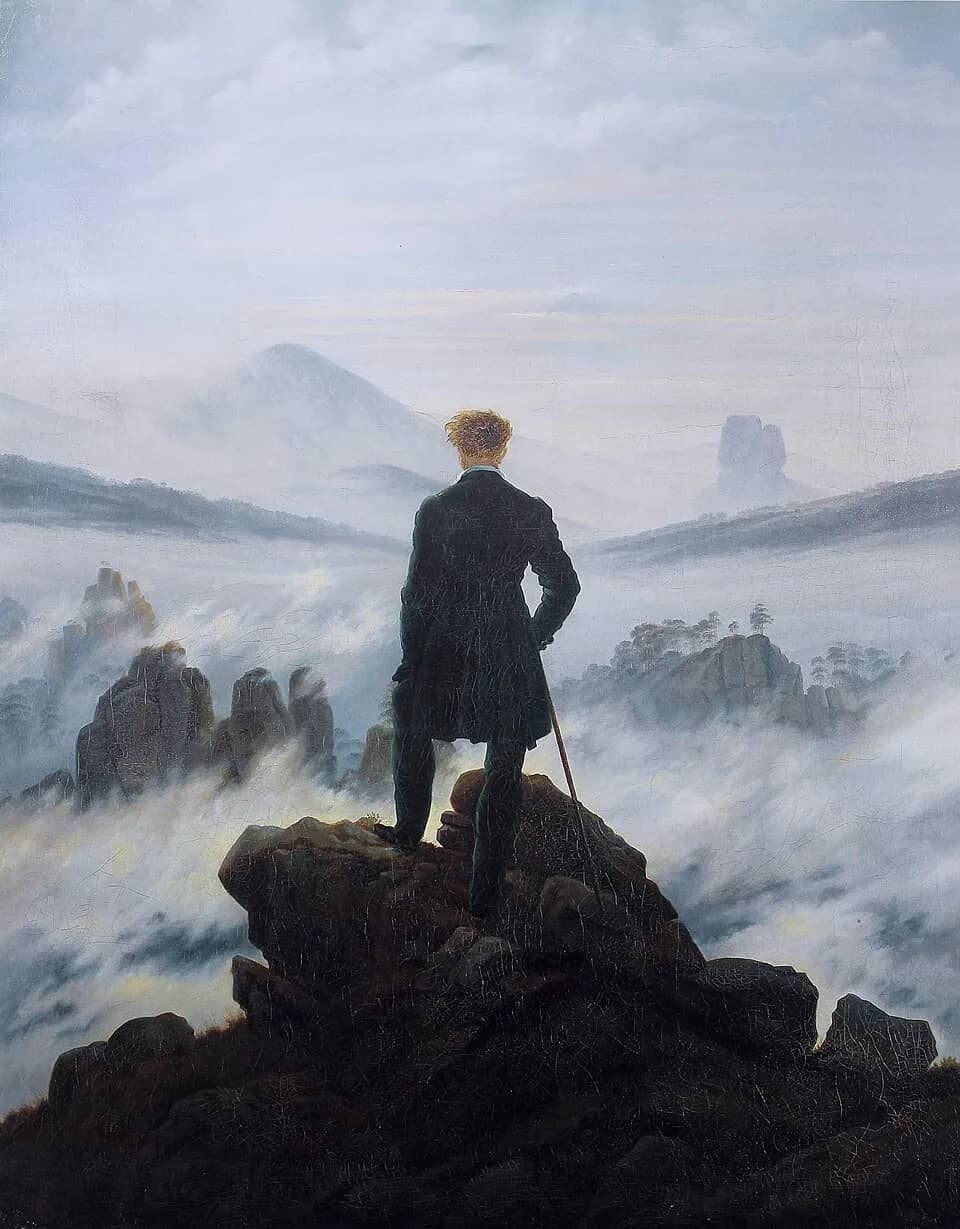
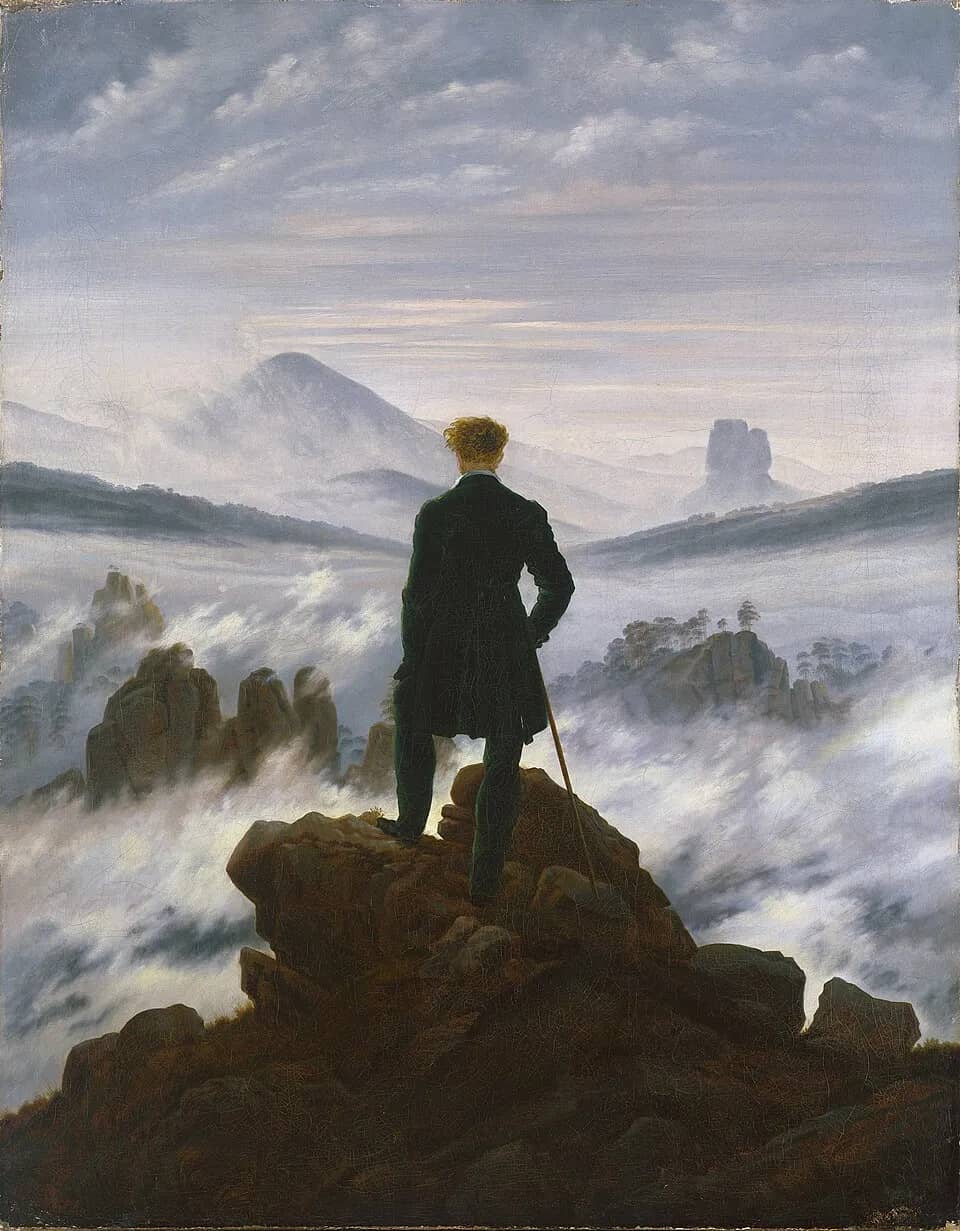
Caspar David Friedrich was the supreme painter of the visual sublime. His figures, when they appear at all, stand at the edge of vast natural panoramas: the "Wanderer above the Sea of Fog" (c. 1818) with his back to the viewer, looking out over an infinite fog-filled valley from a rocky summit; the monk on the seashore beneath a sky that takes up four-fifths of the canvas; the sailing ships dwarfed by polar ice. Friedrich's compositions make the human figure small not to diminish it but to give it dramatic significance: the figure at the edge of the vast space represents the viewer's own consciousness encountering something beyond its comprehension.
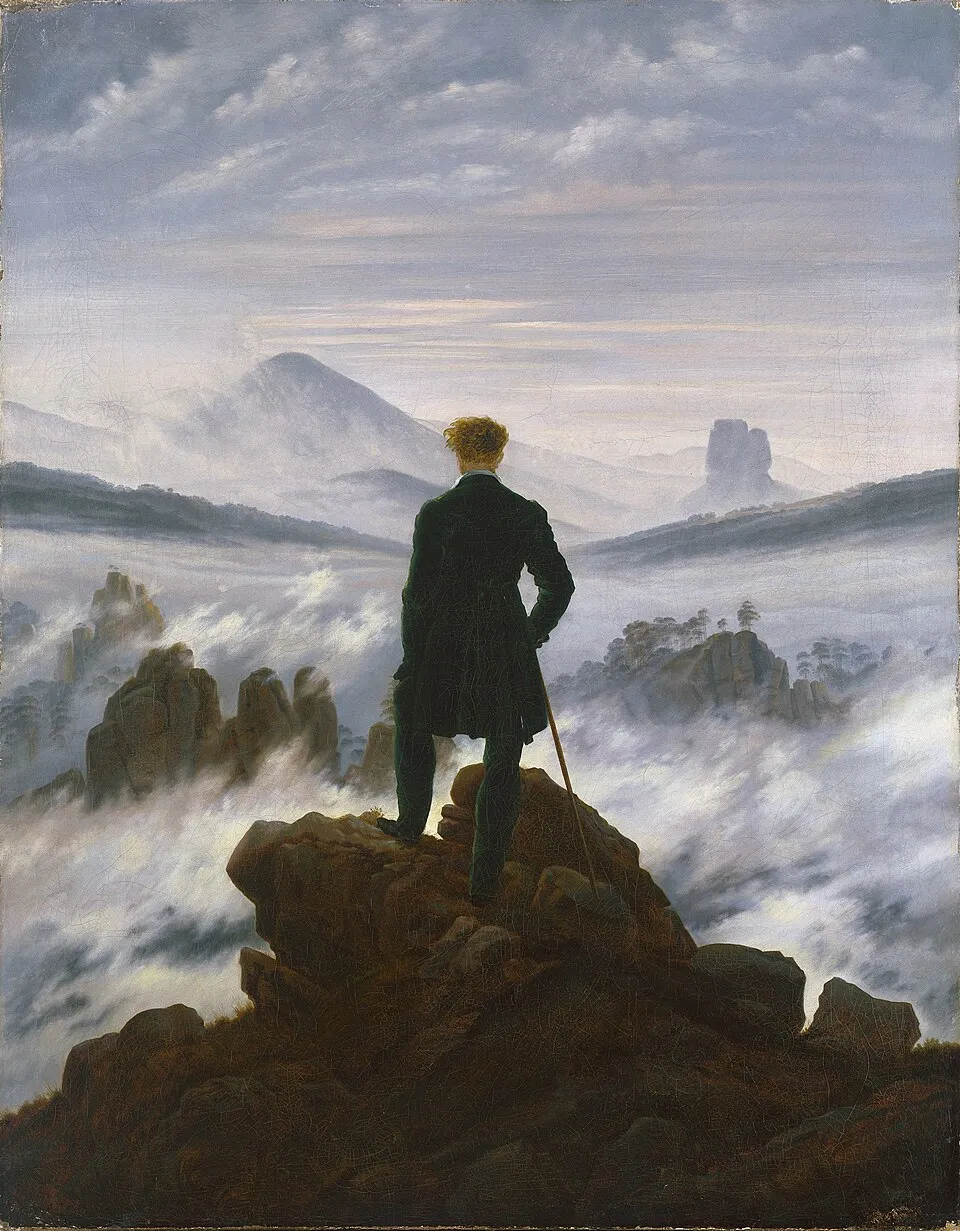
Caspar David Friedrich, "Wanderer above the Sea of Fog" (c. 1818), oil on canvas, 94.8 x 74.8 cm. Kunsthalle Hamburg. The painting is one of the defining images of the Romantic conception of the sublime: a solitary figure at the boundary of human experience, facing a vastness that cannot be comprehended or controlled. The viewer's position directly behind the wanderer makes the identification between viewer and figure nearly irresistible. Image: Public domain, via Wikimedia Commons
The sublime experience that Friedrich's paintings produce in viewers is not simply a response to the depicted landscape. It is a response to the formal construction of the image: the precise placement of the figure relative to the canvas edge, the careful calibration of the fog's density so that enough is suggested to imply vast distance without being literally resolved, the limited palette that prevents any competing sensory interest from distracting from the primary spatial experience. Friedrich's paintings are engineering projects as much as they are emotional expressions, and the engineering produces the emotion reliably because it works directly on the viewer's perceptual and emotional systems.
The Rothko Chapel and Concentrated Aesthetic Experience
The Rothko Chapel in Houston, Texas, completed in 1971, is an octagonal non-denominational meditation space containing fourteen of Mark Rothko's largest and darkest paintings, made specifically for the space in the final years of his life. The chapel is windowless. The paintings are deep maroon and nearly black, enormous in scale, with almost no discernible surface variation. Visitors sit in the chapel in near-darkness and silence.
Reports of the chapel's effect on visitors are remarkably consistent. Many people describe an experience of profound stillness, emotional intensity, and a quality of presence that they struggle to attribute to either the paintings or themselves. Some weep. Some sit for an hour without moving. Many describe it as one of the most significant aesthetic or spiritual experiences of their lives. Several have described feeling physically ill if they stay too long, a mild form of the Stendhal Syndrome Rothko seems to have deliberately designed for.
The chapel demonstrates something that artists have known intuitively and researchers have begun to document: the conditions surrounding the encounter with art matter enormously to the quality of the experience. A Rothko painting in a busy gallery surrounded by other works on a Sunday afternoon produces a different experience than the same painting in a near-dark room specifically designed for contemplation. The secular equivalent of the sacred architecture of a cathedral, the Rothko Chapel creates the conditions for peak aesthetic experience as deliberately as any Gothic cathedral did for religious experience.
A 2026 study conducted at the National Gallery in London with 281 participants tested whether guided viewing strategies could enhance the well-being effects of art viewing. The study found that guided viewing, which focused on slow and detailed observation, led to greater increases in positive mood than a pre-viewing mindfulness session. Among first-time visitors, these strategies were especially beneficial. The implication is clear: the conditions of viewing, how long you look, how you look, what you are asked to notice, directly affect the intensity of the aesthetic experience. You can read the full study at Scientific Reports.
What Makes an Artwork Capable of This
Not every work of art produces peak aesthetic experiences, and the question of what distinguishes those that do from those that do not is one of the most interesting in aesthetics. Research and critical discussion converge on several consistent factors.
Emotional authenticity: Works that produce peak responses tend to express something genuine rather than performed. Viewers appear to detect authenticity, or its absence, even without being able to articulate how.
Formal mastery: Technical excellence is not sufficient on its own, but work that uses its formal elements, color, scale, composition, space, with exceptional precision tends to produce stronger responses than work where the formal execution is approximate.
Scale and context: Many works that are famous for producing peak responses are physically large. Scale affects the body before the mind has assessed anything. The physical experience of being in the presence of something very large is related to the sublime response.
The viewer's openness: The personality research on frisson consistently shows that openness to experience on the viewer's part is essential. A viewer who arrives defended, skeptical, or distracted is unlikely to have a peak response regardless of the quality of the work.
The interaction between the artwork's properties and the viewer's state is essential. Peak aesthetic experiences are not simply the work's doing. They are co-produced by the work and the viewer in the right conditions. Our guide to the neuroscience of beauty covers the specific brain processes involved in more detail. You might also find our guide to why abstract art makes people uncomfortable relevant, since the discomfort of abstraction can be a gateway to peak aesthetic experience.
Final Thoughts
The chills, the tears, the racing heart, the momentary dizziness: these physical responses to art are not embarrassing or irrational. They are evidence that art is doing its deepest work on you. They are the body registering an encounter with something that has exceeded the ordinary threshold of sensory and emotional experience. The artists who produce these effects most consistently are not simply technically skilled. They have understood something about human perception and emotion that allows them to engineer specific states in the viewer with extraordinary precision.
The best advice for anyone who wants more of these experiences is also the simplest: give the work time, give it attention, and arrive without a fixed idea of what you are supposed to feel. For more on how to build this quality of attention, see our guides to how to look at art for beginners and how art affects mental health. What artwork has given you the strongest physical or emotional response? Share in the comments below.