
The figure in "The Scream" does not look like a person screaming. The mouth is open, the hands press against the sides of the head, and the form of the body has dissolved into something closer to a wave or a smear of paint than a human being. The scream, if there is one, may not be coming from the figure at all. Edvard Munch's own description of the experience that generated this image suggests something different and stranger. He described a man who felt overwhelmed by a sound he heard in the landscape around him, trying to represent the experience of an anxiety so physical that it seemed to emanate from the world itself rather than from his own body.
This distinction matters because it is the source of the painting's unusual power. "The Scream" is not a portrait of someone in distress. It is an attempt to paint a subjective experience of the world, what it feels like when anxiety turns perception itself unreliable. In this, it was not just personally expressive but historically prophetic. It was a painting made in 1893 that somehow looked like the 20th century before the 20th century had arrived.
Munch's Diary Entry
Munch recorded the experience in his diary around 1892. The entry reads, in translation: "I was walking along the road with friends. The Sun was setting. Suddenly the sky turned blood red. I paused, feeling exhausted, and leaned on the fence. There was blood and tongues of fire above the blue-black fjord and the city. My friends walked on, and I stood there trembling with anxiety. And I sensed an infinite scream passing through nature."
The phrase "passing through nature" is the key to the painting. The scream is not the figure's, or not only the figure's. It is something Munch perceived in the landscape, a quality of the air, the light, the color of the sky, that overwhelmed him with terror. He was not depicting a psychological state so much as a perceived physical reality. He was painting a world in which the ordinary visual environment had become charged with an almost unbearable emotional intensity.
Scholars have proposed various explanations for the specific visual experience Munch described. The blood-red sky may have been produced by light refracted through volcanic dust still in the atmosphere from the 1883 Krakatoa eruption. The specific location is almost certainly the viewpoint on Ekeberg Hill above Christiania (now Oslo), looking west over the Oslofjord. Both explanations are probably true and neither of them matters. What matters is what Munch made of the experience.
Four Versions
There are four versions of "The Scream," made between 1893 and 1910. Two are paintings (one in the National Gallery of Norway, Oslo; one in the Munch Museum, Oslo), one is a pastel (in a private collection), and one is a tempera and crayon drawing (Munch Museum). The variations between them are significant. The earliest version, from 1893, is the most powerful, with the greatest degree of formal dissolution and the most charged color. Later versions are more controlled and in some cases more conventionally finished.
The most valuable version, the pastel from 1895 with a poem by Munch written in pencil directly on the frame, sold at Sotheby's New York in May 2012 for $119.9 million, then the highest auction price ever paid for a work of art on paper. It was purchased by the American financier Leon Black.
The Composition
The painting's compositional structure is what carries its emotional effect. The bridge railing creates a strong diagonal from the lower left to the upper right, a device that Munch borrowed from Japanese woodblock prints and that creates a sense of perspective recession pulling away from the viewer. The figure stands at the near end of this receding diagonal, isolated from the two dark figures in the middle distance and the single figure further along the bridge.
The sky and landscape have abandoned the conventions of realistic representation. The clouds swirl in rhythmic curves that echo the water of the fjord below, creating a visual environment in which everything is in motion and nothing is stable. The hills, the water, the sky, and the figure itself are all made from the same curving, restless lines, as if the entire visible world were vibrating at the same frequency. The contrast between the curved organic forms of the landscape and the rigid diagonal of the bridge creates a tension that is the painting's formal equivalent of the anxiety it depicts.
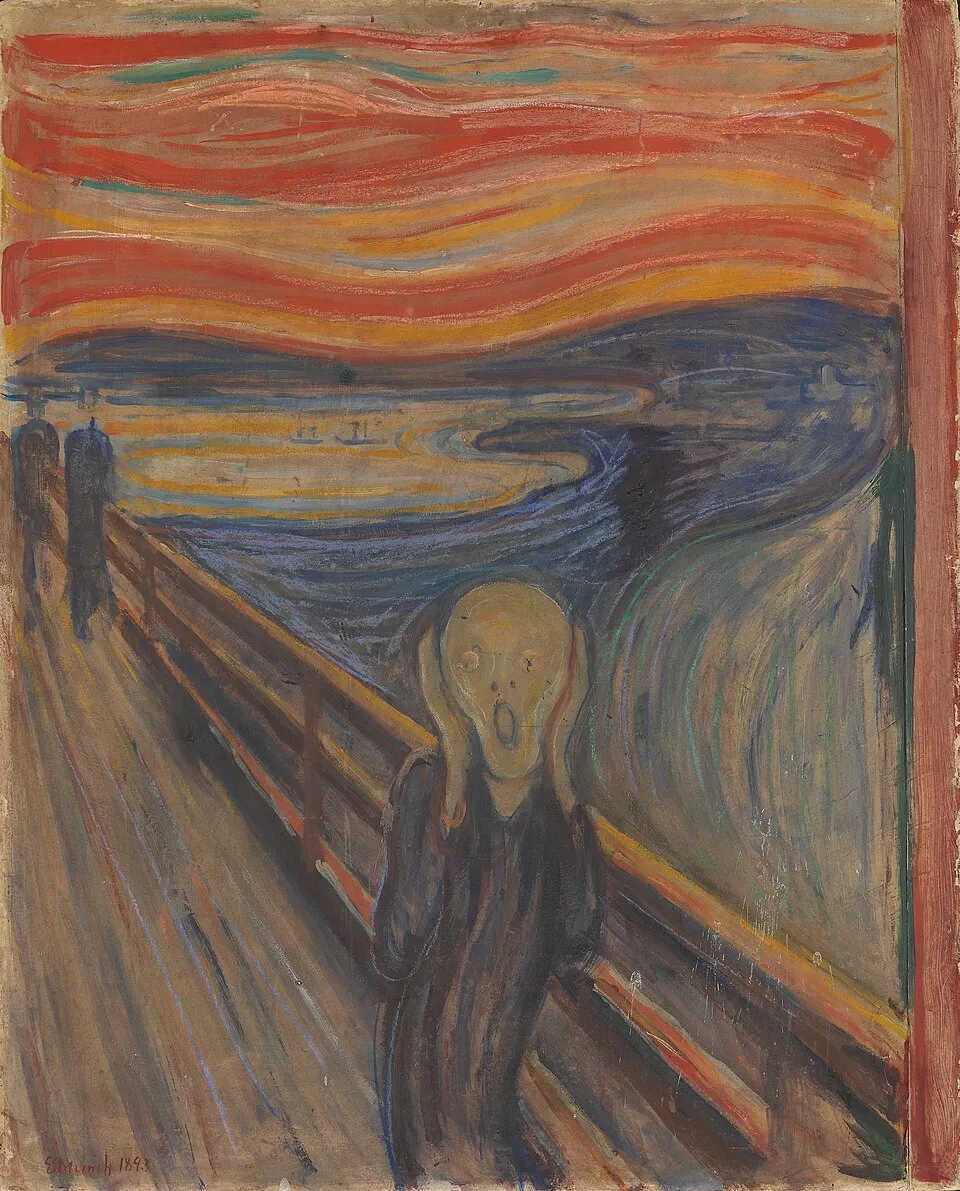
Edvard Munch, "The Scream" (1893), oil, tempera, and pastel on cardboard, 91 x 73 cm. National Gallery of Norway, Oslo. One of four versions Munch made between 1893 and 1910, this earliest version is generally considered the most powerful. Image: Public domain, via Wikimedia Commons
What Science Is Discovering About the Fading Colors
The 1910 version of "The Scream" held by the Munch Museum is fading, and recent research has revealed why. A study published in Science Advances by an international team led by the Italian National Research Council found that the cadmium sulfide pigment Munch used for the yellow brushstrokes in the sky and the figure's throat is oxidizing into cadmium sulfate, causing those areas to turn off-white. The research, which combined macroscale in situ spectroscopy with synchrotron radiation x-ray microspectroscopy, showed that moisture, not light as previously assumed, is the primary driver of the degradation. Mobile chlorine compounds in the paint are also accelerating the process.
This finding has directly shaped the museum's conservation strategy. The Munch Museum now stores the painting in a climate-controlled environment with carefully managed humidity levels, as the museum's conservation team has documented. The painting is no longer displayed continuously but rotated with other versions of the motif to limit environmental exposure.
More recently, a 2025 study presented at the Eurographics conference used a historical black-and-white photograph from 1938, combined with modern multi-spectral imaging, to digitally reconstruct the painting's original colors. The comparison revealed significant differences in lightness, including fading in the yellow areas and an unexpected brightening in the blue areas, a phenomenon not previously reported. This digital reconstruction offers a glimpse of how the painting looked only a few decades after its creation, preserving evidence of its original appearance that is no longer visible to the naked eye. The research was published in the Eurographics Digital Heritage proceedings.
Additionally, a 2025 study published in Frontiers in Computer Science demonstrated how 3D-printed tactile replicas of the painting's color surface features could make the artwork accessible to visually impaired visitors. The replicas were presented at the InArt24 conference in Oslo and at the KHM Museum, where participants reported that interacting with the physical 3D replicas increased their engagement and satisfaction. This kind of multisensory approach to art accessibility, using high-resolution imaging and computer vision to separate and heighten color surface features, is an emerging area where conservation science and public engagement intersect.
The Thefts
The Scream's fame, and the vulnerability of Norwegian museums in the 1990s and 2000s, made it the target of two spectacular thefts. In February 1994, masked thieves broke into the National Gallery of Norway and removed the painting in under a minute, leaving a note reading "Thanks for the poor security." The painting was recovered three months later in a sting operation. In August 2004, armed thieves stole the Munch Museum's version along with Munch's "Madonna" in a daylight raid. Both paintings were recovered in 2006, damaged by the hasty removal and mishandling during their two years in the thieves' possession. The thefts contributed to the painting's mythology while demonstrating something both flattering and alarming about its cultural status. Someone calculated that stealing it was worth the risk.
From Expressionism to Emoji
Munch's painting is the founding document of German and Scandinavian Expressionism, the movement that would produce Ernst Ludwig Kirchner, Oskar Kokoschka, and Egon Schiele in the decade after its creation. The movement, which is covered in the guide to Expressionism: Munch, Kirchner, and Painting Raw Feeling, took Munch's example as a license for using distortion, exaggerated color, and formal dissolution to represent subjective psychological states rather than objective visual reality.
The painting's larger cultural trajectory is harder to account for. The image is now reproduced on refrigerator magnets, emoji, Halloween costumes, and advertising campaigns for horror films. Wes Craven's "Scream" franchise used a mask based on the painting's figure for its killer. The face has become a generic icon of fear or shock, its specific Munchian anxiety reduced to a cartoon of alarm. This process of cultural assimilation is both inevitable and in some ways appropriate. The painting was always about the experience of being overwhelmed by a world that generates more feeling than it is possible to contain. The image's own cultural career has reproduced that experience at a collective level.
For the complete context of the period that produced this work, see the Complete Guide to Art Movements. For more on how Munch's personal history of illness and loss shaped his art, see our post on Edvard Munch: Anxiety, Symbolism, and a Life of Illness. And for how the painting's emotional power connects to broader questions about art and feeling, our post on how art communicates emotion without words explores the mechanisms involved. Which version of the painting do you find most powerful? Share your view in the comments.


