
Weaving is probably older than agriculture. The oldest direct evidence of woven textiles comes from twisted plant fibers found at Dzudzuana Cave in Georgia, dating to roughly 34,000 years before present. Dyed flax fibers from the same site suggest that by the Upper Palaeolithic, humans were already making choices about colour, not simply weaving for warmth. The impulse to make fabric that carries pattern and meaning is as old as any other human artistic impulse. Older than most.
That ancient origin might suggest textile art is fundamentally conservative, tied to tradition in a way that painting or sculpture is not. The history of the last hundred years makes the opposite case. Weaving and textile-making have been sites of radical formal experimentation, from Anni Albers's material investigations at the Bauhaus to El Anatsui's monumental installations made from recycled bottle caps and copper wire that shift in air currents like liquid surfaces. The loom is not a limiting instrument. It is a generative one, and what it generates depends entirely on the intelligence and ambition of the person sitting at it.
How Weaving Works
All weaving is a structure built from two perpendicular sets of threads. The warp runs vertically on the loom under tension. The weft passes horizontally through the warp. The relationship between the two determines the structure of the cloth. Plain weave alternates single warp threads over and under single weft threads. Twill weave creates diagonal lines by offsetting the pattern. Satin weave floats weft threads over multiple warp threads to produce a smooth, reflective surface.
Within those basic structures, the range of possible pattern, texture, and density is enormous. The number of warp threads per centimetre determines the fineness of the weave. The combination of warp and weft colours creates optical effects that shift depending on viewing distance. The choice of fibre, whether wool, cotton, silk, linen, synthetics, or any other spun or twisted strand, fundamentally alters the physical character of the finished textile.
A hand loom can be as simple as a frame with evenly spaced notches or as complex as a multi-shaft floor loom with hundreds of individual warp ends managed through a system of heddles and treadles. The Jacquard loom, invented in France in 1801, used punched cards to control complex pattern repeats. Charles Babbage explicitly referenced Jacquard's punch card system in his Analytical Engine designs of the 1830s, making the loom one of the direct predecessors of the programmable computer.
Tapestry: The Western Court Tradition
Tapestry, in the specific Western sense, refers to weft-faced pictorial weaving in which the warp is entirely covered by coloured weft threads. Unlike plain cloth, tapestry can represent virtually any image: figures, landscapes, architectural views, abstract pattern. The weft threads are not continuous across the full width of the cloth but are worked in sections corresponding to different colours of the design, creating what are called "hatching" transitions between colour areas and sometimes leaving small slits at colour boundaries.
European court tapestry reached its peak of ambition and technical refinement in the 15th and 16th centuries. The Flemish workshops of Brussels and Tournai produced tapestries of extraordinary scale and complexity for royal and aristocratic patrons across Europe. The famous "Millefleurs" tapestries, with their dense flower-covered grounds, and the "Unicorn Tapestries" at the Cloisters in New York (c.1495-1505) represent the highest point of this tradition. The Gobelins Manufactory in Paris, established by Louis XIV's finance minister Jean-Baptiste Colbert in 1662 and still operating today under the French state, continued the tradition through the 18th and 19th centuries.
In the 20th century, the great French tapestry revival of the 1930s to 50s, associated with designer Jean Lurcat and woven primarily at Aubusson, brought modernist painting sensibilities into the tapestry workshop. Lurcat's cartoon designs, characterised by flat colour areas and bold, simplified imagery, moved away from the painterly illusionism of earlier tapestry and toward something more explicitly about weaving as weaving.
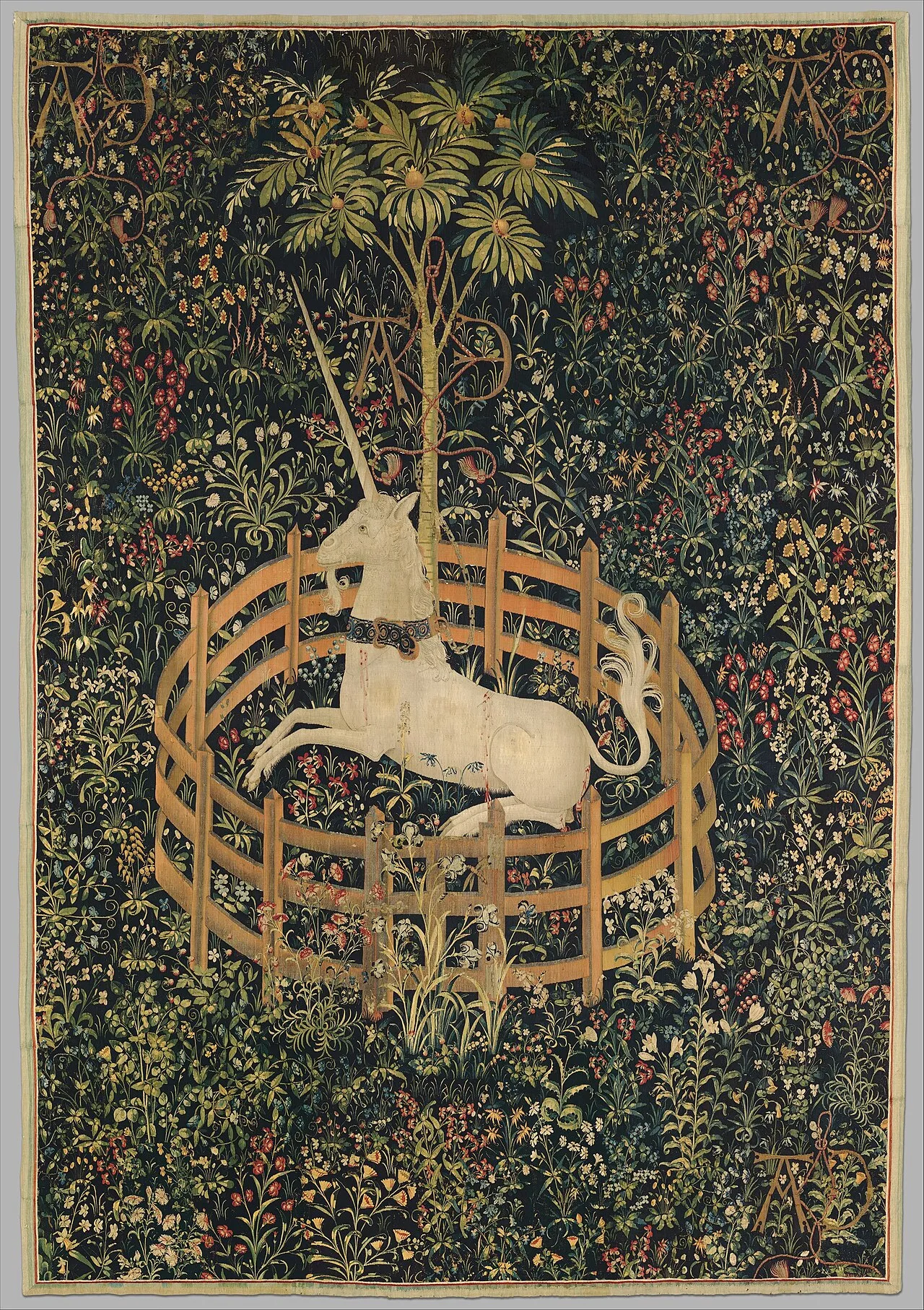
"The Unicorn in Captivity" (c.1495-1505), the final panel of the Unicorn Tapestry series, Metropolitan Museum of Art (The Cloisters), New York. One of the most celebrated examples of Flemish tapestry weaving, measuring approximately 368 x 251 cm. Image: Public domain, via Wikimedia Commons
Anni Albers and the Bauhaus Weaving Workshop
No figure in 20th-century textile art is more important than Anni Albers (1899-1994). She enrolled at the Bauhaus in Weimar in 1922 and was directed into the weaving workshop largely because the school's leadership considered weaving a suitable occupation for women students. She transformed this constraint into a sustained investigation of weaving as a formal discipline equal to any other at the school.
Albers's work at the Bauhaus, and after she and her husband Josef Albers emigrated to the United States in 1933 following the school's closure, was grounded in a rigorous analysis of what weaving as a process could achieve. She studied the relationship between structure and pattern, the optical properties of different thread materials, and the relationship between textile and architectural space. Her weavings are not illustrations. They are investigations of how threads at right angles to each other can generate visual phenomena that have no equivalent in any other medium.
Her 1965 book "On Weaving" remains one of the most important theoretical texts on the craft, combining technical precision with a philosophical seriousness about material that echoes her husband's writings on colour. When she had a solo exhibition at the Museum of Modern Art in New York in 1949, she was the first textile artist to receive that kind of institutional recognition. A 2025 scholarly article in The Art Bulletin by art historian Sarah-Neel Smith reexamined that 1949 show, noting how curator Edgar Kaufmann Jr. and architect Philip Johnson, who were sworn enemies, installed the exhibition in ways that bridged competing visions within MoMA's evolving Department of Architecture and Design. The article argues for recentering modern design narratives around Albers's work rather than treating her as a footnote to male Bauhaus figures.
In 2018, Tate Modern dedicated a major retrospective to her work, re-establishing her place in the canon of 20th-century art history. A new book, "Anni Albers: Constructing Textiles" (Yale University Press, 2026), continues this reassessment, focusing on the architectural dimensions of her work and including previously unpublished pieces from private collections. The exhibition schedule for the book runs through the Unteres Belvedere in Vienna through August 2026.
The Fiber Art Movement and Beyond
The 1960s and 1970s saw a broader reassessment of textile and fiber as artistic mediums, partly driven by the women's movement and its recovery of "women's work" as a category worth serious aesthetic attention. Artists including Magdalena Abakanowicz, whose large-scale hanging fiber sculptures (the "Abakans") filled entire rooms and changed what textile could physically be, Sheila Hicks, whose work ranges from tiny woven tablets to building-scale fiber installations, and Lenore Tawney, whose open-warp weavings expanded the definition of cloth to include air and light, established a generation of practitioners for whom weaving was explicitly an art form without qualification.
Abakanowicz (1930-2017) is particularly important in this genealogy. Her large-scale sisal fiber works of the late 1960s and early 1970s, shown at international exhibitions to significant critical response, demonstrated that woven and knotted fiber could carry sculptural ambition at the largest scale. Her later work in bronze and burlap expanded from fiber into figure, but the textile foundations remained visible in the surfaces she created.
El Anatsui: Fabric from Discarded Metal
El Anatsui (born 1944 in Ghana) is among the most internationally recognised artists of the early 21st century, and his primary medium is a kind of weaving in which the thread is metal wire and the weft is flattened bottle caps, wine-bottle seals, and other metal packaging waste collected near his studio in Nsukka, Nigeria. The resulting "cloths," stitched together by studio assistants following broad compositional directions from Anatsui, cascade from walls and ceilings in folds that suggest both traditional Ghanaian kente cloth and Western art historical references to abstract painting.
The work addresses African history directly. The bottle caps and spirits-trade packaging are material evidence of colonial extraction and exchange. But it does so through a form that references the oldest textile traditions of West Africa, where woven cloth carries enormous social and spiritual weight. Anatsui received the Golden Lion for lifetime achievement at the Venice Biennale in 2015, and his large installations hang in major museums around the world.
In 2023, Tate Modern commissioned "Behind the Red Moon," a monumental installation made of thousands of metal bottle tops and fragments, staged in three acts: The Waves, The World, and The Wall. That installation is now on a global tour. From September 2024 through October 2025, it appeared at the Museum of Art Pudong in Shanghai as "After the Red Moon," redesigned to respond to the museum's waterfront architecture along the Huangpu River. In October 2025, concurrent exhibitions at October Gallery and Goodman Gallery in London presented "Go Back and Pick," featuring new wooden sculptures that return to Anatsui's original and primary material, wood, alongside his metal wall hangings.
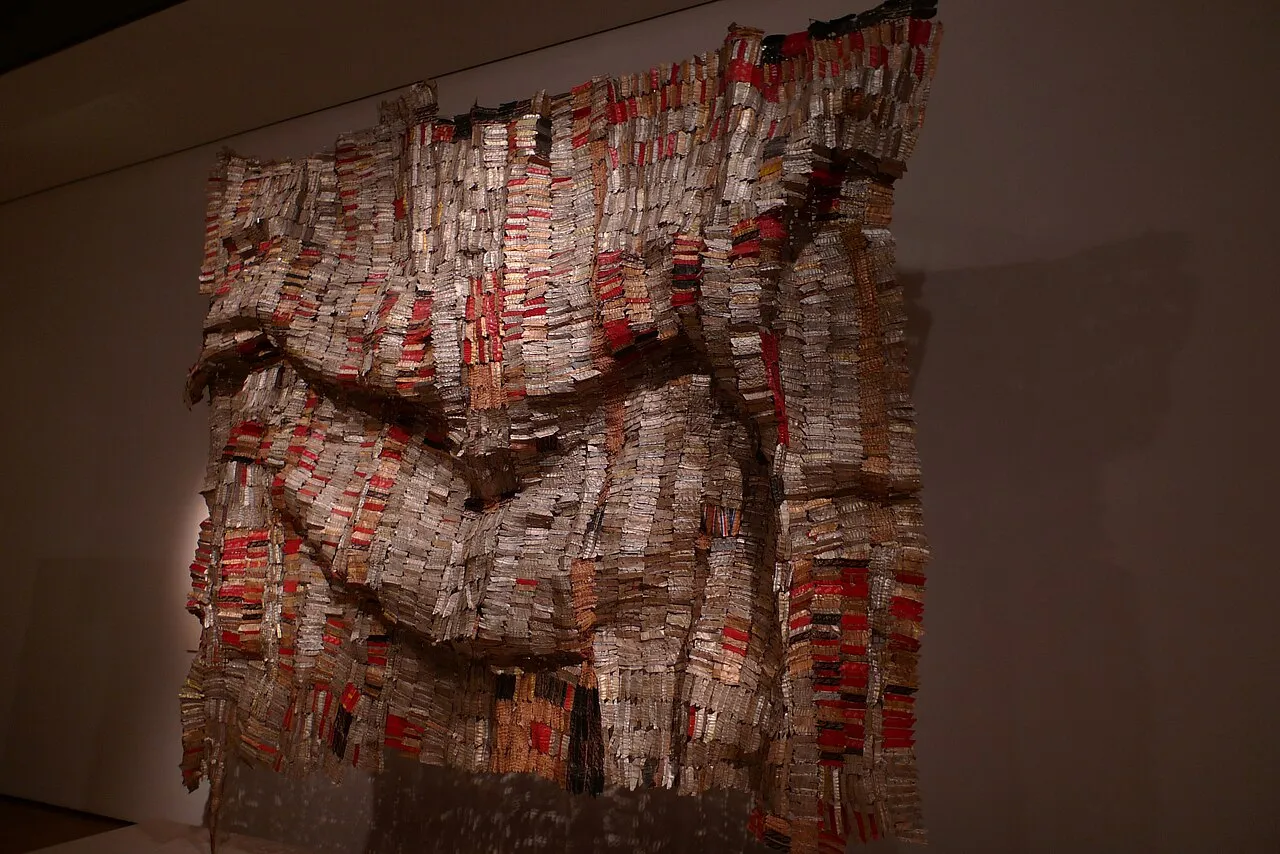
El Anatsui, "Man's Cloth". Made from thousands of flattened aluminium seals and copper wire stitched together, the work references West African kente weaving while engaging with histories of trade and colonialism. Anatsui received the Golden Lion for lifetime achievement at the Venice Biennale in 2015. Image: CC BY-SA, via Wikimedia Commons
Contemporary Textile Art in 2026
The integration of textile practice within the broader contemporary art world is more complete now than at any previous point. Major auction houses include significant textile works in their contemporary art sales. The TextielMuseum in Tilburg, the Fabric Workshop and Museum in Philadelphia, and LACMA's textile department are dedicated institutional spaces. Most large contemporary art museums now include textile and fiber works alongside painting and sculpture without apology.
The TextielMuseum in Tilburg is running several exhibitions that show where the field is heading. "Haus of fibre" (October 2025 through March 2026) examines how textiles tell stories of connection, loss, and resilience within the LGBTQIA+ community, co-created with queer artists Nixie van Laere, Celio Braga, Chathuri Nissansala, and Yamuna Forzani. "Man and Machine: 25 Years of TextielLab" (March through October 2026) explores how computer-controlled weaving has become an experimental medium where digital technology and human intuition merge, featuring 3D-woven sculptural works by designers like Aleksandra Gaca and Fransje Gimbrere. At LACMA, "Textile Alchemy: The Art of Reiko Sudo and NUNO" (September 2026 through March 2027) surveys four decades of the Japanese designer's work merging tradition with experimentation and handicraft with technology.
In Philadelphia, the Fabric Workshop and Museum's "You Stretched Diagonally Across It: Contemporary Tapestry" (July 2026) brings together twenty-five artists, including Diedrick Brackens, Melissa Cody, and Kiki Smith, to challenge the material and narrative conventions of the medium. The exhibition treats tapestry as an active inflection point for unresolved inquiries into the human condition rather than a historical technique preserved in amber.
At Princeton University Art Museum, "Faig Ahmed: Textiles of Consciousness" (March through August 2026) presents the Azerbaijani artist's sculptural textiles that pixelate traditional carpet patterns, creating visual glitches and drips that confound our expectations of craft-based work. These exhibitions collectively show that contemporary textile art is not a single movement but a field of radically different practices sharing a material vocabulary.
New practitioners combine digital pattern-making with hand-weaving, use the Jacquard loom as a computer-driven drawing tool, incorporate found materials including plastic, metal, and electronic components into woven structures, and engage with global weaving traditions from Andean backstrap weaving to Japanese ikat as living reference points rather than historical footnotes. The field is capacious enough to accommodate both someone making a first woven sampler on a simple frame loom and an artist shipping large-scale fiber installations to international biennials.
For the intersection of textiles with fashion and the art world, the art and fashion guide covers how cloth and clothing move between commercial and artistic contexts. The companion piece on embroidery as fine art explores the related field of needle and thread work. For the broader story of how craft disciplines have entered the gallery system, the ceramics and pottery guide traces a parallel journey through clay. And for more on the Bauhaus context that shaped Anni Albers, see our Bauhaus movement guide.


