
On the second floor of an unassuming building in Tokyo's Shinjuku Ward, three young artisans sit cross-legged on tatami, working. They scrub cherry wood with hog hair before inspecting, scrubbing again, then painting and pressing. It is near silent but for the gentle bristle and crackle of brush, wood, and paper. This is the Adachi Institute of Woodcut Prints, an institution that has been producing ukiyo-e prints using the exact same methods developed over 350 years ago. In May 2025, the Tokyo National Museum hosted "Ukiyo-e in Play," an exhibition of 162 prints by 85 contemporary artists, all produced through the Adachi Institute. The show included a woodblock print of Mount Fuji by Yayoi Kusama, proving that a technique invented to print Buddhist sutras in the 8th century can still produce work that feels completely contemporary.
That is the strange persistence of woodblock printing. Unlike etching, which requires acid baths, or lithography, which requires specially prepared stones, woodblock printing needs only a block of wood, a cutting tool, ink, and paper. The barrier to starting is low. The ceiling for mastery is as high as any medium in art history. And in 2025 and 2026, the technique is experiencing a genuine revival, with contemporary publishers, museums, and artists finding new ways to keep it relevant.
Origins: China, Korea, and the Buddhist Print Tradition
The oldest surviving woodblock print is the Diamond Sutra, a Buddhist text printed in China in 868 CE, now held at the British Library. The technique existed in China considerably earlier and was used for printing fabric patterns before it was applied to paper. But the Diamond Sutra is the oldest surviving example of a complete printed book, and it already shows sophisticated technique: a frontispiece illustration, a long printed text, and a precisely cut colophon giving the date and the name of the sponsor.
The spread of Buddhism drove the early spread of woodblock printing. Buddhist sutras were reproduced in large quantities as acts of piety, and the technique spread from China to Korea and Japan by the 8th century. Japan's Nara period (710-794 CE) provides some of the earliest Japanese examples, again primarily Buddhist texts printed for religious distribution. The medium remained primarily a vehicle for text reproduction until it was applied to pictorial images on a significant scale in the 17th century.
Ukiyo-e: The Floating World
The term ukiyo-e means "pictures of the floating world." The "floating world" referred to the entertainment districts of Edo (modern Tokyo), Osaka, and Kyoto: the theatres, teahouses, restaurants, and pleasure quarters that were the subject matter of much early ukiyo-e. Images of kabuki actors, celebrated wrestlers, and fashionable courtesans were the bestselling prints of the 17th and 18th centuries, produced in large editions for a broad urban middle-class market.
Multi-colour printing (nishiki-e, or "brocade pictures") was introduced around 1765, attributed to the publisher Tsutaya Juzaburo working with the printmaker Suzuki Harunobu. Before this development, prints were either monochrome or hand-coloured. Multi-colour printing required multiple woodblocks, one for each colour, precisely aligned using registration marks (kento) cut into the corner of each block. The technical achievement this represented is considerable: each impression involved separate inking and pressing of multiple blocks in exact sequence.
The golden age of ukiyo-e runs roughly from the introduction of multi-colour printing through the 1850s. Its major figures include Kitagawa Utamaro (c.1753-1806), whose close-up portraits of women are studies in psychological observation as much as formal pattern; Toshusai Sharaku (active 1794-95), whose intensely characterised actor portraits produced in a single burst of activity over ten months remain among the most powerful portrait works in any medium; Katsushika Hokusai (1760-1849), whose "Thirty-Six Views of Mount Fuji" series includes "The Great Wave off Kanagawa," the most reproduced Japanese artwork in history; and Utagawa Hiroshige (1797-1858), whose "Fifty-Three Stations of the Tokaido" and "One Hundred Famous Views of Edo" brought landscape printing to a peak of atmospheric refinement. Our Hokusai artist spotlight covers the most famous woodblock printmaker in detail.
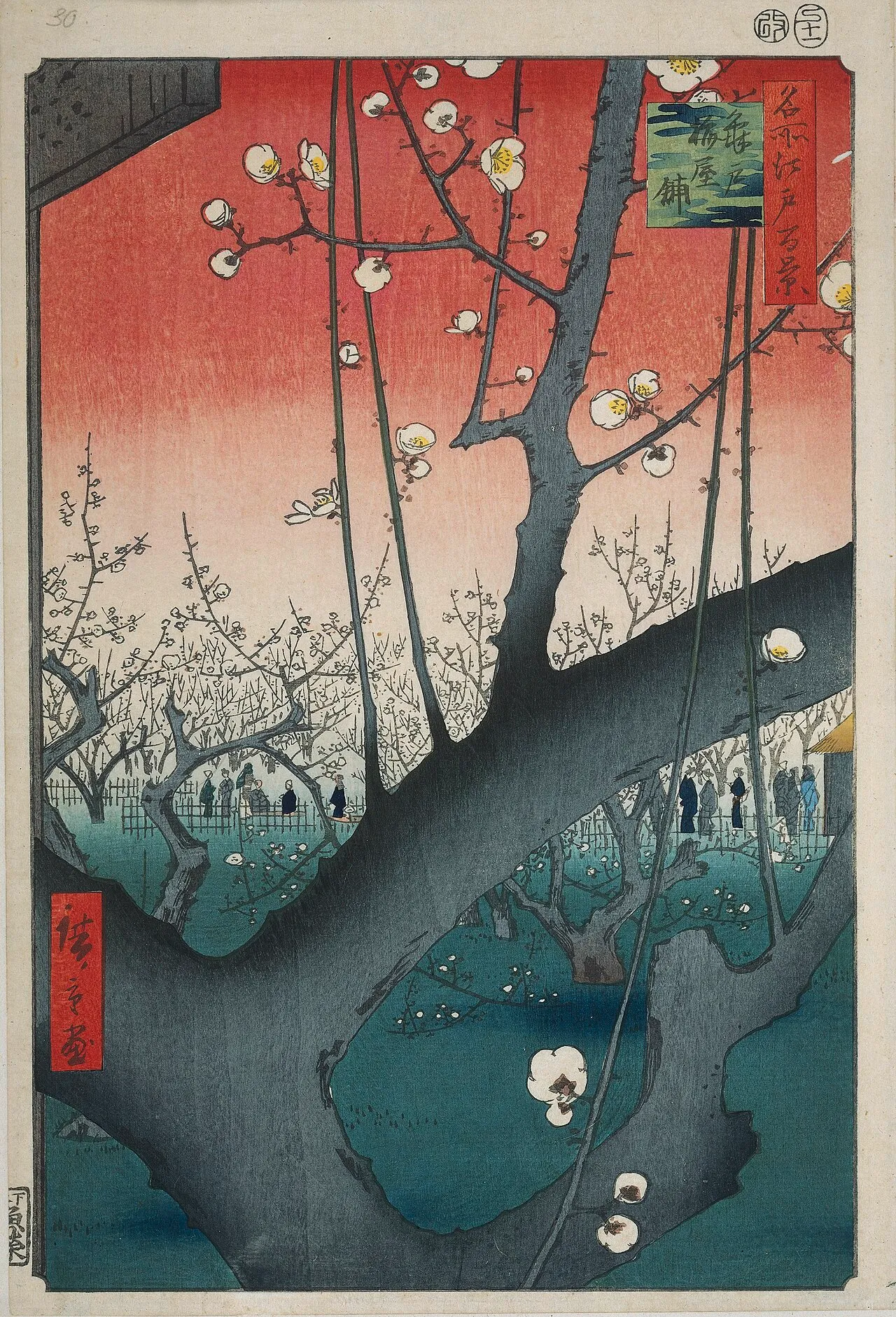
Utagawa Hiroshige, "Plum Garden at Kameido" (1857), from "One Hundred Famous Views of Edo." The bold cropping, flat colour planes, and atmospheric reduction of this image were studied closely by Van Gogh, who made two oil painting copies of Hiroshige prints. Image: Public domain, via Wikimedia Commons
How Traditional Japanese Woodblock Prints Were Made
Traditional Japanese woodblock printing was a collaborative process involving at minimum three specialists: the designer (eshi), who created the original composition; the carver (horishi), who transferred the design to the blocks; and the printer (surishi), who applied the ink and pulled each impression. Large publishers employed teams of all three and managed the entire production process from commissioning to sale.
The carver worked from a "key block" (oban), which carried the main outlines of the design. The designer's drawing was pasted face-down onto the smooth block surface and the paper was abraded away, leaving the lines visible in reverse as a guide for cutting. The carver used a range of chisels (aisuki, sankakuto) and gouges to remove everything except the lines themselves. Additional blocks were prepared for each colour, carved to carry only the ink areas for that specific colour.
Water-based inks mixed with rice paste were applied to the blocks with broad flat brushes. The printer placed hand-made washi paper, with specific absorbency characteristics, over the inked block and burnished it with a baren, a flat pad of twisted bamboo cord wrapped in a bamboo leaf sheath. The pressure transferred the ink to the paper. For a twelve-colour print, the paper passed over twelve blocks in sequence, with the kento registration marks ensuring that each colour aligned precisely with those already printed. The tolerance for error was effectively zero.
What makes this process different from Western printmaking is the water-based ink. Western woodcuts typically use oil-based inks applied with a brayer (roller), which sit on the surface of the paper. Japanese moku hanga uses water-based pigments brushed directly onto the block, which soak into the washi paper fibers. The result is a print where the colour appears to be part of the paper rather than sitting on top of it. This is why Edo-period prints retain their colour vibrancy after 200 years: the pigment penetrated the paper fibers rather than oxidizing on the surface.
Japonisme: The Western Response
Ukiyo-e prints began reaching Europe in significant quantities from the 1850s onward, initially as packaging material. Prints were used to wrap exported porcelain, and European artists discovered them when unpacking shipments. Their impact on Western art was immediate and profound. The flat colour areas without modelling, the dramatic cropping borrowed from the viewing angle of the print, the emphasis on silhouette and pattern over three-dimensional illusion: all of these were absorbed by Impressionist and Post-Impressionist painters as alternatives to the Western academic tradition.
Monet collected ukiyo-e and his garden at Giverny was directly influenced by Japanese garden design. Van Gogh made oil painting copies of two Hiroshige prints and filled his letters with references to Japanese art as a model for direct, colour-based expression. You can read more about this connection in our guide to Impressionism and our profile of Van Gogh's post-Impressionist brushwork. Toulouse-Lautrec's poster designs use flat colour and bold outline in a manner that is explicitly indebted to the ukiyo-e tradition. The influence was not merely surface-level borrowing but a genuine restructuring of how Western artists thought about pictorial space.
Contemporary Woodblock Printing: The 2025-2026 Revival
Woodblock printing is not a museum technique. In 2025 and 2026, several institutions and publishers are actively producing new work using traditional methods. The Adachi Foundation for the Preservation of Woodcut Printing, which operates the Adachi Institute, has been collaborating with contemporary artists since the early 1970s. Their "Ukiyo-e in Play" exhibition at the Tokyo National Museum (May 2025) showcased 162 prints by 85 artists, including Yayoi Kusama's "Mt. Fuji in Seven Colours" (2014). An NHK television special titled "Ukiyo-e Revolution! In Search of the Reiwa-era Sharaku" broadcast in May 2025 documented the foundation's search for a contemporary equivalent to the legendary printmaker Sharaku.
In March 2026, the Adachi Foundation presented a special exhibition celebrating the completion of new original woodcut prints by the British sculptor Antony Gormley and the American artist Kiki Smith. Both artists created their first-ever woodcut prints using a new method developed in collaboration with Adachi's master carvers and printers. The exhibition displayed the actual woodblocks used in production alongside the finished prints, offering a rare glimpse into the collaborative process between contemporary artists and traditional artisans. You can read more about this exhibition at the Adachi Foundation website.
Another major force in contemporary ukiyo-e is the UKIYO-E PROJECT, founded by Yuka Mitsui in 2014 with offices in Los Angeles and Tokyo. The project commissions traditional woodblock prints depicting contemporary subjects: rock stars, film posters, brand collaborations. Their prints have been acquired by the British Museum, the Museum of Applied Arts in Vienna (MAK), and the Miami University Libraries. In 2025, they produced a visual collaboration for the Japanese release of Mission: Impossible - Final Reckoning, and in January 2026 they released an original print commemorating the 35th anniversary of the Japanese rock band THE YELLOW MONKEY.
The MAK Vienna mounted an exhibition titled "KUNIYOSHI + | UKIYOENOW" as part of the 150th anniversary of Austrian-Japanese diplomatic relations, featuring contemporary artists Masumi Ishikawa, Megumi Oishi, and graphic designer Andrew Archer, who translate motifs from pop culture and sport into the ukiyo-e aesthetic. The exhibition posed a direct question: how far do different production forms, from traditional handicraft to digital print, affect the further development of ukiyo-e? More information is available at the MAK Vienna exhibition page.
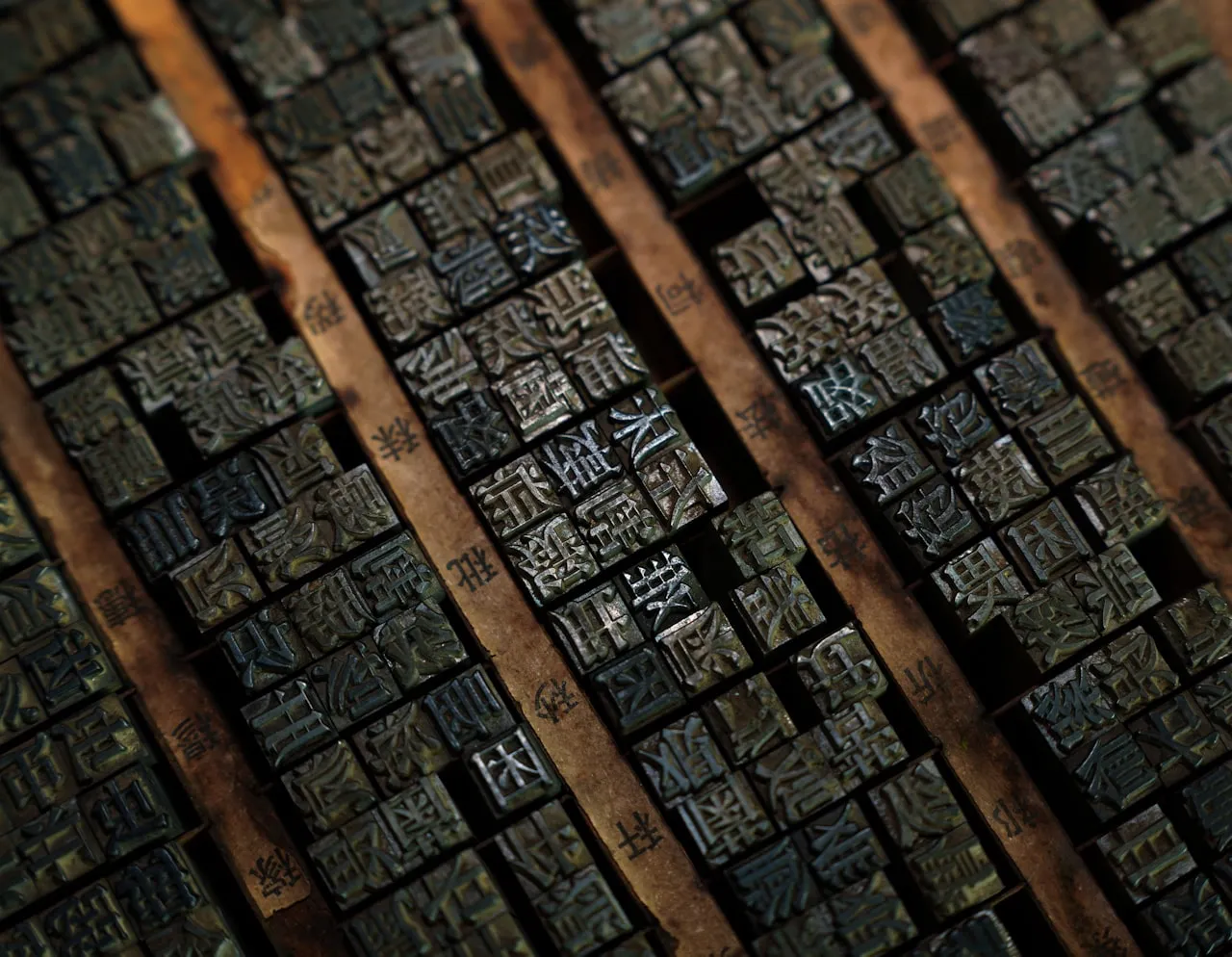
Wooden letterpress type blocks showing the relief surface structure common to all woodblock printing: the raised areas carry ink, the lowered areas do not. The same basic principle underlies everything from Tang dynasty Buddhist sutras to contemporary artists' prints. Photo: Unsplash
Western Woodblock and the Expressionist Tradition
In Europe and North America, woodblock printing as an artistic medium developed largely independently of the Japanese tradition until the two cross-pollinated in the late 19th and early 20th centuries. German Expressionism made extensive use of woodcut, exploiting its capacity for bold, rough marks and strong contrasts. Ernst Ludwig Kirchner, Emil Nolde, and the artists of Die Brucke (The Bridge) produced woodcuts that are among the most powerful prints of the early 20th century. The rough-hewn quality of woodcut suited the Expressionist rejection of academic refinement: the wood grain itself became part of the aesthetic, and the visible tool marks were left as evidence of the artist's hand rather than polished away.
Contemporary printmakers work across both traditions. Some practise traditional Japanese moku hanga techniques, using water-based inks, washi paper, and multiple blocks with extreme technical precision. Others use the more physically direct Western tradition of oil-based inks and press printing. Digital tools are increasingly integrated into the preparation stages, with designs created or refined on screen before being transferred to the block. The physical process of cutting and printing remains handmade. For a broader overview of printmaking techniques, our printmaking 101 guide places woodblock within the full range of the medium.
Getting into Woodblock Printing
Relief printing, including both woodcut and linocut (which uses linoleum rather than wood and cuts more easily, with less grain resistance), is one of the most accessible printmaking techniques for beginners. A basic relief printing setup requires only a block or sheet of linoleum, a set of linocut tools (V-gouges, U-gouges, and veiners), a brayer for rolling ink, water-based or oil-based block printing ink, and paper. The total material cost for a first session is modest, and the basic process can be learned in a single class.
Community print studios and art centres offer printmaking workshops in most cities, and many dedicated printmaking studios have open-access memberships that allow independent practice. For those drawn to the Japanese moku hanga tradition specifically, workshops and intensive courses are offered by practitioners at institutions including Crown Point Press in San Francisco, which has published editions with major contemporary artists since 1962.
For understanding the full context of Japanese art of which ukiyo-e was a part, our guide to Japanese art and the aesthetic of ma covers the broader visual culture. The Great Wave guide explores the world's most recognisable woodblock print in detail. And if you are interested in how a contemporary Japanese artist has engaged with the ukiyo-e tradition, our profile of Yayoi Kusama covers the artist whose Mount Fuji woodblock print was featured at the 2025 Tokyo National Museum exhibition.


