
Ceramics has a problem with categories. It is one of the oldest human technologies, predating agriculture, metal-working, and writing by tens of thousands of years. It is also a medium whose practitioners have included some of the most significant artists of the 20th and 21st centuries. It sits across the boundary between craft and fine art, between the functional and the purely contemplative, in a way that persistently resists tidy classification. The pottery wheel and the gallery vitrine exist in the same world, and clay moves between them with more ease than almost any other material.
Clay's refusal to stay on one side of that divide is, from one angle, exactly the point. When Grayson Perry won the Turner Prize in 2003 with his elaborately decorated ceramic pots, he was not simply crossing a boundary. He was demonstrating that the boundary had been artificial all along. The medium that produced Song dynasty porcelain and Minoan storage jars also produced Peter Voulkos's torn and punctured clay slabs and Ai Weiwei's 100 million individually crafted porcelain sunflower seeds. The range is vast, and all of it uses the same basic process: shaping clay and fixing the shape with heat. In 2025, Grayson Perry's largest solo exhibition to date, "Delusions of Grandeur" at the Wallace Collection in London, presented over 40 new works and marked a career now spanning four decades of ceramics alongside tapestry, print, and other media.
The Material: What Clay Is and Why It Behaves the Way It Does
Clay is a naturally occurring sedimentary material, primarily aluminium silicate combined with water, that becomes plastic when wet and rigid when dry. Firing at temperatures between approximately 900 and 1300 degrees Celsius drives out the chemically bonded water and fuses the particles, creating a permanent ceramic material. The specific character of the fired result, its color, texture, porosity, and sound when tapped, depends on the clay body used, the firing temperature, the kiln atmosphere, and any glazes applied.
Earthenware, fired at lower temperatures around 900 to 1150 degrees, remains porous and requires a glaze for liquid containment. It is the oldest form of fired ceramic and includes terracotta. Stoneware, fired at higher temperatures around 1200 to 1300 degrees, vitrifies partially and is typically denser, harder, and more durable. Porcelain, the refined white ceramic developed in China during the Tang dynasty (618 to 907 CE) and not successfully reproduced in Europe until 1709, requires the highest firing temperatures and produces the translucent, resonant material we associate with fine china. Each clay body has different working properties, different responses to the same glaze chemistry, and a different aesthetic register. The choice of clay is as fundamental to the character of a ceramic work as the choice of canvas and paint is to a painting.
Techniques: How Ceramics Is Made
There are three primary hand-forming techniques: pinching, coiling, and slab building. Pinching, in which the clay is shaped by pressing it between thumb and fingers, is the most direct and produces vessels with visible traces of the maker's hands. Coiling builds form by adding and blending long rolls of clay, allowing larger and more complex shapes than pinching alone. Slab building uses flat sheets of clay joined together, enabling geometric or architectural forms.
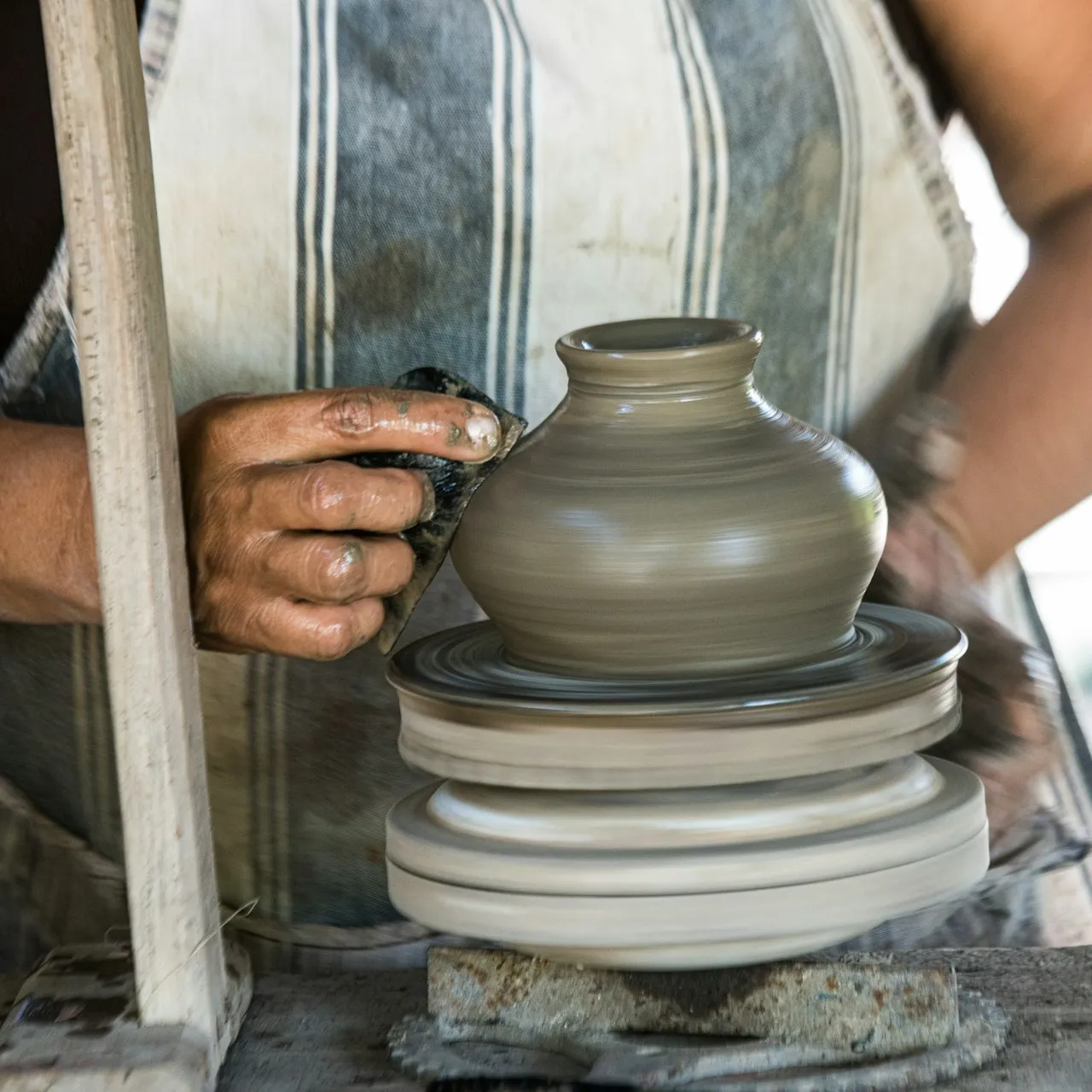
Wheel throwing, in which a ball of clay is centered on a spinning wheel and shaped by the hands while it rotates, is the technique most strongly associated with pottery in the public imagination. It is a demanding skill that requires substantial practice before consistent results emerge, but it rewards that practice with forms of precision and fluency that hand-building methods cannot match. A skilled thrower can produce a hundred identical bowls in a session, or a single vessel of extraordinary subtlety in the same time.
Casting pours liquid clay, called slip, into plaster moulds to produce forms that can be exactly replicated. Many studio potters use combinations of all these techniques within a single body of work, selecting the process that best serves the form they want to achieve.
A finished studio ceramic bowl showing the characteristic qualities of hand-thrown work: slight irregularity, tactile surface, and a glaze that responds to the form beneath it. Photo: Unsplash
Firing Traditions: Raku, Anagama, and the Kiln's Role
No other craft depends so completely on an irreversible process as ceramics. Once work enters the kiln, the maker relinquishes control. Kiln atmosphere, the stacking of the pieces, chance interactions between glazes, and unpredictable firing variations all contribute to the final result in ways that cannot be fully predicted. For many ceramicists, this is not a problem to be solved but the defining quality of the medium.
Raku firing, developed in 16th century Japan for the tea ceremony tradition, removes pieces from the kiln while they are still glowing and places them in containers with combustible materials, creating rapid and dramatic surface effects. The resulting pieces, characteristically black or with metallic lusters and crackled surfaces, are valued for their unpredictability and for the direct involvement of fire in their making. The raku tradition was introduced to Western studio pottery by Paul Soldner in the 1960s and remains widely practiced.
Anagama, or single-chamber wood-firing kilns, fire for days or weeks using split wood as fuel and produce surfaces that cannot be reproduced by other means. The fly ash from the wood, deposited on the surface of the pots during firing, creates natural glazes of extraordinary subtlety. The process requires large quantities of wood, careful kiln loading, and continuous attendance during firing. The resulting pieces carry unmistakable evidence of their making, scarred and enriched by fire in ways that electric kiln work never achieves.
Bernard Leach and the Studio Pottery Tradition
The modern studio pottery tradition in the English-speaking world traces its origins largely to Bernard Leach (1887 to 1979), an English potter who trained in Japan, studied under the Living National Treasure Kenzan VI, and returned to Britain in 1920 to establish the Leach Pottery in St Ives, Cornwall. Leach's synthesis of East Asian and European pottery traditions, his insistence on the value of functional ware as the highest expression of the potter's art, and his influential writings, particularly "A Potter's Book" (1940), shaped studio pottery practice for decades.
His collaborator Shoji Hamada (1894 to 1978) co-founded the Leach Pottery and eventually returned to Japan to become a Living National Treasure himself. Together, and separately, they established a standard for studio pottery that combined formal simplicity, respect for materials, and a philosophy of making rooted in both craft tradition and personal expression.
Lucie Rie (1902 to 1995) and Hans Coper (1920 to 1981), both refugees who came to Britain before and during the Second World War, developed in quite different directions from Leach's influence. Their work engaged with modernist form and surface in ways that pushed studio pottery toward sculpture. Both are now in major international collections and command significant auction prices. Rie's bowls in particular, with their thin walls and subtly varied glazes, are among the most formally refined objects in 20th century British art.
From Studio to Gallery: The 20th and 21st Century Shift
The shift of ceramics from craft studio to art gallery was gradual and is still not entirely complete. Peter Voulkos (1924 to 2002) in California, from the mid-1950s onward, made large-scale ceramic sculpture that drew on Abstract Expressionist painting's energy and improvisation rather than on pottery tradition, decisively repositioning clay within the art world conversation. His students at the Otis Art Institute, and later at UC Berkeley, included many of the figures who would define American ceramic art in the following decades.
By 2026, the gallery world's engagement with ceramics is broader than at any previous point. Magdalene Odundo, the Kenyan-born British ceramicist whose burnished terracotta vessels combine ancient African, pre-Columbian, and Greek references into something wholly original, has had major solo exhibitions at Houghton Hall, the Gardiner Museum in Toronto, and elsewhere. Her work commands prices equivalent to significant paintings, and at 75 her star, as Artnet noted in 2025, is still ascending. Ken Price's painted biomorphic sculptures are in museum collections alongside work by painters of equivalent stature. Theaster Gates uses ceramic and architectural salvage as the material basis for large-scale social practice work. Ceramics is, without question, part of the contemporary art conversation.
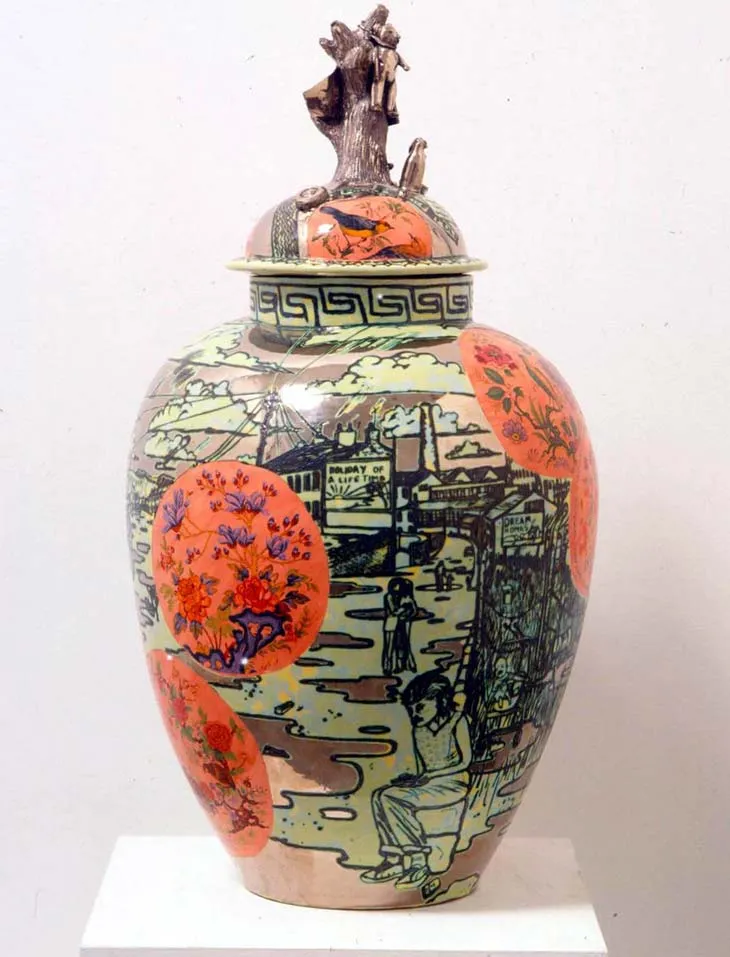
Grayson Perry, "Barbaric Splendour" (2003), one of the works from the Turner Prize-winning body of work that brought ceramics into the mainstream fine art conversation. Perry's vessels combine traditional thrown forms with layers of narrative imagery, text, and cultural commentary. Image: via a-n.co.uk
Grayson Perry and the Turner Prize Moment
When Grayson Perry collected the Turner Prize in 2003 dressed in a pink frock as his alter ego "Claire," the moment was widely covered. The clothing made excellent copy. The work underneath the headlines was serious: tall, classical vessel forms covered in densely layered decoration that combined traditional ceramic motifs with contemporary imagery of class, sexuality, identity, and popular culture. The pots were simultaneously beautiful and deeply strange, and they were undeniably ceramics.
Perry's win was significant not because it introduced something new to fine art, ceramicists had been making gallery-level work for decades, but because it created a public moment that was impossible to ignore. After 2003, the question of whether ceramics could be fine art became significantly harder to ask with a straight face. The medium did not change. The gatekeeping shifted.
Perry has continued to work prolifically. His 2025 Wallace Collection exhibition "Delusions of Grandeur" was described by the gallery as the largest contemporary exhibition it had ever held, and it presented ceramics alongside tapestries, bronzes, and works on paper that together interrogated perfectionism, authenticity, and the role of the artist in an age of digital production. Perry calls himself "a conceptual artist masquerading as a craftsman." The ceramics are where the masquerade and the substance are hardest to separate. For how objects of all kinds enter the market, see the art fairs guide. The companion piece on embroidery as fine art explores another craft that has made a similar journey from domestic setting to gallery walls.
Getting Into Ceramics
Clay is one of the most beginner-friendly materials in the arts. Community studios and pottery classes exist in virtually every city, and a few sessions on the wheel or with hand-building tools will produce objects that are recognizably the result of your specific choices. The learning curve is long, the improvements are constant and visible, and the medium keeps offering new technical and expressive territory no matter how long you work in it.
For collectors, the contemporary studio pottery market is large and accessible. There are ceramics fairs, dedicated gallery spaces, and direct-from-maker purchasing through studios and social media. Many serious collectors began by buying from a maker at a small fair, responding to the physical presence of a single piece, and built from there. Museum collections worth visiting include the Leach Pottery and museum in St Ives, the ceramic holdings at the Victoria and Albert Museum, the Sèvres porcelain collection outside Paris, and the extraordinary East Asian ceramic holdings at the British Museum, the Metropolitan Museum of Art, and the Asian Art Museum in San Francisco. Each offers a different window into a material history that spans more than twenty thousand years.


