
Erik Demaine, a professor of computer science at MIT and a practicing visual artist, makes sculptures from single sheets of paper that he has never once cut. He folds them, along curved lines, using techniques he helped develop mathematically, into three-dimensional forms that fold theory says are possible but that no one had previously figured out how to construct. Some of these pieces have been collected by the Museum of Modern Art. Demaine works at the intersection of computational geometry and visual art, and he would not exist as an artist without paper.
This is the range of what paper is capable of, from grocery lists to permanent MoMA collections, and it is easy to miss because the material is so familiar. Paper can be folded into three-dimensional form without any cutting or adhesive, cut into lace-like structures of extraordinary delicacy, layered into sculptural mass, or used as the ground for drawing, printing, and mark-making of every kind. The discipline of paper art spans Japanese origami and Chinese jianzhi papercut traditions, 18th-century European scherenschnitte, contemporary mathematical paper sculpture, and large-scale installation work using industrial paper at architectural scale. Each of these traditions has its own technical logic and its own aesthetic history.
In this guide, you will learn the material history of paper as an art medium, the major traditions of paper folding and cutting, the key contemporary artists working with paper seriously, and how to get started if you want to explore the medium yourself.
Paper: Material History
Paper was invented in China. The earliest surviving examples date to around 100 BCE during the Western Han dynasty. The papermaker Cai Lun, active around 105 CE, is traditionally credited with refining the process using bark, rags, and hemp waste. From China, papermaking spread to Korea by the 6th century CE, to Japan by the 7th century, to the Arab world in the 8th century (following the Battle of Talas in 751 CE, where Arab forces captured Chinese papermakers), and to Europe through Islamic Spain and Sicily by the 12th century.
The specific material properties of paper are not incidental to its artistic uses. Japanese washi, made from the inner bark of mulberry, gampi, or mitsumata plants, is selected for origami and traditional printmaking because of its exceptional tensile strength (it can withstand hundreds of folds without tearing), its slight translucency, and its consistent surface. Contemporary origami artists working with complex designs requiring five hundred or more folds choose their paper with the same care that a painter chooses canvas. The paper is not just a substrate. It is part of the medium.
Origami: Folding Without Cutting
Origami takes its name from the Japanese ori (folding) and kami (paper). The practice is simple in definition: transform a flat sheet of paper into a three-dimensional form through folding alone, without cutting or adhesive. Every part of the original sheet must be present in the finished piece. This constraint, which sounds limiting, turns out to be generative. It means that the design of any origami model is really a question about the geometry of the flat sheet: how can this particular set of fold lines transform this flat material into that specific three-dimensional structure?
The modern artistic form of origami was largely codified by Akira Yoshizawa (1911-2005), who developed the universal diagramming system of dotted and dashed lines still used today, and who elevated the practice from a children's craft into a recognized art form. Yoshizawa created over 50,000 origami models in his lifetime and received Japan's Order of the Rising Sun for his contributions to Japanese culture. His wet-folding technique, which involves dampening the paper slightly to allow it to hold curves that dry folding cannot produce, opened up organic, flowing forms that the medium had previously been unable to make.
The computational turn in origami began in earnest in the 1990s. Robert Lang, an American physicist and origami artist, developed the software TreeMaker, which calculates the crease pattern required to produce any origami base from a stick-figure skeleton drawing. This made possible designs of previously unachievable complexity. Lang's work and the wider field of computational origami has been applied to engineering problems including the folding of solar panels for spacecraft and the design of deployable medical devices.
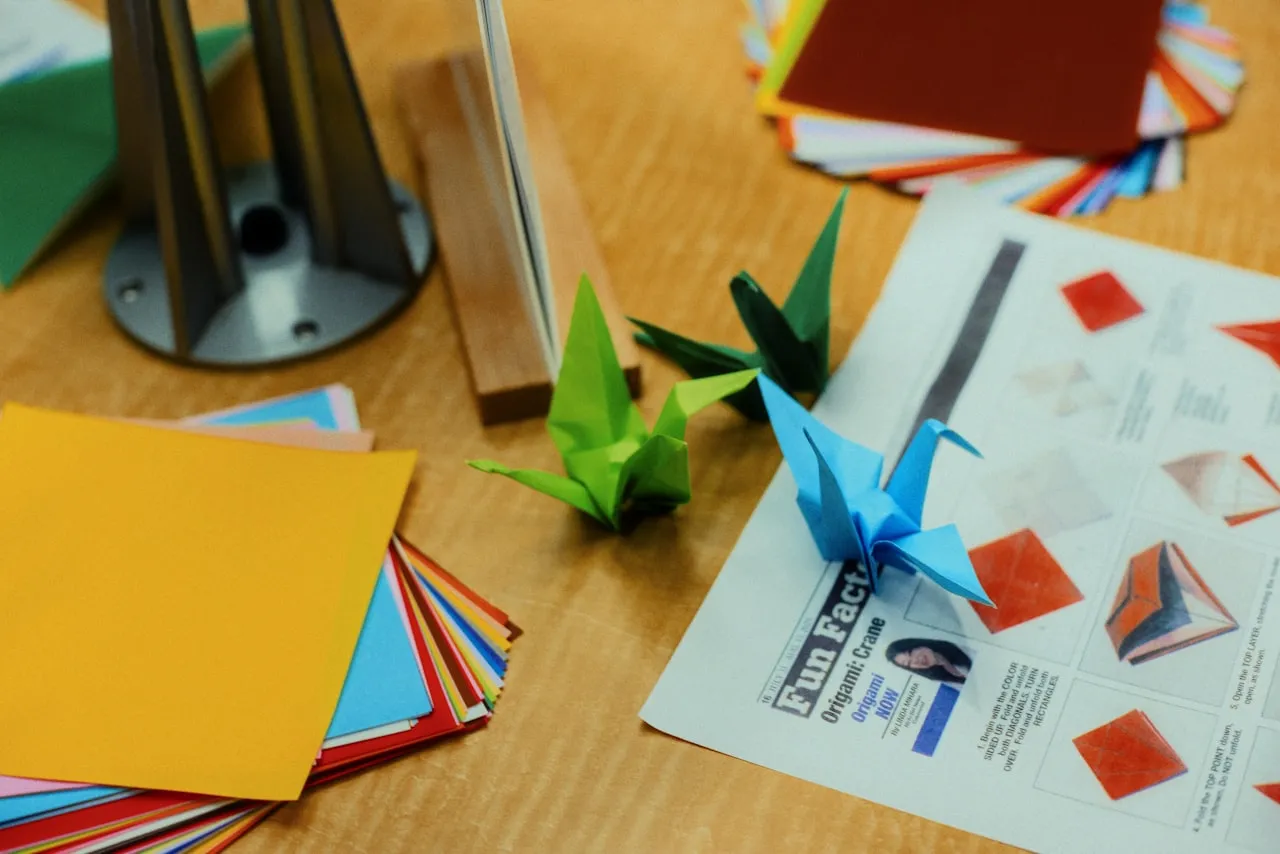
Origami cranes folded from coloured paper. The crane (tsuru) is the most widely recognized origami form, associated in Japanese tradition with longevity and good fortune. The legend of the thousand cranes (senbazuru) holds that folding one thousand cranes grants a wish. Photo: Unsplash
Papercutting: What Removal Reveals
Papercutting works on the opposite principle from origami. Where folding keeps every part of the sheet, cutting removes material to create design through the contrast of presence and absence, paper and air, solid and void. The design emerges from what is taken away.
Chinese jianzhi, or scissor art, is one of the oldest continuous papercutting traditions, with origins in the 4th century CE. Traditional jianzhi uses red paper and depicts auspicious symbols, animals, flowers, and figures associated with festivals and good fortune. The images are cut by hand with scissors, without drawn guidelines, by practitioners who have developed the spatial understanding of positive and negative pattern through years of practice. Contemporary jianzhi artists cut fine mesh-like patterns that push the material close to the limits of what it can sustain without tearing.
European scherenschnitte (German for "scissor cuts") developed independently in the 17th and 18th centuries, particularly in Swiss and German folk art traditions. Jewish cut-paper mizrahim, decorative wall pieces for synagogues, and Polish wycinanki, folk papercuts using stacked layers of brightly colored paper, represent further distinct traditions with their own characteristic imagery and technique.
Contemporary Western artists working with papercut include Bovey Lee, whose large-scale intricate scenes cut from rice paper reference traditional Chinese techniques; and Kara Walker, whose large paper-cut silhouettes address the history of American slavery with a directness and formal power that makes the genteel associations of the silhouette tradition deliberately uncomfortable. Walker's work appears in the art and protest guide in the context of how artists have used formally accessible means to address politically charged content.
Paper Sculpture: Three Dimensions
Paper sculpture moves beyond the flat sheet into three-dimensional form through folding, scoring, layering, and cutting. The range is wide. At one end, Calvin Nicholls, a Canadian artist, builds layered paper reliefs of birds and animals by cutting individual paper elements and attaching them in sequence, building up the surface layer by layer to produce three-dimensional forms of considerable precision. Peter Callesen creates pieces in which a figure or scene appears to emerge from a flat A4 sheet, standing up from the cutout it left behind: the three-dimensional form and the flat sheet it came from remain physically connected, making the relationship between the two inseparable.
Noriko Ambe cuts single sheets of paper in concentric irregular rings, then slightly shifts each ring relative to the one below it to create forms that look like topographic maps made physical. The method treats the surface of the flat sheet as a territory to be mapped in three dimensions. Each of these practices treats paper not as a substrate for other media but as the sole material of the finished work.
Paper in Installation
At architectural scale, paper has been used as a primary structural material in installation art. Tara Donovan's large accumulative installations use everyday materials in vast quantities to create surfaces that read as natural formations. Her paper plate accumulations build up into surfaces that look like geological strata or living tissue at a distance. The individual material is legible at close range; the overall effect requires distance.
The Japanese artist Chiharu Shiota, best known for her immersive wool thread environments, used burned paper in earlier work in ways that treated the material's vulnerability as its subject. Paper burns, tears, and decays in ways that stone, metal, and glass do not. Artists who work with paper's fragility are making work about impermanence from a material that embodies impermanence.
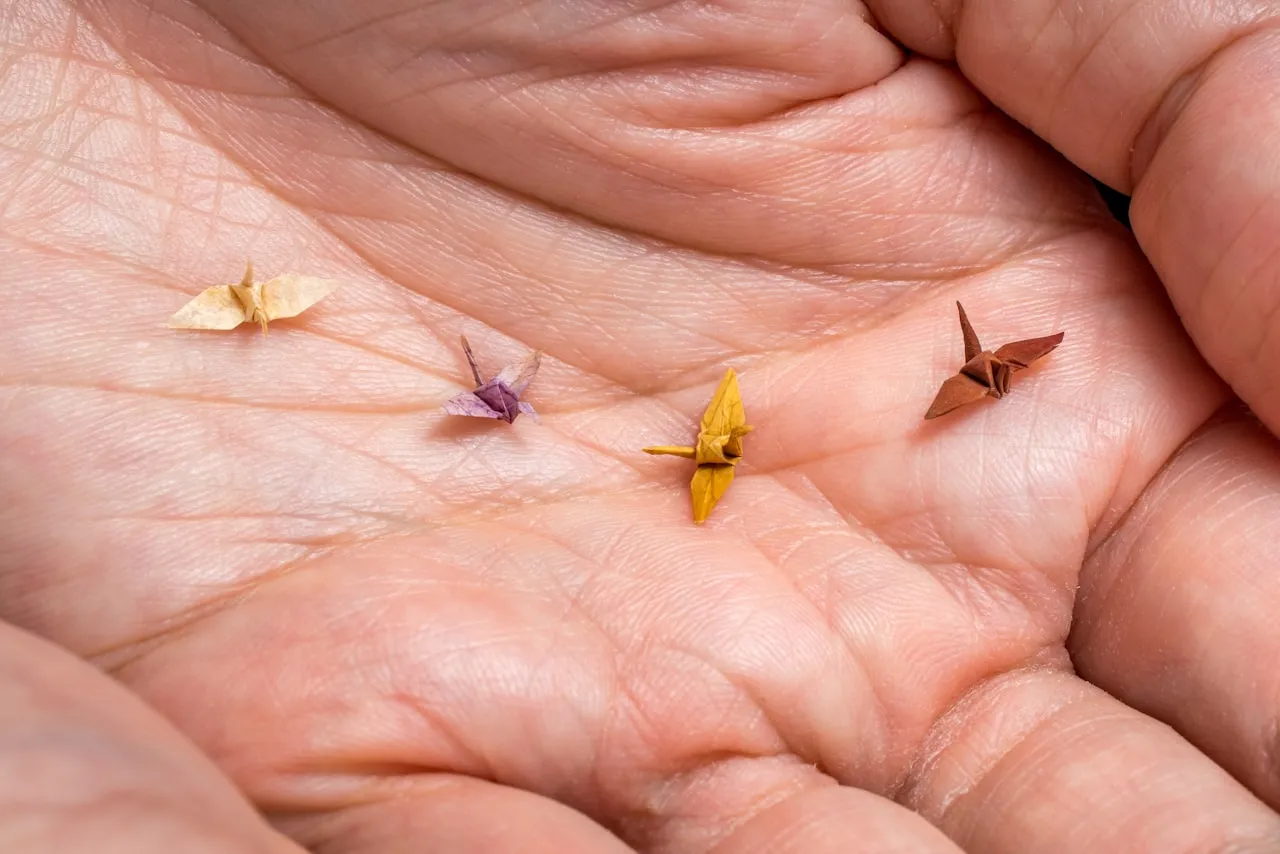
Cut paper detail showing the structural pattern achievable through papercutting. The contrast between the solid paper and the cut-through areas creates design entirely through presence and absence. Photo: Unsplash
Getting Started With Paper Art
Paper is the most accessible of all art materials. Origami requires nothing but a square sheet and a diagram. The British Origami Society provides free instruction from the most basic folds through to advanced complex models, and their resources are available online without charge. Basic papercutting requires a self-healing cutting mat, a sharp craft knife (replaced often), and patience. The only cost is time.
For more advanced work, workshops in origami, papercutting, and paper sculpture are offered by community arts centers and craft organizations worldwide. The Paper and Book Intensive in the United States runs annual workshops across the full range of paper and book arts disciplines. The London Centre for Book Arts offers paper-making alongside bookbinding instruction.
Paper art connects directly to printmaking, where the choice of paper is a fundamental artistic decision. The woodblock printing guide covers the Japanese paper tradition in the printmaking context. The installation art guide shows how artists have extended paper and other everyday materials to the scale of entire rooms. What paper art have you tried? Share in the comments below.


