When Louis Daguerre unveiled the daguerreotype in 1839, the French painter Paul Delaroche reportedly declared that painting was dead. He was wrong about painting, but the anxiety behind the remark was real and would shape the next hundred years of art history. Photography could do something that painting had always struggled with: record the visual world with mechanical precision, in minutes rather than days, with no requirement for the kind of specialized manual training that painters spent a decade acquiring. For the first fifty years of photography's existence, this created an uncomfortable question that critics and institutions refused to answer: if a machine makes the picture, can it be art?
That question has been answered, conclusively, by more than a century of museum practice, critical writing, and market behavior. A print by Cindy Sherman or Andreas Gursky commands the same auction prices and museum walls as paintings by their contemporaries. But the process by which photography earned that position is itself a significant chapter in art history. Understanding it changes how you look at any photograph, whether framed in a gallery or on your phone screen.
This post traces photography's struggle for recognition as fine art, the movements and individuals who drove that campaign, and what the debate still reveals about how we define art today.
The First Fifty Years: Tool or Rival?
The earliest photographs were classified as scientific curiosities, not artworks. Daguerre's 1839 images of Paris boulevards and William Henry Fox Talbot's photogenic drawings from English gardens were technically astonishing, but nobody placed them alongside paintings. Artists adopted the camera and calotype almost immediately as practical tools: reference images for portrait compositions, substitutes for expensive sketch trips, aids for capturing architectural detail. Photography's institutional position was clear: a servant to art, not an equal.
Major art academies and salons in Paris, London, and New York excluded photographs from annual exhibitions. They showed instead at photographic society events, industrial fairs, and science exhibitions. The boundary between "art" and "technology" was enforced by exactly the institutions that had the power to enforce it.
Some photographers pushed back through practice rather than argument. Oscar Gustave Rejlander (1813-1875) created elaborate combination prints assembled from multiple negatives, explicitly adopting the subject matter and compositional conventions of academic painting. His "Two Ways of Life" (1857), a large allegorical composition constructed from over thirty separate negatives, was exhibited at the Manchester Art Treasures Exhibition alongside paintings. Queen Victoria purchased a copy. Rejlander was demonstrating that photography could achieve what painting achieved: deliberate, composed, meaningful imagery. The institutional gatekeepers were not yet convinced, but the argument had been made.
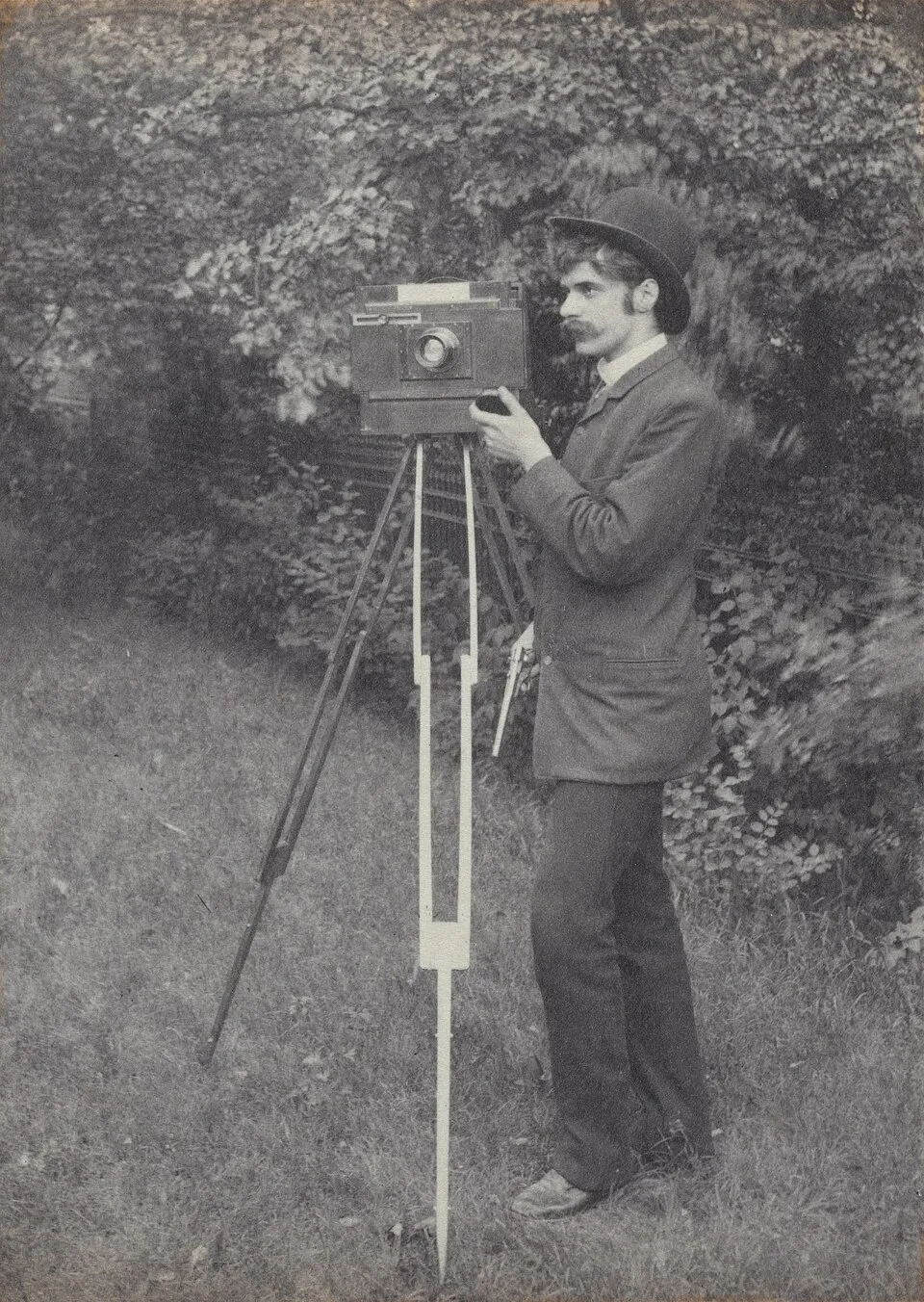
Alfred Stieglitz, "Self-Portrait, Freienwald" (1886). At age 22, Stieglitz was already treating the camera as an artist's instrument. He became the most influential advocate for photography's recognition as fine art in the Western world. Image: Public domain, via Wikimedia Commons
Pictorialism: Making Photographs Look Like Paintings
The most organized campaign for photography's acceptance as fine art was Pictorialism, the dominant movement in artistic photography from roughly 1885 to 1915. Pictorialists believed photography's problem was visual: it looked too sharp, too mechanical, too different from the hand-made surfaces of painting and drawing. Their solution was to make photographs look less like photographs.
They used soft-focus lenses, textured printing papers, platinum and gum bichromate chemistry, and substantial darkroom manipulation that allowed them to paint over, scratch into, and otherwise alter the photographic surface by hand. The results were often beautiful: misty landscapes, atmospheric portraits, and allegorical figure compositions with a painterly quality that made their photographic origin nearly invisible. Robert Demachy in France and George Davison in England produced prints that many contemporary viewers could not immediately identify as photographs.
Peter Henry Emerson (1856-1936) proposed a different path before Pictorialism reached its peak. His 1889 book "Naturalistic Photography for Students of the Art" argued that photography's artistic possibilities lay in capturing what the human eye actually sees, not in imitating painting. The eye does not see everything in focus simultaneously; it locks onto a focal point while the periphery softens. Photography could capture this selective quality with an honesty that painting could not match. Emerson later partially walked back this position, but his argument for photography's own visual language rather than its ability to mimic other media was correct, and Stieglitz was listening.
Alfred Stieglitz and the Gallery That Changed Everything
Alfred Stieglitz (1864-1946) is the central figure in photography's transformation from craft to fine art in America. He started as a Pictorialist, winning prizes and editing Camera Notes and then Camera Work, the most influential photography publication of its era. But Stieglitz gradually shifted from Pictorialism's soft-focus painting imitation toward what he called "straight photography": sharp, unmanipulated images that embraced the camera's mechanical precision rather than hiding it.
"The Steerage" (1907) is the image most often cited as his turning point. Looking down from the first-class deck of a transatlantic ship at the steerage passengers below, Stieglitz saw a visual arrangement of geometric forms: a gangway, circular funnels, the diagonal of a mast, and the crowd of working-class passengers below. He photographed it without any manipulation. The result is a purely photographic image. Nothing it contains could have been achieved by painting, because its specific arrangement of forms existed for a fraction of a second and belonged entirely to the camera's capacity to capture a moment.
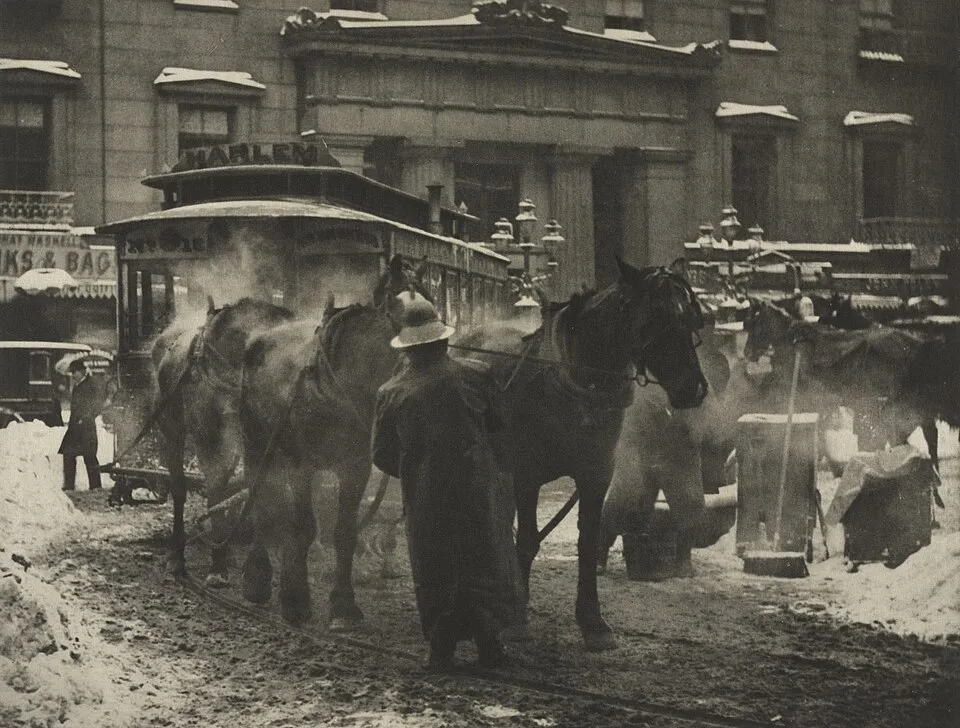
Alfred Stieglitz, "The Terminal" (1892), photogravure. Made in difficult winter conditions in New York, this early street photograph shows Stieglitz's commitment to the directness that would eventually define straight photography. Image: Public domain, via Wikimedia Commons
Stieglitz's "291" gallery at 291 Fifth Avenue in New York, which he ran with Edward Steichen from 1905 to 1917, was decisive. He placed photographs by Stieglitz and Steichen in rooms alongside paintings by Cézanne, Matisse, Picasso, and Rodin, presented with equal seriousness and equal wall space. The act was its own argument: photographs and paintings in the same room, treated as equivalent objects of aesthetic attention. According to the Metropolitan Museum of Art's documentation of Stieglitz's influence, the gallery introduced many Americans to European modernism while simultaneously establishing photography as part of that same cultural conversation.
The f/64 Group: Celebrating What Photography Does Best
Stieglitz's advocacy for straight photography was developed further by the next generation, particularly in California. The f/64 Group, founded in 1932 by Ansel Adams, Edward Weston, Imogen Cunningham, and several others, named itself after the smallest aperture setting on a large-format view camera, which produces the sharpest possible image with the greatest depth of field. The name was a manifesto: they were celebrating photographic sharpness rather than apologizing for it.
Edward Weston's close-up studies of halved peppers, nautilus shells, and sand dunes used the camera's capacity for intense resolution to reveal visual structures invisible to the naked eye. A photograph of a pepper by Weston is not a document of a pepper. It is an image of form, shadow, and organic geometry that happens to originate from a vegetable. The subject provides the occasion; what the camera sees provides the art.
Ansel Adams extended this aesthetic to the landscapes of the American West. His Zone System, a method for precisely relating the tones of a scene to the exposure and darkroom processing of a print, gave him control over tonal range that allowed prints of extraordinary clarity and depth. Adams's work is covered in detail in our guide to Ansel Adams and the Zone System.
How Museums Made the Argument Official
Institutional recognition arrived through museums. MoMA opened its Department of Photography in 1940 under Beaumont Newhall, the first dedicated photography department in any major American museum. Edward Steichen took over in 1947 and in 1955 organized "The Family of Man," assembling 503 photographs by 273 photographers from 68 countries into a statement about shared human experience. Nine million people saw it on its worldwide tour. It remains the most attended photography exhibition ever held, according to MoMA's own records.
The critical writing that followed sealed photography's intellectual status. John Szarkowski, MoMA's photography director from 1962 to 1991, wrote and curated with a precision and intelligence that established photography as a subject for serious aesthetic analysis. Susan Sontag's "On Photography" (1977) and Roland Barthes's "Camera Lucida" (1980) provided the philosophical frameworks that critics and curators still use today. By the late 20th century, photography was fully integrated into the auction market, with prints by Adams, Sherman, and Andreas Gursky reaching millions of dollars.
Why This History Still Matters
The same questions raised about photography in 1850 were raised about cinema in 1895, video art in the 1960s, and AI-generated imagery today. The debate about whether photography was art generated a century of argument about what art actually is, what skill means, and what distinguishes a meaningful image from a document. Understanding how photography won its argument provides a working model for thinking about every new image-making technology. The question is never whether the tool is capable of producing art. It is whether the person using it brings intention, a distinct way of seeing, and the skill to translate that vision into a made object.
For a parallel history of moving images going through the same process, our guide to video art's history covers how film and video earned their place. And for the tools to look at any photograph as a viewer rather than a consumer, our guide to how to look at art applies directly to photographs as much as to paintings.
Final Thoughts
Photography earned its place in art history not by becoming more like painting, but by discovering what only it could do: capture a specific moment in a specific light with a specific geometry that no human hand could replicate. From Stieglitz's winter streets to Cartier-Bresson's decisive moments to Sherman's conceptual self-portraits, the camera in the hands of an artist with a clear vision is as capable as any brush.
The next time you stand in front of a photograph in a museum, give it the time you would give a painting. Consider the decision to be in this place at this moment, to frame the image this way, to wait for this light. That chain of decisions is the art. The camera only fires when the photographer judges the moment has arrived.


