In December 1863, a 48-year-old woman received a camera as a gift from her daughter. She had no training in photography. Within months, she was producing portrait photographs that had no precedent in the medium's 24-year history. She worked in a converted henhouse on the Isle of Wight, using large glass plates and wet collodion chemistry that required long exposures and intense natural light. Her subjects included Charles Darwin, Alfred Lord Tennyson, and the astronomer John Herschel. Her portraits were deliberately out of focus, a decision that critics called a technical deficiency and that she called an artistic choice. Her name was Julia Margaret Cameron, and she was the first photographer to treat portraiture as psychological interpretation rather than visual record.
The gap between a portrait photograph that accurately describes how someone looks and one that communicates who they are is the territory that portrait photography as art occupies. The best portrait photographers have been navigating that gap for 160 years, and the history of how they have done it is a history of changing ideas about identity, social status, and what a face can reveal.
Julia Margaret Cameron: The Deliberate Blur
Cameron (1815-1879) received her camera at age 48 and within a year was making portraits that the photographic establishment did not know what to do with. Sharp detail and technical precision were the established values of 1860s portrait photography. Cameron rejected both. She used close-up framing, dramatic natural side-lighting, and intentional soft focus to create portraits that emphasized psychological character over physical exactitude. Her portraits of Herschel, with his wild white hair caught in raking light against a dark background, look more like paintings by Rembrandt than like photographs by her contemporaries.
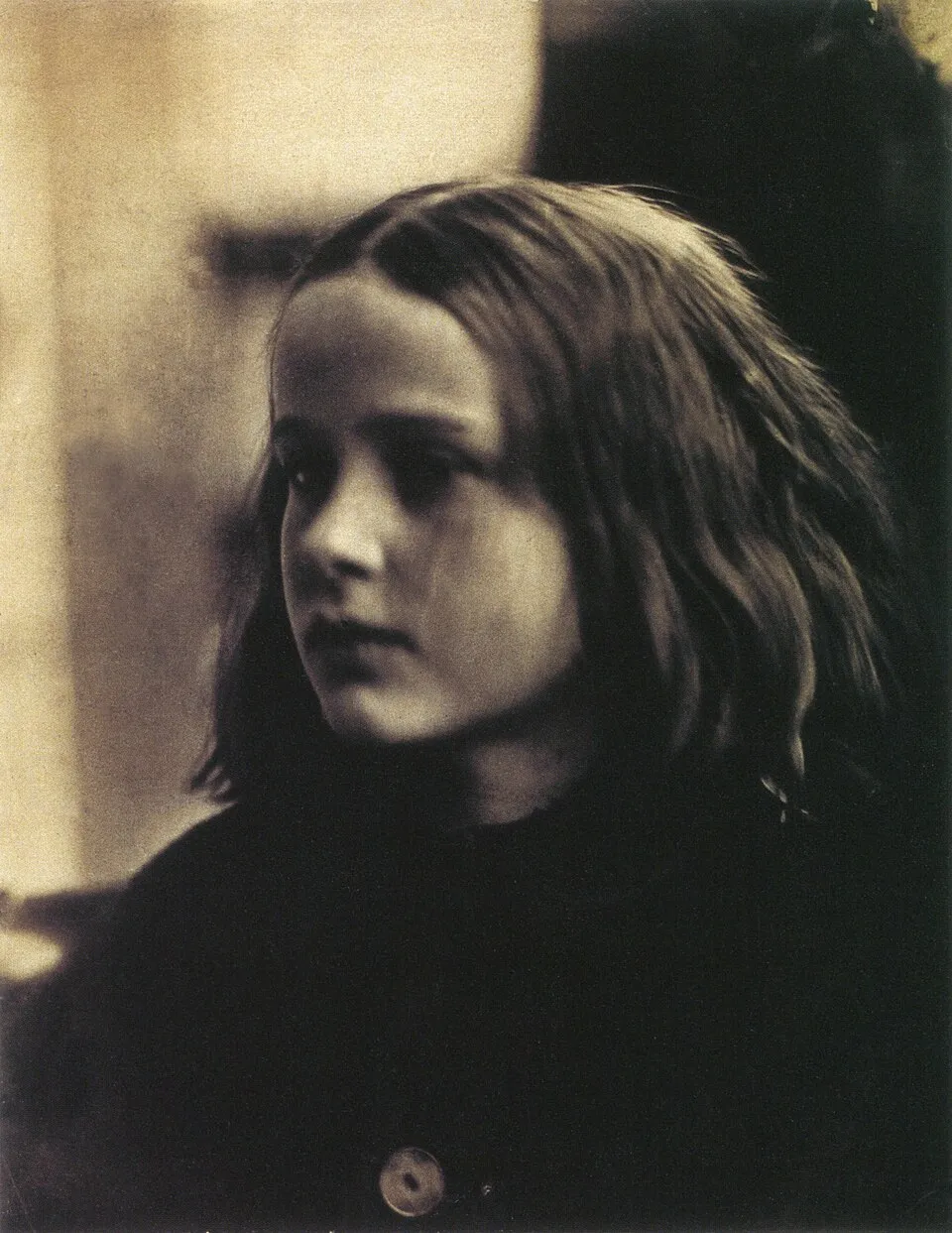
Julia Margaret Cameron, "Annie, My First Success" (1864), albumen print. Cameron considered this her first successful portrait, made in January 1864 shortly after receiving her camera. The soft focus and dramatic close-up framing she developed would influence portrait photography for generations. Image: Public domain, via Wikimedia Commons
The photographic society of her time rejected her work. The Photographic Society of Scotland returned her submissions, calling them "sloppy" and "amateurish." Cameron responded by exhibiting at the South Kensington Museum (now the Victoria and Albert Museum) directly, bypassing the photographic establishment entirely. The V&A's archive of Cameron's work documents how she insisted on the artistic status of her photographs at a time when the medium was still widely considered a mechanical process. History has sided with her. Her portraits are now held by the Metropolitan Museum of Art, the V&A, and the J. Paul Getty Museum, and they are recognized as among the finest portraits in any medium of the Victorian era.
Nadar: The First Celebrity Portraitist
Gaspard-Felix Tournachon, known professionally as Nadar (1820-1910), was the first photographer to make celebrity portraiture into a form of cultural documentation. His Paris studio on the Boulevard des Capucines became, in the 1850s and 1860s, the place where the leading figures of French cultural life came to be photographed: Baudelaire, Delacroix, Daumier, Sarah Bernhardt, Gustave Dore, and dozens of others.
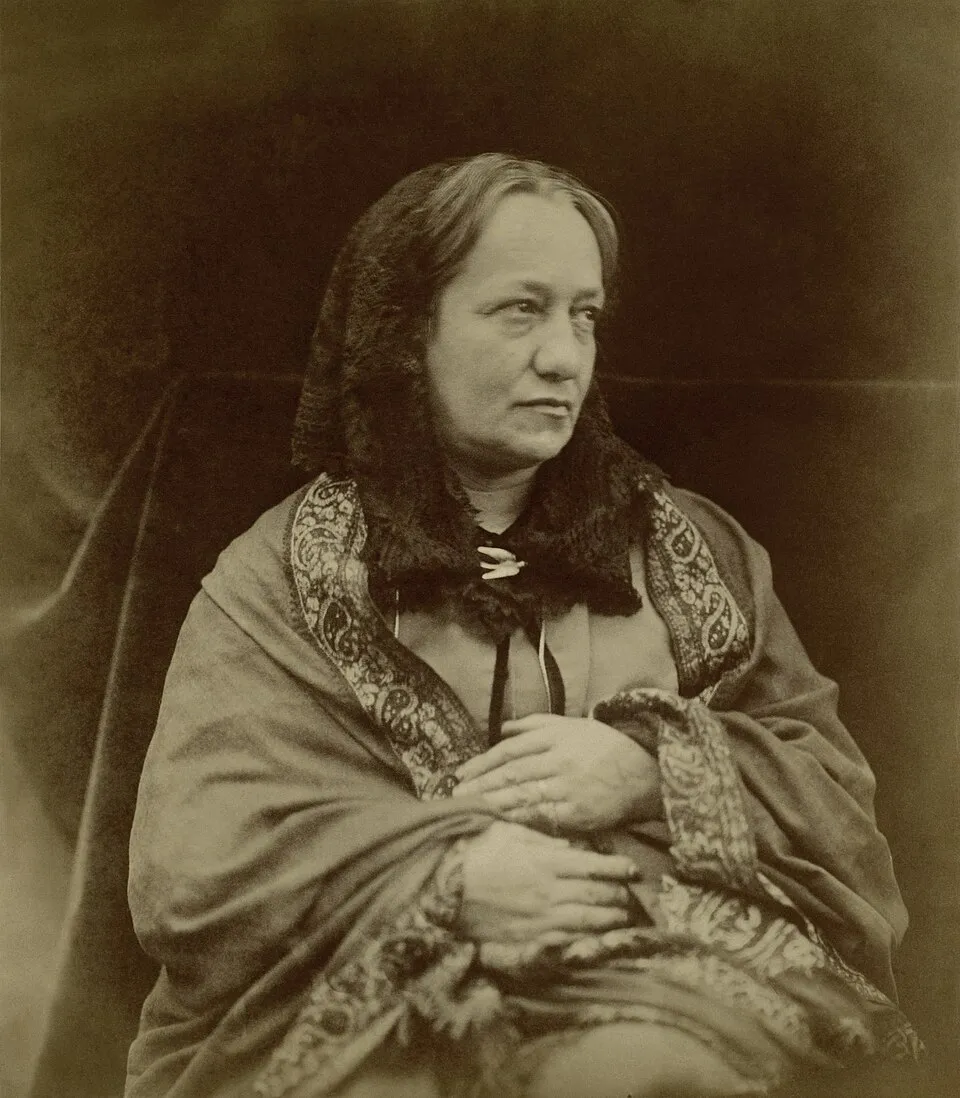
Portrait of Julia Margaret Cameron (c. 1870). We have a photographic record of Cameron's own appearance from the period of her most active work, which helps contextualize her practice within the social world of Victorian intellectual and artistic life. Image: Public domain, via Wikimedia Commons
Nadar's portraits share a quality of individual attention that most of his contemporaries did not achieve. Each subject appears observed rather than positioned. He was known for engaging his subjects in conversation during sittings, preferring to photograph them when they were mentally present rather than formally posed. His portrait of Charles Baudelaire shows a slight figure with a fixed, intelligent, slightly mocking gaze. It is as revealing a likeness as any written description of Baudelaire by his contemporaries. Nadar understood that a portrait's function was not to record appearance but to communicate personality.
He also pioneered photography outside the studio. He made aerial photographs from a balloon in 1858, the first in history, and photographed the Paris catacombs using artificial light in 1861. The same curiosity about what photography could do that produced his celebrity portraits drove him continuously toward new technical territory.
The 20th Century: From Dignity to Confrontation
The dominant tradition of early 20th-century portrait photography maintained the formal, dignified approach of Victorian portraiture: even lighting, dignified poses, flattering processing. Yousuf Karsh, working in Ottawa from the 1930s through the 1990s, was the master of this tradition. His 1941 portrait of Winston Churchill is the best-known political portrait of the 20th century. Karsh achieved Churchill's characteristic scowl by snatching the cigar from Churchill's mouth just before pressing the shutter. The technique was theatrical, but the result is a portrait that communicates Churchill's combative personality more directly than any photograph taken with his cooperation would have.
Richard Avedon (1923-2004) is the figure who most decisively shifted American portrait photography from flattery toward interrogation. His fashion work for Harper's Bazaar and Vogue established him as the defining image-maker of mid-century glamour. But his personal portrait projects pursued something entirely different. "In the American West" (1979-1984) was a series of large-format portraits made in shadowless outdoor light against a white background, with subjects from small-town and rural Western America: coal miners, drifters, day laborers, rodeo riders, slaughterhouse workers. Avedon photographed them with the same formal intensity he brought to celebrities.
The white background eliminated all social context. There was no living room, no workplace, no clothing that located the subject in a class or profession. Just the face and body, in flat light, at close range. The result was simultaneously democratic and ruthless. A coal miner and a movie star received identical visual treatment. The differences that emerged were differences of face, posture, and the accumulated physical record of a life. According to the Amon Carter Museum's documentation of the project, Avedon traveled to 17 states and photographed 752 subjects over five years, selecting 125 for the final exhibition and book.
Contemporary Portrait Photography
Contemporary portrait photography operates across an enormous range. Platon's close-up celebrity portraits, shot at extreme proximity with a wide-angle lens, make the face fill the frame so completely that the viewer cannot avoid direct engagement. Cindy Sherman's conceptual self-portraiture uses makeup, costumes, and staged scenarios to investigate how identity is constructed through visual codes. Dawoud Bey's community-based portraits collaborate with subjects to create images that address the relationship between photographer, subject, and viewer. His later work uses large-format Polaroid materials to create multi-panel portraits that fragment the face across several frames, challenging the idea that a single image can capture a person.
The proliferation of portrait photography through social media and smartphone selfie culture has not diminished the genre's artistic ambitions. If anything, it has clarified them. The difference between a selfie and a portrait by Avedon or Cameron is not primarily technical. It is a matter of intention, attention, and the willingness to look at a person seriously enough to find something worth showing. The same visual principles that govern great portraiture in painting, discussed in our guide to how to look at art, apply equally to photographs: what does the image ask the viewer to attend to, and why?
For how Cindy Sherman's work reconceives the photographic portrait from the inside, our post on Cindy Sherman covers her career in detail. And for how painted portraiture handled the same challenge of psychological communication across centuries, our guide to how to read a portrait approaches the question from the painter's side.
Final Thoughts
Portrait photography's history is the story of a medium that arrived with utilitarian commercial purposes and was gradually converted into one of the most psychologically demanding art forms available. From Cameron's soft-focus Victorian intellectuals to Nadar's sharp-eyed Parisian celebrities, from Karsh's theatrical political portraits to Avedon's confrontational American West workers, each generation of portrait photographers has found new ways to use a recorded face as the site for investigation of identity, social condition, and the elusive interior life.
The challenge is unchanged. Take a flat, static image of a specific person's external appearance and make it reveal something that the person may not have consciously offered. The best portrait photographers do this not through trick or manipulation but through sustained looking: the discipline of paying close enough attention to someone that the moment arrives when the image of that attention is worth making.