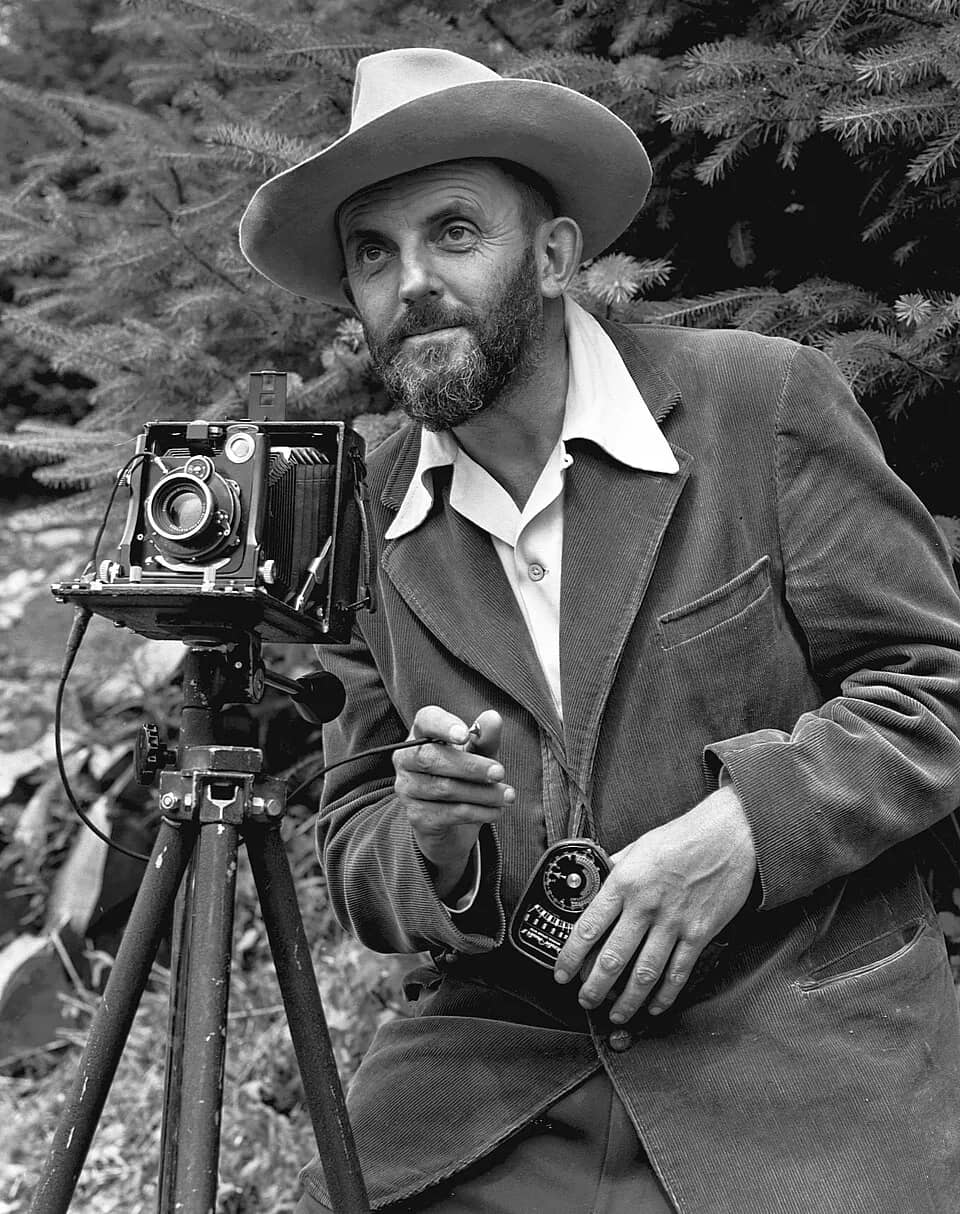
In the summer of 1927, Ansel Adams was near the top of Half Dome in Yosemite with exactly one unexposed glass plate left in his camera. He had already made several photographs that day and could have saved that final plate for something safer. Instead, he screwed a deep red filter onto his lens, one he knew would darken the blue sky so severely it would print nearly black, and he made the exposure. The resulting image, "Monolith, the Face of Half Dome," looks nothing like the mountain looks on a clear Californian afternoon. It looks the way the mountain feels: permanent, severe, indifferent to human time. Adams later wrote that this was his first consciously previsualized photograph. He did not record the scene. He decided what the scene would become.
That distinction drove his entire career. Adams is the most famous landscape photographer in the history of the medium, and his reputation rests on a specific combination: the Zone System he developed with Fred Archer to give photographers precise control over tonal values, an unmatched darkroom practice, and a genuine conviction that the American wilderness deserved the same attention that European painters had given cathedrals and classical ruins. These were not separate interests. They reinforced each other at every stage of his work.
Early Life: Music Before Photography
Ansel Easton Adams was born in San Francisco in 1902. School did not suit him and he was eventually educated at home, but he found real discipline in music. He trained seriously as a concert pianist through his teens and early twenties, and that training was not incidental to his photography. The relationship between a musical score (the notation of intention) and a live performance (its realization in time and space) gave him his core metaphor for the photographic process: the negative is the score; the print is the performance.
His family took him to Yosemite for the first time in 1916, when he was fourteen, and gave him a Box Brownie camera for the trip. He photographed Yosemite every year for the rest of his life, eventually building his home near the park. In 1927, the Sierra Club published his first significant photobook, "Parmelian Prints of the High Sierras," beginning a long and productive partnership between his images and the American conservation movement.
Through the 1930s, his technical approach grew more deliberate. He co-founded the f/64 Group in 1932 with Edward Weston and Imogen Cunningham, committing publicly to straight photography: large-format cameras, sharp focus edge to edge, no darkroom manipulation to soften or distort the image's optical clarity. He published "Making a Photograph" in 1935, laying out his technical principles for a broad audience. By the end of the decade he was ready to codify his thinking into something systematic.
The Zone System: Turning Light Into a Language
The Zone System, developed with photographer and teacher Fred Archer at the Art Center School in Los Angeles around 1939 and 1940, is Adams's most lasting technical contribution to photography. It is a method for translating the tonal values of a real scene into the tonal values of a finished print, through deliberate control of exposure, film development, and darkroom printing. The Zone System, as Adams described it, was "not an invention of mine; it is a codification of the principles of sensitometry," drawing on the sensitometry studies of Hurter and Driffield from the late 19th century.
The system divides the tonal scale into eleven zones, numbered 0 through X in Roman numerals. Zone 0 is pure black with no recoverable detail. Zone V is middle gray, the default reading of any reflected-light meter. Zone X is pure white with no detail. Zones II through VIII are the textural range, where shadow and highlight detail are both visible and legible. The meter, Adams noted, always reads Zone V regardless of what it points at. Photograph freshly fallen snow with no adjustment and it prints as gray. Photograph a black horse the same way and it prints gray too. The Zone System fixes this by teaching photographers to place tonal values deliberately rather than accept the meter's default.
In practice, the system works like this: identify the darkest area in the scene where you need visible texture, meter it, then set your exposure so that area falls on Zone III rather than Zone V. Everything else in the scene shifts proportionally. Then decide whether the scene's brightness range is "normal" for standard development, or whether highlights need to be pulled down with reduced development (N-1, N-2) or pushed up with increased development (N+1, N+2). The famous rule "expose for the shadows, develop for the highlights" captures the core principle: exposure placement determines where the shadow detail sits; development time determines how far the highlights separate from each other in the negative.
Adams could previsualize the finished print while standing in the field, before touching the shutter. This was not guesswork. It was systematic decision-making, and it replaced the approximate intuition that had governed photographic exposure before he and Archer formalized the method. Photography programs still teach it today, and the underlying principle has transferred almost intact to digital photography: the histogram on a modern mirrorless camera is the Zone System's eleven-zone scale displayed in real time, and the technique known as Expose to the Right (ETTR) is its direct digital equivalent.
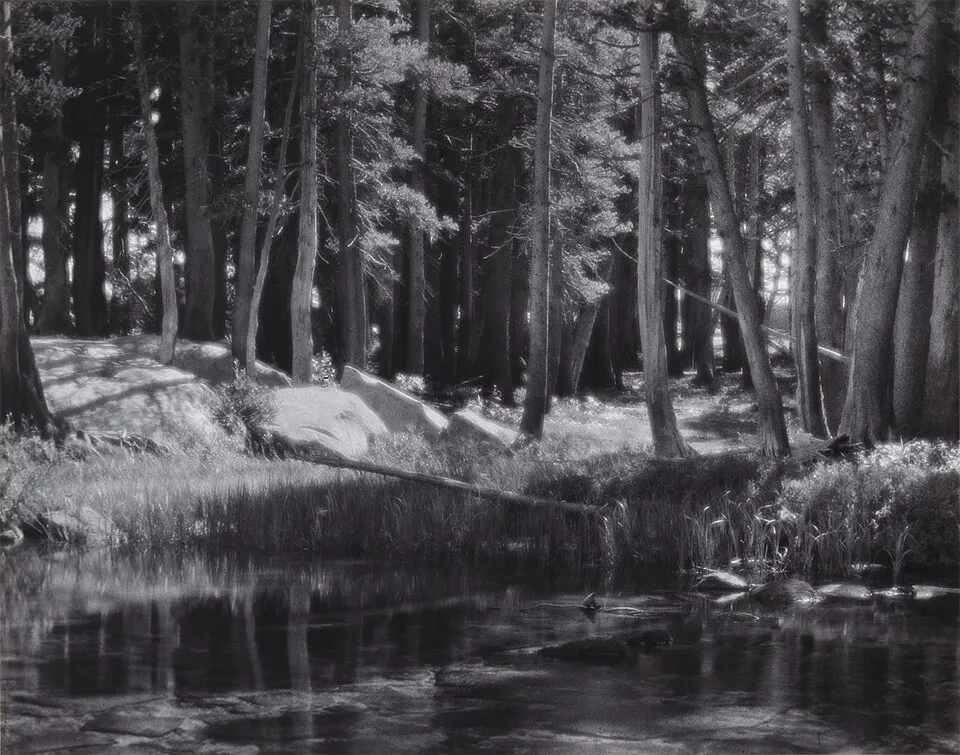
Ansel Adams, "Lodgepole Pines" (c. 1921), gelatin silver print. Even in his early work, Adams pursued deliberate tonal separation: bark, ground, and sky each occupy distinct zones that give the image its clarity and spatial depth. Image: Public domain, via Wikimedia Commons
The Darkroom as the Second Exposure
Adams spent as much time in the darkroom as he did in the field, and he was specific about the distinction between a technically correct print and a satisfying one. His printing process involved extensive dodging (holding back light from shadow areas to prevent them from going too dark) and burning (adding extra light to specific highlight areas to control their brightness). He also chose paper grade, developer chemistry, and selenium toning with the same deliberateness he brought to field exposure decisions.
His "Moonrise, Hernandez, New Mexico" (1941) is the clearest example of how his darkroom practice shaped meaning. He made the exposure at around 4:05 pm on October 31, 1941, while driving with his son and his assistant, stopping the car and setting up his 8x10 large-format camera in under a minute as the light changed. The negative captured the scene, but the print took years to reach its final form. He reprinted it repeatedly across his career, each time burning the sky darker, pushing toward the stark, near-surreal quality it has in its later versions: white crosses, white moon, black sky, white town of Hernandez against dark foreground. The final print does not look like a record of a moment on a New Mexico highway. It looks like an elegy. That transformation happened in the darkroom.
Adams considered the darkroom print the final creative act, not a mechanical reproduction of what the camera recorded. This position was not obvious in his time, when many photographers treated the negative as the photograph and the print as a copy. His insistence that printing was as creative as exposure put him in a line of artists who understood their medium's whole process as their artistic material, from photographers like Paul Strand to, in a different medium, printmakers like Rembrandt who also worked extensively in proof states.
Photography as a Conservation Argument
Adams was a committed conservationist, and he used his photographs as direct tools in advocacy campaigns. His images appeared in Sierra Club publications, in government briefings, and in direct communication with President Franklin D. Roosevelt, contributing to the establishment of Kings Canyon National Park in 1940. The argument his photographs made was not verbal: it was visual. This place is worth protecting because it is beautiful in a way that language cannot fully capture. A photograph of sufficient quality creates an experience of being in the landscape, of understanding its scale and light and irreplaceable atmosphere. Adams believed that experience could produce protective instincts that written arguments alone could not.
Whether specific photographs directly shifted specific legislative votes is difficult to prove. But their cumulative cultural impact on how Americans imagine their national parks is not in question. The look and feel of unspoiled American wilderness as it exists in the national imagination was substantially shaped by Adams's images. His archive is held at the Center for Creative Photography at the University of Arizona, which he co-founded in 1975. It contains roughly 40,000 original prints, 9,600 negatives, and extensive documentation of his technical methods.
Adams in the Wider History of Photography as Art
Adams's institutional contributions were as important as his photographic ones. He co-founded the Department of Photography at the Museum of Modern Art in New York in 1940, alongside Beaumont Newhall and Edward Weston. This was the first photography collection in an American art museum, and it created the institutional framework through which photography would be taught, exhibited, and collected for the rest of the 20th century. Without that framework, the serious art-historical attention that photography now receives would have taken much longer to develop.
His technical books, "The Camera" (1980), "The Negative" (1981), and "The Print" (1983), the final revised versions of the series he began in 1948, remained the standard photography education texts for decades. They embody his core conviction: that technical mastery does not constrain artistic vision but enables it. He shared this belief with the Renaissance painters who wrote technical treatises alongside their paintings, with Johann Sebastian Bach who composed systematic counterpoint exercises as works of art in their own right, and with any artist who understands that craft and expression are not opposites but partners.
For the broader history of how photography established itself as a fine art medium, our post on photography as fine art covers the Stieglitz era and the institutional debates that preceded Adams's work. For how other American artists approached the landscape as a serious subject, our overview of American art styles from realism to contemporary places Adams in a tradition that runs from the Hudson River School painters through the Western photographers of the 19th century.
What Adams Still Teaches
Adams did not document the American West. He revealed it. His photographs do not show Yosemite as it looks on an overcast morning; they show Yosemite as it means, stripped of the accidental and reduced to the essential. That is a different thing from a record, and it required a very different kind of attention from the photographer.
The Zone System gave him the technical language to translate his intentions into prints with consistent precision. His darkroom practice gave him the ability to refine that translation across years and dozens of proof states. His conservation commitment gave the work a purpose beyond aesthetics. None of these elements was separate from the others. If you photograph landscapes today, with any camera, Adams's core lesson applies: previsualize, decide what tonal relationships matter, and make the decisions that will produce them. The tool changes. The principle does not. For more on how visual elements like light and tonal contrast work across painting and photography, see our guide to mastering the essential visual elements of art.