Henri Cartier-Bresson was standing behind a fence at the Gare Saint-Lazare in Paris in 1932 when he made one of the most famous photographs of the 20th century. A man is mid-leap over a puddle, his heel just touching the water's surface. Behind him, a poster on the station wall shows a figure in a similar pose, as if the world had arranged itself into a visual rhyme specifically for this fraction of a second. Cartier-Bresson could not have planned the coincidence. He could not have arranged the poster, the puddle, the man's trajectory, and the light. What he did was recognize the moment forming and press the shutter at the precise instant when all of these elements aligned. He later said he was shooting through the fence because he could not get through the gate, and the fence's bars are visible at the bottom of the frame, a detail that confirms how quickly he had to work.
That photograph, "Behind the Gare Saint-Lazare," is the clearest illustration of what Cartier-Bresson called the decisive moment: the instant when visual elements in a scene achieve a balance that reveals something about the situation that no other moment could. Not the moment before, when the alignment has not yet occurred. Not the moment after, when it has passed. The decisive moment is specific, unrepeatable, and visible only to someone who is paying close enough attention to recognize it as it happens. Cartier-Bresson did not invent street photography, but he gave it its most influential theory and its most enduring examples, and the photographers who came after him, from Robert Frank to Vivian Maier to the people working today with smartphone cameras, are all working inside the framework he defined.
This guide covers the history of street photography, the photographers who shaped it, the ethical questions it raises, and how the practice has changed in an era when cameras are everywhere and privacy expectations have shifted.
Before Cartier-Bresson: Atget and the Empty Street
Street photography begins, in most accounts, with Eugène Atget. Atget was not a street photographer in the Cartier-Bresson sense. He worked in Paris between 1898 and 1927, carrying a large wooden view camera and heavy glass plate negatives through the city's streets at dawn, photographing empty streets, shop fronts, parks, and architectural details before the crowds arrived. He sold these images to painters, architects, and designers as reference material. He did not consider himself an artist, and he did not exhibit in galleries.
Over three decades, Atget made approximately 10,000 photographs of Paris as it existed before and during the enormous urban changes of the late 19th and early 20th centuries. Entire neighborhoods, market stalls, and working-class districts that he photographed in the 1890s had been demolished or transformed by the 1920s. Man Ray and the Surrealists discovered his work in the 1920s and immediately recognized its uncanny quality. His photographs of empty streets at dawn, shop windows with their mannequins and reflections, and public parks devoid of people had an atmosphere of strangeness that his documentary intention had never sought. The Surrealists published some of his images in La Révolution surréaliste without attribution, as though they were found objects rather than intentional artworks.
After Atget's death in 1927, the American photographer Berenice Abbott purchased a large portion of his archive, brought it to New York, and began promoting his work as art. The archive now belongs to MoMA, which holds over 5,000 of his prints. MoMA's archive on Atget provides extensive documentation of his working methods. Atget established that systematic documentation of the city could produce work of deep artistic resonance even without conscious artistic intention. Every street photographer who came after him benefits from the precedent he accidentally set.
Cartier-Bresson and the Leica Revolution
Cartier-Bresson (1908-2004) started as a painter, studying in the studio of André Lhote in Paris in the late 1920s. He was also deeply influenced by the Surrealists, whose interest in chance, coincidence, and the unconscious shaped his understanding of what a photograph could capture. In 1932, he acquired a Leica II, a small 35mm rangefinder camera, and the combination of this technical tool and his particular sensibility produced a revolution in photography.
The Leica was essential to what Cartier-Bresson achieved. Previous cameras were large, slow, and conspicuous. They required tripods, glass plates, and long exposures. Photographing people in motion on the street was technically difficult and socially awkward. The Leica was small enough to carry unobtrusively, fast enough to capture motion, and quiet enough to operate without drawing attention. It used 35mm motion picture film, which allowed thirty-six exposures per roll. This capacity meant a photographer could work continuously, shooting multiple frames as a situation developed, and the camera's portability meant they could be in the right position to do so. Cartier-Bresson covered the lens in black tape to reduce reflection, wore dark clothing, and moved through public spaces with the focused invisibility of a hunter.
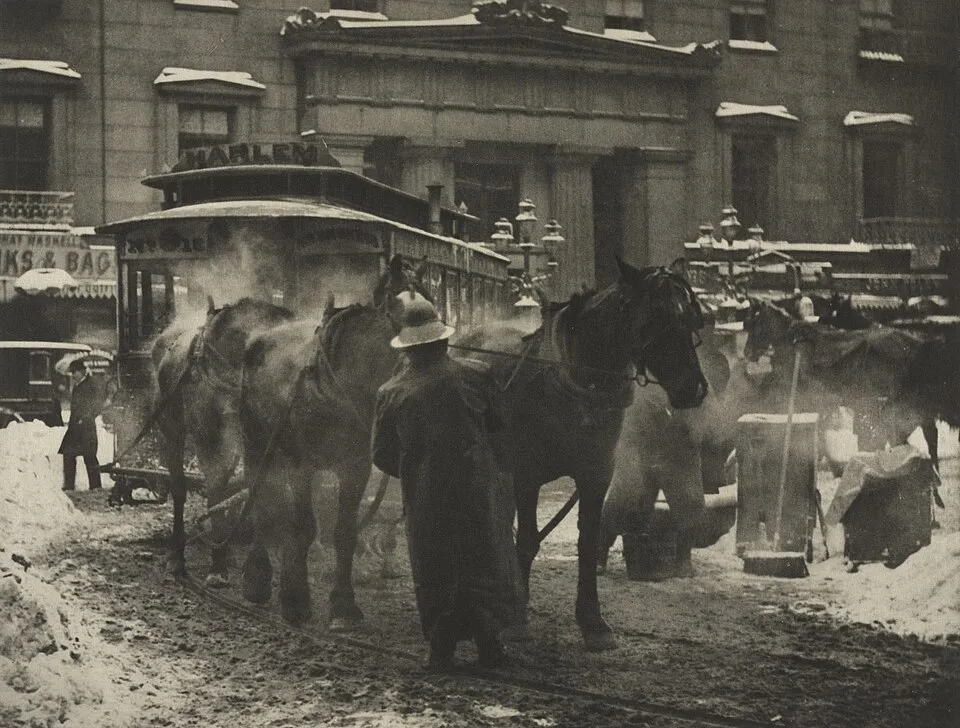
Alfred Stieglitz, "The Terminal" (1892). Decades before Cartier-Bresson defined street photography's aesthetic, Stieglitz was already documenting urban life in public space. Image: Public domain, via Wikimedia Commons
"The Decisive Moment," the title of his 1952 book (published in French as "Images à la Sauvette," meaning images on the run), gave street photography its defining concept. Cartier-Bresson wrote: "Photography is the simultaneous recognition, in a fraction of a second, of the significance of an event as well as of a precise organization of forms which give that event its proper expression." The decisive moment is the instant at which the visual composition is perfect and the human or emotional significance is at its height simultaneously. Too early, the forms have not yet organized. Too late, they have dissolved.
This is not a technical principle. It is a way of seeing that requires years of practice, acute visual intelligence, and the ability to anticipate movement, position, and light all at once. Cartier-Bresson's photographs demonstrate this mastery repeatedly: figures in public spaces are found at the precise moments when they form visual structures as precise as a Mondrian painting. His formal training in painting under Lhote, who emphasized geometric structure in the tradition of Cézanne, directly shaped how he composed photographs in fractions of a second. He never cropped his negatives. The photograph had to be right in the camera, at the moment of exposure.
Magnum Photos and the Expansion of Street Photography
In 1947, Cartier-Bresson co-founded Magnum Photos with Robert Capa, David "Chim" Seymour, George Rodger, and William Vandivert. Magnum was the first photographer-owned cooperative agency, and it gave photojournalists control over their work, their assignments, and their copyright. The agency's model was revolutionary, and it shaped the economics of serious photography for the next half century.
Through Magnum, Cartier-Bresson and his colleagues traveled the world documenting major events and ordinary life. Cartier-Bresson photographed Gandhi's funeral in 1948, the last days of the Chinese Nationalist government in Beijing in 1949, and the Soviet Union after Stalin's death in 1954. His work always maintained the same formal rigor regardless of the subject: the decisive moment was as applicable to a political event as to a man jumping a puddle.
Other Magnum photographers extended street photography in different directions. Robert Frank's "The Americans" (1958), photographed during a Guggenheim-funded road trip across the United States, used a looser, grainier, more subjective approach that rejected Cartier-Bresson's formal precision in favor of something rawer and more personal. Frank's images of segregated buses, jukeboxes, flag-draped windows, and lonely diners were initially criticized in the United States for being unflattering. They are now recognized as one of the most important photography books of the century. Garry Winogrand's work in New York during the 1960s and 1970s was more chaotic and provisional than Cartier-Bresson's geometrically precise images, embracing the visual disorder of American urban life as a subject rather than trying to extract composed order from it. Elliot Erwitt's street photographs combined a deadpan wit and formal economy that made his images feel simultaneously accidental and inevitable.
Vivian Maier: The Photographer Nobody Knew
The most remarkable street photography story of the 21st century belongs to Vivian Maier (1926-2009). A French-American woman who spent most of her adult life working as a nanny in Chicago and New York, Maier photographed the streets of both cities obsessively for over forty years, using a Rolleiflex twin-lens camera. She produced approximately 150,000 negatives. She printed very few of them and showed almost none to anyone. She stored the undeveloped film in boxes in storage lockers. When she stopped paying the locker fees in 2007, the contents were auctioned. John Maloof, a local historian and real estate agent, purchased approximately 30,000 negatives for $380 at one of these auctions, not knowing what he had.
Maloof began developing and scanning the negatives. What emerged was one of the most accomplished bodies of street photography ever produced. Maier's images show Chicago and New York street life with formal sophistication, psychological depth, and a quality of attention that matches or exceeds Cartier-Bresson's. She photographed children, workers, pedestrians, and the poor with a directness and empathy that never tips into sentimentality. Her self-portraits, reflected in mirrors and shop windows, show a woman who was both present in the world and observing it from a position of deliberate detachment.
Maier died in April 2009, shortly before her work became public. She never knew that her photographs would be exhibited at major museums, published in books, and discussed as one of the great achievements of American street photography. The discovery raised difficult questions about authorship, privacy, and the ethics of posthumous publication that have not been fully resolved. It also demonstrated that extraordinary work can be made entirely outside the professional art world, without exhibition, publication, or recognition, by someone driven purely by the compulsion to look and to record what they see.
The Ethics of Photographing Strangers
Street photography raises ethical questions that studio art does not. When you photograph a stranger on the street without their knowledge or consent, you are making an image of a person who did not agree to be photographed and who may not want to be represented in the way your photograph represents them. This is not a simple issue, and the answers vary by context.
Legal frameworks vary significantly by country. In the United States, photographing people in public spaces is generally legal without consent. In France and Germany, individuals have stronger rights to control the use of their image even in public settings. The legal right to photograph does not resolve the ethical question. A photograph of a person in a vulnerable moment, grieving, homeless, intoxicated, can cause real harm if it is published and circulated, regardless of the photographer's intent. Cartier-Bresson generally photographed people without asking permission, believing that asking would destroy the naturalness he was trying to capture. Contemporary practice is shifting toward greater sensitivity to these issues, partly because the internet has made it impossible to control where a photograph ends up once it is published.
The practical guidance most working street photographers offer is this: photograph people with the same respect you would want if someone were photographing you. If someone notices you and objects, stop. If the photograph would embarrass or endanger the subject, do not take it. The decisive moment does not justify every photograph, and the fact that a moment is visually compelling does not automatically mean it should be captured and shared. The philosophical overlap between street photography's visual approach and the urban art documented in our guide to street art is significant: both practices treat the city as a creative space. For the documentary dimension, our post on documentary photography covers the genre's commitments and contradictions in greater depth.
Street Photography Now
The smartphone has democratized street photography in ways that have both expanded and complicated the practice. The technical barriers that once required a Leica and years of practice are gone. Anyone with a phone can make a photograph on the street. The result is more street photography being made than ever before, and more of it being shared instantly through platforms that shape how images circulate and are seen.
The formal principles Cartier-Bresson defined remain useful. Composition, timing, and the relationship between elements in the frame still determine whether a street photograph works. But the social context has shifted. People are more aware of cameras, more concerned about privacy, and more likely to object to being photographed. Street photography in 2026 requires more tact and awareness than it did in 1932, and the best contemporary practitioners are finding ways to work that respect both the tradition and the changed conditions.
For the broader history of photography as an art form, the guide to photography as art provides the full context. And for the technical foundations that underpin all photographic practice, understanding composition covers the formal principles Cartier-Bresson applied with such precision.