
Walk into the Smithsonian American Art Museum in Washington, D.C., and you will find a map of the United States made from 336 television monitors, 50 DVD players, and roughly 575 feet of multicolored neon tubing. Each state plays video clips that reference its culture and history, flashing and looping in a cascade of electronic imagery. Nam June Paik built this piece, "Electronic Superhighway: Continental U.S., Alaska, Hawaii," in 1995. He was predicting the internet. He was also making one of the most important works of video art ever created.
Video art is art that uses moving images as its primary medium. It is not film. It is not television. It does not need to tell a story, entertain an audience, or sell anything. It can be a single continuous shot lasting hours, a multi-screen installation filling a gallery, a loop projected onto a building, or a tiny screen embedded in a sculpture. Since the 1960s, video art has grown from a fringe experiment into one of the dominant forms of contemporary art. Every major museum and biennale now programs video work, and the medium has expanded into AI-driven simulations, real-time generative pieces, and immersive multi-channel environments that would have been technically impossible when Paik started.
This guide traces the history of video art from Paik's first television experiments through Bill Viola's spiritual meditations to the artists working with screens, code, and AI in 2026. If you have ever walked past a darkened room in a museum because a video was playing, this is for you.
What Makes Video Art Different from Film
Video art uses moving-image technology as an artistic medium rather than a storytelling tool. The distinction from cinema and television is not just about where it is shown. It is about what it tries to do. Video art does not need a plot. It can explore rhythm, color, movement, time, and space as pure visual phenomena. It is typically shown in galleries and museums rather than theaters, often as looped projections or multi-screen installations. Viewers enter and leave at any point. There is no beginning or ending in the conventional sense.
Video artists also manipulate the medium itself. They distort images, slow time down to a crawl, layer footage, or combine video with sculpture, sound, and performance. The technical manipulation is part of the art. When Bill Viola shoots at 400 frames per second and plays it back at normal speed, the slow motion is not an effect. It is the content. The Museum of Modern Art's media art collection provides a good overview of how museums classify and care for video work, which involves its own conservation challenges around obsolete playback equipment and degrading tape formats.
Nam June Paik: The Person Who Started It All
Korean-American artist Nam June Paik is universally recognized as the founder of video art. He was trained as a classical musician and became involved with the Fluxus movement in the early 1960s, which brought an experimental, anti-commercial sensibility to art making. In 1963, Paik exhibited "Exposition of Music: Electronic Television" at the Galerie Parnass in Wuppertal, Germany. The show featured thirteen television sets displaying distorted images created by manipulating the sets' internal electronics with magnets. It was the first time anyone had treated television as a sculptural material rather than a broadcast medium.
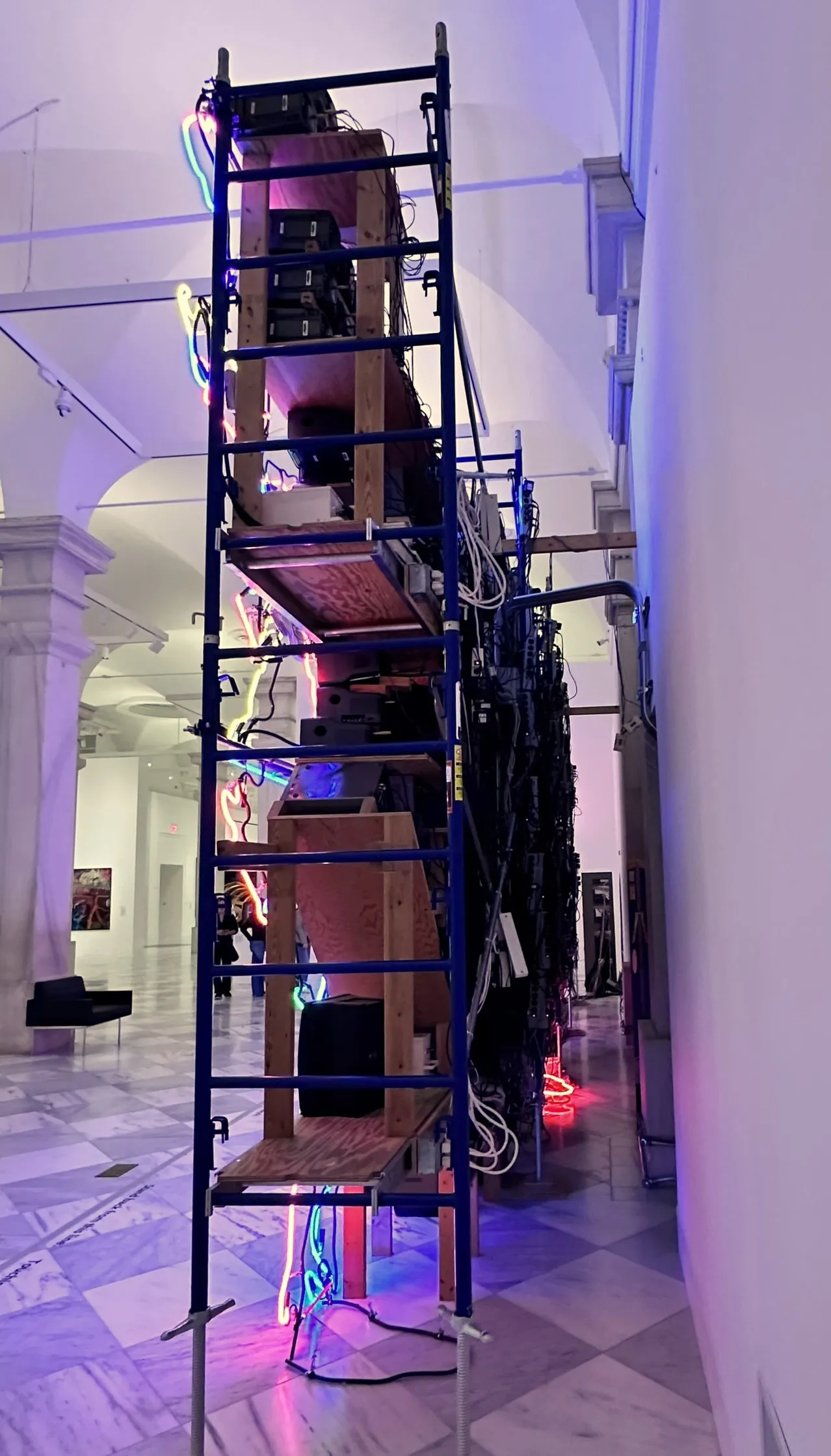
Nam June Paik, "Electronic Superhighway: Continental U.S., Alaska, Hawaii" (1995), 49-channel closed-circuit video installation. Smithsonian American Art Museum, Washington, D.C. Image: Public domain, via Wikimedia Commons
Paik saw television not as a passive entertainment device but as a material he could shape. He built TV sculptures: assemblages of monitors arranged in the shape of a cello, a robot, a Buddha, a garden of screens. When the Sony Portapak, the first portable video camera, was released in 1967, Paik was one of the first artists to use it. The Portapak made video recording accessible to individual artists for the first time, and Paik's experiments with it helped establish video as a medium for personal, experimental expression rather than broadcast production.
His 1965 quote reads like prophecy now: "Someday artists will work with capacitors, resistors, and semiconductors as they work today with brushes, violins, and junk." He was right. The artists currently working with AI-generated video, real-time rendering, and data-driven installations are working in the space Paik opened up.
The Early Pioneers: Acconci, Nauman, and Jonas
Paik was not alone for long. By the early 1970s, other artists had picked up video cameras and started exploring what the medium could do that painting and sculpture could not.
Vito Acconci used video to probe the relationship between artist and viewer. "Centers" (1971) shows Acconci pointing at the camera for twenty minutes, turning the viewer's gaze back on itself. "Theme Song" (1973) features Acconci lying on the floor, speaking intimately to the camera as if seducing the viewer, exposing the false intimacy that the television screen creates.
Bruce Nauman built video installations that used surveillance cameras, corridors, and closed-circuit systems to make viewers aware of their own bodies being watched. "Live-Taped Video Corridor" (1970) placed cameras and monitors in a narrow corridor so that viewers saw themselves from behind as they walked through. The experience was disorienting. It made surveillance physically tangible years before surveillance became a daily fact of urban life.
Joan Jonas combined video with live performance, mirrors, and props, creating layered works that explored female identity, mythology, and the relationship between live presence and mediated image. Her "Vertical Roll" (1972) exploited a technical glitch in television transmission, the rolling horizontal bar, as a structural element of the work. Jonas was making glitch art decades before the term existed.
Bill Viola: Video as Spiritual Practice
Bill Viola is widely considered the most important video artist of the late twentieth and early twenty-first centuries. His works use extreme slow motion, water imagery, and references to religious painting to create meditative experiences that evoke birth, death, and the passage between states of consciousness.
"The Crossing" (1996) shows a man walking toward the camera on a large double-sided screen. On one side, he is gradually engulfed by rising water. On the other, by flames. Both elements consume him completely before receding, leaving nothing. The piece stretches a few seconds of real time into twelve minutes of slow motion. What sounds like a simple image becomes a profound meditation on destruction, purification, and renewal. You sit with it. You wait. The slowness is the point.
"Tristan's Ascension" (2005) shows a body lying on a stone slab as water cascades upward around it in reverse. The figure appears to dissolve into a torrent of ascending water. Projected on a wall over fifteen feet high, with overwhelming sound, the piece creates an experience closer to religious ecstasy than to watching a video. Viola's work demonstrates that video art can achieve the spiritual intensity of the greatest religious paintings, but with the added dimensions of time, movement, and sound. The Tate's artist page on Viola provides a good overview of his career and major works.
Video Art Since 2000: Multi-Channel, Social Media, and AI
Contemporary video art has expanded in several directions. Artists increasingly use multiple screens or projections to create immersive environments. Ragnar Kjartansson's "The Visitors" (2012) uses nine screens showing musicians performing a single song simultaneously in different rooms of a decaying mansion. Each screen is a different musician, and the sound builds as their performances layer together. Christian Marclay's "The Clock" (2010), a 24-hour montage of thousands of film clips showing clocks and watches synchronized to real time, won the Golden Lion at the Venice Biennale and became a cultural phenomenon. People sat through all twenty-four hours of it.
The explosion of online video has given artists new platforms and materials. Hito Steyerl's essay-films examine how images circulate, degrade, and accumulate meaning in the digital age. Her "How Not to Be Seen: A Fucking Didactic Educational .MOV File" (2013) uses the aesthetics of tutorial videos to explore surveillance, visibility, and the politics of image resolution. Steyerl's work is particularly relevant in 2026, when AI-generated video has made the question of what is real and what is fabricated more urgent than ever.
Video art also increasingly intersects with video games and interactive media. Artists like Ian Cheng create "live simulations," real-time, AI-driven ecosystems that evolve continuously without human intervention, blurring the line between video art and artificial life. The connection between video art and our broader guide to digital art is direct: video art was one of the first digital art forms, and it continues to push the boundaries of what digital media can do as art.
Where to See Video Art
Major museums with strong video art collections include Tate Modern in London, which has extensive holdings and regular screenings; the Museum of Modern Art in New York, which maintains a comprehensive media art collection; the Centre Pompidou in Paris, which has been pioneering new media acquisitions for decades; and the ZKM Center for Art and Media in Karlsruhe, Germany, which is dedicated entirely to media art and technology. The Smithsonian American Art Museum in Washington, D.C. is home to Paik's "Electronic Superhighway" and the Paik Archive. Many of these institutions have expanded their video art programming significantly in recent years, reflecting the medium's centrality to contemporary practice.
How to Watch Video Art (Without Walking Out)
Video art is not designed for quick consumption. Commit to watching a piece for at least its full loop if it is short, or a substantial portion if it is long. Do not wait for a plot. Pay attention to rhythm, repetition, color, sound, and how the images make you feel. Notice the installation context: how the video is displayed, the projection size, the room darkness, the speaker placement, the number of screens. All of this is part of the artwork. And sit down. Most video art spaces provide seating for a reason. Comfort allows you to engage more deeply with work that asks for your time.
If you want to understand how video art fits into the broader tradition of art that creates environments you step into rather than objects you look at, our guide to installation art covers that territory. For the historical context of how moving images became an art form, our overview of the history of digital art traces the trajectory from early experiments to current AI-driven work.
Final Thoughts
Video art has evolved from a radical experiment with television sets into one of the most versatile and powerful mediums in contemporary art. It can create intimate psychological portraits, vast immersive environments, political provocations, and spiritual experiences that rival the greatest achievements of painting and sculpture. In a culture saturated with moving images on our phones, our computers, our billboards, and our walls, video artists are the ones who ask us to look at those images differently, more carefully, and with greater awareness of what they do to us.
The next time you encounter a darkened room with a projection in a museum, do not walk past. Walk in, sit down, and let the moving images work on you. You may be surprised by what you see and by what you feel. What is your favorite video artwork? Share in the comments below.


