
Every printmaking technique, from etching to lithography to screen printing, is designed to produce multiple identical copies of an image. That is the point of printmaking: one matrix, many prints. The monotype breaks this rule completely. A monotype is a print made from a smooth, non-absorbent surface that cannot be re-inked and printed a second time to produce an identical result. Each monotype is, by definition, a unique object. Print one copy and the image is gone. This contradiction, a printing technique that produces only one print, sits at the center of what makes monotype so interesting to artists and collectors.
Edgar Degas, who made more than four hundred monotypes during his career, understood the technique's special quality. In his hands, monotype was not a preparatory method or a lesser form of printmaking. It was a medium for his most experimental and private work: dark, atmospheric scenes of cafe life, intimate views of women bathing, and theatrical performances caught in dramatic artificial light. Many of his monotypes he then worked over with pastel, creating a unique category of work that belongs to both printmaking and drawing simultaneously. As the Museum of Modern Art described in their 2016 exhibition "A Strange New Beauty", Degas pushed monotype to radical ends, using the medium's capacity for gestural, improvisational marks to produce some of his most adventurous work.
This guide explains exactly how monotype works, the difference between additive and reductive approaches, why Degas used the technique so prolifically, and how to make your first monotype with minimal equipment.
What Is a Monotype and How Does It Differ From Other Prints
A monotype is made by applying ink or paint to a smooth, flat surface, typically a metal plate, a piece of plexiglass, or a sheet of glass, and then pressing paper against the inked surface to transfer the image. The key difference from other printmaking techniques is that the plate has no fixed image engraved, etched, or chemically fixed into it. In etching, the image is cut into the plate. In lithography, it is chemically established. The plate can be re-inked and printed many times from the same fixed matrix. In a monotype, the image is on the surface in wet ink or paint, not embedded in it. Press the paper once, and most of the ink transfers. A second pull from the same plate (called a "ghost print") gives a much paler, altered version that is never identical to the first.
This distinction matters to collectors and museums because it affects both rarity and value. A signed, numbered etching "1/50" is one of fifty identical impressions. A monotype is inherently unique. There is no edition. The ghost print, if taken, is a separate work that records what remained on the plate after the first impression.
The other major distinction is that monotype requires almost no specialized equipment to begin. No acid for etching, no lithographic stone or aluminum plate, no screen or squeegee. A smooth surface, ink or oil paint, paper, and a press or a steady hand for hand-printing are all that is necessary. The Monotype Guild of New England, which celebrated its 40th anniversary in 2025 with a national juried exhibition at the Art Complex Museum in Duxbury, Massachusetts, selected 73 works from 645 submissions by 238 artists. The exhibition demonstrated that monotype remains one of the most active and evolving printmaking practices in the United States.
The Two Approaches: Additive and Reductive
Every monotype begins from one of two starting points, which define entirely different working processes and different visual outcomes.
Additive Monotype
In the additive method, you apply ink or paint to a clean plate and build up the image by adding marks. This is the most direct approach. Dip a brush in ink, paint your image onto the plate, press paper onto the painted surface, and lift to reveal the print. Because the image on the plate appears in mirror, you must think in reverse, or accept reversed text and asymmetrical compositions. The additive method rewards loose, gestural marks and bold tonal areas, since fine detail and thin marks are the hardest to preserve through the transfer process.
Reductive Monotype
In the reductive method, you begin by coating the entire plate with a uniform layer of ink, then remove ink to create the image by wiping, brushing, or scraping areas clean. Wherever you remove ink, those areas will print light. Wherever you leave ink, those areas print dark. The reductive approach is closely associated with Degas. He would coat a plate with a thin, even layer of oil-based ink using a roller, then use rags, brushes, and his fingers to wipe and draw into the ink, creating figures and backgrounds from subtracted tone. The resulting images have a distinctive quality: dark, atmospheric, with soft tonal gradations and luminous light areas where the plate was wiped clean.
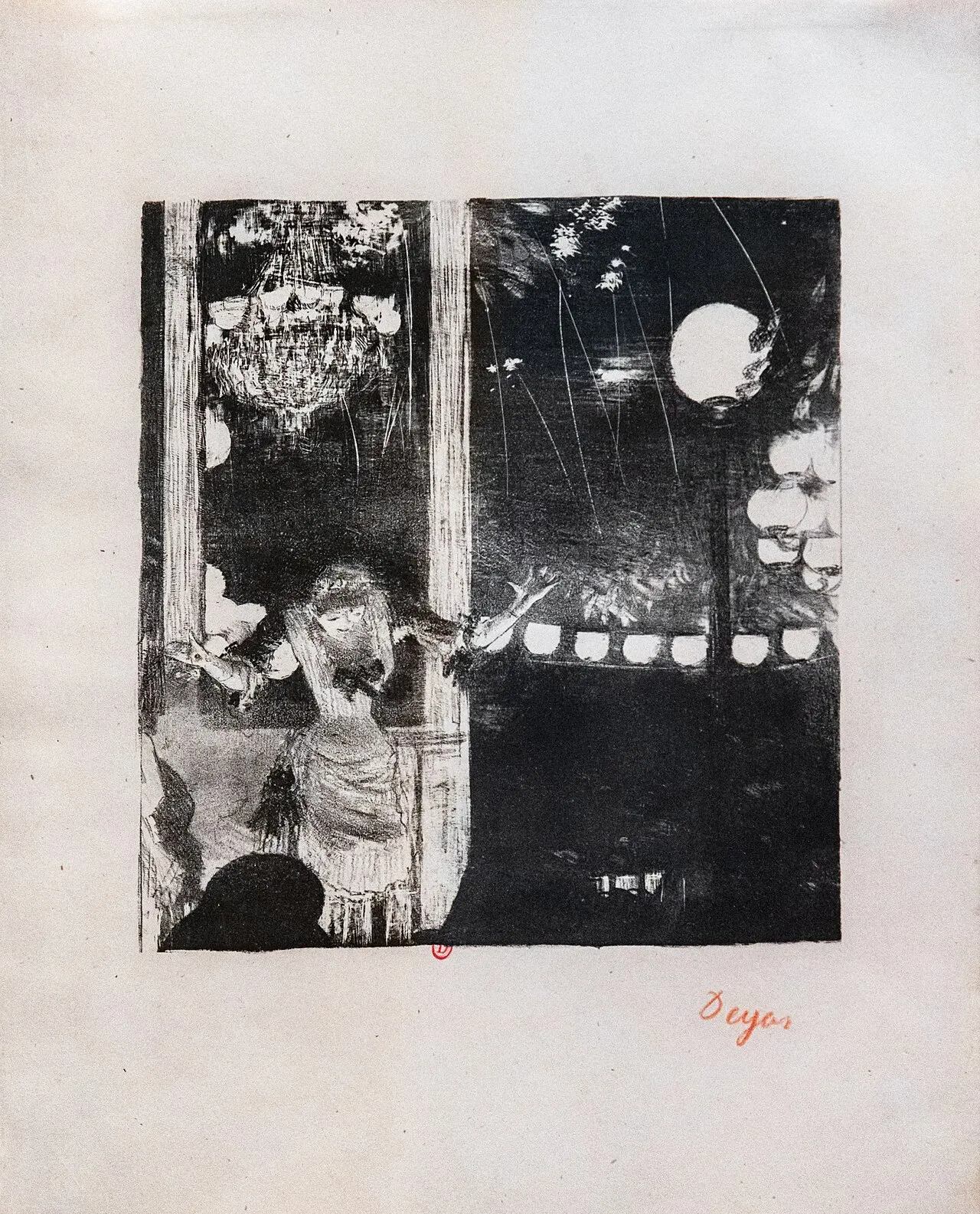
Edgar Degas, "Cafe-Concert aux Ambassadeurs" (c. 1876 to 1877), pastel over monotype on paper, 37 x 26 cm. Musee des Beaux-Arts, Lyon. This work combines a reductive monotype base with applied pastel, creating the richly atmospheric lighting and tonal depth that defines Degas's cafe-concert series. Image: Public domain, via Wikimedia Commons
Degas and the Monotype: Over Four Hundred Works
Edgar Degas made his first monotype in 1874, and the technique became central to his work for the next fifteen years. He made approximately 430 monotypes in total, more than any other major artist of the period, and a significant portion of those he worked over in pastel to create finished, exhibited pieces. Yet because many of these works were private and experimental, the monotypes were not widely known during his lifetime. The full extent of his involvement with the medium only became clear after his death, when his studio contents were catalogued.
What attracted Degas to monotype was precisely its experimental quality. Unlike his public paintings, which went through extensive revision and preparation, the monotypes allowed him to work quickly, responsively, and privately. The reductive technique suited his interest in artificial light. By coating a plate with dark ink and then wiping light areas into it, he could render the upward-cast artificial light of the Paris Opera, the Cirque Fernando, and the cafe-concert venues he frequented with a directness and atmospheric accuracy that conventional drawing techniques could not achieve.
The ghost prints from his monotypes provided Degas with another creative opportunity. The pale, altered impression produced by a second pull from the same plate gave him a tonal foundation with a different quality from a fresh plate, and he used these as bases for reworked pastel pieces of their own. The resulting works, pastel over monotype ghost, occupy a unique technical category that makes them some of the most complex and layered works in his output.
The Clark Art Institute's 2024 exhibition, "Edgar Degas: Multi-Media Artist in the Age of Impressionism," examined Degas's remarkably experimental approach across printmaking, pastel, and mixed media, situating his monotype practice within the broader context of his technical restlessness. The exhibition, curated by Michelle Foa and Anne Leonard, coincided with the 150th anniversary of the inaugural Impressionist exhibition and highlighted how Degas's monotype experiments fit within his wider search for new procedures.
This relationship between monotype and pastel connects to the broader context of Degas's draftsmanship. For more on his pastel technique and its relationship to the Impressionist movement, see our guide to pastel drawing. And for the broader Impressionist context, our guide to Impressionism covers the movement that Degas helped shape.
Other Major Monotype Artists
Degas dominates the history of monotype, but he is not alone. Giovanni Benedetto Castiglione (1609 to 1664) is the first identified artist known to have made monotypes, and his works from the 1640s and 1650s show an immediately mature grasp of the reductive technique applied to atmospheric landscape and mythological subjects.
Mary Cassatt (1844 to 1926) made a small but significant group of monotypes in the 1890s, several showing domestic scenes in a style that combines Degas's atmospheric printing with a flatter, more decorative approach influenced by Japanese woodblock prints. Her monotypes are less well-known than her pastels and oils but demonstrate an experimental range that her public reputation has somewhat obscured.
In the 20th century, Milton Avery, Paul Gauguin (who made monotype prints during his time in the Pacific), and Edvard Munch all used the technique. More recently, Elizabeth Peyton has made monotype central to her practice, creating works that combine references to art history, opera, and contemporary portraiture. Contemporary artists including Kiki Smith, William Kentridge, and Sam Messer have extended monotype's possibilities through scale, combination with digital processes, and multi-plate printing.
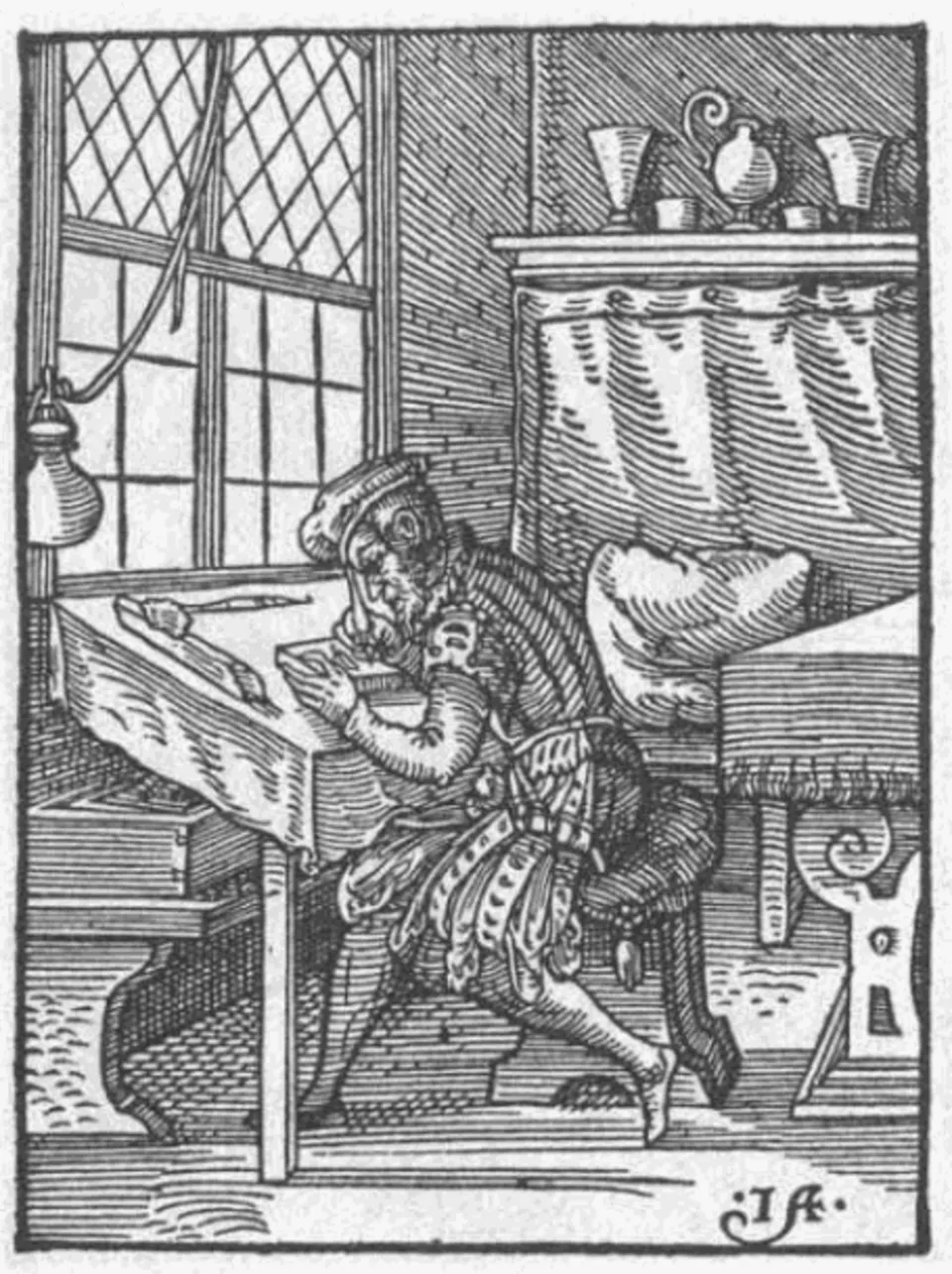
A 16th-century woodcut showing a printer's workshop. While monotype uses a smooth plate rather than a carved block, the basic press mechanics are related. The printmaking tradition that surrounds monotype includes etching, woodcut, and lithography, all of which use a fixed matrix for multiple identical prints. Image: Public domain, via Wikimedia Commons
How to Make Your First Monotype
A basic monotype setup requires: a smooth plate (plexiglass cut from hardware store sheet, a sheet of glass with taped edges, or a dedicated etching plate), oil-based printing ink or heavy-bodied oil paint, a brayer (rubber roller) for the reductive method, soft brushes and rags, and a sheet of thin, slightly damp printing paper (or ordinary copy paper for experiments).
Reductive method: Roll a thin, even layer of ink over the entire plate surface. Use rags, a dry brush, and your fingers to wipe and draw areas of the ink away, creating your image. When you are satisfied with the ink drawing, place a sheet of paper over the plate and press firmly and evenly over the entire surface, either by running it through a press or by burnishing the back of the paper with a spoon. Peel the paper back carefully from one corner.
Additive method: Starting with a clean plate, apply ink or paint directly using brushes. Apply a sheet of paper and press as above.
Compare monotype with other printmaking techniques covered in our guide to printmaking fundamentals, which covers the etching, linocut, and screen printing methods that use fixed matrices for reproducible editions.
Final Thoughts
Monotype occupies a productive paradox: a printmaking technique that produces unique, non-reproducible works. This quality has attracted artists who want the textural qualities of printing and the expressive freedom of drawing without the discipline of edition-based work. Degas's four hundred-plus monotypes remain the high-water mark of the form, but the technique is accessible to anyone with a smooth surface, some ink, and a sheet of paper.
The ghost print from your first monotype is not a failure. It is a second work. Keep it. Work over it in pastel, ink, or watercolor. Degas understood that every technical limitation, including the impossibility of repeating a monotype exactly, is actually a creative constraint that points toward new work. For more on how constraints shape artistic practice, see our guide to composition in art, which covers how formal limitations can generate visual innovation.


