
Barnett Newman had a specific instruction for how to look at his paintings. He said you should stand close. Very close. About fifteen centimetres from the surface, close enough that the painting fills your entire field of vision. Most museum visitors ignore this. They stand back at a polite distance of a metre or two, the way you look at every other painting. But when you follow Newman's instruction and step right up to "Vir Heroicus Sublimis" (1950-1951) at MoMA, which is 244 centimetres tall and 513 centimetres wide, something changes. The deep cadmium red fills your peripheral vision completely. The five thin vertical lines that Newman called "zips" stop being marks on a surface and become presences in space. You are not looking at the painting anymore. You are inside it.
That is what scale does. It is not the same thing as size. Size is a measurement. Scale is a relationship between the dimensions of an artwork and your body, between the depicted objects and their context, between the ambition of a work and the physical experience it produces. A painting that is two metres tall and a painting that is twenty centimetres tall demand fundamentally different relationships from the viewer. The large one asks you to stand back, to take it in as an environment. The small one asks you to lean in, to bring your face close, to enter a private space. These are not accidental differences. Artists choose scale deliberately, and reading that choice is essential to understanding what a work is doing.
Scale is also one of the few artistic decisions that reproductions cannot convey at all. You can get a reasonable sense of a painting's color from a photograph. You can understand its composition. But you cannot feel its scale until you are standing in front of it, your body in physical relation to its surface. This is why Newman's paintings, Rothko's paintings, and the Sistine Chapel ceiling all feel disappointing in photographs and overwhelming in person. The scale is the content, and photographs eliminate it.
Scale and Power: From Pharaohs to Cathedrals
The use of large scale to assert power is one of the oldest strategies in art. The seated statues of Ramesses II at Abu Simbel, carved around 1264 BCE, are roughly twenty metres tall. They were not made for quiet contemplation. They were political statements carved into living rock at the border of his territory, visible from the Nile, announcing to anyone who approached that the pharaoh was closer to the gods than to ordinary humans. The scale was the message. Ramesses is larger than you. That is the whole point.
Medieval European cathedrals used the same logic for a different purpose. The enormous vertical scale of the Gothic nave was designed to make the human visitor feel small in the presence of the divine. When you walk into Chartres Cathedral and look up at a vaulted ceiling that is thirty-seven metres above you, your body responds before your mind does. You feel physically diminished. That feeling of smallness was the devotional experience. Gothic architects understood that height produces a physical sensation of transcendence that no sermon could match. The Encyclopaedia Britannica's overview of Gothic architecture notes that the pursuit of height was a defining technical and spiritual ambition of the period, driving innovations in pointed arches, flying buttresses, and ribbed vaults that made ever-taller naves possible.
In the Renaissance, Michelangelo applied monumental scale to ceiling fresco. The Sistine Chapel ceiling, painted between 1508 and 1512, covers approximately forty by fourteen metres. The figures in his "Last Judgment" (1536-1541) on the altar wall reach nearly two metres in painted height, deliberately superhuman. When you stand in the Sistine Chapel and look up, you cannot take in the entire ceiling from any single position. You have to move, crane your neck, physically work to see it all. That physical effort is part of the experience. Michelangelo wrote that the most powerful artistic effects came from exceeding what nature normally produces, and the scale of these frescoes is that principle in action. For more on Michelangelo's approach to the human form at monumental scale, our guide to Michelangelo's career and methods goes deeper.
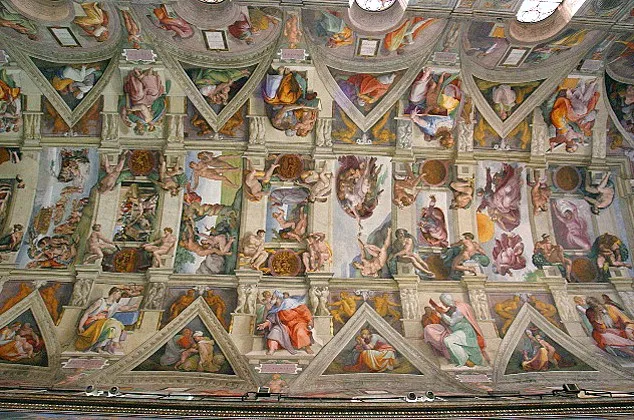
Michelangelo, Sistine Chapel ceiling (1508-1512), fresco, approximately 40 x 14 metres. Vatican Palace, Rome. The scale is inseparable from the experience: the ceiling is too large to see fully from any single position, requiring constant movement and creating a sense of being inside a depicted universe rather than viewing a picture. Image: Public domain, via Wikimedia Commons
When Small Is the Point: Intimacy and Devotion
Scale works just as powerfully at the other end of the spectrum. Medieval manuscript illuminations were made to be held in the hands, viewed from inches away, in private devotional practice. The Book of Kells, produced around 800 CE, contains pages with patterns so fine that you need a magnifying glass to appreciate their full complexity. A 2017 analysis by Trinity College Dublin's conservation and research team confirmed that some of the ink work in the manuscript is too small to have been executed without magnification, meaning the monks who created it were working with tools that allowed them to see detail beyond the capacity of the naked eye. The labour itself was the devotion. The scale was the proof of commitment.
Dutch cabinet paintings of the seventeenth century offer another model of intimate scale. These paintings, typically smaller than a modern sheet of printer paper, were made for domestic interiors and for close personal viewing. Gerard ter Borch's small genre scenes and Adriaen van Ostade's tiny landscapes require the viewer to lean in, to bring their face near the surface, to notice details that reward proximity. A painting that is fifteen centimetres wide creates a relationship of intimacy and attention that a painting three metres wide cannot achieve. The scale is saying: this is private, this is for you alone, come closer.
This is why scale is never accidental. A small painting is not a failed large painting. It is a different kind of work, demanding a different kind of attention. For more on how the physical properties of artworks shape the viewing experience, our guide to composition in art covers how size relationships within a painting direct the eye.
The Abstract Expressionists: Scale as Physical Encounter
The American Abstract Expressionists of the late 1940s and 1950s made a decision that was radical at the time and influential ever since: they worked at a scale that overwhelmed the viewer rather than accommodating them. Pollock's large drip paintings, such as "One: Number 31, 1950" (269 x 530 cm), were made on the floor, with the artist working around and across the canvas. The scale was not about what could be seen at a glance. It was about the physical relationship between the artist's body and the canvas during the making, and consequently about the viewer's body and the canvas during the viewing. You do not look at a Pollock of this size. You confront it.
Rothko was even more explicit about the physical experience he wanted. He told viewers to stand close to his large color field paintings because he wanted the work to envelop their visual field, to produce an experience closer to being inside the color than seeing it from outside. The Rothko Chapel in Houston, opened in 1971, was designed specifically to contain fourteen large paintings in a permanently dedicated octagonal space. There are no competing distractions. The paintings are the entire environment. People sit in the chapel for long periods, sometimes in tears, experiencing something that functions more like a religious space than a gallery. The scale makes that possible.
Newman's theory of "the sublime" drew on Edmund Burke's eighteenth-century definition: the experience of something too vast or powerful for reason to fully contain. Newman sized his paintings to produce that experience. A small painting, no matter how good, cannot produce the feeling of being physically surrounded by color. A painting that fills your visual field can. This is why Newman's work must be experienced in person. Reproductions reduce his paintings to decorative objects. The scale that is the work's primary content is exactly what photographs cannot convey. For more on this movement's approach to scale and physical presence, see our guide to Abstract Expressionism.
Christo and Jeanne-Claude: Scale in the Landscape
Christo and Jeanne-Claude worked at scales that redefined what a visual artwork could be and where it could exist. "The Gates" (2005), their installation in Central Park in New York, used 7,503 saffron-colored fabric panels suspended from 4.87-metre-tall gates along thirty-seven kilometres of park footpaths. The installation lasted sixteen days. No single vantage point allowed the full work to be seen. You could only experience it by walking through it, encountering it again and again in different weather and light over its brief existence.
"Wrapped Coast" (1969) covered 2.4 kilometres of Australian coastline with 92,900 square metres of fabric. The scale made the human body feel genuinely small against the natural landscape. Both works were temporary. They were removed after their completion, and that impermanence was part of the point. The scale was not about creating permanent monuments. It was about temporarily transforming familiar space into something that reorganized attention and made you navigate your environment differently. Our guide to land art and earth art covers this tradition of working at landscape scale.
Hierarchic Scale: Size as Meaning Within the Painting
Scale operates not only between an artwork and its viewer but within a composition. The size relationships between depicted elements communicate hierarchy, narrative, and meaning. In medieval and Byzantine religious painting, figures are sized according to spiritual importance rather than physical distance from the viewer. Christ is larger than the apostles. The Virgin is larger than the donors who commissioned the painting. This convention, called hierarchic scale, was consistent for over a thousand years, and understanding it transforms how you read any pre-Renaissance European or Byzantine image. The largest figure is the most important figure. It is that simple.
When single-point perspective replaced hierarchic scale in the Renaissance, depicted size became governed by spatial recession. Figures farther away are smaller, and the relationship between figure size and position in space communicates depth. But artists continued to use scale for expressive purposes within this perspectival framework. Goya's "Saturn Devouring His Son" (1819-1823) gives Saturn a scale wildly out of proportion with his victim. The broken scale makes the image feel nightmarish rather than naturalistic. The wrongness of the size relationship is the expression. For a deeper look at how artists manipulate spatial relationships, our guide to perspective drawing covers the technical framework.
Final Thoughts
The next time you stand in front of a painting or sculpture, before you start reading its subject or style, register its scale. Notice how close you are standing and whether the work invites you closer or holds you at a distance. Notice how the depicted figures relate in size to each other and what that tells you about the hierarchy of the scene. Notice whether the work fills your visual field or sits within it. These observations take about five seconds, and they tell you more about what the artist intended than most wall labels.
Scale speaks to the body before the intellect has had time to engage. When a painting is designed to overwhelm your visual field, that decision about dimensions is as much a part of the work as any detail of brushwork or color. For more on how immersive environments use scale to create experiences you can step inside, explore our guide to installation art. And for a systematic approach to analyzing all the visual elements of a painting, including scale, our essential art toolkit guide walks through each component.


