
Step inside Sainte-Chapelle in Paris and the effect is immediate and almost physical. The walls dissolve into 15 meters of stained glass on every side. On a clear day, the light transforms the interior into something between a jewel box and a vision: deep blues and reds and golds, the biblical narrative made luminous. The stone structure is there, but it barely seems to matter. What matters is the light.
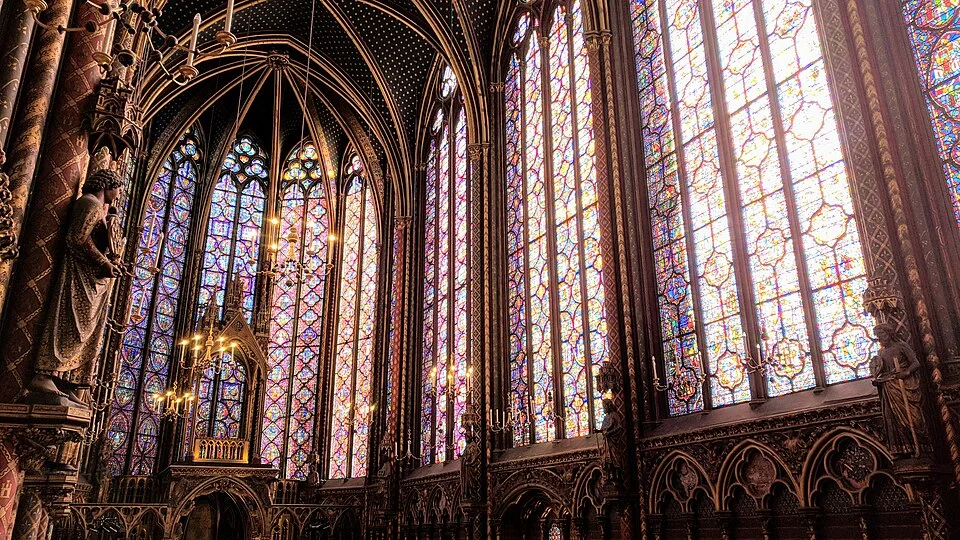
The interior of Sainte-Chapelle, Paris. The walls dissolve into 15 meters of stained glass on every side. On a clear day, the light transforms the interior into something between a jewel box and a vision. Image: CC BY-SA 4.0, via Wikimedia Commons
That effect is the entire point of Gothic architecture, and it is one of the most sophisticated achievements in the history of visual art. The builders of Gothic cathedrals were not simply solving engineering problems, though they were doing that with extraordinary ingenuity. They were building a theology in stone and glass: a physical space designed to make its occupants feel the presence of the divine through the transformation of light.
This guide covers Gothic art and architecture in full: where it came from, how the cathedrals were built and why they look the way they do, what illuminated manuscripts reveal about medieval visual culture, and why Gothic art remains one of the most coherent and ambitious artistic programs ever attempted in the Western world.
The Origins of the Gothic Style
From Romanesque to Gothic
Gothic architecture did not replace something inferior. The Romanesque style that preceded it was itself a powerful and coherent tradition: thick walls, round arches, heavy piers, and a sense of massive, earthbound solidity. A Romanesque church like the Abbey of Cluny in Burgundy or Durham Cathedral in England communicated the Church's permanence and authority through sheer physical mass.
Gothic changed the equation. The key technical innovation was structural rather than aesthetic: the pointed arch, combined with the ribbed vault and the flying buttress. Together, these three elements transferred the weight of stone ceilings from the walls to external supports, allowing walls to be thinned dramatically and opened up for glass. Where Romanesque walls were solid and load-bearing, Gothic walls became frames for windows.
The First Gothic: Saint-Denis
The Gothic style is generally traced to the Abbey Church of Saint-Denis near Paris, rebuilt by the powerful Abbot Suger in the 1140s. Suger was not an architect but a theologian with strong aesthetic convictions. He believed that beautiful things, particularly beautiful light, could elevate the soul toward God. He wanted his church to materialize that belief: to create a space where the physical and spiritual would seem continuous.
The east end of Saint-Denis, with its ambulatory of thin columns and large stained glass windows flooding the choir with colored light, was the template. Within decades, the major cathedrals of northern France were under construction in the new style: Notre-Dame de Paris (begun 1163), Chartres (largely rebuilt after 1194), Reims (begun 1211), Amiens (begun 1220).
How Gothic Cathedrals Were Built
The Three Key Innovations
The Gothic's structural system works because of three interdependent elements that had not previously been combined at scale:
The pointed arch, unlike the round arch, can be adjusted in height without changing the span. This flexibility allowed builders to achieve consistent ceiling heights across vaults of different widths, creating the uniform interior height that defines Gothic interiors. The pointed arch also directs more force vertically downward than outward, reducing the lateral thrust that solid walls needed to resist.
The ribbed vault concentrates the ceiling's weight onto specific structural ribs rather than distributing it evenly across a continuous curved surface. The ribs carry the load to the piers below; the thin stone panels between the ribs are essentially non-structural fill. This reduced the mass of material needed above, which reduced the weight the walls needed to carry.
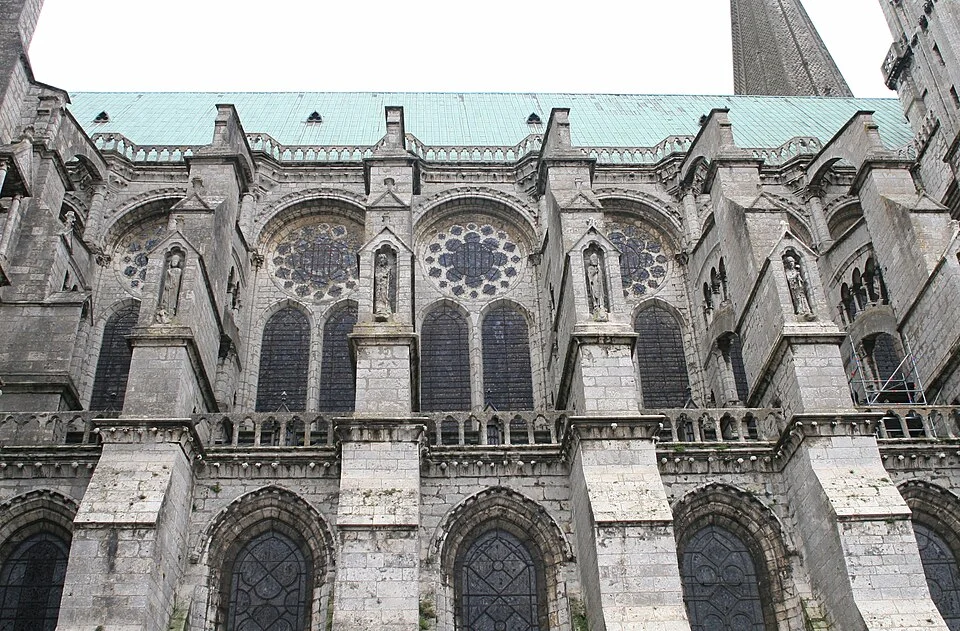
Flying buttresses at Chartres Cathedral. By taking the thrust outside the building entirely, flying buttresses freed the interior walls from their structural role and allowed them to be opened up for the enormous windows that define the Gothic aesthetic. Image: CC BY-SA 3.0, via Wikimedia Commons
The flying buttress is an arch-shaped strut that reaches from an exterior pier across empty space to the upper wall of the nave, counteracting the outward thrust of the vault at the point where it actually occurs. By taking the thrust outside the building entirely, flying buttresses freed the interior walls from their structural role and allowed them to be opened up for the enormous windows that define the Gothic aesthetic.
Building Over Centuries
The great Gothic cathedrals were not the product of a single architect's vision. They were built over decades and sometimes centuries, with construction pausing for lack of funds, wars, plague, and structural problems, then resuming under different master builders with different priorities. Chartres Cathedral preserves two different spire designs because one was built in the 12th century and the other in the 16th. Notre-Dame de Paris was under construction from 1163 to approximately 1345, nearly two centuries.
The master builders who directed these projects were extraordinary technical minds working without modern engineering tools. They understood the behavior of stone under load through practical observation and accumulated craft knowledge passed between generations. When something went wrong, which it sometimes did, they solved it through improvisation and structural reinforcement. The evidence of their problem-solving is often visible in the buildings themselves.
Stained Glass: Theology Made Visible
Gothic stained glass is one of the great art forms of any era, and it is easy to underestimate it by treating it as decoration. The windows of Chartres Cathedral, covering more than 2,600 square meters of glass in some 167 windows, are a complete theological program. They narrate biblical history from the Old Testament through the New, include scenes from the lives of saints, display the donors who paid for individual windows (merchants, guilds, nobility), and present a hierarchical arrangement of sacred figures that mirrors the medieval understanding of the cosmos.
Reading a Gothic window requires patience and a knowledge of iconographic conventions that modern viewers rarely have. But even without that knowledge, the effect of colored light flooding an interior space works directly on perception and mood in ways that no analysis fully explains. Light transformed by stained glass does not behave like normal light: it pools, it shifts with cloud cover and time of day, it colors the stone and the air itself. Gothic architects understood this effect and designed for it.
Gothic Sculpture
Gothic sculpture developed alongside Gothic architecture and underwent its own revolution. Early Romanesque sculpture was often stylized and hieratic: figures arranged in formal patterns with little individual expression. By the Gothic period, particularly from the 13th century onward, sculptors began giving their figures naturalistic drapery, individualized faces, and coherent poses that suggest movement and weight.
The portal sculptures at Chartres, Reims, and Amiens demonstrate this evolution. The column figures at Chartres's Royal Portal (c. 1145–1155) are still elongated and architecturally integrated, their bodies merged with the columns they decorate. A century later, the "Smiling Angel" at Reims (c. 1250) has a face of remarkable individuality and gentleness, standing in a contrapposto pose that shows awareness of the body as a thing that has weight and shifts its weight. This trajectory points directly toward the naturalism of the Renaissance.
Illuminated Manuscripts: Gothic Art in the Scriptorium
Not all Gothic art was monumental. The manuscripts produced in monasteries and later commercial scriptoria represent a parallel tradition of extraordinary refinement. A Gothic illuminated manuscript like the "Book of Hours of the Duc de Berry" (the Très Riches Heures, c. 1411–1416) contains miniature paintings of such precision and color that they repay as much attention as any easel painting.
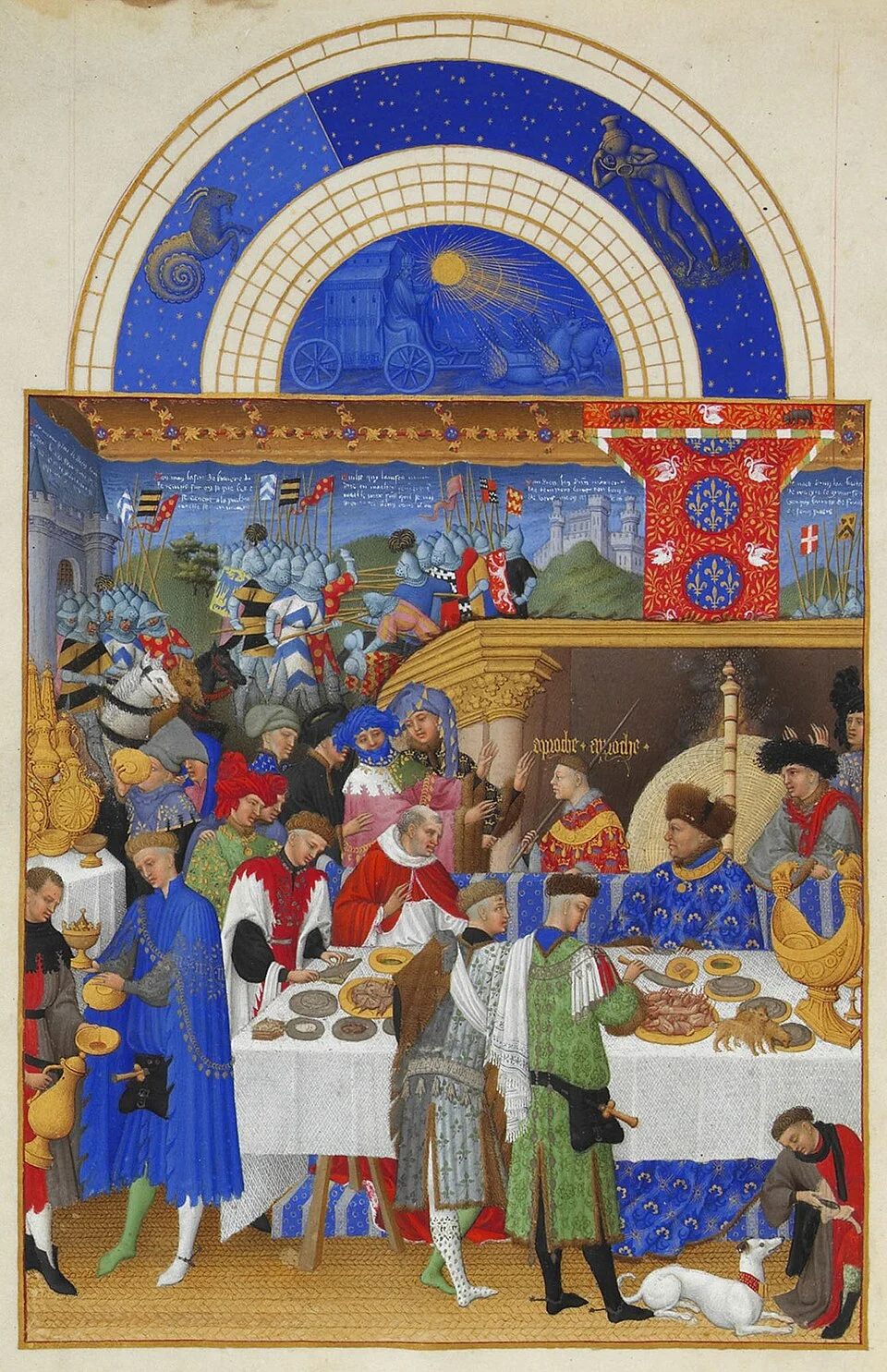
The Très Riches Heures calendar page for January (c. 1411-1416), by the Limbourg brothers for the Duc de Berry. Among the most reproduced images of the Middle Ages: detailed depictions of aristocratic life painted with the freshness and specificity of something seen from a window. Image: public domain, via Wikimedia Commons
These manuscripts brought together calligraphy, illustration, and gold illumination (the word comes from "illuminare," the gilding that made pages literally glow). A fully illuminated Book of Hours contained calendar pages with seasonal scenes, Marian devotions, biblical narratives, and elaborate decorated borders combining foliage, fantastic creatures, and sometimes surprisingly secular or comic vignettes. The Très Riches Heures calendar pages are among the most reproduced images of the Middle Ages: detailed depictions of peasant life, aristocratic hunting, and seasonal landscapes painted with the freshness and specificity of something seen from a window.
For guidance on how to read the visual elements in works like these, from their use of gold and color to their spatial conventions, the guide on looking at art for beginners provides useful foundations. And for an understanding of how Gothic's visual language of ornament and nature worship fed into a later movement, see Art Nouveau: Nature, Ornament, and the Total Work of Art.
Gothic Art Outside France
Gothic spread rapidly from France to England (where it developed distinctive national characteristics including the Perpendicular style with its fan vaults and great windows), to Germany (where the elaborate "flamboyant" tracery reached its most elaborate expression), to Spain, Italy (where the tradition was modified by the persistence of classical and Byzantine precedents), and eventually to the whole of Catholic Europe.
Italian Gothic is particularly interesting because it diverged most strongly from the French model. Italian churches tend to be wider and lower, with fewer windows and more wall space available for fresco. It was in this context that painters like Cimabue and Giotto emerged in the late 13th and early 14th centuries, developing a naturalism in painting that prepared the way for the Renaissance.
Gothic Revival and the Modern Legacy
Gothic did not simply end with the Renaissance. It remained an underground tradition, surfacing in the Gothic Revival of the 18th and 19th centuries, when architects like Augustus Pugin and John Ruskin championed medieval Gothic as a morally and aesthetically superior tradition. The Houses of Parliament in London (1840–1870), St. Patrick's Cathedral in New York (begun 1858), and hundreds of Victorian churches are Gothic Revival buildings. They demonstrate how Gothic's vocabulary of pointed arches, tracery, and vertical aspiration retained its psychological power centuries after the medieval world that produced it had vanished.
The Pre-Raphaelite Brotherhood in 19th century England drew explicitly on Gothic themes and formal qualities, finding in medieval art an emotional directness and narrative honesty they felt contemporary academic painting had lost. The Gothic tradition, in this sense, never quite ended: it became available as a counter-tradition to return to whenever the present felt insufficient.
For sculpture's materials and techniques across the Gothic and later periods, the sculpture materials guide covers what builders and sculptors were working with and how. And to understand the full arc of art history that Gothic both closes and opens, the evolution of art styles guide places Gothic in its full context.
Few traditions in the history of art attempted what Gothic attempted: to build the invisible in stone and glass, to make a space where the physical world seemed momentarily transparent to the divine. Whether you believe in the theology or not, walking into Chartres or Sainte-Chapelle does something to your sense of what is possible with human hands and human material. That is a permanent achievement.


