In 1908, Lewis Hine traveled to a glass factory in Indiana where he found children as young as eight years old working through the night, their faces illuminated by furnace glow, their small hands handling sharp-edged glass. He photographed them. The photographs appeared in publications distributed to the National Child Labor Committee, to reform advocates, to journalists, and eventually to members of Congress. They were not the only factor in the passage of the Keating-Owen Child Labor Act of 1916, but the historians who have studied the legislative campaign agree they were among the most effective persuasive tools available. Photographs of specific children in specific conditions did what statistics about the number of children in employment could not do: they made the cost of the practice visible to people who would never see a factory floor.
This is documentary photography's central claim and its defining tension: the photograph as evidence, as witness, as argument. It claims to tell the truth about real situations involving real people. But a photograph is not a neutral record. It is a selection made by a person with a point of view, in a specific light, from a specific angle, at a specific moment chosen from among many available moments. Every documentary photograph is simultaneously a fact about what existed and a construction about what it means. Understanding this tension is essential to reading documentary photographs critically and to understanding why they have been among the most powerful agents of social change in the past 150 years.
Lewis Hine and the Photography of Reform
Lewis Hine (1874-1940) trained as a sociologist before turning to photography, and his approach bears the marks of that training: systematic, descriptive, and evidence-based. He worked for the National Child Labor Committee from 1908 to 1918, traveling across the United States to photograph children working in factories, mines, farms, canning operations, and street trades. He faced considerable opposition from factory owners and managers who attempted to prevent him from photographing their operations, sometimes through physical intimidation. He gained access through ingenuity: posing as a fire inspector, a Bible salesman, or a factory machinery assessor.
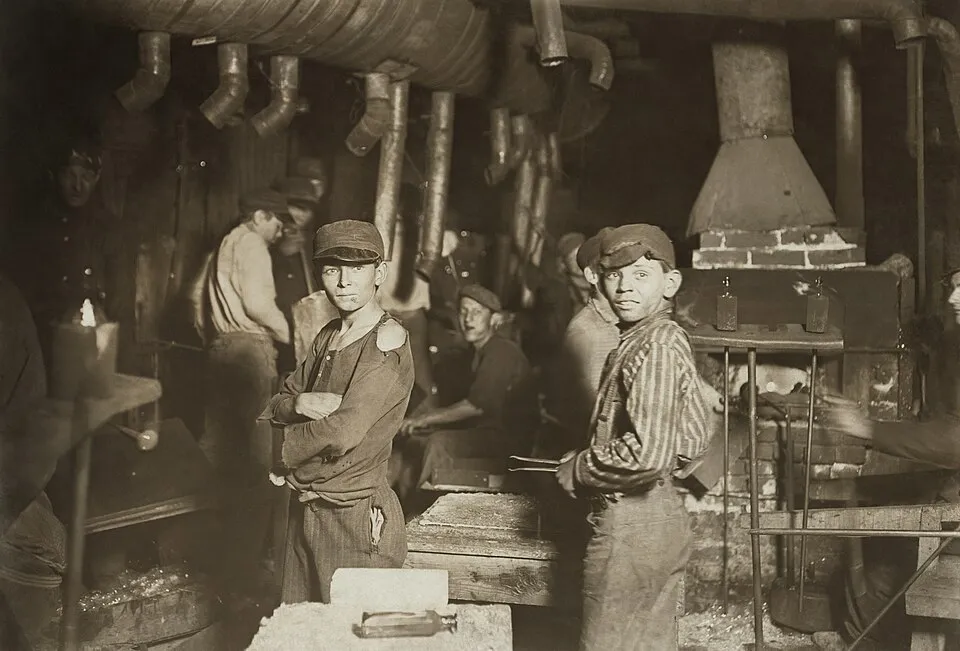
Lewis Hine, "Midnight at the Glassworks" (1908), gelatin silver print. Hine photographed night-shift child workers across American industry for the National Child Labor Committee. The work he produced between 1908 and 1918 contributed directly to child labor reform legislation. Image: Public domain, via Wikimedia Commons
Hine's photographs combined factual specificity with emotional directness. He recorded the names and ages of the children he photographed when he could obtain them, giving his images a testimonial quality: this is not a type, but a specific person. The practice of naming subjects, of making them individuals rather than examples, was as important as the visual content of the images. "Little Lottie," photographed in Alabama shucking oysters, is not child labor in the abstract. She is a named child with visible exhaustion, whose context and working conditions are legible in a single image.
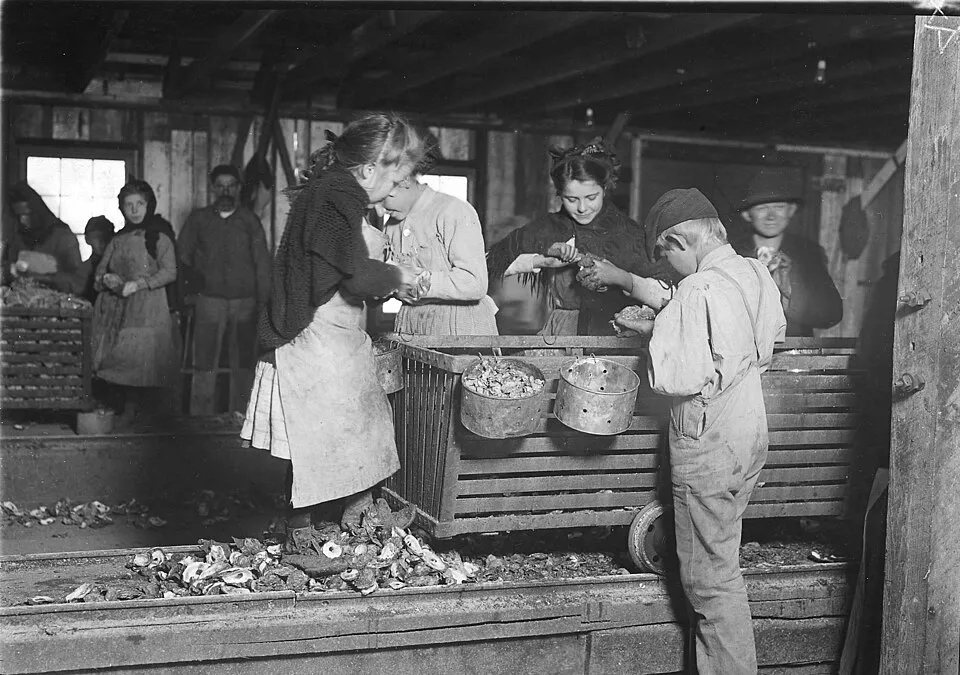
Lewis Hine, "Little Lottie, a Regular Oyster Shucker in Alabama" (c. 1911). Hine's practice of recording subjects' names and circumstances gave his images a testimonial specificity that made them harder to dismiss than statistics. Image: Public domain, courtesy National Archives via Wikimedia Commons
The FSA Project: Photography as New Deal Policy
The Farm Security Administration photography project (1935-1944) was the most ambitious government-sponsored documentary photography program in American history. Roy Stryker, heading the FSA's Historical Section, commissioned a team of photographers including Dorothea Lange, Walker Evans, Arthur Rothstein, Russell Lee, and Gordon Parks to document the conditions of rural poverty during the Great Depression and the effectiveness of New Deal programs. The stated goal was to produce images that would build public support for federal agricultural relief programs.
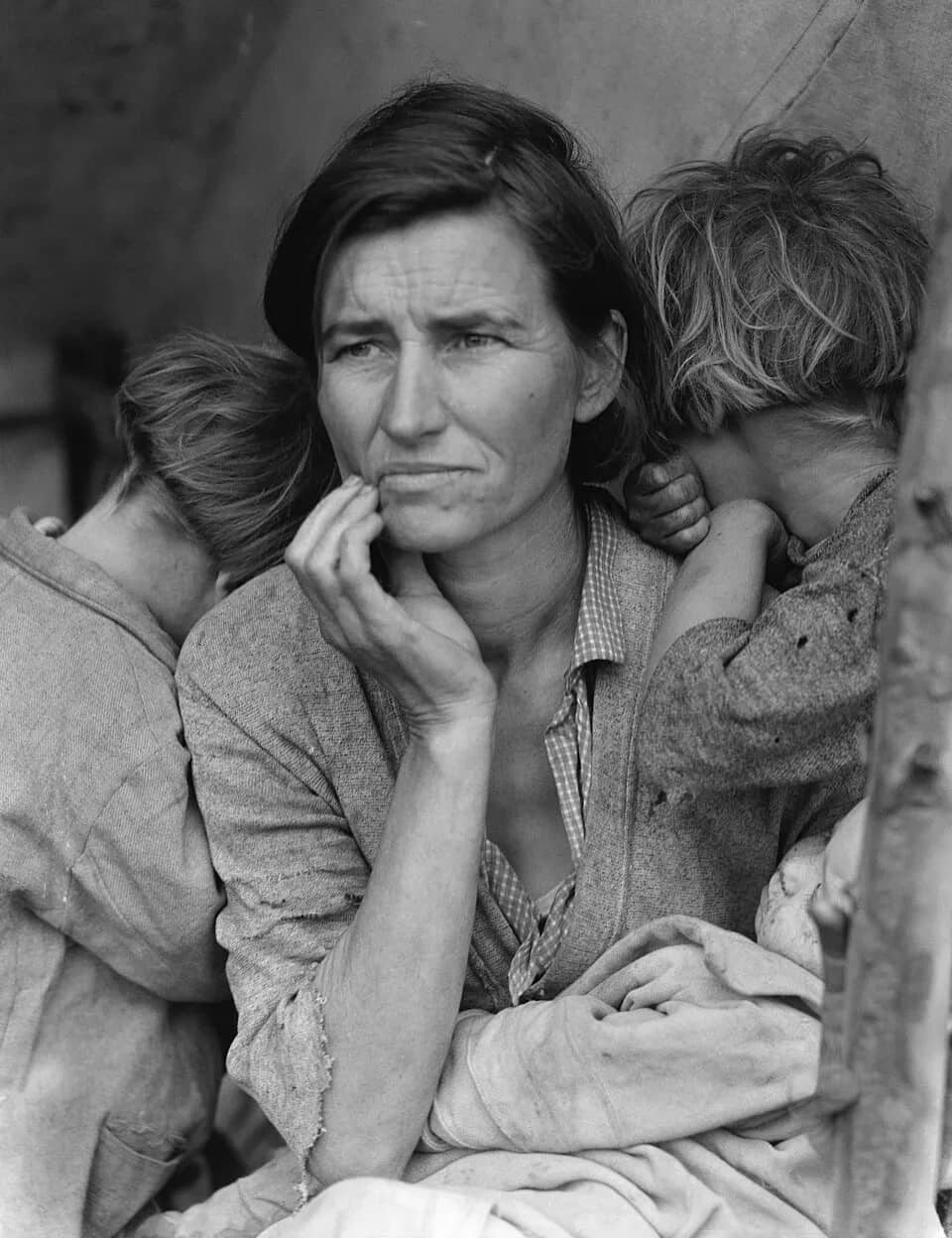
The photographs that resulted are the defining images of Depression-era America. Dorothea Lange's "Migrant Mother" (1936), taken at a pea-picker camp in Nipomo, California, is the most recognized documentary photograph in American history: a woman in her thirties, her face lined with worry, two children turned away from the camera against her shoulders, a nursing infant in her lap. It is formally composed, carefully shot, and immediately intelligible as an image of hardship and maternal endurance. It appeared in the San Francisco News and generated donations of food and aid to the camp within days of publication.
The FSA project also raised the ethical questions that continue to haunt documentary photography. Stryker sent photographers written instructions about what kinds of images were needed, effectively directing their documentary work toward subjects and interpretations that served political objectives. Walker Evans, whose photographs for the FSA and his book "Let Us Now Praise Famous Men" (1941, with writer James Agee) are among the most admired documentary photographs ever made, resisted Stryker's directions and maintained a photographic independence that often produced images less directly useful as propaganda but more artistically resonant.
The tension between Evans and Stryker is worth understanding because it is the same tension that runs through all documentary photography: between the image as evidence for a predetermined argument and the image as honest observation that may complicate or even undermine that argument. The best documentary photographers operate in the second mode even when working within institutions that prefer the first.
War Photography: Capa and the Limits of Truth
Robert Capa (1913-1954), born Endre Erno Friedmann in Budapest, invented documentary war photography as it has been practiced ever since. His Spanish Civil War images, including the contested "Falling Soldier" (1936), brought the physical reality of combat closer to civilian audiences than any previous war imagery. Capa covered World War Two, the D-Day landings at Omaha Beach in June 1944, producing 106 frames of which 11 survived a darkroom processing error, the Chinese Civil War, the Israeli Independence War, and the First Indochina War, where he was killed by a landmine in 1954.
Capa coined the principle that has guided photojournalism ever since: "If your pictures aren't good enough, you're not close enough." The statement captures both the requirement for physical proximity that makes war photography so dangerous and the demand for emotional directness that distinguishes memorable documentary images from generic ones. He was a co-founder of Magnum Photos, the cooperative photographic agency that established professional standards for documentary and editorial photography from 1947 onward and remains the most respected photo agency in the world.
The "Falling Soldier," showing a Republican militiaman apparently at the moment of being shot, has been the subject of sustained debate since the 1970s about whether it is an authentic action photograph or a staged image. The controversy has not been definitively resolved. But it raised a question that documentary photography cannot avoid: if a staged image produces genuine emotional understanding of a real situation, does its staging make it dishonest? Photography claims a different relationship to truth than painting precisely because of the camera's mechanical recording function. When that recording function is manipulated, the claim is compromised, and with it the authority that documentary images derive from their status as evidence.
Contemporary Documentary Photography
The practices and ethics of documentary photography have become more complex as digital technology has made manipulation easier, algorithmic curation has changed how images reach audiences, and the line between professional photojournalism and smartphone documentation has blurred. Major photojournalism prizes including the World Press Photo Award have disqualified entries in recent years for post-processing manipulation that judges determined exceeded acceptable standards, yet the line between acceptable enhancement and dishonest manipulation is genuinely difficult to draw.
Sebastiao Salgado's large-format black-and-white documentary work, including his series on gold miners in Brazil ("Serra Pelada," 1986), global refugees ("Migrations," 1993-1999), and intact wilderness ecosystems ("Genesis," 2013), demonstrates that contemporary documentary photography can achieve the scale and ambition of fine art while maintaining its commitment to real-world subject matter. His work is simultaneously social critique and formal achievement, and the tension between those two functions is productive rather than contradictory. His archives and exhibition history are documented through the Magnum Photos website.
The relationship between documentary photography and social realism in painting is direct and historically documented. Our post on social realism in art covers the parallel tradition of using visual art as political argument, including the FSA-era painters who worked alongside photographers on New Deal documentation projects. And for the street photography tradition that grew out of documentary practice, our guide to street photography traces how Cartier-Bresson and Magnum applied documentary instincts to everyday public life.
Final Thoughts
Documentary photography's power rests on a claim it cannot fully fulfill: the claim to show things as they are. No photograph is neutral. Every image is made by a person who chose what to include and exclude, when to press the shutter, how close to stand, and how to use available light. The best documentary photographers acknowledge this and work within it rather than pretending otherwise. They make choices that serve their subjects' dignity, use their technical skills to produce images that communicate honestly, and take responsibility for the impact their work has on the real people it depicts.
Lewis Hine's photographs of child laborers, Dorothea Lange's "Migrant Mother," and Salgado's gold miners are not transparent windows onto reality. They are constructed arguments about it. Their power comes precisely from the care and intelligence with which they are constructed, in service of a commitment to making visible what would otherwise remain unseen. Which documentary photograph has stayed with you most? Share it in the comments below.