
She turns her head to look at you over her left shoulder. Her mouth is slightly open, as though she is about to say something or has just finished saying something. The large pearl earring catches the light. The background is pure, impenetrable darkness. She is familiar to most people in the world who have any awareness of Western art, and yet no one knows who she is.
Johannes Vermeer's "Girl with a Pearl Earring," painted around 1665 and now held at the Mauritshuis museum in The Hague, Netherlands, is one of those paintings that becomes more interesting the more carefully you look at it. Its surface rewards scrutiny with technical details that are not visible in reproduction. Its history, recovered slowly over centuries, raises questions about how Vermeer worked and who he painted for. And the mystery at its centre, the identity of the young woman looking over her shoulder, has generated more speculation than any portrait in Northern European art outside a handful of Rembrandt self-portraits.
What Kind of Painting This Is
"Girl with a Pearl Earring" is not a portrait in the conventional sense of the word. A portrait depicts a named individual, usually commissioned by or for that person, serving as a record of their appearance and status. This painting is a "tronie," a Dutch word for a head study or character type: a painting of a figure intended as an exploration of expression, light, or type rather than a record of a specific person's identity. Tronies were common in 17th-century Dutch painting. Rembrandt painted dozens of them. They were generally sold on the open market rather than commissioned by the subject.
This distinction matters because it means we should not necessarily expect to identify the subject. The painting is not a portrait that has lost its label; it is a work that may never have had one. The young woman Vermeer used as his model may have been a family member, an apprentice's daughter, a young woman hired for the purpose, or, in the view of some scholars, a composite of observation and imagination rather than a direct likeness of any one person.
The Dutch art historian Johan ten Doesschate Chu and others have noted that the costume worn by the figure, particularly the blue and yellow headscarf, does not correspond to any identifiable Dutch fashion of the 1660s. It may be a studio prop, a piece of exotic fabric intended to give the figure a vaguely Oriental or timeless quality. This is consistent with the tronie tradition, which often dressed subjects in theatrical or unusual clothing to distance the figure from a specific social identity.
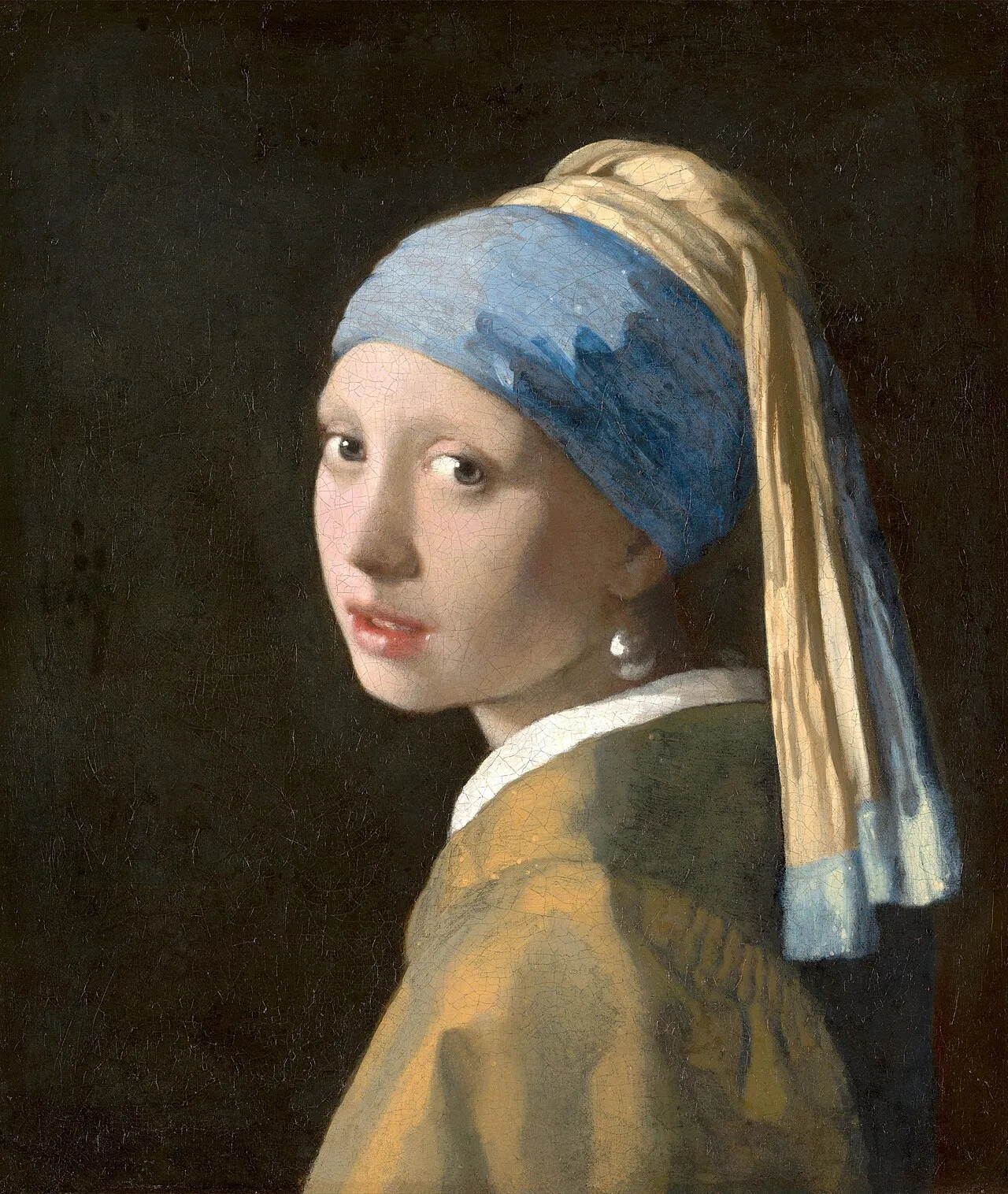
Johannes Vermeer, "Girl with a Pearl Earring" (c.1665), oil on canvas, 44.5 x 39 cm. Mauritshuis, The Hague. Known since the 19th century as "the Mona Lisa of the North" for the mystery of its subject's gaze and expression. Image: Public domain, via Wikimedia Commons
The Earring: Is It Actually Pearl?
The "pearl" earring has been subject to considerable technical scrutiny. A pearl in direct light would typically show a soft lustre with diffused reflections, the characteristic iridescence of nacre. The earring in Vermeer's painting is rendered with a single bright, sharp highlight that art historians and conservators have noted is more consistent with glass, glazed ceramic, or tin than with actual pearl. The highlight is too hard, too concentrated, for the soft optical qualities of genuine pearl.
A 2014 study by art historians Emilie Gordenker and others examined the painting's technical treatment and concluded that the earring was most likely a painted representation of a large drop pendant rather than a naturalistic record of a specific object. Vermeer was not a painter who traded in accuracy for its own sake; his interiors are lit in ways that serve compositional and emotional purposes rather than strictly documentary ones. The earring functions in the painting primarily as a light source and a compositional anchor for the figure's lower left, and its optical behaviour serves those functions regardless of what material it would be in life.
Recent conservation work (the Mauritshuis undertook major technical examination in 2018) confirmed the presence of an extremely fine paint layer in the eye area, suggesting lashes and faint shadows that have become nearly invisible due to age and previous restoration. The examination also revealed that the dark background, which appears black in reproduction, is actually a deep green, created by a transparent glaze over a dark ground that has degraded over time. In its original state, the background would have been a rich, dark green rather than the flat black we now see, a small but significant difference in the painting's overall atmosphere.
The Technical Achievement: Light and the Open Mouth
Vermeer was one of the most precise handlers of light in the history of Western painting, and "Girl with a Pearl Earring" demonstrates this economy at its most concentrated. The light source is off-canvas to the left, and Vermeer uses it to model the turned face with extraordinary subtlety. The lit side of the face glows with warmth; the shadow side is cool and retreating. The boundary between them is gradual rather than sharp, the product of thin glazes applied with control.
The slightly open mouth is one of the painting's most discussed elements. It catches a thin edge of light on the lower lip, suggesting moistness, the physical reality of a mouth in a particular position. Combined with the over-the-shoulder gaze, the effect is of a moment rather than a pose: the figure has just turned, is just about to speak or has just finished speaking, and is caught in the fraction of a second before the moment resolves. This is a temporal quality that portraits rarely achieve, and it accounts for much of the painting's peculiar intimacy.
Vermeer used a camera obscura in his studio, as technical analysis and the work of David Hockney and Philip Steadman have established. The camera obscura would have projected the image of the model onto the canvas surface, allowing Vermeer to trace the broad outlines of the composition with exceptional accuracy. But the light quality in the painting goes beyond what simple tracing would produce; the subtle modelling, the glazing over the flesh tones, the precise management of highlights required hand and eye working together with great skill.
For the full range of Vermeer's techniques and the extraordinary care he applied to every canvas he made, the Vermeer artist spotlight covers his life and practice in depth.
The Mystery of the Subject: The Theories
Given that this is a tronie rather than a named portrait, scholarly attention to the subject's identity has sometimes outrun the available evidence. The most frequently proposed identification is Vermeer's eldest daughter Maria, who would have been around twelve to fourteen years old in 1665. The intimacy of the painting and the relative informality of the dress are consistent with a family sitter, and Vermeer is known to have used his family members as models for other works.
Other proposals have included Magdalena van Ruijven, the daughter of Vermeer's primary patron Pieter van Ruijven, a connection that would explain why the painting remained in the van Ruijven family collection. The painting was purchased at a 1696 Amsterdam sale (possibly the dispersal of the Dissius collection, which included many Vermeers) for a remarkably small sum, suggesting its fame was not established in its own time.
The honest answer is that we do not know and probably cannot know. The records of Vermeer's studio, his commissions, and his personal life are extremely sparse. He left no letters or notebooks. His name appears in guild records and a small number of legal documents. The paintings themselves, all thirty-four or thirty-six surviving works, are the primary evidence for what he cared about, how he worked, and who sat for him. This evidentiary situation has proven to be fertile ground for fiction writers.
Tracy Chevalier, the Novel, and the Modern Revival
The painting's current global fame owes a significant debt to Tracy Chevalier's 1999 novel "Girl with a Pearl Earring," which imagines the fictional story of a servant girl in Vermeer's household who becomes the model for the painting. Chevalier's novel was an international bestseller, translated into dozens of languages, and the 2003 film adaptation, starring Scarlett Johansson as Griet and Colin Firth as Vermeer, brought the painting to an even wider audience.
Neither the novel nor the film makes any claim to historical accuracy; Chevalier has been explicit that she invented the story wholesale, inspired by her own response to the painting's gaze. But both works achieved something of lasting cultural value: they made the painting the object of genuine public curiosity and gave millions of people a reason to seek out the original. Museum visitor numbers at the Mauritshuis rose substantially after the novel's publication and again after the film's release.
This kind of secondary cultural production has a long history in art reception. "Lust for Life," Irving Stone's 1934 biography of Van Gogh, similarly shaped public perception of that artist for decades. The fictional frame can simplify and sometimes distort, but it also creates emotional access to works that might otherwise remain the province of specialists. The art and literature guide explores the long tradition of writing about images and how it shapes the way we see art.
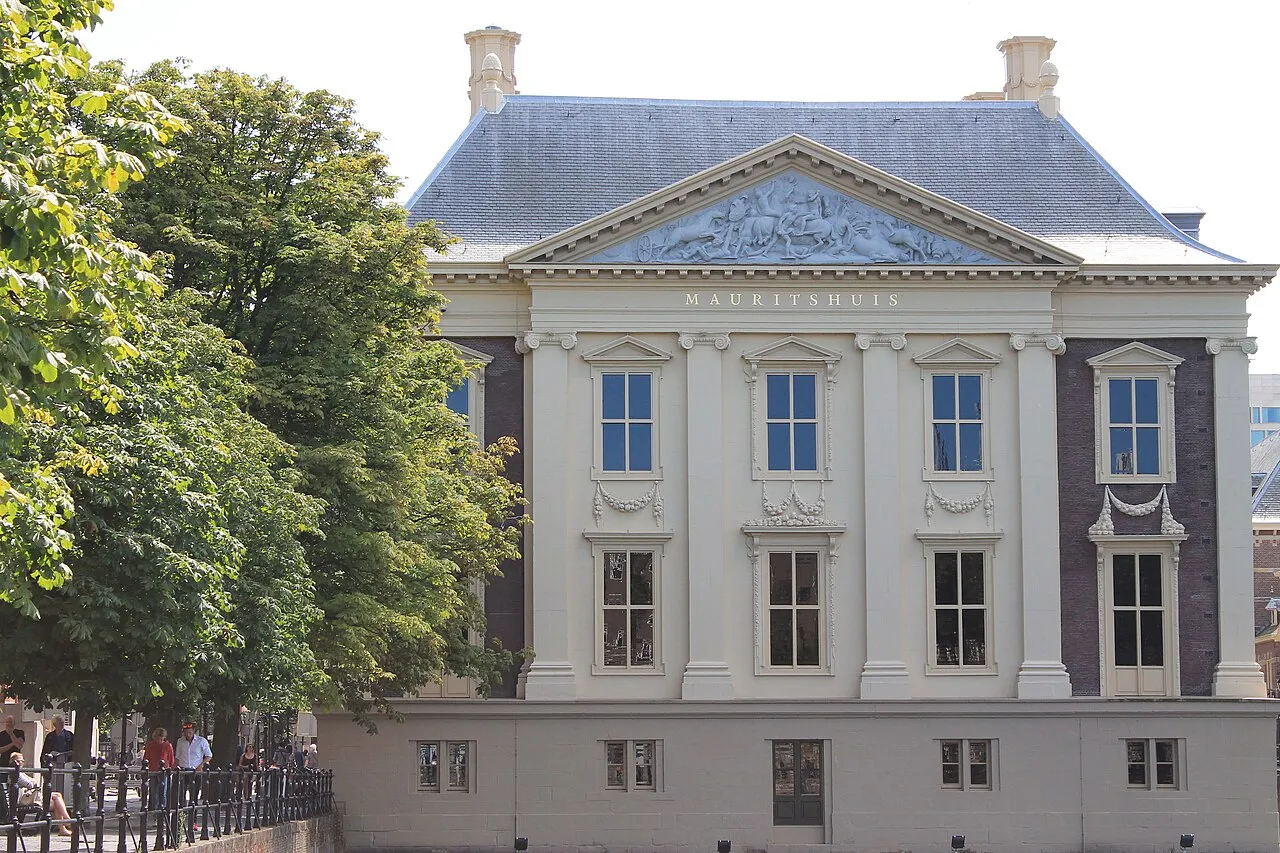
The Mauritshuis museum, The Hague, Netherlands, housed in a 17th-century palace built for Johan Maurits van Nassau-Siegen. The museum holds one of the finest collections of Dutch Golden Age painting in the world, including Vermeer's "Girl with a Pearl Earring" and "View of Delft." Image: Public domain, via Wikimedia Commons
Seeing It at the Mauritshuis
The Mauritshuis in The Hague is one of the most accessible major art museums in the world, occupying a 17th-century palace within walking distance of the city centre. Unlike the Louvre, it is a small collection displayed without crowd-management barriers. You can stand as close to "Girl with a Pearl Earring" as the room allows, which is close enough to see the individual brushstrokes and assess the paint surface directly.
What becomes apparent at close range that reproduction does not show: the painting is small (roughly the size of a standard A2 sheet), the background has more tonal variation than the near-black it appears to be in photographs, and the handling of the white collar is breathtakingly confident, laid in with broad, economical strokes that suggest the fabric's texture without describing it minutely. The light on the earring, whatever material it represents, is applied in a single short highlight that catches the eye from across the room.
The experience of standing in front of this painting and understanding what you are looking at is significantly enhanced by knowing its history, its technique, and its genre. A tronie looks different once you understand that its subject's identity is not a mystery to be solved but an openness built into the work from the beginning. For the broader context of Dutch Golden Age painting, the Baroque art guide covers the period and its visual culture. For reading paintings with this kind of attention, the step-by-step painting analysis guide offers a systematic framework.


