
Pick up a piece of vegetable-tanned cowhide that has been dampened with a wet sponge and you will find that the surface has become temporarily plastic. Press a metal stamp into it and the grain compresses. When the leather dries, that compression is permanent. The surface now stands in relief, a three-dimensional form pressed out of a flat material using nothing more than a shaped piece of metal, a mallet, and the right kind of leather. That is the entire technical principle behind leather tooling, and it has produced some of the most sophisticated decorative surfaces in human art history: the carved saddles of 19th-century California, the geometric blind-tooled bindings of medieval Islamic manuscripts, the elaborate polychrome panels of 16th-century Mudejar Spain.
Leather tooling sits at an awkward boundary in the art world. It is undeniably a craft, associated with functional objects like saddles, belts, and book covers. But the level of skill required for the finest examples, and the visual complexity of the results, puts serious leather work in the same territory as any other discipline where technical mastery and artistic vision have to work together. The craft vs. art question is worth setting aside entirely. The more useful question is what you can see in the work if you look carefully.
The Material: Why Vegetable-Tanned Leather Is Different
Not all leather can be tooled. The technique requires vegetable-tanned hide, where the raw skin has been preserved using tannin-rich plant materials: bark, leaves, or fruits of oak, chestnut, or sumac. This is the traditional method, slow and expensive, taking several months in pit-tanning operations where hides soak in progressively stronger tannin baths. The resulting leather is firm, has a distinctive earthy smell, and ranges in color from pale cream to medium brown depending on the source hide and the tannin concentration.
The critical property is how the leather responds to moisture. When dampened with water, a process called casing, the grain structure becomes temporarily workable. Metal stamps pressed into the surface displace the grain fibers, creating permanent impressions. As the leather dries over several hours, it locks those impressions in place. The depth and sharpness of the tooling depends on how evenly the leather was cased, the precision of the stamp placement, and the quality of the hide itself. Thin or poorly tanned leather produces shallow, muddy impressions. Good leather, properly cased, holds crisp detail at depths of several millimeters.
In 2026, the main producing regions for craft-quality vegetable-tanned leather are the Veneto in Italy (particularly the Consorzio Vera Pelle Italiana Conciata al Vegetale tanneries around Santa Croce sull'Arno), Spain, and a handful of specialist tanners in England and the United States. The Italian veg-tan, particularly the heavyweight bridle leather and the softer Buttero grades, is generally regarded as the standard for fine tooling work.
Islamic Traditions: The Origin of Blind Tooling
The most historically significant tooled leather tradition is Islamic. From the 7th century onward, Islamic bookbinders developed covers of remarkable formal complexity using blind tooling: small metal stamps pressed into dampened leather without any gold or color, creating patterns purely from the compressed grain. Geometric interlace, arabesque floral scrollwork, and calligraphic inscriptions were combined in compositions that are precise enough to read as architectural drawings. The craft spread with Islamic civilization across North Africa, Persia, and into Moorish Spain.
The Mudejar tradition, which developed in Al-Andalus and continued after the Christian reconquest in work made by Muslim craftsmen for Christian patrons, brought Islamic tooling techniques directly into European bookbinding and decorative arts. Spanish bookbindings from the 12th through the 16th centuries show the characteristic Mudejar interlaced geometric patterns, and their influence on French and Italian bookbinders is traceable through the 16th and 17th centuries.
Moroccan leather, particularly from Fez and Marrakesh, remains among the most recognized decorative leather in the world. The Chouara tannery in Fez, visible from the surrounding buildings as a pattern of stone dyeing vats, uses methods essentially unchanged since the 11th century. The finest Moroccan leather goods, including the elaborately tooled satchels and pouches made for the Quran, are made to a standard that commands respect from craftspeople in any other tradition.
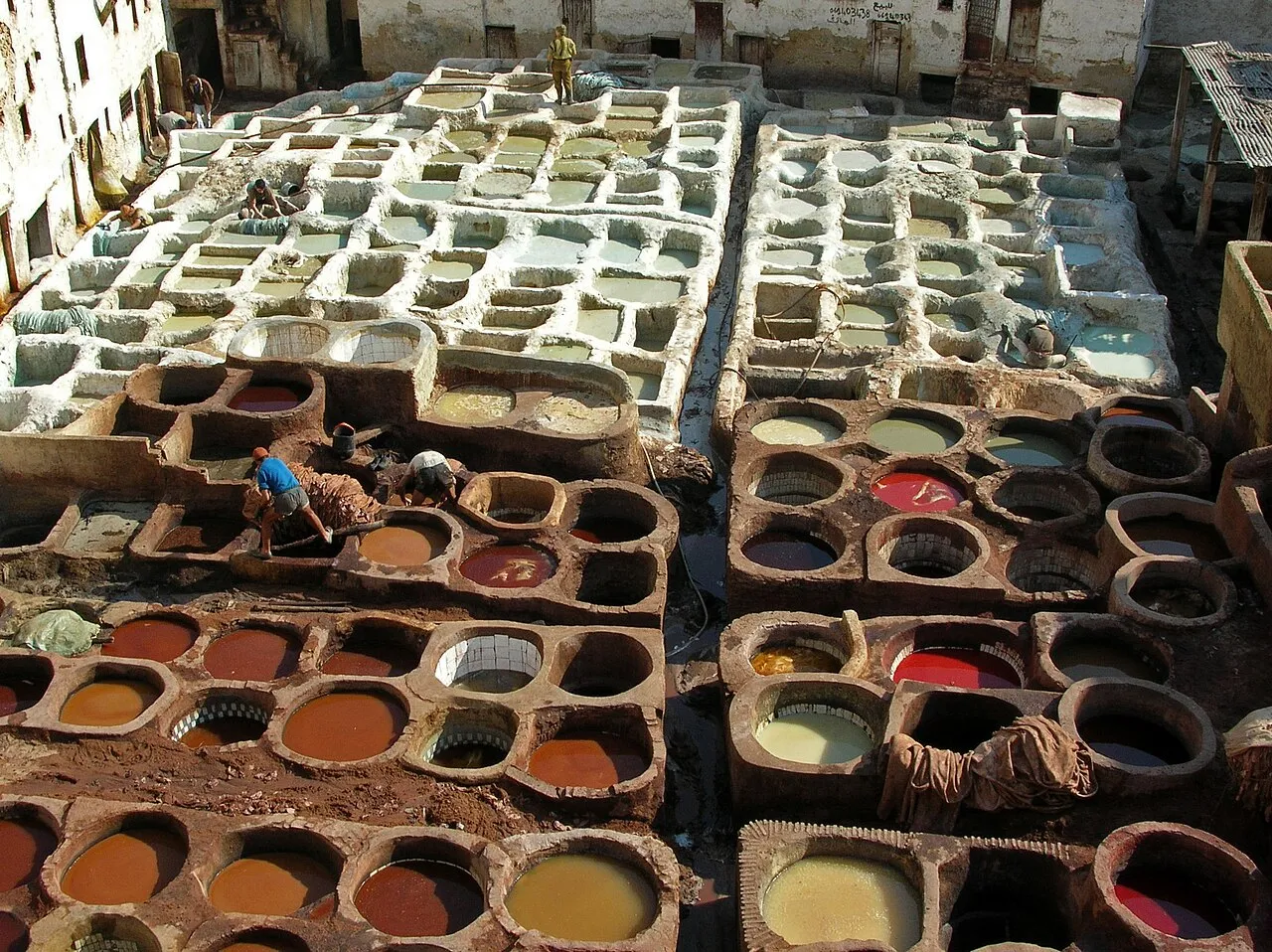
The Chouara tannery in Fez, Morocco. The circular stone vats for dyeing hides have been in continuous operation since the 11th century. Fez leather goods represent one of the oldest continuous craft traditions in the world. Image: CC BY-SA, via Wikimedia Commons
Western Saddle Making and the American Tradition
The American tradition of decorative leatherwork developed from the 1840s as the cattle industry expanded across the Southwest. Saddlers working in Texas, California, and the Great Basin developed a visual vocabulary that drew on Spanish colonial traditions, which themselves derived from Moorish Andalusia, and added new formal elements in response to their specific clients and working conditions. The characteristic Western floral carving style, with its acanthus-like scrolls, roses, and oak leaves, is a genuinely American development built on a chain of transmission stretching back to medieval Islamic Spain.
The technique uses a swivel knife to cut the outline of the design, followed by a beveler to press the leather down alongside the cut and create a raised edge, then pear shaders for depth and shadow, background tools for texturing recessed areas, and a range of specialty stamps for specific floral and leaf elements. A single carved saddle panel might use fifteen to twenty different stamps and require forty or more hours of work.
Al Stohlman (1909-1998) codified the techniques of Western floral carving in a series of technical manuals that remain standard references. His books, published through Tandy Leather and still in print, describe the tools, the casing process, and the specific stamp sequences for the major carving patterns in enough detail that a patient beginner can work through them systematically. The finest custom saddles from working master saddlers represent hundreds of hours of tooling and prices that reflect it, often well into five figures.
Bookbinding: Leather at Its Most Technically Demanding
Fine bookbinding is where the technical demands of leather decoration reach their highest pitch. Gold tooling, the process of applying gold leaf to a leather cover using a heated brass finishing tool, requires that the tool be at exactly the right temperature, that the leather be sized with egg white to accept the gold, and that the tool be pressed with exactly the right pressure and angle. Too hot and the tool burns through the gold. Too cool and it does not adhere. A millimeter of drift in any direction ruins the impression. On a binding that has taken days to prepare, a single error on the cover can be catastrophic.
Contemporary fine binders working in the designer binding tradition treat leather cover decoration as a medium for original visual composition. The interplay between the leather surface, the impressed or raised design, and the gold or colored fills creates a three-dimensional pictorial space unlike any other form of surface decoration. As the bookbinding guide explores, the covers of fine bound books have been decorated this way for centuries, and the tradition is still producing work of serious ambition.
Contemporary Leather Art and Getting Started
By 2026, decorative leatherwork has a visible presence in the craft world and, to a lesser degree, in the contemporary art market. Craft galleries and exhibitions include leather work alongside ceramics, glass, and jewelry. The luxury goods market, led by makers like Hermes whose workshops still produce many goods by hand using traditional techniques, has brought wider public attention to high-quality leatherwork. A growing number of independent leather artisans are making work at the boundary between traditional craft and contemporary design.
Getting started with leather tooling requires less equipment than most crafts. A swivel knife, a beveler, a pear shader, a background tool, a mallet, a small piece of marble or granite as a work surface, and a sponge. A beginner-grade piece of vegetable-tanned leather from Tandy Leather or one of the Italian suppliers costs a few dollars. The Al Stohlman books provide step-by-step instruction that is genuinely usable without a teacher. The learning curve is steep for fine work but the basic technique is accessible within a few hours of practice.
The craft connects to the wider world of decorative arts in ways worth exploring. For the question of how another traditionally utilitarian craft crossed into the art world, the ceramics guide covers that transition in a medium with many parallels to leather. For how the patterns and motifs that decorate objects across traditions carry cultural and historical meaning, the symbolism in art guide provides a framework for reading those surfaces more carefully.


