
Stand inside the Sheikh Lotfallah Mosque in Isfahan, Iran, and look up. The dome above you is covered in a network of interlocking geometric compartments that radiate from a central sunburst, diminishing in scale as they approach the outer ring. The effect is dizzying. The whole interior glows with turquoise, gold, and ivory tile. It was completed in 1619, and architects and mathematicians are still analyzing precisely how it was made.
In 2007, physicists Peter Lu and Paul Steinhardt published a study in the journal Science showing that Islamic geometric artists working in the 15th century were generating quasi-crystalline patterns with five-fold rotational symmetry, structures that Western mathematics did not formally describe until Roger Penrose worked on them in the 1970s. The designers were not theorizing. They were solving design problems with compass and straightedge. The solutions happened to be mathematically equivalent to what Western mathematicians would rediscover five centuries later. If that fact does not change how you think about the word "decorative," nothing will.
This guide explains where Islamic geometric art came from, why it developed the way it did, and how to actually read the patterns when you encounter them.
Why Geometry? The Philosophical and Theological Background
Islamic geometric art emerged from specific theological and philosophical contexts that shaped what was considered appropriate for religious spaces and objects. Early Islamic theology emphasized the absolute transcendence of God and the danger of idolatry. While the prohibition on figural imagery in religious contexts is often overstated (human figures appear extensively in Islamic manuscript illustration and secular art), it did create a strong preference for non-figural decoration in mosques and religious architecture. Geometry stepped in not as a compromise but as a positive choice.
A geometric pattern makes no claim to represent any created being. It points instead to the underlying mathematical order of creation, to the idea that the universe is designed according to rational principles that human minds can perceive and appreciate. The philosopher al-Kindi, working in 9th-century Baghdad, argued that geometric forms were the most stable and universal features of reality. If you wanted to point toward the transcendent without depicting it, geometry offered a language that was both exact and inexhaustible.
The culture that produced this art was also deeply engaged with mathematics. The scholars working in the House of Wisdom in 9th-century Baghdad were advancing algebra, optics, and geometry at a level Europe would not reach for several centuries. This intellectual environment shaped the visual arts directly: the artisans designing mosque tilework were not simply craftspeople. They were applied mathematicians solving problems with compass and straightedge that required genuine geometric understanding.
The Grammar of Islamic Geometric Pattern
Islamic geometric art operates according to a coherent visual grammar. Understanding its basic elements helps you read even very complex patterns with confidence.
The Underlying Grid
Almost all Islamic geometric patterns are generated from one of a small number of underlying grids: the square grid, the triangular grid, the hexagonal grid, or combinations of these. The designer begins with the grid, then constructs the pattern by connecting specific intersection points with straight lines or arcs, following geometric rules that ensure perfect symmetry and repeatability across the entire surface. The patterns that result are called tilings: arrangements of shapes that fill a flat surface without gaps or overlaps.
The quasi-crystalline tilework at the Darb-i Imam shrine in Isfahan (1453), analyzed by Lu and Steinhardt in their landmark 2007 Science paper, uses a system of five interlocking tile shapes, now called girih tiles, that generate non-repeating but mathematically ordered patterns. The formal Western description of quasi-crystalline structures dates to 1984. The Isfahan tilework predates it by more than five centuries.
Stars, Symmetry, and the Alhambra
Two of the most characteristic elements of Islamic geometric art are six-pointed star patterns and five-fold symmetry patterns. Six-pointed stars, generated from the hexagonal grid, appear in tilework across the Islamic world from Morocco to India. Five-fold symmetry, producing decagons and ten-pointed stars, is mathematically more demanding to tile continuously and appears in the most sophisticated examples.
The Alhambra palace complex in Granada, built for the Nasrid dynasty in the 13th and 14th centuries, is the most intensively studied collection of Islamic geometric art in the Western world. Its walls and floors contain examples of all 17 mathematically possible wallpaper symmetry groups, the complete classification of all distinct ways of tiling a plane with a repeating pattern. Mathematicians confirmed there were exactly 17 such groups only in the late 19th century. The Nasrid court designers had worked through all 17 using compass and straightedge alone, centuries earlier.
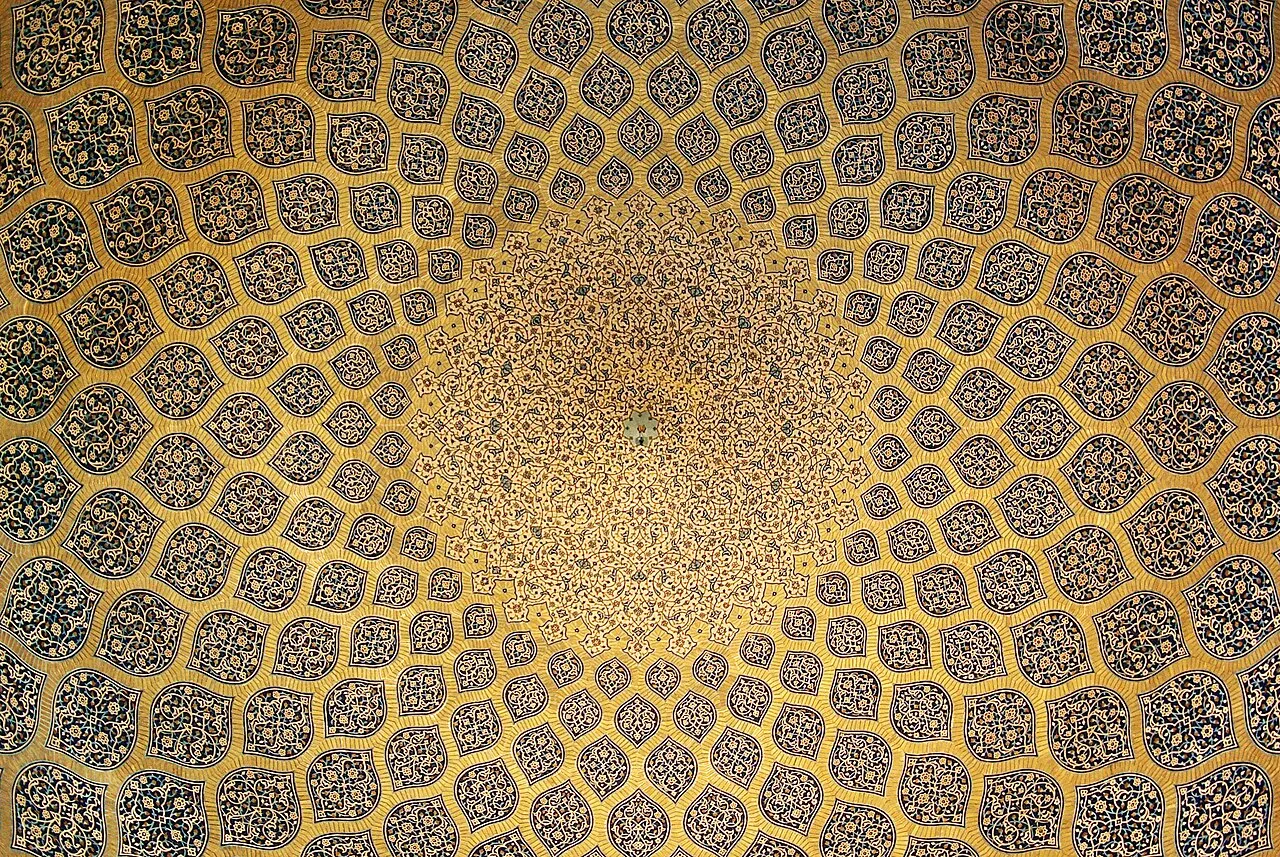
The interior dome of the Sheikh Lotfallah Mosque, Isfahan, Iran (completed 1619). The radiating geometric compartments, each filled with arabesque ornament, diminish in scale from a central motif outward, creating a vertigo-inducing sense of infinite expansion. Image: Wikimedia Commons, CC BY-SA 3.0
Arabesque: The Living Line
Geometric pattern is one element of Islamic visual art. Equally important is the arabesque, a form of ornament based on branching, spiraling, and intertwining vegetal forms. Unlike a botanical illustration, the arabesque is an abstract rhythmic system: spiraling stems that generate symmetrical leaves and blossoms according to precise geometric rules. It is not random organic growth. It is controlled, self-similar, and subject to the same rigor as the tiling patterns.
A well-designed arabesque can be traced from any point outward along its spiraling stems without losing the path, and the overall pattern repeats across the surface with perfect symmetry. The effect is of infinite organic growth held within mathematical order. In the finest examples, geometric pattern and arabesque are woven together in a single composition: the angular geometry of stars and polygons filled with the curving growth of arabesque ornament. The geometry provides structure. The arabesque provides life. Neither works as well without the other.
Calligraphy as Visual Art
Islamic visual art has a third major element that is inseparable from the other two: calligraphy. In Islamic aesthetics, the written word, particularly the Quran, is held in the highest possible regard. Writing out Quranic text is itself a sacred act, and the art of calligraphy is considered the highest of the visual arts. Many mosque inscriptions are visual compositions as carefully designed as any painting, with letter forms adjusted, stretched, and interlocked to create balanced, harmonious fields of text.
The major scripts used in Islamic calligraphy include Kufic (angular and architectural), Naskh (rounded and legible), Thuluth (monumental, used for important inscriptions), and Nastaliq (fluid and diagonal, dominant in Persian and Indian Islamic art). Each script has its own proportional rules and aesthetic character, and master calligraphers spent decades studying their correct execution.
In the most elaborate examples, calligraphic inscriptions are worked into geometric compositions so that the letters themselves become part of the tiling pattern, readable as text from close up and legible as geometric form from a distance. This integration of text and geometry is one of the most intellectually demanding achievements in the history of decorative art.
Regional Traditions and Key Monuments
Islamic geometric art spans an enormous geographic and temporal range, and different regions developed distinctive approaches within the shared framework.
North Africa and Andalusia are known for zellij, the cut-tilework tradition in which geometric patterns are assembled from small hand-cut pieces of fired and glazed clay. Each piece is shaped by hand with a small hammer, achieving geometric precision through skilled craft rather than mechanical production. The mosques and madrasas of Fez, Morocco, and the Nasrid palaces of Granada represent the highest achievements of this tradition. The Ben Youssef Madrasa in Marrakech (1565) has walls covered floor-to-ceiling in zellij of extraordinary intricacy, and getting close enough to see the individual cuts reveals a level of precision that photographs do not adequately convey.
Iran and Central Asia are known for large-format glazed tile panels in turquoise and cobalt blue that cover mosque exteriors and interiors. The great mosques of Isfahan, including the Sheikh Lotfallah Mosque and the Imam Mosque (Shah Mosque), represent the peak of Iranian tilework. The Metropolitan Museum's overview of Islamic art provides useful context for the range of this tradition. The blue domes of Samarkand in modern Uzbekistan are another defining expression of the Central Asian tradition.
Ottoman Turkey developed a distinctive tradition of Iznik tiles, named for the town where the finest ceramics were produced in the 16th and 17th centuries. Iznik tiles feature geometric and floral patterns in cobalt blue, turquoise, sage green, and tomato red on a white ground. The Rustem Pasha Mosque in Istanbul (1563) is covered entirely in Iznik tile, creating one of the most visually intense interiors in Islamic architecture. The density of pattern at close range is genuinely overwhelming in person in a way that photographs do not replicate.
How to Read Islamic Geometric Art
Most people encountering Islamic geometric art for the first time are overwhelmed by the density and do not know where to look. A few approaches help significantly.
Start by looking for the underlying grid. Trace the dominant shapes, whether hexagons, squares, or triangles, that generate the pattern. Every Islamic geometric pattern has a basic repeating unit, the smallest section that, when tiled, produces the full composition. Finding this unit makes the underlying logic visible.
Follow the stars. In most Islamic patterns, the most prominent element is a star or rosette. Count its points (six, eight, ten, twelve) and notice how the surrounding geometry develops from it. The number of points tells you what grid the pattern derives from and gives you a starting point for reading the rest.
Find the repeat. Try to identify where the pattern begins to repeat. The unit of repetition is often larger than it first appears, and locating it reveals the mathematical structure of the whole composition. This is the moment where the pattern shifts from overwhelming to legible.
Then move between scales. Islamic geometric art works at multiple scales simultaneously, with large geometric divisions containing smaller ones that contain smaller ones still. Step back and come close again. The pattern changes character at different distances, and experiencing both is part of how it works.
For context on how geometry functions as an artistic tool more broadly, our guide to composition in art covers symmetry and balance. You might also explore how color relationships amplify geometric pattern's visual impact.
Final Thoughts
Islamic geometric art is not decoration. It is a mathematical and philosophical tradition of the highest order, one that explored the properties of symmetry, tiling, and proportion for a thousand years before Western mathematicians formally described what Islamic artists had already solved with compass, straightedge, and fired clay. Understanding it requires adjusting the assumption that art must depict something in order to mean something. In this tradition, pattern itself carries meaning. The geometric order points toward the mathematical intelligence underlying creation, and the viewer's experience of following that order, tracing the stars, finding the repeat, moving between scales, is the intended experience.
Standing in the Sheikh Lotfallah Mosque or walking through the Alhambra, you are not looking at art from the outside. You are inside a system that the people who built it understood as a reflection of the structure of the universe. That is a serious claim. The mathematics backs it up.
For more on how different traditions use visual pattern and symbol, our guides to Japanese art and Byzantine art cover traditions where the spiritual and the visual are similarly intertwined. Our guide to how to look at art for beginners offers practical tools for any museum encounter. What aspect of Islamic geometric art do you find most extraordinary? Share your thoughts in the comments.


