
On a December morning in 1891, three thousand copies of a single lithograph went up on the walls of Paris overnight. By the following evening, the Moulin Rouge cabaret was packed. The poster was by Henri de Toulouse-Lautrec, it cost money to print and was designed to sell tickets, and it is now displayed in major museums as one of the most important graphic images of the 19th century. Nobody changed what it looked like. Only the wall changed.
The boundary between art and advertising has always been more about institutional permission than visual quality. Some of the most visually sophisticated images of the past two centuries were made to sell things: theatre tickets, cigarettes, bicycles, soup, vodka. Andy Warhol made Campbell's Soup cans the subject of fine art; he had previously made his living drawing shoes for I. Miller. The traffic between the two fields has run in both directions without stopping, and understanding that traffic changes how you read both fine art and the advertisements you see every day.
The Birth of the Poster: Toulouse-Lautrec and the Street as Gallery
Chromolithography, which became commercially viable in the mid-19th century, made large-format color printing affordable for the first time. Jules Chéret, the first master of the French poster tradition, developed a visual language for this new medium: vivid color, simplified form, dynamic composition. His images for Parisian cabarets and balls were designed to be read at a distance from a moving carriage or a crowded boulevard, and they worked.
Toulouse-Lautrec went further. His posters borrowed the formal logic of Japanese ukiyo-e woodblock prints: flat areas of saturated color, bold outline, unconventional cropping that cuts figures at unexpected points. "Moulin Rouge: La Goulue" (1891) reduces a complex night scene to a handful of flat color shapes. The silhouetted crowd in the foreground is almost abstract. La Goulue's skirts are a single white mass. The gaslit yellow background is flat and non-atmospheric. The image compresses the entire sensory experience of a Paris cabaret night into something readable from twenty feet away. That is a specific and difficult visual problem, and Lautrec solved it with more intelligence than most painters of his generation brought to their canvases. According to The Art Story, Lautrec was the first artist to elevate advertising to the status of fine art, setting a standard that runs directly from him to Alphonse Mucha to Warhol.
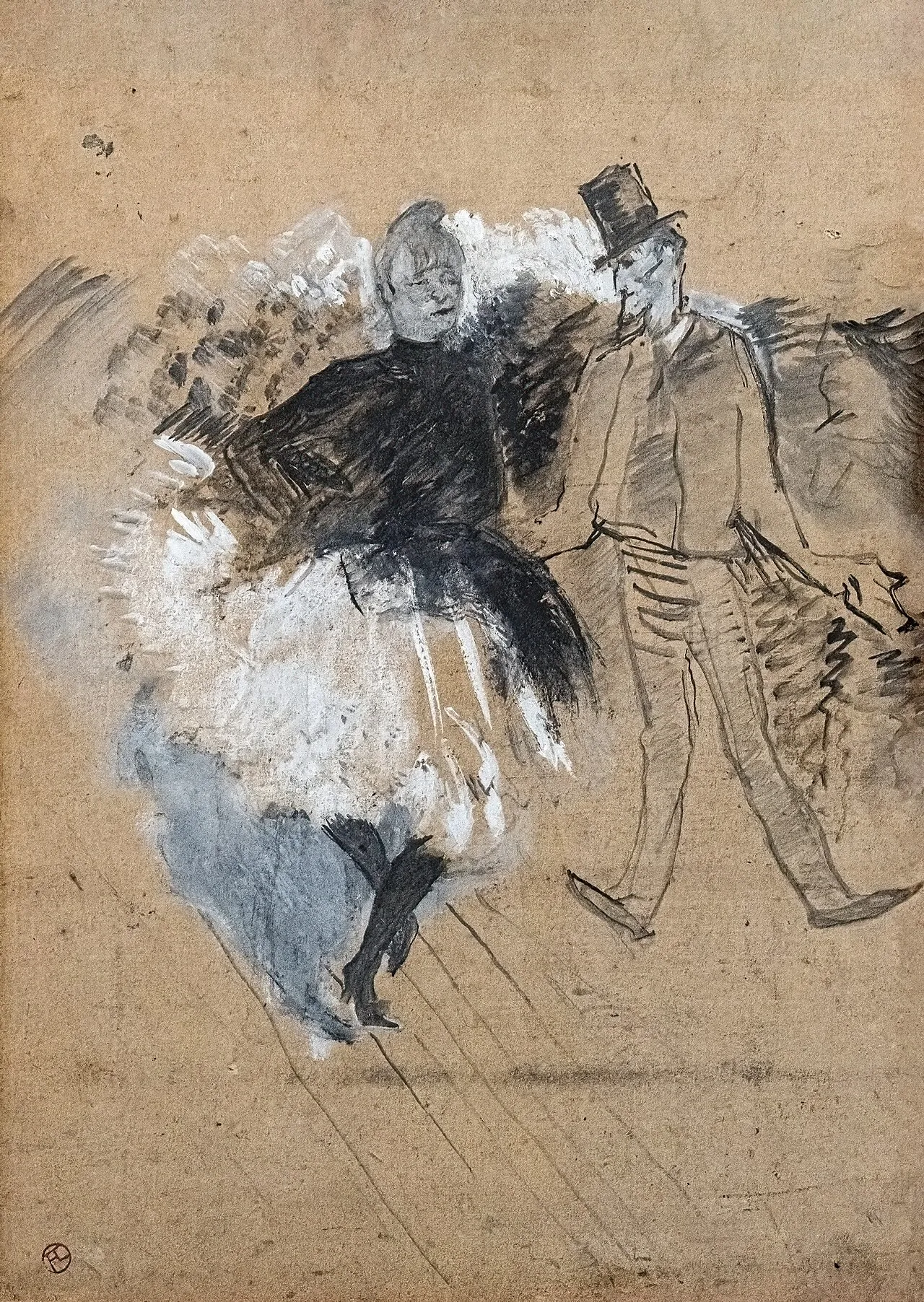
Henri de Toulouse-Lautrec, "Moulin Rouge: La Goulue" (1891), lithograph poster, 191 x 117 cm. Musée Toulouse-Lautrec, Albi. Made to be pasted on Paris streets, it is now one of the most celebrated graphic images of the 19th century. Image: Public domain, via Wikimedia Commons
William Morris and the Argument Against Ugly Things
William Morris, whose Arts and Crafts Movement in Britain took shape from the 1860s onward, made a political argument that the division between fine art and applied design was a symptom of industrial capitalism's worst impulse. Mass production had severed the connection between the maker and the made thing, producing cheap, ugly goods that degraded workers and buyers alike. His wallpapers, textiles, typefaces, and book designs were not decorative hobbies. They were an argument that beautiful, carefully made everyday objects were a democratic right rather than an aristocratic privilege.
This argument fed directly into the Bauhaus (1919-1933), which trained artists and designers together on the principle that industrial production and aesthetic quality were not opposites. The Bauhaus produced graphic design, typography, furniture, textiles, and architecture whose visual principles, geometric simplicity, rational grid, clear hierarchy of information, are still the baseline of contemporary design. The guide to The Bauhaus Movement: Where Art Met Design and Function covers this foundational institution in full.
Soviet Constructivism: The Revolutionary Poster as Art Form
The Bolshevik Revolution of 1917 created an immediate need for mass communication to a largely illiterate population across a vast territory. Soviet Constructivist designers, including Alexander Rodchenko, El Lissitzky, and the Stenberg brothers, developed a visual language that combined the formal innovations of Cubism and Futurism with the legibility requirements of mass communication: diagonal compositions, bold sans-serif typography, high-contrast red and black, photomontage assembled at steep angles that created kinetic energy on flat paper.
Rodchenko's posters for Knigi (Books) and other state organizations remain among the most formally inventive graphic design ever produced. They are collected and exhibited as fine art. Their formal quality does not excuse their political function, but it demonstrates that the division between serious art and commercial or political design was never as stable as art institutions wanted to believe. The same visual intelligence that made them great posters made them great images, and those two things were inseparable.
Warhol and the Question That Wouldn't Go Away
Andy Warhol worked as a commercial illustrator for Vogue, Harper's Bazaar, and I. Miller shoes from 1949 through the late 1950s, and he was very good at it. He made his living from blotted-line drawings of shoes and fashion accessories, developing a style that was simultaneously casual and precise. When he pivoted to the fine art world in the early 1960s, his commercial training was not baggage he left behind. It was the foundation he built on: visual clarity, surface appeal, the repetition of instantly recognizable images, the understanding that a picture needs to work before it can mean anything.
Campbell's Soup Cans (1962) and the Brillo Box sculptures (1964) brought consumer products into the gallery not as celebrations but as questions. If a painting of a soup can and a soup can label are visually indistinguishable, why does one belong in a museum and the other in a grocery store? Warhol's irony ran in both directions: at the pretensions of the fine art world that claimed to transcend commerce, and at the consumer culture that had become the dominant visual environment of American life. A 2024 exhibition at Stockholm's Spritmuseum, "Money on the Wall: Andy Warhol," curated by Warhol biographer Blake Gopnik, argued that Warhol saw what he called "business art" as a more honest position than the art world's denial of its own economic foundations. The spotlight on Andy Warhol: The Factory, Fame, and Everything Is Art covers his career in full.
Graphic Design as Cultural Force
From the 1960s onward, graphic design understood itself increasingly as cultural production rather than service provision. The Pentagram partnership, founded in London in 1972, argued that design intelligence was equivalent to creative intelligence in any other field. The Swiss International Style of the 1950s and 1960s, built on grid systems, Helvetica and Univers typefaces, and a commitment to objective visual clarity, became the dominant visual language of global corporate communications and remains recognizable wherever a clean, rationalist visual hierarchy appears.
Milton Glaser's "I Love New York" logo (1977) and his Bob Dylan poster (1966) showed what design could do when it achieved real cultural penetration. The Dylan poster, with its silhouetted profile dissolving into a colored afro drawn from a Marcel Duchamp silhouette, was simultaneously a concert promotion and a psychedelic art object. It was printed in millions of copies and distributed free. When a design reaches that scale of cultural saturation, the distinction between it and fine art becomes purely nominal. The object is the same. The wall it hangs on is different.
Luxury Brands and the Art Adjacency Strategy
Contemporary luxury brands have developed a systematic approach to using fine art association as cultural positioning. The Louis Vuitton collaborations with Yayoi Kusama (2012, repeated in 2023), Takashi Murakami (2003), and Jeff Koons use the cultural prestige of fine art to place products at the top of the cultural hierarchy. These are not straightforward endorsements. They are more complicated than that.
Murakami's 2003 Vuitton collaboration was a genuine turning point. His superflat aesthetic, derived from manga, anime, and traditional Japanese decorative painting, was reproduced across handbags in a collaboration that was both enormously commercially successful and a real extension of his artistic practice. The boundary between the collaboration and the art became genuinely unclear, which was part of the point. Kusama's 2023 collaboration with Vuitton generated record-breaking commercial results while also functioning as a genuine extension of her dot and infinity room practice into retail space design. The question of where the artwork ends and the product begins stopped having a clean answer. The guide to Pop Art covers the tradition in which this collapse of high and low cultural distinctions first became a deliberate artistic strategy.
Where the Line Actually Is
The relationship between art and advertising will not resolve into a clean answer, because both sides have real interests in maintaining the distinction and real interests in crossing it. Artists benefit from the freedom and prestige of the fine art context. Advertisers benefit from the cultural authority that art association provides. The institutional art world needs the distinction to justify its own prestige. The advertising industry needs art's credibility to lift products above mere utility.
What is clear is that visual quality does not respect the boundary. The Toulouse-Lautrec poster is as visually sophisticated as any painting of its period. Warhol's commercial illustrations are as interesting as his fine art. The Bauhaus designed everyday objects with the same formal intelligence the best sculpture brings to its material. The question of what belongs to art and what to advertising is not a question about visual quality. It is a question about who has institutional permission to decide. For a broader view of how visual culture works as a system, see The Complete Guide to Art Movements. Which advertising image do you think deserves to be called art? Share in the comments.


